Changshu Bank(601128)

Search documents
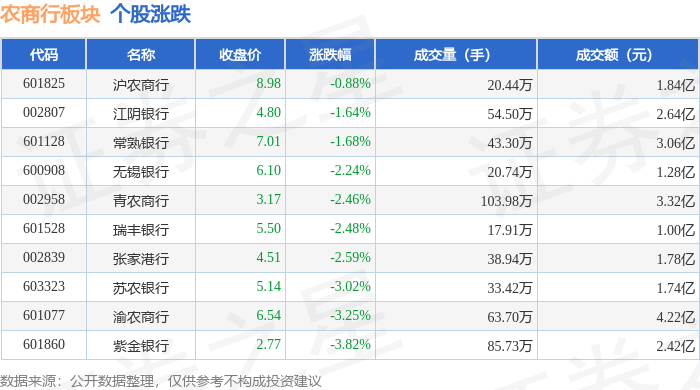
农商行板块11月21日跌2.08%,紫金银行领跌,主力资金净流出1.52亿元
Zheng Xing Xing Ye Ri Bao· 2025-11-21 09:33
Market Overview - The rural commercial bank sector experienced a decline of 2.08% on November 21, with Zijin Bank leading the drop [1] - The Shanghai Composite Index closed at 3834.89, down 2.45%, while the Shenzhen Component Index closed at 12538.07, down 3.41% [1] Individual Stock Performance - Key stocks in the rural commercial bank sector showed varied performance, with the following notable declines: - Zijin Bank: -3.82% closing at 2.77 [1] - Yunnan Rural Commercial Bank: -3.25% closing at 6.54 [1] - Su Nong Bank: -3.02% closing at 5.14 [1] - Jiangyin Bank: -1.64% closing at 4.80 [1] - The trading volume and turnover for these stocks were significant, with Jiangyin Bank recording a turnover of 2.64 billion [1] Capital Flow Analysis - The rural commercial bank sector saw a net outflow of 1.52 billion from main funds, while retail investors contributed a net inflow of 1.41 billion [1] - Specific stock capital flows indicated: - Qingnong Bank: Main funds net inflow of 26.47 million, retail net outflow of 16.33 million [2] - Zijin Bank: Main funds net outflow of 24.65 million, retail net inflow of 14.04 million [2] - Yunnan Rural Commercial Bank: Main funds net outflow of 59.37 million, retail net inflow of 57.10 million [2]



A股最年轻上市银行行长,“真金白银”给常熟银行“投票”
Sou Hu Cai Jing· 2025-11-21 06:06
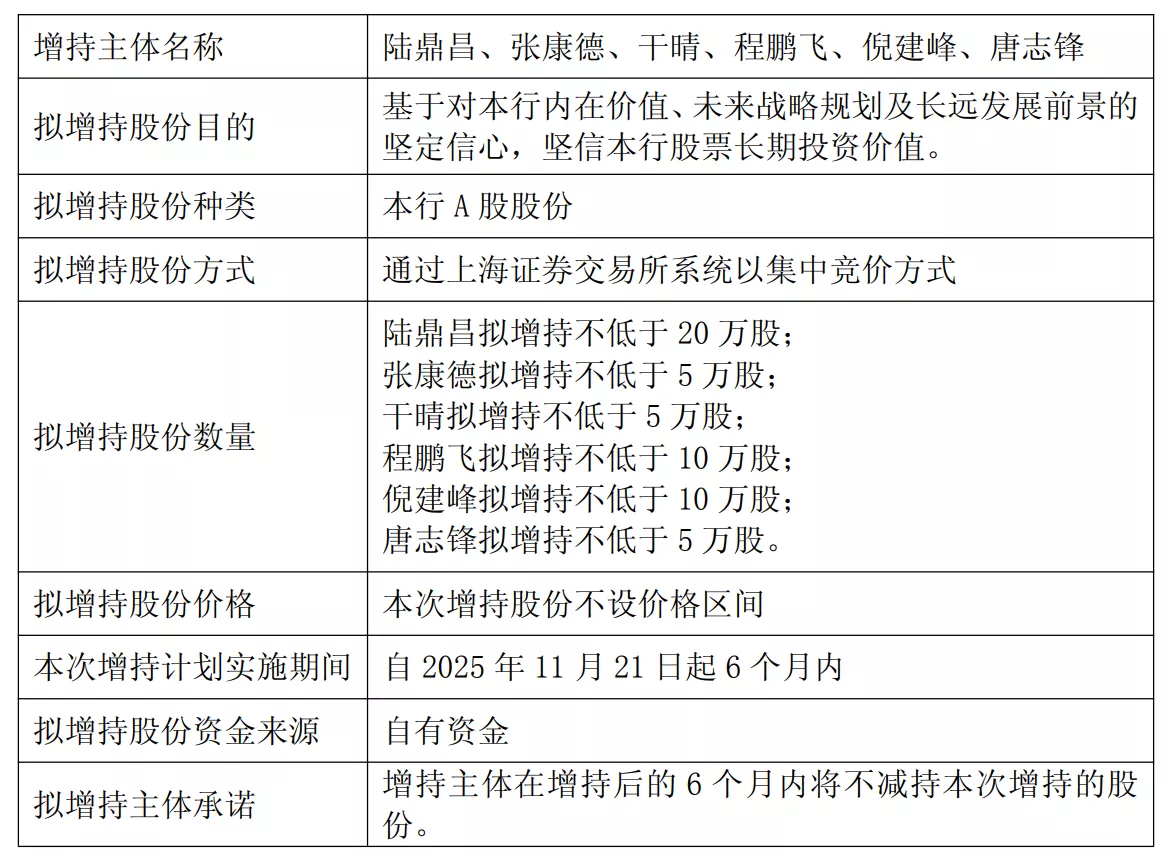
打工挣钱图啥?常熟银行(601128)新任行长陆鼎昌给出了个实在答案——不仅把两年税后工资几乎全投进了自家公司股票,算下来可能还得 倒贴点钱。 11月20日,常熟银行发布公告,宣布包括新任行长陆鼎昌在内的6名高级管理人员启动自愿增持股份计划,自2025年11月21日起实施,为期6个 月,合计拟增持不少于55万股。 在这场集体增持中,新任行长陆鼎昌的手笔尤为引人注目。公告显示,他拟增持不低于20万股,占本次计划增持总数的近三成;副行长程鹏 飞、倪建峰各拟增持不低于10万股,副行长张康德、干晴及董事会秘书唐志锋则各拟增持不低于5万股。 值得一提的是,陆鼎昌目前已持有常熟银行12.1万股股份,持股比例为0.0036%。 陆鼎昌曾任常熟银行副行长,近日被该行提名为新任行长,由此成为目前A股上市银行中最年轻的行长人选。截至目前,其行长任职资格尚待 国家金融监督管理总局苏州监管分局核准。 2024年之前,他并未持有该行股份,直到2024年1月8日至12日期间,才通过集中竞价交易方式一次性增持10万股,耗资66万元,折算下来此次 增持成本约为6.596元/股。后续经资本公积转增股本,其持股数量增至12.1万股,对应持股比例 ...
拓荆科技:国家集成电路基金拟减持不超3%股份;东方雨虹全资子公司拟收购巴西Novakem公司60%股权 | 公告精选
Mei Ri Jing Ji Xin Wen· 2025-11-20 16:16
Shareholding Changes - Changshu Bank's executives plan to collectively increase their holdings by no less than 550,000 shares [1] - TuoJing Technology's major shareholder, the National Integrated Circuit Fund, intends to reduce its stake by up to 843,490 shares, representing no more than 3% of the total share capital [2] - LongXun Co., Ltd. announces that two shareholders plan to reduce their holdings by a combined maximum of 2.63% [3] - HuaYa Intelligent's shareholders plan to reduce their holdings by no more than 399,210 shares, accounting for 2.98% of the total share capital [4] Mergers and Acquisitions - Dongfang Yuhong's wholly-owned subsidiary plans to invest approximately 1.08 billion Brazilian Reais (about 144 million RMB) to acquire 60% of Brazil's Novakem, a leading supplier of cement additives and concrete admixtures [5] - Junting Hotel has signed an agreement to acquire the remaining 21% stake in Junlan Management for 79.8 million RMB, resulting in full ownership [6] - HuDian Co., Ltd. intends to purchase 15% of Shengwei Strategy for 1,909,100 Euros, increasing its ownership from 84% to 99% [7] Risk Matters - Wenfeng Co., Ltd. reports that its Deputy General Manager, Qin Guofen, is under investigation and has been placed under detention, although this matter is personal and will not significantly impact the company's operations [8]






每天三分钟公告很轻松 | 平潭发展、海峡创新周五复牌;艾迪精密、航材股份拟回购股份
Shang Hai Zheng Quan Bao· 2025-11-20 15:47
Core Points - Pingtan Development and Haixia Innovation have completed their suspension review and will resume trading on November 21, 2025 [1][2] - Eddy Precision and Hangcai Co. plan to repurchase shares [3] - Wenfeng Co.'s deputy general manager has been placed under investigation [4] - Kesi Co. has undergone a change in its actual controller [6][7] - Major events include the completion of restructuring investments by *ST Lian Shi and acquisitions by Jun Ting Hotel and Lek Electric [8][9] Group 1: Resumption of Trading - Pingtan Development's stock will resume trading on November 21, 2025, after confirming no significant changes in its operations or undisclosed major matters [1] - Haixia Innovation's stock will also resume trading on November 21, 2025, with similar confirmations regarding its operational status [2] Group 2: Share Repurchase Plans - Eddy Precision plans to repurchase shares with a total amount between 100 million and 200 million yuan, at a price not exceeding 27 yuan per share [3] - Hangcai Co. intends to repurchase shares using excess funds, with a total amount between 50 million and 100 million yuan, at a price not exceeding 80 yuan per share [3] Group 3: Investigations and Changes in Management - Wenfeng Co.'s deputy general manager, Qin Guofen, is under investigation, but the company states this will not significantly impact its operations [4] - Kesi Co. has changed its actual controller from Zhou Jiuqing and Zhou Xuming to Zhou Xuming alone following the death of Zhou Jiuqing [6][7] Group 4: Major Events - *ST Lian Shi has received a total of 1.238 billion yuan in restructuring investments from all investors [8] - Jun Ting Hotel has agreed to acquire the remaining 21% stake in Junlan Management for 79.8 million yuan, making it a wholly-owned subsidiary [9] - Lek Electric plans to transfer 90% of its subsidiary's equity to Chuangyuan Resources, with a target valuation of 235 million yuan [9]




11月20日这些公告有看头
Di Yi Cai Jing Zi Xun· 2025-11-20 15:24
Major Announcements - EVE Energy signed a procurement framework agreement with Smoore International for the continuous supply of battery cells and other products as raw materials, with actual amounts to be determined by future orders [3] - ST Huami's stock is under "double risk" warning due to an audit report expressing inability to provide an opinion for the 2024 financial report, with a recovery of 1.567 billion yuan in occupied funds [4] - Wuzhou Transportation received a regulatory warning for accounting irregularities and failure to fulfill integrity checks for executives, leading to inaccurate financial disclosures [5] - Wenfeng Co. announced that its vice president is under investigation, but this will not significantly impact the company's operations [6] - Fosun Pharma's subsidiary has had its drug included in the breakthrough therapy designation program for gastric cancer treatment, marking a significant development in its product pipeline [7][8] - Shandong Steel's subsidiary is applying for bankruptcy liquidation, which is expected to increase the parent company's net profit by 15.88 million yuan [9] - Zhouming Technology established a new subsidiary, Shenzhen Zhixian Robotics Co., with a registered capital of 50 million yuan [10] Share Buybacks and Holdings - Spring Airlines conducted its first share buyback, acquiring 35,800 shares for a total of 1.9997 million yuan [11] - Donghua Software's controlling shareholder reduced his stake by 1%, selling 10.9832 million shares [12] - Changshu Bank's executives plan to increase their holdings by at least 550,000 shares over the next six months [13] Major Contracts - Nanfeng Co. won contracts worth 45.7 million yuan and 47.17 million yuan for HVAC systems, with delivery scheduled for 2027 [14] - Huakang Clean announced a pre-bid win for a purification system project at Keqiao Future Medical Center, with a bid price of 176 million yuan [15][16] - Qinglong Pipe Industry secured a contract worth 294 million yuan for a pipe procurement project, expected to impact its performance from 2026 to 2030 [17] - China Nuclear Engineering signed new contracts totaling 123.84 billion yuan as of October, with cumulative revenue of 81.334 billion yuan [18]


11月20日增减持汇总



Xin Lang Cai Jing· 2025-11-20 14:25
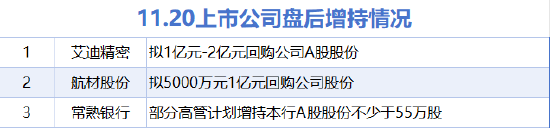
Core Insights - On November 20, several companies disclosed their share repurchase and reduction plans, indicating varying levels of confidence in their stock performance [1] Group 1: Share Repurchase Plans - Eddie Precision plans to repurchase A-shares worth between 100 million to 200 million yuan [2] - Aviation Materials plans to repurchase shares worth between 50 million to 100 million yuan [2] - Changshu Bank's executives plan to increase their holdings by no less than 550,000 shares [2] Group 2: Share Reduction Plans - New Hongze's major shareholder reduced their holdings during a period of abnormal stock fluctuations [2] - General Electric's Singapore company plans to reduce its holdings by no more than 3% in China Xidian [2] - Senior management of Lifespring Pharmaceutical plans to reduce their holdings by no more than 0.0044% [2] - Shareholder Zhoushan Ruihao of Wan Feng plans to reduce holdings by no more than 1.75% [2] - Shareholders of Dongxin plan to collectively reduce holdings by no more than 0.71% [2] - Haigang Group, a shareholder of Hainan Mining, plans to reduce holdings by no more than 0.75% [2] - Actual controller Zhang Guifeng of Fulongma reduced 3.7812 million shares from November 19 to November 20 [2] - Shareholder Dongguan Kechuang Investment Group of Shengyi Electronics plans to reduce holdings by no more than 1% [2] - Shareholder Qinyi Partnership of Yayi Technology plans to reduce holdings by no more than 0.25% [2] - Controlling shareholder Yuansi Industrial of New City plans to reduce holdings by no more than 3% [2] - Controlling shareholder of Kaishan plans to reduce holdings by no more than 1% [2] - The largest shareholder of Tuo Jing Technology, the National Fund, plans to reduce holdings by no more than 3% [2] - Controlling shareholder Li Zheng of Wajinjiao plans to reduce holdings by no more than 3% [2] - Shareholder Shanxi Huaxin Hai of Baose plans to reduce holdings by no more than 1% [2] - Shareholders of Huaya Intelligent plan to collectively reduce holdings by 399.21 million shares, accounting for 2.98% of total share capital [2] - Directors and executives of Changxin Bochuang plan to collectively reduce holdings by no more than 0.05% [2] - Shareholders of Longxun plan to collectively reduce holdings by no more than 2.63% [2] - Some directors and executives of Fulede plan to collectively reduce holdings by no more than 0.0104% [2]
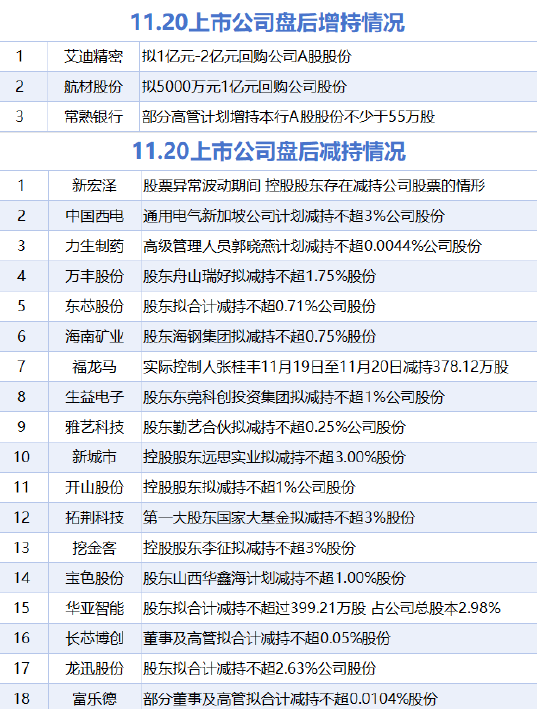
11月20日增减持汇总:常熟银行等3股增持 新宏泽等18股减持(表)
Xin Lang Zheng Quan· 2025-11-20 14:19
炒股就看金麒麟分析师研报,权威,专业,及时,全面,助您挖掘潜力主题机会! MACD金叉信号形成,这些股涨势不错! | | | 11.20上市公司盘后增持情况 | | --- | --- | --- | | 1 | 文迪精密 | 拟1亿元-2亿元回购公司A股股份 | | 2 | 航材股份 | 拟5000万元1亿元回购公司股份 | | 3 | 常熟银行 | 部分高管计划增持本行A股股份不少于55万股 | | | | 11.20上市公司盘后减持情况 | | 1 | 新宏泽 | 股票异常波动期间 控股股东存在减持公司股票的情形 | | 2 | 中国西电 | 通用电气新加坡公司计划减持不超3%公司股份 | | 3 | 力生制药 | 高级管理人员郭晓燕计划减持不超0.0044%公司股份 | | 4 | 万丰股份 | 股东舟山瑞好拟减持不超1.75%股份 | | ਦ | 东心股份 | 股东拟合计减持不超0.71%公司股份 | | 6 | 一百时时 | 股东海钢集团拟减持不超0.75%股份 | | 7 | 福龙马 | 实际控制人张桂丰11月19日至11月20日减持378.12万股 | | 8 | 生益电子 | 股东东莞科创投 ...
常熟银行:关于部分高级管理人员自愿增持股份计划公告
Zheng Quan Ri Bao· 2025-11-20 13:09
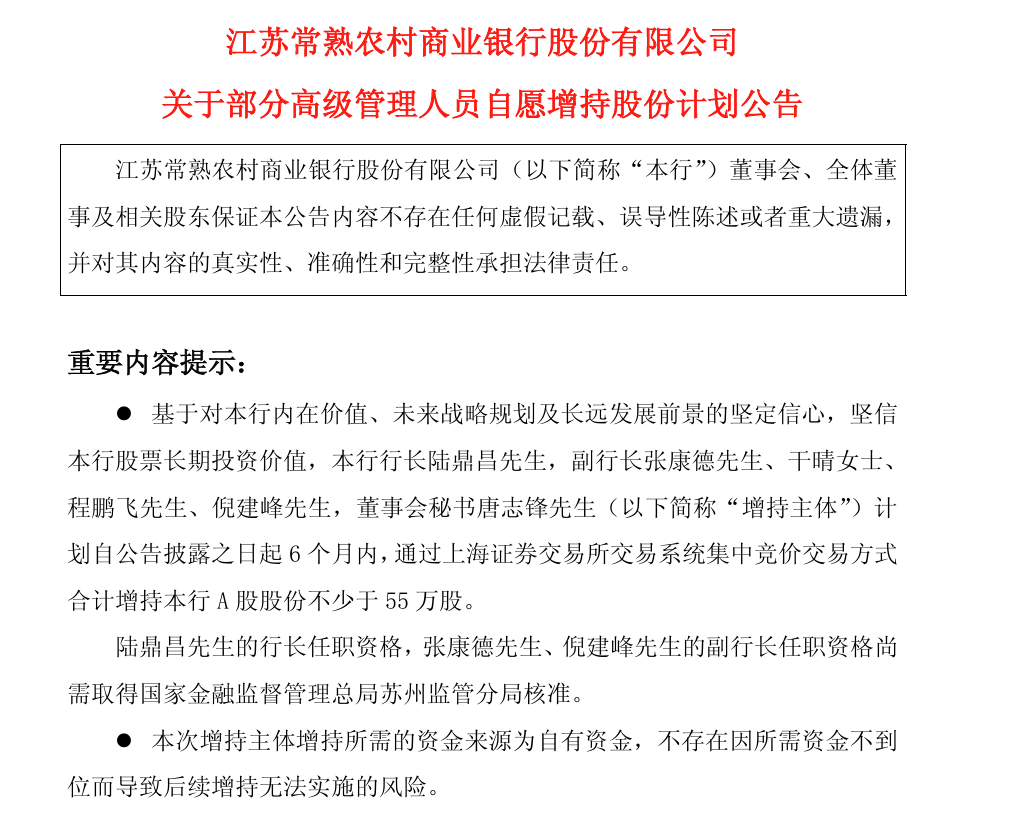
证券日报网讯 11月20日晚间,常熟银行发布公告称,基于对本行内在价值、未来战略规划及长远发展 前景的坚定信心,坚信本行股票长期投资价值,本行行长陆鼎昌先生,副行长张康德先生、干晴女士、 程鹏飞先生、倪建峰先生,董事会秘书唐志锋先生(以下简称"增持主体")计划自公告披露之日起6个 月内,通过上海证券交易所交易系统集中竞价交易方式合计增持本行A股股份不少于55万股。陆鼎昌先 生的行长任职资格,张康德先生、倪建峰先生的副行长任职资格尚需取得国家金融监督管理总局苏州监 管分局核准。本次增持主体增持所需的资金来源为自有资金,不存在因所需资金不到位而导致后续增持 无法实施的风险。 (文章来源:证券日报) ...
A股公告精选 | 15天13板合富中国(603122.SH):如股价进一步异常上涨 可能申请停牌核查
智通财经网· 2025-11-20 12:25
Group 1 - Moer Thread announced an issuance price of 114.28 CNY per share, with a total of 70 million shares to be publicly issued, aiming to raise 8 billion CNY, netting approximately 7.576 billion CNY after expenses [1] - EVE Energy signed a procurement framework agreement with Simo International for battery cells from 2026 to 2028, with the agreement effective until December 31, 2028, but does not specify a concrete amount [1] - Tuojing Technology's major shareholder, the National Integrated Circuit Industry Investment Fund, plans to reduce its stake by up to 3% through block trading from December 12, 2025, to March 11, 2026 [1] Group 2 - Shengyi Electronics announced that its shareholder, Dongguan Science and Technology Innovation Investment Group, plans to reduce its stake by up to 1% from December 12, 2025, to March 11, 2026, due to funding needs [2] - Deep Technology reported that it is a leading domestic high-end storage chip packaging and testing company, currently operating at full capacity in Shenzhen and Hefei, and is expanding based on customer demand [2] - Wengfeng Co. announced that its deputy general manager, Qin Guofen, is under investigation, but this matter is personal and will not significantly impact the company's operations [2] Group 3 - Fosun Pharma's subsidiary, Shanghai Fuhong Hanlin Biotechnology, has had its drug, Surulitinib, included in the breakthrough therapy designation for gastric cancer, with no other PD-1 monoclonal antibody approved for this indication globally [3] - Daye Co. is responding to the EU's anti-dumping investigation on Chinese lawnmowers, adjusting its overseas production structure and integrating resources to mitigate impacts [4]


常熟银行:行长陆鼎昌、副行长张康德等高管拟增持不少于55万股股份
Cai Jing Wang· 2025-11-20 12:23
| 增持主体名称 | 陆鼎昌、张康德、干晴、程鹏飞、倪建峰、唐志锋 | | --- | --- | | 拟增持股份目的 | 基于对本行内在价值、未来战略规划及长远发展前景 | | | 坚定信心,坚信本行股票长期投资价值。 | | 拟增持股份种类 | 本行 A 股股份 | | 拟增持股份方式 | 通过上海证券交易所系统以集中竞价方式 | | 拟增持股份数量 | | | | 陆鼎昌拟增持不低于 20万股; 张康德拟增持不低于 5万股; | | | 干晴拟增持不低于 5万股; | | | 程鹏飞拟增持不低于 10万股; | | | 倪建峰拟增持不低于 10万股; | | | 唐志锋拟增持不低于5万股。 | | 拟增持股份价格 | 本次增持股份不设价格区间 | | 本次增持计划实施期间 | 自 2025 年 11 月 21 日起 6 个月内 | | 拟增持股份资金来源 | 自有资金 | | 拟增持主体承诺 | 增持主体在增持后的6个月内将不减持本次增持的 | | | 份。 | (常熟银行) 11月20日,常熟银行(601128)发布公告称,基于对该行内在价值、未来战略规划及长远发展前景的坚定信心,坚信该行股票长期投资 ...