
Changshu Bank(601128)

Search documents
常熟农商行:多名管理层计划合计增持A股股份不少于55万股
Bei Jing Shang Bao· 2025-11-20 12:21
常熟农商行指出,本次增持主体增持所需的资金来源为自有资金,不存在因所需资金不到位而导致后续 增持无法实施的风险。陆鼎昌的行长任职资格,张康德、倪建峰的副行长任职资格尚需取得国家金融监 督管理总局苏州监管分局核准。 北京商报讯(记者宋亦桐)11月20日,常熟农商行发布公告指出,基于对该行内在价值、未来战略规划及 长远发展前景的坚定信心,坚信该行股票长期投资价值,该行行长陆鼎昌,副行长张康德、干晴、程鹏 飞、倪建峰,董事会秘书唐志锋(以下简称"增持主体")计划自公告披露之日起6个月内,通过上海证券 交易所交易系统集中竞价交易方式合计增持该行A股股份不少于55万股。 ...
11月20日晚间重要公告一览
Xi Niu Cai Jing· 2025-11-20 10:15
Group 1 - EVE Energy signed a procurement framework agreement with its affiliate, Smoore International, for continuous procurement of battery cells starting from January 1, 2026 [1] - Zhaoyi Information plans to issue H-shares and list on the Hong Kong Stock Exchange [1] - Fuke Environmental announced a change in its stock abbreviation to "Fuke Technology" effective November 26 [1] Group 2 - Dajia Weikang's shareholder and director terminated a share reduction plan ahead of schedule, having reduced 1% of total shares [2] - Aohong Electronics received approval from the China Securities Regulatory Commission for the issuance of convertible bonds [2] - Yingfeng Environment's controlling shareholder plans to issue exchangeable bonds not exceeding 1 billion yuan [2] Group 3 - Longshen Rongfa's subsidiary obtained a renewed drug production license covering various pharmaceutical products [4] - Xinhua News' subsidiary invested 15 million yuan in a fund with a total commitment of 221 million yuan [5] - Guang'an Aizhong appointed two new deputy general managers [6] Group 4 - Fosun Pharma's subsidiary's drug for gastric cancer treatment was included in the breakthrough therapy program by the National Medical Products Administration [7] - Nanjiao Foods reported a significant decline in October net profit due to rising raw material costs [8] - Nanfeng Co. won two nuclear power project bids totaling 928.7 million yuan [10] Group 5 - Puluo Pharmaceutical received a drug registration certificate for its Cefdinir capsules [11] - Liming Co.'s subsidiary received environmental approval for a new pesticide raw material project [12] - Longhua New Materials' expansion project for polyether polyols has commenced trial production [13] Group 6 - Pumen Technology's products received IVDR CE certification from TÜV Rheinland [15] - China Chemical reported new contracts worth 312.67 billion yuan from January to October [18] - China Nuclear Construction achieved new contracts totaling 123.84 billion yuan as of October [19] Group 7 - Changshu Bank's executives plan to purchase at least 550,000 shares of the bank [20] - Shandong Steel's subsidiary is applying for bankruptcy liquidation to focus on core business [21] - Huakang Clean is expected to win a bid for a purification system project worth 176 million yuan [23] Group 8 - Huawu Co. plans to internally transfer subsidiary equity [24] - Tianen Kang's subsidiary received clinical trial acceptance for a new drug [26] - Tianyi Medical's subsidiary obtained a medical device registration certificate for a blood dialysis product [27] Group 9 - Xuelang Environment is facing a pre-restructuring application from creditors [27] - Chitianhua's subsidiary resumed production after passing safety inspections [28] - Huaping Co.'s director plans to reduce 0.03% of company shares [30] Group 10 - Xizhuang Co. plans to establish a wholly-owned subsidiary in Singapore [31] - Ruisheng Intelligent's subsidiary won a 60.23 million yuan ICT project bid [32] - Junyi Digital plans to invest 120 million yuan in Guanghong Precision [33] Group 11 - Fuguang Co.'s controlling shareholder plans to increase holdings between 80 million to 150 million yuan [34] - Ganyue Express reported a 13.68% increase in logistics revenue in October [39] - Jiangsu Sop terminated its 2025 private placement plan [41] Group 12 - Langke Intelligent's shareholders plan to reduce a total of 1.68% of company shares [42] - Yuantong Express reported an 8.97% increase in express product revenue in October [45] - Jinbei Automotive plans to invest 158 million yuan to acquire 52% of Zhongtuo Technology [46]



晚间公告|11月20日这些公告有看头
Di Yi Cai Jing· 2025-11-20 10:12
Group 1 - Company Yiwei Lithium Energy signed a procurement framework agreement with Simor International on November 20, 2025, for the continuous supply of battery cells and other products as raw materials, with actual amounts to be determined by future orders [1] - ST Huamei's stock is under "double risk" warning due to an inability to express an opinion in its 2024 financial report, with a recovery of 1.567 billion yuan in occupied funds as of August 15, 2025, and the stock remains under risk warning with a 5% trading limit [2] - Wuzhou Transportation received a regulatory warning from the Shanghai Stock Exchange for non-compliance in accounting practices and failure to fulfill integrity checks for executives, requiring a rectification report [3] Group 2 - Wenkang Co.'s deputy general manager Qin Guofen is under investigation, but the company states this will not significantly impact its operations [4] - Fosun Pharma's subsidiary Shanghai Fuhong Hanlin's drug, SLR-121, has been included in the breakthrough therapy designation for gastric cancer treatment, marking a significant milestone as no PD-1 monoclonal antibody has been approved for this indication globally [5] - Shandong Steel's subsidiary plans to apply for bankruptcy liquidation, which is expected to increase the parent company's net profit by 15.88 million yuan, allowing the company to focus on its core business [6] Group 3 - Zhuhai Ming Technology established a new subsidiary, Shenzhen Zhixian Robotics Co., with a registered capital of 50 million yuan, in which Zhuhai Ming holds a 50% stake [7] - Spring Airlines conducted its first share buyback, repurchasing 35,800 shares for a total of 1.9997 million yuan, representing 0.0037% of its total share capital [9] - Donghua Software's controlling shareholder reduced his stake by 1%, bringing his direct holding down to 10.90%, in line with a previously disclosed plan [11] Group 4 - Changshu Bank's executives plan to increase their holdings by at least 550,000 shares over the next six months, with specific minimum amounts for each executive [12] - Nanfeng Co. won contracts worth 45.7 million yuan and 47.17 million yuan for HVAC systems, with delivery dates set for July and August 2027, respectively [14] - Huakang Clean's bid for the Keqiao Future Medical Center purification system project was successful, with a bid amount of 176 million yuan [15] - Qinglong Pipe Industry secured a contract worth 294 million yuan for a pipe procurement project, expected to impact its performance from 2026 to 2030 [16] - China Nuclear Engineering signed new contracts totaling 123.84 billion yuan and achieved revenue of 81.334 billion yuan as of October 2025 [17]

常熟银行11月20日现1笔大宗交易 总成交金额192万元 溢价率为-10.24%
Xin Lang Zheng Quan· 2025-11-20 09:50
Core Viewpoint - Changshu Bank's stock price increased by 0.42% to 7.13 yuan, with a significant block trade occurring on November 20, 2023 [1] Group 1: Stock Performance - The closing price of Changshu Bank was 7.13 yuan, reflecting a 0.42% increase [1] - In the last five trading days, the stock has experienced a cumulative decline of 1.38% [1] Group 2: Block Trade Details - A block trade was executed with a total volume of 300,000 shares and a transaction amount of 1.92 million yuan [1] - The first transaction price was 6.40 yuan per share, with a total of 300,000 shares traded, resulting in a transaction amount of 1.92 million yuan and a premium rate of -10.24% [1] - The buyer was Dongwu Securities Co., Ltd. from the Shanghai Xizang South Road branch, while the seller was from the Changshu Mall Middle Road branch of the same company [1] Group 3: Recent Trading Activity - Over the past three months, Changshu Bank has recorded a total of four block trades, amounting to 8.51 million yuan [1] - The net outflow of main funds in the stock reached 69.89 million yuan [1]
常熟银行今日大宗交易折价成交30万股,成交额192万元
Xin Lang Cai Jing· 2025-11-20 09:37
Core Insights - On November 20, Changshu Bank executed a block trade of 300,000 shares, with a transaction value of 1.92 million yuan, accounting for 0.77% of the total trading volume for the day [1] - The transaction price was 6.4 yuan, representing a discount of 10.24% compared to the market closing price of 7.13 yuan [1] Trading Details - Trading Date: November 20 - Stock Code: 601128 - Transaction Price: 6.4 yuan - Transaction Amount: 1.92 million yuan - Transaction Volume: 300,000 shares - Buying Brokerage: 藝骨董多醫與幫翠 - Selling Brokerage: 藝園景菜醫留學園 - Special Trading: No [2]


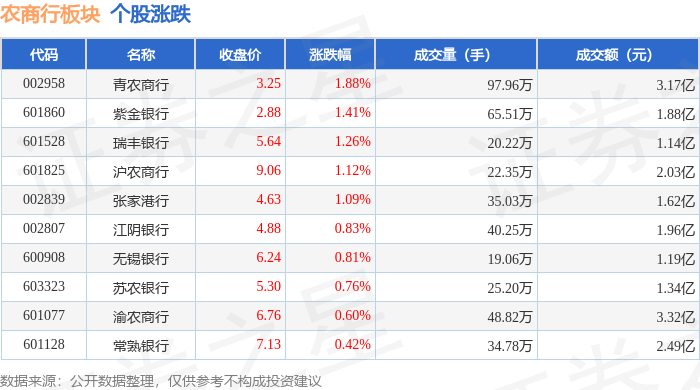
农商行板块11月20日涨0.95%,青农商行领涨,主力资金净流入4189.02万元
Zheng Xing Xing Ye Ri Bao· 2025-11-20 09:04
Core Insights - The rural commercial bank sector experienced a rise of 0.95% on November 20, with Qingnong Commercial Bank leading the gains [1] - The Shanghai Composite Index closed at 3931.05, down 0.4%, while the Shenzhen Component Index closed at 12980.82, down 0.76% [1] Stock Performance - Qingnong Commercial Bank (002958) closed at 3.25, up 1.88% with a trading volume of 979,600 shares and a transaction value of 317 million yuan [1] - Zijin Bank (601860) closed at 2.88, up 1.41% with a trading volume of 655,100 shares and a transaction value of 188 million yuan [1] - Ruifeng Bank (601528) closed at 5.64, up 1.26% with a trading volume of 202,200 shares and a transaction value of 114 million yuan [1] - Other notable performances include: - Hunan Commercial Bank (601825) up 1.12% - Zhangjiagang Bank (002839) up 1.09% - Jiangyin Bank (002807) up 0.83% [1] Capital Flow - The rural commercial bank sector saw a net inflow of 41.89 million yuan from main funds, while retail funds experienced a net outflow of 24.95 million yuan [1] - Main fund inflows were led by Zijin Bank with 21.16 million yuan and Jiangyin Bank with 20.85 million yuan [2] - Retail fund outflows were significant in Zijin Bank (-15.92 million yuan) and Jiangyin Bank (-14.52 million yuan) [2]


常熟银行部分高管拟增持不少于55万股股份
Zhi Tong Cai Jing· 2025-11-20 08:23
Core Viewpoint - Changshu Bank (601128.SH) expresses strong confidence in its intrinsic value, future strategic planning, and long-term development prospects, leading to a planned stock buyback by key executives [1] Summary by Relevant Categories Company Actions - The president and several vice presidents of Changshu Bank plan to collectively increase their holdings of the bank's A-shares by no less than 550,000 shares within six months from the announcement date [1] Strategic Outlook - The bank's leadership emphasizes the long-term investment value of its stock, indicating a positive outlook on the bank's future performance and stability [1]
常熟银行(601128.SH)部分高管拟增持不少于55万股股份
智通财经网· 2025-11-20 08:20
Core Viewpoint - Changshu Bank (601128.SH) expresses strong confidence in its intrinsic value, future strategic planning, and long-term development prospects, indicating a belief in the long-term investment value of its stock [1] Summary by Relevant Sections - **Management's Commitment** - The president, Mr. Lu Dingchang, along with vice presidents and the board secretary, plan to collectively increase their holdings of Changshu Bank A-shares by no less than 550,000 shares within six months from the announcement date [1]
常熟银行:部分高管拟增持不少于55万股公司股份
Zheng Quan Shi Bao Wang· 2025-11-20 08:07
Core Viewpoint - Changshu Bank announced that its executives plan to collectively increase their holdings of the bank's A-shares by at least 550,000 shares within six months from the date of the announcement [1] Group 1 - The announcement was made on November 20, 2023, by Changshu Bank [1] - The executives involved in the share purchase include the President, Lu Dingchang, and several Vice Presidents [1] - The share purchase will be conducted through the Shanghai Stock Exchange trading system [1]
常熟银行(601128.SH):部分高级管理人员拟合计增持不少于55万股
Ge Long Hui A P P· 2025-11-20 08:03
Group 1 - The core viewpoint of the article is that Changshu Bank (601128.SH) is confident in its intrinsic value and long-term investment potential, leading to a planned share buyback by its executives [1] - The bank's president, Mr. Lu Dingchang, along with other executives, plans to collectively increase their holdings by at least 550,000 shares within six months through centralized bidding on the Shanghai Stock Exchange [1] - The qualifications of the president and vice presidents are pending approval from the local financial regulatory authority [1]