Changshu Bank(601128)

Search documents
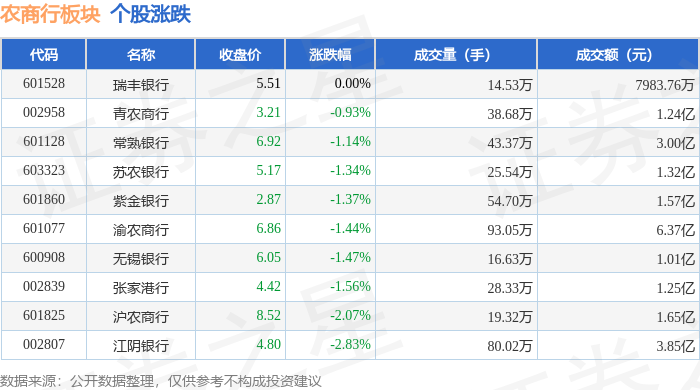
农商行板块10月29日跌1.59%,江阴银行领跌,主力资金净流入7863.93万元
Zheng Xing Xing Ye Ri Bao· 2025-10-29 08:41
Core Points - The rural commercial bank sector experienced a decline of 1.59% on October 29, with Jiangyin Bank leading the drop [1] - The Shanghai Composite Index closed at 4016.33, up 0.7%, while the Shenzhen Component Index closed at 13691.38, up 1.95% [1] Group 1: Stock Performance - Ruifeng Bank (601528) closed at 5.51 with no change in price [1] - Qingnong Commercial Bank (002958) closed at 3.21, down 0.93% [1] - Changshu Bank (601128) closed at 6.92, down 1.14% [1] - Sunong Bank (603323) closed at 5.17, down 1.34% [1] - Zijin Bank (601860) closed at 2.87, down 1.37% [1] - Yunnan Agricultural Commercial Bank (601077) closed at 6.86, down 1.44% [1] - Wuxi Bank (600908) closed at 6.05, down 1.47% [1] - Zhangjiagang Bank (002839) closed at 4.42, down 1.56% [1] - Shanghai Agricultural Commercial Bank (601825) closed at 8.52, down 2.07% [1] - Jiangyin Bank (002807) closed at 4.80, down 2.83% [1] Group 2: Capital Flow - The rural commercial bank sector saw a net inflow of 78.64 million yuan from main funds, while retail funds experienced a net outflow of 10.52 million yuan [2] - Speculative funds had a net outflow of 68.12 million yuan [2]




农商行板块10月28日跌0.75%,江阴银行领跌,主力资金净流入1650.52万元
Zheng Xing Xing Ye Ri Bao· 2025-10-28 08:40
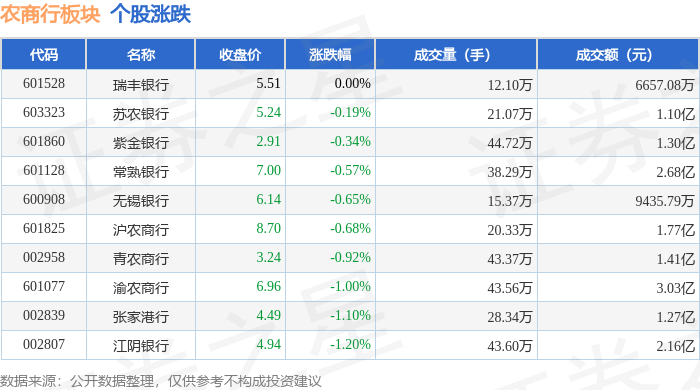
Market Overview - The rural commercial bank sector experienced a decline of 0.75% on October 28, with Jiangyin Bank leading the drop [1] - The Shanghai Composite Index closed at 3988.22, down 0.22%, while the Shenzhen Component Index closed at 13430.1, down 0.44% [1] Individual Stock Performance - Key stock performances in the rural commercial bank sector included: - Ruifeng Bank: Closed at 5.51, unchanged - Sunong Bank: Closed at 5.24, down 0.19% - Zijin Bank: Closed at 2.91, down 0.34% - Changshu Bank: Closed at 7.00, down 0.57% - Yuanxi Bank: Closed at 6.14, down 0.65% - Hunan Rural Commercial Bank: Closed at 8.70, down 0.68% - Qingnong Bank: Closed at 3.24, down 0.92% - Yunnan Rural Commercial Bank: Closed at 6.96, down 1.00% - Zhangjiagang Bank: Closed at 4.49, down 1.10% - Jiangyin Bank: Closed at 4.94, down 1.20% [1] Capital Flow Analysis - The rural commercial bank sector saw a net inflow of 16.51 million yuan from institutional investors, while retail investors experienced a net outflow of 25.96 million yuan [1] - Detailed capital flow for selected banks included: - Sunong Bank: Net inflow of 13.07 million yuan from institutional investors, with a net outflow of 9.25 million yuan from retail investors [2] - Hunan Rural Commercial Bank: Net inflow of 13.06 million yuan from institutional investors, with a net outflow of 16.03 million yuan from retail investors [2] - Qingnong Bank: Net inflow of 7.95 million yuan from institutional investors, with a net outflow of 7.73 million yuan from retail investors [2] - Jiangyin Bank: Net outflow of 5.93 million yuan from institutional investors, with a net inflow of 8.14 million yuan from retail investors [2]

农商行板块10月27日跌0.13%,沪农商行领跌,主力资金净流入2473.66万元
Zheng Xing Xing Ye Ri Bao· 2025-10-27 08:25
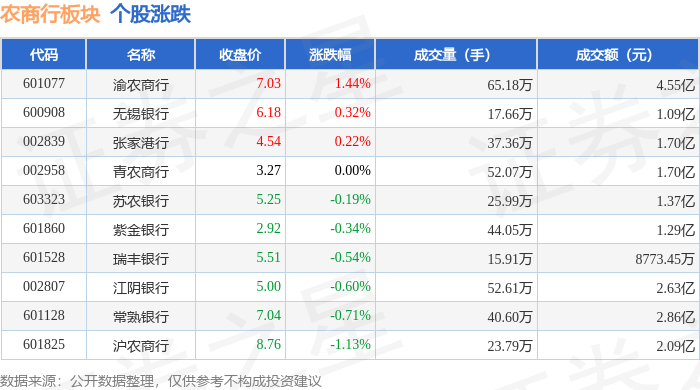
Core Insights - The agricultural commercial bank sector experienced a slight decline of 0.13% on October 27, with the Shanghai Agricultural Commercial Bank leading the drop [1] - The Shanghai Composite Index closed at 3996.94, up 1.18%, while the Shenzhen Component Index closed at 13489.4, up 1.51% [1] Stock Performance - The closing prices and performance of key agricultural commercial banks are as follows: - Yunnan Agricultural Commercial Bank (601077) closed at 7.03, up 1.44% with a trading volume of 651,800 shares and a transaction value of 455 million [1] - Wuxi Bank (600908) closed at 6.18, up 0.32% with a trading volume of 176,600 shares and a transaction value of 109 million [1] - Zhangjiagang Bank (002839) closed at 4.54, up 0.22% with a trading volume of 373,600 shares and a transaction value of 170 million [1] - Other banks like Su Nong Bank (603323) and Zijin Bank (601860) saw declines of 0.19% and 0.34% respectively [1] Fund Flow Analysis - The agricultural commercial bank sector saw a net inflow of 24.73 million from institutional investors and 41.41 million from retail investors, while retail investors had a net outflow of 66.14 million [1] - Detailed fund flow for specific banks indicates: - Jiangyin Bank (002807) had a net inflow of 9.34 million from institutional investors and a net outflow of 18.65 million from retail investors [2] - Wuxi Bank (600908) had a net inflow of 8.72 million from institutional investors and a net outflow of 10.73 million from retail investors [2] - Other banks like Zijin Bank (601860) and Yunnan Agricultural Commercial Bank (601077) also experienced mixed fund flows with significant retail outflows [2]
行业深度报告:零售风险及新规影响有限,兼论信贷去抵押化
KAIYUAN SECURITIES· 2025-10-27 05:44
Investment Rating - The investment rating for the industry is "Positive" (maintained) [1] Core Insights - The report highlights that retail non-performing loan (NPL) rates and generation rates are currently high, indicating ongoing pressure on bank profitability. Despite a low overall NPL rate, the retail sector shows signs of risk, with a marginal increase in the NPL rate to 1.28% [14][15] - The transition period for new risk regulations is nearing its end, with concerns about the impact on banks' provisioning levels. However, the report suggests that the actual impact may be less severe than market expectations [16] - The trend of de-collateralization in bank lending is evident, driven by both business characteristics and strategic choices made by banks to reduce reliance on collateralized loans [17] Summary by Sections 1. Retail NPL and Generation Rates - The retail NPL rate has increased to 1.28%, with a steepening curve indicating ongoing risk. The generation rate for retail loans remains high, with significant increases noted in certain banks [14][18] - The report indicates that while the overall NPL rate is low, the divergence between overdue and NPL indicators suggests underlying risks in the retail sector [19] 2. Impact of New Risk Regulations - The new risk regulations will require banks to classify impaired loans as NPLs, potentially increasing reported NPL rates. However, the report anticipates that the actual provisioning pressure may be manageable [16][17] 3. De-Collateralization in Lending - The report notes a significant decline in the proportion of collateralized loans, with banks shifting towards non-collateralized lending strategies. This shift is influenced by the need to manage risk more effectively [17][18] 4. Investment Recommendations - The report recommends certain state-owned banks due to their customer base advantages and manageable retail risk pressures. It also highlights specific banks such as CITIC Bank and Agricultural Bank of China as beneficiaries of this trend [6]






本周聚焦:黄金波动下的机遇与挑战:银行贵金属业务有望成重要增长极
GOLDEN SUN SECURITIES· 2025-10-27 00:58
Investment Rating - The report maintains an "Accumulate" rating for the banking sector, indicating a positive outlook despite challenges in the gold market in 2025 [1]. Core Insights - The gold market is expected to present both opportunities and challenges for banks, with a trend towards deepening precious metal business driven by central bank purchases [1][2]. - The demand for gold bars and coins has increased significantly, reflecting a growing need for gold as a hedge and store of value among residents [4]. - The establishment of a market-making system for gold trading is anticipated to enhance market liquidity and stability, positioning listed banks as key players [3][4]. Summary by Sections 1. Policy and Market Environment - As of September 2025, China's official gold reserves reached 74.06 million ounces, marking an increase for 11 consecutive months [2]. - In Q2 2025, global central banks added 166 tons of gold to their reserves, with 95% of surveyed central banks expecting further increases in the next 12 months [2]. - New policies allowing insurance funds to invest in gold are expected to create new opportunities for banks to provide services to insurance institutions, enhancing their intermediary income [2]. 2. Business Dynamics and Revenue Contribution - In the first half of 2025, China's gold consumption was 505.205 tons, a year-on-year decrease of 3.54%, with significant growth in gold bar and coin consumption by 23.69% [4]. - The decline in gold jewelry consumption is prompting banks to shift focus from traditional jewelry sales to investment-oriented precious metal businesses [4]. - The growth in investment demand for gold bars and coins is expected to stabilize income from investment-related businesses, enhancing the profitability of the precious metals segment for banks [4]. 3. Industry Trends - The report highlights a structural shift in gold consumption, with investment demand rising while jewelry demand declines, indicating a need for banks to adapt their business strategies [4]. - The performance of the banking sector is expected to benefit from expansionary policies aimed at stabilizing the economy, with specific banks like Ningbo Bank and Jiangsu Bank recommended for investment due to positive fundamental changes [8]. 4. Key Data Tracking - The report includes various financial metrics, such as average daily trading volume and margin financing balances, which are essential for assessing market conditions [9][10].





关注信贷需求修复:银行业周报-20251026
Xiangcai Securities· 2025-10-26 14:50
Investment Rating - The industry investment rating is maintained at "Overweight" [4][7]. Core Insights - The new policy financial tools have been implemented to boost credit demand, with over 330 billion yuan allocated by three policy banks [3][27]. - A total of 500 billion yuan in new policy financial tools has been initiated, with 250 billion yuan already invested in 12 major economic provinces, focusing on infrastructure, foreign trade, and emerging sectors like digital economy and AI [4][5]. - The expected leverage effect of the 500 billion yuan policy financial tools could generate approximately 5 trillion yuan in investments and 4 trillion yuan in loans [4][29]. - The rapid deployment of these financial tools is anticipated to enhance credit demand in the fourth quarter, particularly benefiting regional banks due to the demonstration effect from major economic provinces [5][29]. Summary by Sections Market Review - The banking index increased by 1.40% during the period from October 20 to October 26, 2025, underperforming the CSI 300 index by 1.84 percentage points [9]. - The performance of major banks was relatively strong, with Agricultural Bank of China leading with a 4.86% increase [9]. Financial Market - The central bank's net injection in the open market was 198.1 billion yuan, maintaining a loose monetary environment [18]. - The average issuance rates for one-year interbank certificates of deposit were 1.68% for state-owned banks and 1.74% for regional banks, with a notable increase in net financing of 425.3 billion yuan in October [22][26]. Industry Dynamics - The policy financial tools are expected to support long-term public loans and improve loan term structures, with a focus on sustainable credit demand release during project operation cycles [29]. - Investment in emerging industries, particularly AI, is projected to maintain strong financing demand, with technology innovation loans expected to grow rapidly [5][29]. Investment Recommendations - The report suggests focusing on state-owned banks for their stable high dividend yields and potential valuation recovery opportunities for joint-stock and regional banks amid improving economic expectations [7][30].


\十五五\规划背景下,银行如何进行战略升级?:银行业周报(20251020-20251026)-20251026
Huachuang Securities· 2025-10-26 11:16
Investment Rating - The report maintains a "Recommendation" rating for the banking sector, expecting the industry index to outperform the benchmark index by over 5% in the next 3-6 months [24]. Core Insights - The banking sector is transitioning from a "deposit-loan intermediary" to a key executor of national strategies and resource allocation hubs, focusing on five major areas: technology finance, green finance, inclusive finance, pension finance, and digital finance [2]. - The "14th Five-Year Plan" emphasizes the importance of financial system security, urging banks to balance profit-making with risk management while enhancing operational efficiency and service quality [3]. - The report highlights the need for banks to adapt to a more complex international competitive environment while prioritizing financial security and risk management in cross-border capital flows [3]. - The overall market performance shows a 1.40% weekly increase in the banking index, lagging behind the Shanghai Composite Index by 1.84 percentage points [7]. Summary by Sections Industry Overview - The banking sector's total market capitalization is approximately 1.15 trillion yuan, with a circulating market value of about 790 billion yuan [4]. - The report notes a 3.24% increase in the Shanghai Composite Index and a 2.88% increase in the Shanghai A-share market during the week [7]. Performance Metrics - The banking sector's absolute performance over the last month is 5.0%, with a relative performance of 2.8% compared to the benchmark [5]. - The report indicates a significant increase in the banking index over the past 12 months, with a relative performance of 24.4% [5]. Investment Recommendations - The report suggests a diversified investment strategy focusing on state-owned banks and stable joint-stock banks, highlighting the ongoing dividend plans and valuation improvement initiatives [8]. - Specific banks recommended for investment include China Merchants Bank, CITIC Bank, and Jiangsu Bank, among others, due to their solid fundamentals and growth potential [8][9].

常熟银行取消监事会 年内约20家银行监事会退场
Guo Ji Jin Rong Bao· 2025-10-24 14:40
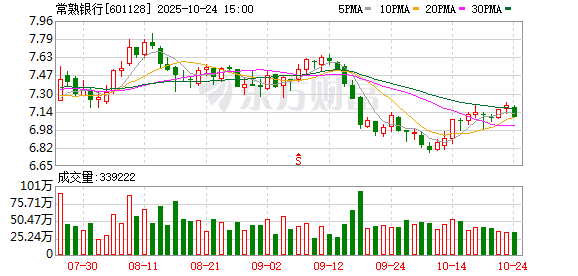
Core Viewpoint - Changshu Bank has announced the abolition of its supervisory board, following the approval of its revised articles of association by the Suzhou Financial Regulatory Bureau, marking a trend among commercial banks to eliminate supervisory boards [2][5]. Group 1: Changes in Governance Structure - Changshu Bank's supervisory board has been officially dissolved, and current supervisors will no longer hold their positions [2]. - The responsibilities of the supervisory board will now be assumed by the board of directors' audit and consumer rights protection committee [4]. - This move aligns with a broader trend where major state-owned banks, including ICBC, CCB, ABC, BOC, and BOCOM, have also announced the cancellation of their supervisory boards [5]. Group 2: Legal and Regulatory Context - The revised Company Law of 2023 allows joint-stock companies to exercise supervisory board functions through an audit committee under the board of directors, providing a legal basis for banks to abolish supervisory boards [5]. - The Commercial Banking Law states that the organizational form of commercial banks is subject to the Company Law, further supporting this governance change [5]. - A notification from the Financial Regulatory Administration in late 2024 clarified that financial institutions can choose to replace supervisory boards with audit committees [5]. Group 3: Implications and Considerations - The abolition of supervisory boards is seen as an innovation aimed at addressing the issue of ineffective supervision traditionally associated with these boards [5]. - Legal experts have raised concerns about potential independence risks and the need for clear delineation of responsibilities during the transition period, emphasizing the importance of revising company articles and improving internal control processes [6].
常熟银行取消监事会,年内约20家银行监事会退场
Guo Ji Jin Rong Bao· 2025-10-24 14:37
又一家银行宣布不再设立监事会! 10月23日,常熟银行发布公告称,已于近日收到《苏州金融监管分局关于常熟农村商业银行修改公司章程的批复》。自《公司章程》核准之日起,常 熟银行监事会依法撤销,现任监事不再担任监事及监事会相关职务,该行《监事会议事规则》等监事会相关制度同时废止。 (截图来源:常熟银行) 常熟银行官网"组织构架"显示,该行原监事会由监督委员会、提名与履职考评委员会和监事会办公室组成。公告内容显示,后续将由董事会审计与消 费者权益保护委员会依法承接监事会职权。 《国际金融报》记者注意到,今年以来,商业银行监事会正密集退出历史舞台。 9月25日,工商银行、建设银行、农业银行、中国银行和交通银行5家国有大行纷纷发文宣告获批取消监事会。据不完全统计,年内还有招商银行、光 大银行、沪农商行、华夏银行和长沙银行等约20家机构的监事会退场。事实上,自2022年以来,多家国有大行和股份行监事长一职便"名存实亡",职 位陆续空缺。 据了解,2023年新修订的《公司法》第121条明确允许股份有限公司通过董事会下设审计委员会行使监事会职权,《商业银行法》规定商业银行组织形 式适用公司法,则为银行裁撤监事会提供了直接法律 ...
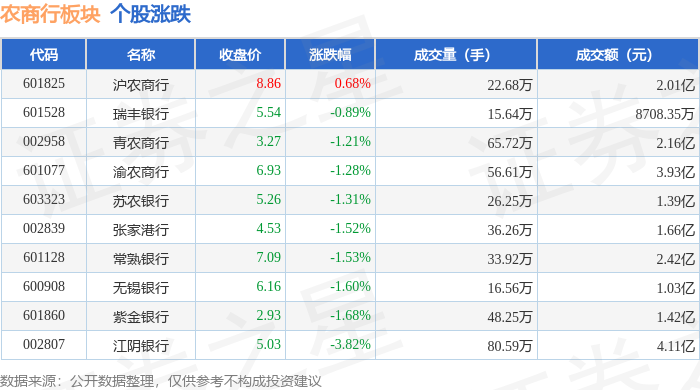
农商行板块10月24日跌0.82%,江阴银行领跌,主力资金净流出1.44亿元
Zheng Xing Xing Ye Ri Bao· 2025-10-24 08:27
Market Overview - The rural commercial bank sector experienced a decline of 0.82% on October 24, with Jiangyin Bank leading the drop [1] - The Shanghai Composite Index closed at 3950.31, up 0.71%, while the Shenzhen Component Index closed at 13289.18, up 2.02% [1] Individual Stock Performance - The closing prices and changes for key rural commercial banks are as follows: - Hu Nong Commercial Bank: 8.86, +0.68% - Ruifeng Bank: 5.54, -0.89% - Qingnong Commercial Bank: 3.27, -1.21% - Yunnan Commercial Bank: 6.93, -1.28% - Su Nong Bank: 5.26, -1.31% - Zhangjiagang Bank: 4.53, -1.52% - Changshu Bank: 7.09, -1.53% - Wuxi Bank: 6.16, -1.60% - Zijin Bank: 2.93, -1.68% - Jiangyin Bank: 5.03, -3.82% [1] Capital Flow Analysis - The rural commercial bank sector saw a net outflow of 144 million yuan from main funds, while retail funds experienced a net inflow of 63.71 million yuan [1] - The detailed capital flow for individual banks indicates: - Hu Nong Commercial Bank: Main funds net inflow of 6.22 million yuan, retail net outflow of 16.25 million yuan - Wuxi Bank: Main funds net outflow of 29.30 million yuan, retail net outflow of 0.99 million yuan - Jiangyin Bank: Main funds net outflow of 56.10 million yuan, retail net inflow of 36.93 million yuan [2]