
INDUSTRIAL BANK(601166)

Search documents
鹭岛兴行 融活聚力|兴业银行“投行万里行”厦门站成功举办
Jin Rong Jie· 2025-09-28 07:47
Group 1 - The core event was the "Ludao Xingxing Ruanhuo Jule" salon focused on revitalizing state-owned enterprise assets, successfully held in Xiamen [1] - The event was organized by Industrial Bank's Xiamen branch, with participation from various local government financial departments and over 30 executives from state-owned enterprises in Fujian and Xiamen [1] - The salon aimed to explore new cooperation opportunities for revitalizing state-owned enterprise assets, bringing together experts from Industrial Bank and its asset management subsidiary [1] Group 2 - Xu Haihui, Deputy General Manager of the Investment Banking Department, emphasized the bank's commitment to high-quality regional economic development through its "five major areas" of financial services [2] - The bank's strategy includes a "commercial bank + investment bank" approach, providing comprehensive financial support across various markets for local state-owned enterprises [2] - The event featured discussions on comprehensive financial services for local state-owned enterprises, including capital revitalization, asset management, and project construction, along with insights on new merger policies [2] Group 3 - The salon established an efficient communication platform for banks, government, and enterprises, laying a solid foundation for future cooperation [3] - Industrial Bank aims to leverage its investment banking expertise and group synergy to meet the diverse needs of state-owned enterprises in asset revitalization and transformation [3] - The bank looks forward to collaborating with more partners to inject new momentum into the economic and social development of Xiamen and the high-quality growth of state-owned enterprises [3]
兴业银行提示广大信用卡客户 “智享”分期 理性消费
Bei Jing Shang Bao· 2025-09-28 02:27
信用卡分期作为一种便捷的金融工具,是促消费、惠民生的有效辅助手段之一。但持卡人也需理性选 择、清醒消费,让信用卡成为提升生活品质、增强消费水平的"好帮手"。兴业银行特别提醒广大持卡 人: 当个消费的"明白人" 信用卡分期的核心价值是帮助持卡人在面对大额消费需求时,能够通过分期还款的方式降低当前的消费 压力,以便持卡人在不影响现金流的前提下拥有自己喜爱的商品。但是,分期不会减少负债总金额,如 果超出自身财务能力消费,可能会带来还款压力。 远离资金的使用"禁区" 信用卡分期一般用于个人消费场景,如购买家具家电、旅游、装修等,不得用于购房、投资、缴税、生 产经营等方面。银行可能会核查资金是否用于约定的用途。因此,建议消费者通过银行的官网或者客服 电话提前了解不同银行的要求,妥善保管相关消费凭证。 享受生活也要算好"细账" 怎样才能在提升生活品质的同时又当好资金管家呢?一要明确分期成本,比较不同分期产品的年化利 率。二要选择合适的分期期数,平衡好短期偿还能力与长期资金成本之间的关系。三要了解提前还款规 则,办理分期前,消费者可咨询提前还款的相关政策。 兴业银行始终高度重视消费者权益保护,持续开展金融知识普及工作,帮助 ...
用专业与温度守护美好生活
Bei Jing Ri Bao Ke Hu Duan· 2025-09-27 22:52
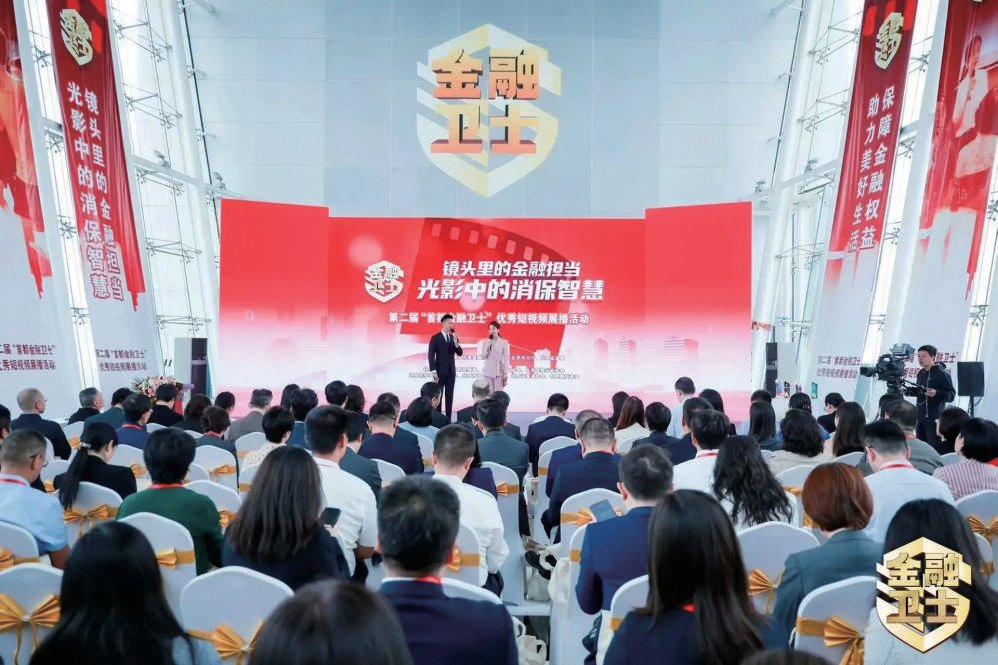
Core Viewpoint - The article emphasizes the importance of enhancing public financial literacy and establishing risk prevention measures as a key responsibility for financial institutions in today's integrated financial and daily life environment [1]. Group 1: Financial Literacy Initiatives - In September 2025, the Beijing branch of Industrial Bank organized a series of promotional activities themed "Protecting Financial Rights and Supporting a Better Life" across various community settings, including schools and enterprises [1]. - Multiple branches collaborated to innovate scenarios and implement targeted strategies, transforming professional financial knowledge into accessible language and engaging interactions [1]. Group 2: Community Engagement - The Financial Street sub-branch conducted a "Financial Knowledge Classroom" at Xidan Primary School, while other branches engaged with local communities to educate residents about financial fraud, particularly targeting elderly individuals [3][5]. - Activities included hands-on case studies and simulations to help residents identify fraud tactics, receiving positive feedback from community members [3][5]. Group 3: Customized Financial Education - The Xicheng sub-branch provided tailored financial education sessions for union staff, focusing on financial rights and dispute resolution, addressing common concerns such as personal account protection and recognizing fraudulent advertisements [6]. - The Baizifang sub-branch utilized a dual approach of in-branch and corporate training to cover a wide range of financial knowledge, enhancing public awareness of financial security and risk prevention [7]. Group 4: Youth and Student Engagement - The bank's initiatives also targeted younger audiences, with engaging financial lessons designed for elementary school students and university entrepreneurs, focusing on practical financial knowledge and risk awareness [8][9]. - The activities aimed to instill good financial habits and provide essential information on protecting personal finances and recognizing financial scams [8][9]. Group 5: Recognition and Future Plans - The Beijing branch received accolades for its community service, including the "Top Ten Works Award" for financial convenience and benefit, highlighting its commitment to public financial education [4][9]. - The bank plans to continue its financial literacy efforts beyond the "Financial Education Promotion Week," aiming for a more sustainable and impactful approach to financial knowledge dissemination [10].

固收深度报告20250927:从42家上市银行半年报解读银行债券投资“攻守道”





Soochow Securities· 2025-09-27 14:32
1. Report Industry Investment Rating No information about the report industry investment rating is provided in the given content. 2. Core Viewpoints of the Report - External environment factors such as interest rate fluctuations, bond supply - demand, and policy orientation jointly impact bond investment returns. In H1 2025, the bond investment of 42 listed banks showed certain characteristics in scale, structure, and profit and loss, but there are still challenges in maintaining stable returns in the future [1]. - The overall bond investment scale of 42 listed banks expanded steadily in H1 2025. There were differences in the investment structure among different types of banks, with state - owned banks and city commercial banks having stable growth in the bond allocation portfolio, while joint - stock banks and rural commercial banks increased their efforts in the bond trading portfolio. The bond investment portfolio generally presented a pattern of "stable foundation and flexible gain" [1]. - The coupon income of 42 listed banks was generally stable in H1 2025 but showed a slight year - on - year decline. The fair value change loss was significant, and the investment income increased. However, the bond investment of the banking industry still faces pressure to maintain stable returns [1]. 3. Summary According to the Table of Contents 3.1 42 Listed Banks' Bond Investment Volume - **Overall Bond Investment Scale: Steady Expansion**: In H1 2025, the total scale of the three types of bond - type financial assets of 42 listed banks showed a steady expansion trend. The growth of debt investment - type financial assets measured at amortized cost was relatively slow, while the growth of trading financial assets measured at fair value and included in current profits and losses was relatively large, indicating that banks increased the proportion of trading positions [9]. - **Differentiated Bond Investment Distribution Structures among Different Bank Types**: In H1 2025, state - owned banks and city commercial banks showed stable growth in the bond allocation portfolio, which may be related to their participation in the primary - market issuance of important national and regional bond varieties. Joint - stock banks and rural commercial banks slightly weakened their bond allocation power but significantly increased their efforts in the bond trading portfolio, showing a differentiated feature of "stable allocation by large banks and prominent trading flexibility by small and medium - sized banks" [13]. - **Bond Investment Allocation Tilted towards Government - Related Bonds**: In H1 2025, commercial banks increased their allocation of government - related bonds, with an average month - on - month increase of about 10% for state - owned banks, joint - stock banks, and city commercial banks, and a slightly smaller increase for rural commercial banks. The allocation of financial bonds and other bonds was differentiated. All banks held a relatively large scale of government - related bonds, followed by financial bonds and credit - related bonds [18]. - **Correlation between Financial Asset Types and Bond Variety Structures**: The banking industry maintained a stable growth of interest - rate bonds in the bond allocation portfolio and increased the allocation of credit bonds, while the allocation of financial bonds was relatively weak. In the bond trading portfolio, interest - rate bonds and financial bonds were the core varieties, with a more significant increase than credit bonds, showing a "stable foundation and flexible gain" pattern [22]. 3.2 42 Listed Banks' Bond Investment Profit and Loss - **Coupon Income: Generally Stable and Still the Main Source of Income**: In H1 2025, the total coupon income of 42 listed banks decreased slightly year - on - year. Although the scale of held - to - maturity bonds increased, the decline in the coupon rate of newly issued bonds led to a decrease in coupon income. In the future, coupon income is still expected to be the main source of bond investment income for commercial banks [26]. - **Fair Value Change Loss: Losses in the Trading Level**: In H1 2025, the total fair value change loss of 42 listed banks decreased significantly year - on - year, indicating that it was difficult to obtain capital gains through short - term trading in the volatile bond market, and there were floating losses in bond trading [28]. - **Investment Income: Growth in All Bank Types**: In H1 2025, the actual investment income of 42 listed banks in the bond field increased significantly year - on - year. Although the book value appreciation of bond - type trading financial assets and other debt investment - type financial assets was not as good as that of the previous year, banks could still increase their investment income by selling floating - profit old bonds and waiting for the maturity of high - coupon bonds [31]. 3.3 Attribution and Summary - **External Environment Driving Factors: Interest Rate Fluctuations, Bond Supply - Demand, and Policy Orientation Jointly Impact Bond Investment Returns**: In H1 2025, the "more adjustments and fewer opportunities" bond market environment led to a general decline in the prices of existing bonds, resulting in a significant year - on - year decline in the fair value change loss of listed banks' bond investment. The supply of national bonds, local government bonds, and policy - based financial bonds increased, but the coupon rate of newly issued bonds decreased, leading to a decline in coupon income. Regulatory policies indirectly affected bond investment performance [35]. - **Banking Industry's Bond Investment Pressure and Future Outlook** - Overall Income Shows a Positive Trend but There Are Still Hidden Concerns: In H1 2025, the actual bond investment income of 42 listed banks increased slightly year - on - year, but the coupon income faced downward pressure in the interest - rate downward cycle, and it was more difficult to obtain spread income through band trading. Since H2 2025, the "stock - strong and bond - weak" pattern has emerged, and the loss caused by fair value change will be more obvious [3]. - Different Bank Types Show Differentiated Performance, and State - owned Banks' Pressure Is Relatively Controllable: State - owned banks can maintain a certain profit - making ability in the low - interest - rate volatile bond market due to their advantages in bond allocation and trading portfolios. Joint - stock banks, city commercial banks, and rural commercial banks are more vulnerable, and they may increase their capital allocation in the equity market, commodity market, and related structured fixed - income products in the future [3].
兴业银行北京分行被罚 贷款“三查”失职
Zhong Guo Jing Ji Wang· 2025-09-27 07:32
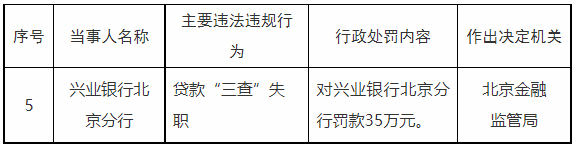
北京金融监管局对对兴业银行北京分行罚款35万元。 | 序号 | 当事人名称 | 主要违法违规行 | 行政处罚内容 | 作出决定机关 | | --- | --- | --- | --- | --- | | | | 为 | | | | 5 | 兴业银行北 | 贷款"三查"失 | 对兴业银行北京分 | 北京金融 | | | 京分行 | मिति | 行罚款35万元。 | 监管局 | 中国经济网北京9月27日讯 国家金融监督管理总局北京监管局网站昨日披露的行政处罚信息公开表显 示,兴业银行北京分行贷款"三查"失职。 (责任编辑:蔡情) ...
北京监管局一日开出五张罚单 银行贷款“三查”失职问题集中曝光
Jing Ji Guan Cha Bao· 2025-09-27 04:28
Core Viewpoint - The recent administrative penalties imposed on five banks in Beijing highlight the ongoing regulatory focus on compliance in credit operations, particularly regarding the "three checks" system in loan management [1][2][5]. Group 1: Regulatory Actions - Five banks, including major state-owned banks and joint-stock banks, were fined 350,000 yuan each for violations related to loan management, specifically the "three checks" system [1][2][4]. - The "three checks" system, which includes pre-loan investigation, in-process review, and post-loan inspection, is crucial for managing loan risks and ensuring asset quality [2][3]. Group 2: Systemic Risks and Challenges - Inadequate management of working capital loans can lead to misuse of funds and potential systemic financial risks if multiple banks face similar issues [3][4]. - The penalties reflect a broader industry challenge, indicating that loan management problems are not isolated incidents but rather a common issue across the banking sector [4]. Group 3: Regulatory Environment and Future Directions - The regulatory authority has emphasized the importance of compliance and risk management in credit operations, with a focus on enhancing internal controls within banks [5][6]. - Future regulatory measures are expected to diversify, incorporating tools like window guidance and stress testing to create a multi-layered regulatory framework [5]. Group 4: Cultural and Mechanism Reforms - The penalties serve as a catalyst for banks to rethink their internal assessment criteria, ensuring that compliance and asset quality are prioritized alongside growth metrics [6]. - The adoption of advanced technologies such as big data and artificial intelligence is necessary to improve the efficiency and effectiveness of the "three checks" system [6].



锚定“五大战略定位” 金融助力新疆新发展格局
Zhong Guo Jing Ying Bao· 2025-09-26 18:31
Core Insights - The establishment of the Xinjiang Uygur Autonomous Region in 1955 marked a new era for its development, with the financial sector playing a crucial role in this progress [1] - Xinjiang's financial industry has achieved significant growth by aligning with the national strategic positioning, evolving from a sparse institutional framework to a robust financial service system [2] Financial Sector Development - Xinjiang's financial institutions have expanded significantly, with the number of banking and insurance entities and personnel increasing by over 15% since the 18th National Congress of the Communist Party of China [2] - The financial sector has created a multi-faceted service system that combines policy guidance and market operations, providing essential support for the region's economic development [2] Support for Key Industries - Major financial institutions, such as the Industrial and Commercial Bank of China (ICBC), have implemented innovative service models to support local enterprises, including a market-oriented debt-to-equity swap for a leading wind power manufacturer [3] - As of mid-2025, the Guangfa Bank's Urumqi branch reported a 33.7% year-on-year increase in loan balances for its "ten major industry clusters" clients [4] Focus on Advanced Manufacturing - Advanced manufacturing and technological innovation are prioritized in Xinjiang's industrial strategy, with financial institutions increasing support for these sectors to enhance productivity and drive economic growth [5] - The region's manufacturing sector saw a 10.7% year-on-year increase in value added from January to August 2025, outpacing the national average [5] Innovative Financial Services - Financial institutions are adapting their service models to better support advanced manufacturing, with the Agricultural Bank of China investing over 3 billion yuan in a local aluminum enterprise to facilitate its transition to a green and high-end industry [6] - The Industrial Bank's Urumqi branch has developed a "technology flow" credit evaluation system to address the financing challenges faced by technology-driven companies, focusing on innovation capabilities and intellectual property [7] Conclusion - The financial sector in Xinjiang is evolving to provide more precise and innovative services, significantly contributing to the region's economic development and the cultivation of new productive forces [7]

兴业银行首笔独立承贷出口买方信贷落地广西
Guang Xi Ri Bao· 2025-09-26 16:02
Core Viewpoint - Industrial Bank's Nanning Branch successfully issued a buyer's credit financing of 712.9 million yuan for a new materials company to support its renewable energy project in Indonesia, marking the bank's first independently undertaken export buyer's credit business [1] Group 1: Financing and Project Details - The financing is aimed at supporting the construction of a renewable energy project in Indonesia, with a project company established to manage the construction and operation [1] - The loan is insured by China CITIC Insurance and utilizes the export buyer's credit model, with future operational revenues from the project serving as the repayment source [1] Group 2: Strategic Contributions - The initiative integrates cross-border finance with green finance, enhancing the ESG performance of enterprises and contributing to Guangxi's role as a financial open portal towards ASEAN [1] - The bank has tailored cross-border financial service solutions to meet the financing needs identified during preliminary research, effectively alleviating the financial pressure on enterprises and enhancing the competitiveness of Chinese companies in international markets [1] Group 3: Future Directions - Industrial Bank's Nanning Branch plans to continue supporting national strategies and the real economy, leveraging opportunities in China-ASEAN cooperation [1] - The bank aims to strengthen its capabilities in cross-border finance, green finance, and investment banking, exploring new paths for the integration of "cross-border + industry" development to facilitate more overseas project financing and the expansion of industrial chains [1]
银行基金代销格局生变!
Zhong Guo Jing Ying Bao· 2025-09-26 13:21
Core Insights - Recent regulatory actions have highlighted compliance issues in fund distribution by banks, with nearly ten banks receiving warnings or being ordered to rectify their practices this year [2] - The competitive landscape for bank fund distribution is intensifying, with larger banks maintaining a stronghold while smaller banks face declining market shares [2][3] Group 1: Bank Performance in Fund Distribution - As of the first half of 2025, banks hold 24 positions in the top 100 fund distribution institutions, with a significant presence in the market [3] - China Merchants Bank leads with a fund holding scale of 1,041.9 billion yuan, followed by other major banks maintaining over 100 billion yuan in non-monetary fund holdings [3] - The focus on equity funds is increasing among top banks, with banks holding 1.9 trillion yuan in active equity funds, accounting for 59% of the total among the top 100 distributors [3] Group 2: Challenges and Strategic Shifts - The leading banks benefit from a large customer base and extensive distribution networks, but face growing competition from securities firms and internet platforms [4][5] - There is a pressing need for banks to transition from a product sales model to a customer-centric approach in wealth management to retain clients [5][6] - Regulatory pressures and compliance requirements are increasing, impacting traditional revenue models and necessitating a shift in internal management practices [5] Group 3: Position of Smaller Banks - Smaller banks are struggling in the fund distribution space due to limited resources and a lack of competitive advantages compared to larger banks [7][8] - Recommendations for smaller banks include focusing on customer needs, enhancing digital capabilities, and developing professional advisory teams to improve service efficiency [8][9] - Collaborations with wealth management subsidiaries are on the rise among smaller banks, indicating a strategic shift towards optimizing income structures through fund distribution partnerships [8]


兴业边疆惠民生” 兴业银行乌鲁木齐分行全力书写金融“五篇大文章
Zheng Quan Shi Bao Wang· 2025-09-26 10:34
Core Insights - The article emphasizes the proactive role of Industrial Bank's Urumqi branch in supporting the economic and social development of Xinjiang, aligning with national strategies and focusing on innovation in financial services [1] Financial Support for New Quality Productivity - The bank recognizes the importance of financial support for the development of new quality productivity and has increased its technology finance loan balance to 17.199 billion yuan, up by 541 million yuan since the beginning of the year [2] - It focuses on strategic emerging industries and high-tech enterprises, employing a comprehensive service approach that combines financing and intelligence to support the growth of technology-driven companies [2] Green Finance Initiatives - The Urumqi branch has actively responded to national green development strategies, with a green finance loan balance reaching 10.746 billion yuan, an increase of 2.342 billion yuan since the start of the year [3] - Innovative financial products have been introduced, such as climate loans and carbon market-based loans, to enhance project evaluation and promote the healthy development of the carbon market in Xinjiang [3][4] Support for Small and Micro Enterprises - The bank has adhered to its commitment to serve the public, with inclusive finance loans totaling 3.927 billion yuan, an increase of 221 million yuan since the beginning of the year [5] - It has established a regular information exchange channel with government platforms to better meet the financing needs of small and micro enterprises [5] Agricultural and Rural Development - The bank focuses on rural revitalization, implementing differentiated financial services to support the agricultural supply chain and enhance the efficiency of asset evaluation and risk warning through technology [6] Elderly Financial Services - The Urumqi branch has developed a comprehensive elderly financial service system, with a financing balance of 416 million yuan, an increase of 91 million yuan since the beginning of the year [7] - It has created dedicated spaces and services for elderly clients, enhancing their financial experience and promoting community engagement through educational initiatives [8] Digital Financial Services - The bank is integrating digital services into various aspects of life and business, enhancing efficiency and user experience through innovative digital financial products [9] - It aims to improve service quality and financial supply, contributing to the high-quality development of Xinjiang's economy and society [9]