INDUSTRIAL BANK(601166)

Search documents
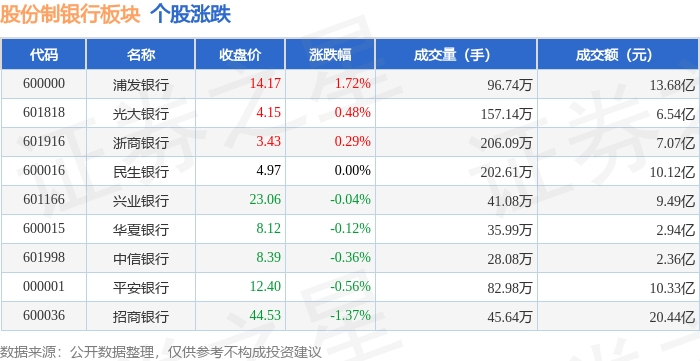
股份制银行板块8月8日跌0.24%,招商银行领跌,主力资金净流出3.65亿元
Zheng Xing Xing Ye Ri Bao· 2025-08-08 08:35
Group 1 - The banking sector experienced a decline of 0.24% on August 8, with China Merchants Bank leading the drop [1] - The Shanghai Composite Index closed at 3635.13, down 0.12%, while the Shenzhen Component Index closed at 11128.67, down 0.26% [1] - Among the listed banks, Shanghai Pudong Development Bank saw the highest increase of 1.72%, while China Merchants Bank had the largest decrease of 1.37% [1] Group 2 - The banking sector faced a net outflow of 365 million yuan from main funds, while retail investors contributed a net inflow of 363 million yuan [1] - Specific banks like Huaxia Bank and China Merchants Bank experienced significant net outflows from main funds, with China Merchants Bank seeing a net outflow of 239 million yuan [1] - Retail investors showed strong interest in several banks, with notable inflows into Huaxia Bank and China Merchants Bank, despite the overall outflow from main funds [1]





兴业银行济南分行提升金融服务适配性助力制造业企业破解融资难题
Qi Lu Wan Bao Wang· 2025-08-08 08:02
Core Insights - The article highlights the successful collaboration between Industrial Bank's Jinan branch and a key metal processing enterprise in Binzhou, showcasing the effectiveness of financial services in supporting the real economy [1][2] Group 1: Financial Solutions - The enterprise, with an annual output value exceeding 200 million yuan, faced a tight liquidity situation requiring 10 million yuan for raw material purchases due to a new factory construction project [1] - Industrial Bank provided a tailored financing solution through its "Xing Su Loan" product, which utilized the enterprise's existing assets as the basis for credit without requiring collateral, thus meeting the urgent funding needs efficiently [1][2] Group 2: Service Efficiency - The bank implemented a "green channel" to expedite the service process, completing the corporate account setup and product signing within one working day, and achieving online automatic approval for the 10 million yuan credit limit within 24 hours [2] - The use of electronic signature systems allowed for loan disbursement within three working days, ensuring timely access to funds for the enterprise [2] Group 3: Client Relationship and Future Cooperation - The collaboration has evolved from a singular financing relationship to a comprehensive partnership, with the enterprise expressing intentions to transfer more settlement and fund management operations to the bank [2] - The bank's approach of leveraging financial technology to replace traditional processes has created a replicable model for inclusive financial services, enhancing the financing accessibility for similar enterprises [2] Group 4: Commitment to Economic Development - The bank's leadership emphasized the role of technological empowerment and product innovation in supporting the real economy, committing to explore new paths for inclusive finance to bolster regional economic development [2]

金融资产投资公司扩容至七家 科技创新将获增量耐心资本支持
Jin Rong Shi Bao· 2025-08-08 07:59
Group 1 - The establishment of financial asset investment companies (AICs) by commercial banks is accelerating, with China Citic Bank recently receiving approval to set up its AIC, following the establishment of similar companies by other banks like Industrial Bank and China Merchants Bank [1][2][4] - The registered capital for Citic Bank's AIC is planned to be RMB 10 billion, with Citic Bank holding a 100% stake [1] - The regulatory environment is supportive, as the Financial Regulatory Bureau has encouraged national commercial banks to establish AICs, which are expected to provide additional capital for technology innovation [4][5] Group 2 - AICs are transitioning from focusing on debt-to-equity swaps to engaging in equity investment, thus becoming significant players in supporting technology innovation [2][3] - The pilot program for equity investment by AICs has expanded, allowing for a broader range of banks to participate and increasing the investment limits from 4% to 10% of total assets [3][6] - The total signed intention amount for AIC equity investment pilot programs has exceeded RMB 380 billion, with 74 private equity funds established [6][7] Group 3 - AICs are targeting strategic emerging industries and local特色产业, with specific investments already made in sectors like smart driving cockpit chips and polyester film production [7] - The establishment of AICs provides banks with new avenues to meet the financing needs of technology enterprises, enhancing their service capabilities and competitiveness [7][8] - The expansion of AICs is expected to lead to innovative business models in venture capital, equity investment, and corporate restructuring [5][8]

绿水青山绘津图 金融“兴”动向未来 兴业银行天津分行奋力书写绿色金融新篇章
Jin Rong Shi Bao· 2025-08-08 07:59
Core Viewpoint - The article emphasizes the transformation of the financial system from a mere service provider of capital flow to a proactive participant and promoter of ecological civilization construction, aligning with the national strategy of green development and the "dual carbon" goals [1][3]. Group 1: Green Finance Initiatives - Industrial Bank's Tianjin branch has achieved a green loan balance exceeding 13 billion yuan and a green financing balance nearing 30 billion yuan by June 2025, serving over 1,800 regional green enterprises [1]. - The branch has successfully implemented various innovative green finance tools, including the first ESG-linked loan and the first carbon emission-linked loan in Tianjin, which have been recognized as benchmark cases in the industry [2]. - The bank has developed a comprehensive green finance service model that integrates policy guidance, product innovation, and scenario integration, focusing on key industries such as energy conservation, new energy manufacturing, and green construction [1][2]. Group 2: Digital Transformation in Green Finance - The Tianjin branch has launched a distributed photovoltaic project financing channel through its "Bank融平台," enabling online document submission, automatic approval, and same-day responses, thus providing efficient financing solutions for small and medium-sized enterprises [2]. - The bank's approach includes collaboration with emerging industries and park economies in key areas like Binhai New Area and Beichen District, creating a multi-tiered financial service network that supports the green transformation of both large enterprises and SMEs [2]. Group 3: Future Directions - Moving forward, the Tianjin branch aims to deepen its green product system, enhance green management mechanisms, and broaden the boundaries of green services, all while maintaining a commitment to high-quality economic development and the dual carbon strategy [3].
为科技企业保驾护航
Jin Rong Shi Bao· 2025-08-08 07:55
Group 1 - The core viewpoint emphasizes the urgent need for financial institutions to support technology startups due to high innovation costs, significant investments, and a lack of collateral [1][2] - The People's Bank of China and seven other departments have launched a work plan to enhance financial services for technology firms, focusing on early, small, long-term, and hard technology investments [2][5] - Financial institutions are innovating new service models to support early-stage technology companies, with commercial banks increasingly willing to provide loans to startups [2][3] Group 2 - The "Technical Flow" credit evaluation system by Industrial Bank has successfully provided loans totaling nearly 850 billion yuan to over 15,000 enterprises, addressing funding needs during critical phases of development [3][7] - Beijing Zhongguancun Bank has introduced the "Hui Chuang Loan" product, which assesses credit based on talent evaluation, including educational background and technical capabilities [4][6] - The government has emphasized the importance of supporting early-stage technology firms, leading to the establishment of a financial support system that integrates equity investment and loan mechanisms [5][6] Group 3 - Banks are actively exploring new models of investment-loan linkage to broaden financing channels and meet diverse financial needs of technology companies [6][7] - The Industrial Bank has partnered with external financial resources to create a 20 billion yuan industry cluster fund targeting key sectors such as electronic information and biomedicine [7][8] - Construction Bank is building a technology financial ecosystem by connecting various stakeholders, providing comprehensive services that include financial support, incubation, and industry guidance [8]


科创金融助“新秀”变身“小巨人”
Jin Rong Shi Bao· 2025-08-08 07:55
"这些年,我们企业从蹒跚起步到申报IPO,发展过程中每遇到困难,总有严毅明和他的同事帮我 们搭桥铺路,急人之所急,这一点实在难能可贵。"提及兴业银行员工严毅明,影石创新科技公司相关 负责人印象深刻、连连称赞。 从一名一线的业务经理,到兴业银行深圳分行科技金融中心主任,严毅明在陪伴科技公司一路成长 的同时,深入研究科技型企业所属行业及其产业链上下游行业的特点、金融需求,逐渐成长为创投机构 和科技产业的"圈内人"。 置身于深圳这座"创新之城",近年来,严毅明带领团队发挥兴业银行科技金融优势,因地制宜打造 特色服务,引金融活水滋养创新一线,持续助力科技新秀成长为"小巨人""独角兽"。 跳出"商行"思维 走出"高定"路线 2022年,严毅明在带领团队拜访一家国家级专精特新"小巨人"企业时发现,面对传统的贷款、理财 等商业银行服务,企业负责人兴致不高,于是他便迅速转换思路,提到兴业银行在业内较早发力园区金 融新赛道,"如果有园区金融需求,我们可以帮忙推进"。 听闻此话,企业负责人顿时眼前一亮。原来,这家公司正值扩产增效的关键时期,但现在租赁的厂 房已经不能满足在手订单和设备更新的增产需求,企业负责人正为寻找合适的生产场 ...

商业银行企业类场景金融创新:变革、突破与协同发展
Jin Rong Shi Bao· 2025-08-08 07:55
Group 1: Background of Banks Focusing on Corporate Clients - The rise of industrial digitalization presents opportunities for banks to overcome challenges in traditional supply chain finance, enabling better access to real-time and reliable data [1] - The integration of big data, AI, and IoT technologies allows banks to identify potential risks and monitor new types of collateral in real-time, facilitating a shift towards a more intelligent supply chain finance model [1] Group 2: Promoting High-Quality Development of Inclusive Finance - Despite efforts to advance inclusive finance, banks face challenges in serving the diverse needs of small and micro enterprises, leading to incomplete and uneven service [2] - By leveraging financial technology, banks can better understand enterprise operations and provide comprehensive "financial + non-financial" services, enhancing customer satisfaction and loyalty [2] Group 3: Implementing the Five Key Financial Areas - The central financial work conference outlines five key areas for banks: technology finance, green finance, inclusive finance, pension finance, and digital finance, guiding future development [3] - Engaging in corporate scene finance can help banks address challenges such as talent shortages and information asymmetry, enabling them to provide tailored financial products and services [3] Group 4: Development Strategies for Corporate Scene Finance - Banks need to carefully select corporate finance scenes based on their resources and strategic goals, integrating these into their overall development plans [4] - Establishing industry selection principles and internal organizational structures is crucial for the sustainable development of scene finance [4] Group 5: Intelligent Transformation of Supply Chain Finance - Banks are adopting advanced technologies like big data, AI, and IoT to upgrade supply chain finance, enhancing data integration and creating intelligent systems [5] - The goal is to develop automated business models that can be applied in specific scenes, thereby deepening the supply chain finance landscape [5] Group 6: Empowering Merchant Operations - Banks are providing differentiated operational tools such as IaaS, PaaS, and SaaS to support the digital transformation of merchants and small enterprises [6] - By exploring new technologies like IoT and blockchain, banks aim to offer comprehensive solutions that reduce costs and improve operational efficiency [6] Group 7: Comprehensive "Financial + Non-Financial" Service Orientation - Banks are increasingly offering integrated "financial + non-financial" services to meet diverse customer needs, leveraging high-frequency non-financial scenarios to drive financial engagement [7] - Collaborations with various industries help create unique service offerings, enhancing customer experience and satisfaction [7][8] Group 8: Innovative Practices in Corporate Scene Finance - The digital supply chain finance sector is undergoing transformation, with banks like Ping An leveraging IoT and satellite technology to create a new supply chain finance model [9] - This model addresses financing challenges for small and micro enterprises by reducing reliance on core enterprise credit [9] Group 9: Innovations in Smart Agriculture - In the context of rural revitalization, banks are focusing on the livestock industry, utilizing IoT and AI to create innovative financial models that address the lack of traditional collateral [10] - New products like "Smart Livestock Loans" and advanced risk control technologies are being developed to support this sector [10] Group 10: Innovations in Smart Canteens - Banks are innovating in the smart canteen sector to enhance customer engagement and operational efficiency, employing technologies like facial recognition and AI for seamless service [11] - Collaborations with companies like Meituan are aimed at improving dining experiences while driving financial demand [11] Group 11: Innovations in Smart Parks - Smart parks are becoming a focal point for banks, leveraging technologies like big data and cloud computing to provide diverse services and enhance user experience [12] - The development of a smart park management system allows banks to analyze data and improve operational efficiency [12]


兴业银行济南“碳足迹挂钩贷款”助力企业低碳转型
Qi Lu Wan Bao Wang· 2025-08-08 07:51
Core Viewpoint - The private economy is becoming a key player in green development under the "dual carbon" goals, with innovative financial products like "carbon footprint-linked loans" facilitating the green transformation of enterprises [1][5]. Group 1: Financial Innovation - The "carbon footprint-linked loan" is designed to tie financing costs directly to the company's emission reduction achievements, allowing for lower interest rates as carbon footprints decrease [2]. - This innovative financing approach addresses the dual challenges of high transformation pressure and financing costs faced by private enterprises in the chemical industry [2]. Group 2: Environmental and Financial Benefits - The product effectively converts environmental benefits into financial gains, making carbon reduction tangible and financially rewarding for companies [3]. - It not only reduces financing costs for green transformation but also provides strong internal motivation for continuous investment in emission reduction technologies and production optimization [3]. Group 3: Broader Impact on Private Enterprises - The implementation of this loan product is a vivid example of how financial institutions can support the green transformation of private enterprises, with nearly 200 million yuan in loans issued to multiple companies [5]. - The initiative aims to help every private enterprise find the optimal balance between economic and environmental benefits, marking a shift from passive carbon reduction to proactive transformation [5].
首家全国性股份制银行AIC获批筹建
Zheng Quan Ri Bao· 2025-08-08 07:24
Core Points - The National Financial Regulatory Administration supports qualified national commercial banks to establish Asset Investment Companies (AIC), with approvals expected to be granted soon [1][2] - The establishment of Xingyin Financial Asset Investment Company by Industrial Bank is aimed at enhancing support for technology innovation and private enterprises, while also professionalizing and marketizing debt-to-equity swap operations [2] - The expansion of AIC's equity investment pilot program to 18 cities indicates a significant increase in the scope and potential investment amounts, with signed intention amounts exceeding 380 billion yuan [3] Summary by Sections Regulatory Support - The National Financial Regulatory Administration has approved the establishment of Xingyin Financial Asset Investment Company, marking the entry of a national joint-stock bank into the AIC sector [1] - The regulatory body emphasizes the need for compliance with legal requirements during the establishment process, which must be completed within six months [1] Company Initiatives - Industrial Bank's establishment of the AIC is expected to lower corporate leverage and enhance support for technology and private enterprises, contributing to sustainable and high-quality development [2] - Other banks, such as China Merchants Bank, are also considering the establishment of AICs, indicating a broader industry trend [2] Market Impact - The AICs are designed to fill the gap in equity investment capabilities for commercial banks, allowing for direct equity investments and enhancing comprehensive service capabilities [2] - The expansion of the AIC pilot program to 18 cities reflects a strategic move to bolster investment in technology innovation and support for private enterprises [3]
股份制银行争锋:兴业、中信离招商银行有多远?
Zhong Guo Jing Ji Wang· 2025-08-08 07:23
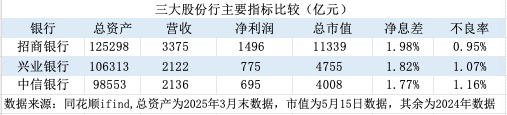
Core Viewpoint - The re-issuance of AIC licenses marks a shift in focus from debt-to-equity swaps to supporting the development of new productive forces in the financial sector [1] Group 1: AIC License and Bank Recognition - The National Financial Regulatory Administration approved the establishment of the Xingyin Financial Asset Investment Company by Industrial Bank, with other banks like China Merchants Bank and CITIC Bank also planning to set up similar companies pending regulatory approval [1] - This indicates regulatory recognition of the strength of these banks, which have carved out their positions in the market through innovation despite lacking the capital strength of state-owned banks [1] Group 2: Financial Performance Comparison - As of March 2025, the total assets of China Merchants Bank, Industrial Bank, and CITIC Bank were 12.5 trillion, 10.6 trillion, and 9.9 trillion yuan respectively, with China Merchants Bank leading in all major financial metrics [2][4] - China Merchants Bank's net profit for 2024 was 149.6 billion yuan, significantly higher than the 77.5 billion yuan of Industrial Bank and 69.5 billion yuan of CITIC Bank [2] Group 3: Retail Business Focus - Retail banking is identified as a cornerstone for future competition among these banks, with Industrial Bank and CITIC Bank actively working to enhance their retail business capabilities [3] - The ability to excel in retail banking and wealth management will likely determine which bank secures the second position among the joint-stock banks [3] Group 4: Asset Growth Trends - Over the past decade, while Industrial Bank and CITIC Bank have pursued aggressive growth strategies, the asset gap with China Merchants Bank has widened, with their total assets at 85% and 79% of China Merchants Bank's respectively by 2024 [4][7] - China Merchants Bank's financial investments grew 2.65 times from 2017 to 2024, indicating a strategic shift towards government bonds amid a challenging lending environment [7] Group 5: Net Interest Margin and Cost of Deposits - In 2024, China Merchants Bank's net interest margin was 1.98%, outperforming Industrial Bank and CITIC Bank by approximately 20 basis points [11][12] - The lower cost of deposits at China Merchants Bank, primarily due to a higher proportion of low-cost personal deposits, contributes to its competitive advantage [11] Group 6: Strategic Directions and Future Outlook - The transition from the old economic cycle to a new one focused on technology, industry, and finance presents opportunities for banks to identify new business avenues [20] - Industrial Bank's strategy of combining commercial and investment banking positions it well to capitalize on emerging trends in the financial landscape [21]