INDUSTRIAL BANK(601166)

Search documents
通达集团(00698)附属认购若干兴业银行理财产品
智通财经网· 2025-08-11 13:49
Group 1 - The company Tongda Group (00698) announced that on June 6, 2025, and August 11, 2025, its indirect non-wholly owned subsidiaries, Tongda Chuangzhi (Xiamen) and Tongda Chuangzhi (Shishi), will utilize idle funds to subscribe to several financial products [1] - The subscription amounts for the financial products include RMB 18 million for the first Industrial Bank financial product, RMB 20 million for the second Industrial Bank financial product, and RMB 36 million for the third Industrial Bank financial product [1]

通达集团附属认购若干兴业银行理财产品
Zhi Tong Cai Jing· 2025-08-11 13:43
Core Viewpoint - Tongda Group (00698) announced that its indirect non-wholly owned subsidiaries, Tongda Chuangzhi (001368) in Xiamen and Tongda Chuangzhi in Shishi, will utilize idle funds to subscribe to several financial products [1] Summary by Category - **Investment Details** - The company will subscribe to three financial products from Industrial Bank, with amounts of RMB 18 million, RMB 20 million, and RMB 36 million respectively [1]
A500成分股掀涨停潮,A500ETF嘉实(159351)红盘蓄势,机构:中国主动投资优势正在回归
Sou Hu Cai Jing· 2025-08-11 02:57
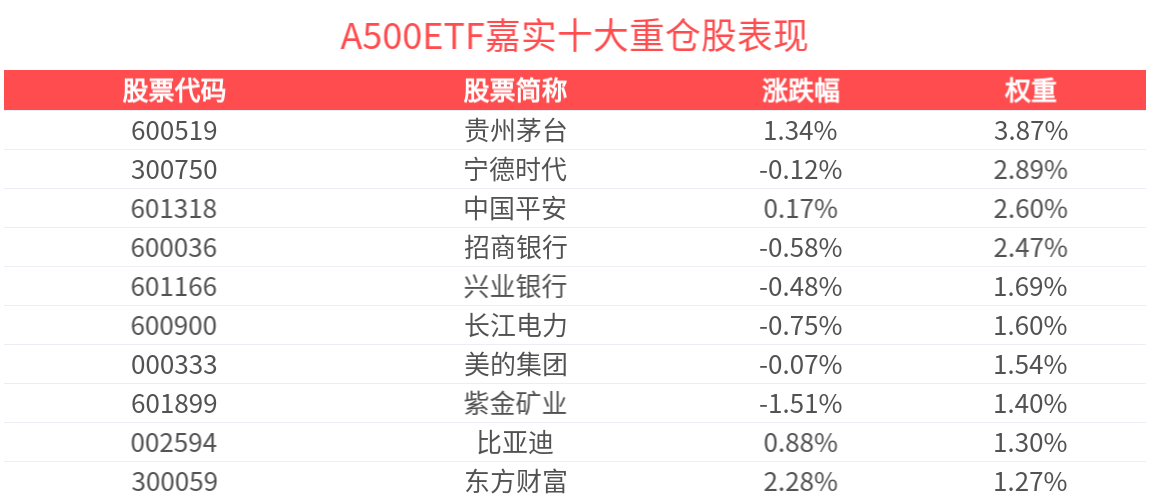
Group 1 - The A500 index increased by 0.43% as of August 11, 2025, with notable stocks like Jiangte Electric, Dazong Laser, Tianqi Lithium, and Shiyuan Co. hitting the 10% limit up [1] - The A500 ETF managed by Harvest has seen a trading volume of 1.294 billion yuan with a turnover rate of 10.34%, indicating active market participation [1] - The A500 ETF's latest scale reached 12.433 billion yuan, with a net inflow of 133 million yuan over three out of the last five trading days [1] Group 2 - The top ten weighted stocks in the A500 index as of July 31, 2025, include Kweichow Moutai, CATL, Ping An Insurance, and others, collectively accounting for 19.83% of the index [1] - The A500 ETF has achieved a net value increase of 6.95% over the past six months, with a maximum monthly return of 4.48% since its inception [1] - The proportion of actively managed equity funds in China has reached a historical high, with active public fund indices rising nearly 10% since the beginning of the year [2]






科创债3个月发行超8800亿元中小机构、民企加速进场
Zheng Quan Shi Bao· 2025-08-10 17:41
Core Insights - The new policy for technology innovation bonds has led to a significant issuance of 883.16 billion yuan in just three months, with financial institutions accounting for nearly 36% of this total [1][2] - The issuance of technology innovation bonds has expanded to include more small and private enterprises, alongside the traditional dominance of central and state-owned enterprises [1][2] - The average coupon rate for newly issued technology innovation bonds is 1.9282%, with some bonds having rates as low as 0.01% [1][3] Issuance Details - From May 7 to August 10, a total of 700 technology innovation bonds were issued, amounting to 883.16 billion yuan, compared to 197 bonds totaling 208.11 billion yuan in the same period last year, indicating a significant policy impact [1][2] - Financial institutions have issued 314.27 billion yuan of the total, with banks leading at 230.3 billion yuan across 32 banks, including major players like Agricultural Bank of China and Industrial and Commercial Bank of China [2] - Securities companies have collectively issued 54.1 billion yuan, with the largest issuers being China Merchants Securities and CITIC Securities [2] Characteristics of New Bonds - The newly issued technology innovation bonds predominantly have longer maturities, with 76.23% of the total issuance being bonds with maturities of three years or more [3] - The majority of the bonds were issued by central and local state-owned enterprises, with 203 bonds from central SOEs and 369 from local SOEs, while private enterprises issued 94 bonds [3]





科创债3个月发行超8800亿元 中小机构、民企加速进场
Zheng Quan Shi Bao· 2025-08-10 17:37
Core Viewpoint - The new policy for technology innovation bonds (科创债) has led to a significant increase in issuance, with a total of 883.16 billion yuan in new bonds over the past three months, indicating a strong market response to regulatory support [1][2]. Group 1: Issuance Scale and Participants - The total issuance scale of technology innovation bonds reached 883.16 billion yuan, with financial institutions accounting for nearly 36% of this amount [1][2]. - Among the financial institutions, banks led the issuance with 230.3 billion yuan, followed by 38 securities companies that collectively issued 54.1 billion yuan [2]. - The participation of small and medium-sized institutions and private enterprises has increased, with various smaller banks and private equity firms also issuing technology innovation bonds [2]. Group 2: Characteristics of New Bonds - The average coupon rate for newly issued technology innovation bonds was 1.9282%, which is notably low compared to other credit bonds of similar ratings [3]. - A significant portion of the new bonds has a maturity of over three years, with 76.23% of the total issuance (673.22 billion yuan) falling into this category [3]. - The majority of the issuers are central and local state-owned enterprises, with 203 bonds issued by central state-owned enterprises and 369 by local state-owned enterprises [3].

银行新周期、新格局系列之“险资还能买多少”:长钱长投,险资配置银行既是短期必行,也是长期正确
Shenwan Hongyuan Securities· 2025-08-10 13:13
Investment Rating - The report maintains a positive outlook on the banking sector, indicating that insurance funds are expected to continue allocating to high-dividend, high ROE bank stocks, establishing a solid and sustainable funding base for a long-term bullish trend in the banking sector [3][4]. Core Insights - The report emphasizes the necessity for insurance companies to invest in high-dividend assets due to the low interest rate environment and asset scarcity, making bank stocks an attractive option [4]. - It highlights that the banking sector has shown stable performance with an average ROE of approximately 12% from Q1 2015 to Q1 2025, which is significantly higher than the average of non-financial listed companies [4][8]. - The report suggests that insurance funds are currently under-allocated in bank stocks, with a potential increase in allocation that could lead to an influx of over 330 billion yuan into the banking sector [4][16]. Summary by Sections Why Invest - The low interest rate environment and asset scarcity compel insurance companies to seek stable, high-dividend investments, with bank stocks meeting these criteria [4][6]. Current Allocation - As of Q1 2025, insurance funds have over 7 trillion yuan allocated to equities, with approximately 570 billion yuan in bank stocks, indicating a low allocation compared to other indices [4][10]. Future Potential - The report estimates that insurance funds could potentially allocate an additional 330 billion yuan to bank stocks, based on the upper limits of equity allocation [16]. Investment Recommendations - The report recommends focusing on high-quality city commercial banks and undervalued joint-stock banks, suggesting specific banks such as Chongqing Bank and Industrial Bank for investment [4][17].


国债利息收税的连锁反应
Hua Xia Shi Bao· 2025-08-09 05:47
Core Viewpoint - The introduction of VAT on interest income from newly issued government bonds, local government bonds, and financial bonds starting August 8 has led to a rise in the value of existing bonds compared to new ones, causing a shift in investment focus towards high-dividend stocks in the A-share market, particularly bank stocks [1][2][3]. Group 1: Bond Market Impact - New tax policy on interest income from bonds has resulted in a decline in the investment attractiveness of government bonds, leading to a short-term increase in bond market values [1]. - The long-term downtrend in interest rates has made traditional bond investments less appealing, prompting investors to seek alternative high-yield assets [2]. Group 2: A-share Market Dynamics - A-share market saw a significant rise, with the index increasing by 200 points in July, driven by insurance funds favoring high-dividend assets [1][2]. - Insurance funds have increasingly turned to bank stocks, with at least eight instances of shareholding increases in banks from January to May 2025, particularly by the Ping An group [2][3]. Group 3: Bank Stock Performance - Bank stocks have shown substantial growth, with Agricultural Bank surpassing Industrial and Commercial Bank in market capitalization as of August 6, 2025 [3]. - Year-to-date performance of major banks indicates significant gains, with Shanghai Pudong Development Bank up over 38% and Agricultural Bank close to 30%, outperforming the broader market indices [3][4]. Group 4: Future Considerations - The recent surge in bank stock prices may lead to a reevaluation of their investment value, potentially triggering a renewed interest in government bonds if bank stock prices exceed their investment attractiveness [5].

一场银行大收缩,正在悄然发生
虎嗅APP· 2025-08-09 03:01
Core Viewpoint - The establishment of bank fintech subsidiaries has not led to the expected growth and profitability, with many returning to their parent banks due to operational challenges and market competition [9][15][37]. Group 1: Industry Overview - The fintech subsidiary of SPDB, PuYin JinKe, opened in Shanghai on August 5, 2024, but this does not indicate a revival of bank tech subsidiaries, as the industry has seen a decline in new establishments since 2022 [4][6]. - Over the past decade, more than 20 banks have established fintech subsidiaries, driven by the need for improved cybersecurity and competition from internet financial companies [7][8]. - Despite initial hopes, these subsidiaries have struggled to generate independent revenue and often rely on their parent banks for survival [9][15]. Group 2: Financial Performance - Financial reports indicate that many fintech subsidiaries have failed to achieve profitability. For instance, ZhongYin JinKe reported a net profit of only 0.11 million yuan in the first half of 2024, while Financial One Account has accumulated losses of 7.33 billion yuan from 2017 to 2023 [18][19]. - The business model of these subsidiaries often leads to losses, as seen with XingYe ShuJin, which reported a net loss of 1.67 million yuan in the first half of 2019 [19]. Group 3: Market Dynamics - The fintech market has become increasingly competitive, with major players like Alibaba and Tencent dominating the financial cloud market, leaving bank subsidiaries struggling to gain market share [29]. - Regulatory changes have also impacted the ability of these subsidiaries to operate independently, as new guidelines restrict the outsourcing of core IT functions [26][27]. Group 4: Future Outlook - The trend of fintech subsidiaries returning to their parent banks is expected to continue, as their primary revenue source remains servicing the parent bank, which diminishes their independent operational significance [37][39]. - The lack of competitive advantage and the challenges in providing innovative solutions further complicate the sustainability of these subsidiaries [39][40].

兴业银行厦门分行精准赋能“专精特新”小巨人成长
Zhong Guo Jin Rong Xin Xi Wang· 2025-08-08 12:22
Core Viewpoint - The article highlights the importance of financial services tailored for "specialized, refined, unique, and innovative" enterprises in China's economic transformation, exemplified by the successful financing of Xiamen Oulitong Electronic Technology Development Co., Ltd. through the "Xing Su Dai" product by Industrial Bank's Xiamen branch [1][3]. Group 1: Financial Innovation - The "Xing Su Dai" product provides efficient financing services specifically designed for high-growth, asset-light technology companies, addressing their unique financing needs [2][3]. - The Xiamen branch of Industrial Bank has embraced digital transformation, utilizing advanced digital technologies to create comprehensive enterprise customer profiles, enabling precise identification of promising tech enterprises [2]. Group 2: Policy Implementation and Collaboration - The successful implementation of the "Xing Su Dai" product is a direct result of the bank's commitment to national policies supporting small and micro enterprises, showcasing effective collaboration between financial institutions and businesses [3]. - The bank has actively engaged in initiatives like the "Thousand Enterprises, Ten Thousand Households" outreach program to understand the actual financing needs of enterprises, thereby providing tailored financial solutions [3]. Group 3: Future Outlook - The emergence of more online financing products like "Xing Su Dai" signifies a closer integration of traditional finance with technological innovation, contributing to high-quality economic development in China [4]. - The Xiamen branch plans to continue offering comprehensive financial services to technology enterprises, supporting their growth and contributing to the broader innovation landscape in Xiamen and nationwide [4].
股份制银行板块8月8日跌0.24%,招商银行领跌,主力资金净流出3.65亿元
Zheng Xing Xing Ye Ri Bao· 2025-08-08 08:35
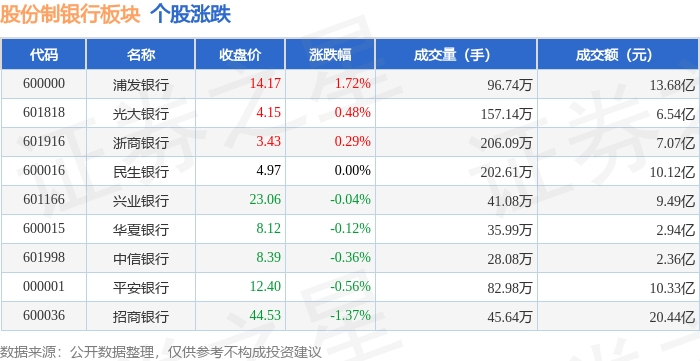
Group 1 - The banking sector experienced a decline of 0.24% on August 8, with China Merchants Bank leading the drop [1] - The Shanghai Composite Index closed at 3635.13, down 0.12%, while the Shenzhen Component Index closed at 11128.67, down 0.26% [1] - Among the listed banks, Shanghai Pudong Development Bank saw the highest increase of 1.72%, while China Merchants Bank had the largest decrease of 1.37% [1] Group 2 - The banking sector faced a net outflow of 365 million yuan from main funds, while retail investors contributed a net inflow of 363 million yuan [1] - Specific banks like Huaxia Bank and China Merchants Bank experienced significant net outflows from main funds, with China Merchants Bank seeing a net outflow of 239 million yuan [1] - Retail investors showed strong interest in several banks, with notable inflows into Huaxia Bank and China Merchants Bank, despite the overall outflow from main funds [1]