INDUSTRIAL BANK(601166)

Search documents
金融风向标2026-W03:25年理财规模扩张,增配存款和基金
CMS· 2026-01-25 13:00
Investment Rating - The report maintains a positive outlook on the banking sector, particularly highlighting the potential of specific banks such as China Merchants Bank [1][5]. Core Insights - The banking sector is experiencing a significant expansion in wealth management, with the total scale reaching 33.3 trillion yuan by the end of 2025, reflecting a growth of 3.34 trillion yuan and an annual growth rate of 11.2% [3][12]. - The report indicates a strategic shift towards increasing allocations in deposits and public funds while slightly reducing allocations in certificates of deposit and equity assets [4][5]. - The average yield of wealth management products is reported at 1.98%, with a total of 730.3 billion yuan generated for investors in 2025 [4]. Summary by Sections Market Dynamics - The A-share market saw an increase of 1.81% this week, while the banking sector declined by 2.70% [15]. - The People's Bank of China maintained the loan market quotation rate (LPR) at 3.0% for one year and 3.5% for five years and above [1][12]. Wealth Management Trends - By the end of 2025, the wealth management scale is projected to reach 33.3 trillion yuan, with various product categories showing different growth patterns [3][4]. - Cash management products have seen a decline, with a total decrease of 0.26 trillion yuan in 2025, although there was a recovery in the second half of the year [3]. Asset Allocation - As of the end of 2025, the investment assets of wealth management products totaled 35.66 trillion yuan, with bonds, deposits, and public funds making up the majority of the allocations [4]. - The report notes a significant increase in allocations to deposits (2.38 trillion yuan) and public funds (0.89 trillion yuan) [4]. Future Outlook - The report anticipates that the wealth management scale will continue to grow rapidly in 2026, with a neutral expectation of an increase of approximately 3 trillion yuan [5].





金融行业周报(2026、01、25):业绩比较基准新规正式落地,坚定保险中长期向好逻辑-20260125
Western Securities· 2026-01-25 10:30
Investment Rating - The report maintains a positive long-term outlook for the insurance sector, indicating a strong continuity in market performance despite recent fluctuations [2][12][16]. Core Insights - The financial sector experienced a mixed performance this week, with the non-bank financial index down by 1.45%, underperforming the CSI 300 index by 0.83 percentage points. The insurance sector saw a decline of 4.02%, while the brokerage sector decreased by 0.61% [1][10]. - The insurance sector's performance is driven by two main factors: policy support leading to economic recovery and liquidity easing combined with a strong stock market. The report suggests a shift from liquidity-driven growth to a focus on macro policy support and economic recovery expectations [2][13][16]. - The brokerage sector is expected to benefit from new regulations that enhance investment management quality, with a recommendation to focus on larger, undervalued firms and those involved in mergers and acquisitions [3][18]. - The banking sector is facing a slight decline, but there are signs of recovery in profitability for leading banks, with recommendations to focus on banks with high dividend yields and those expected to benefit from market conditions [19][21]. Summary by Sections Insurance Sector - The insurance sector's recent decline is attributed to short-term market sentiment and liquidity changes, but the long-term outlook remains positive due to strong support from both the liability and asset sides [2][12][16]. - Key recommendations include focusing on companies like China Pacific Insurance, China Ping An, China Life (H), and China Taiping, with a specific recommendation for New China Life [4][16]. Brokerage Sector - The brokerage sector's performance is slightly better than the overall market, with a focus on the new guidelines from the regulatory body that aim to improve fund management quality [3][17]. - Recommended firms include Guotai Junan, Huatai Securities, and others, particularly those with strong merger and acquisition prospects [4][18]. Banking Sector - The banking sector has shown a decline but is expected to stabilize, with recommendations to focus on banks with high earnings elasticity and strong dividend yields [19][21]. - Specific banks to watch include Hangzhou Bank, Ningbo Bank, and others, with a focus on those that have previously been undervalued [4][21].




银行周报(2026/1/19-2026/1/23):银行快报陆续披露,25A业绩稳健增长-20260125
GUOTAI HAITONG SECURITIES· 2026-01-25 07:47
Investment Rating - The report assigns an "Overweight" rating to the banking sector [4]. Core Insights - As of January 23, 2026, eight banks have reported stable growth in performance and maintained asset quality. The outlook for 2026 suggests continued improvement in bank performance, supported by narrowing interest margin declines and decreasing credit costs [2][4]. Summary by Sections 1. Performance Indicators - Eight banks reported their performance for 2025, showing stable growth and asset quality. The revenue growth rates for major banks were as follows: - Shanghai Pudong Development Bank: +1.9% - Industrial Bank: +0.2% - China Merchants Bank: +0.01% - CITIC Bank: -0.6% - Regional banks showed varied performance, with Nanjing Bank at +10.5%, Ningbo Bank at +8.0%, Hangzhou Bank at +1.1%, and Suzhou Rural Bank at +0.4% [4][6]. 2. Scale and Growth - Quality regional banks continued to experience strong credit growth. By the end of 2025, asset growth rates were: - Nanjing Bank: 16.6% - Ningbo Bank: 16.1% - Hangzhou Bank: 12.0% - Loan growth rates were: - Nanjing Bank: 13.4% - Ningbo Bank: 17.4% - Hangzhou Bank: 14.3% - Overall deposit growth remained stable, with city commercial banks maintaining a growth rate of over 10% and joint-stock banks at 7%-8% [4][6]. 3. Asset Quality - The non-performing loan (NPL) ratios showed a stable or declining trend across the eight banks, with Shanghai Pudong Development Bank at 1.26%, Suzhou Rural Bank at 0.88%, and CITIC Bank at 1.15%. The provision coverage ratios remained robust, with Hangzhou Bank and China Merchants Bank showing a decline of over 10 percentage points but still at high absolute levels [4][6]. 4. Outlook for 2026 - The report anticipates continued improvement in bank performance in 2026, driven by: - A narrowing decline in interest margins leading to improved net interest income growth. - Increased fee income from insurance and wealth management channels. - Continued resolution of risks in key corporate sectors and stabilization of retail risk exposure [4][6]. 5. Investment Recommendations - The report suggests focusing on three main investment lines for 2026: 1. Identifying banks with potential for performance growth, recommending Ningbo Bank, China Merchants Bank, and Nanjing Bank. 2. Considering banks with convertible bond expectations, recommending Chongqing Bank and Changshu Bank. 3. Continuing dividend strategies, recommending Bank of Communications, Jiangsu Bank, and Chongqing Rural Commercial Bank [4][6].


展望“十五五” 八桂启新篇 | 关键金属里的“金”动力
Guang Xi Ri Bao· 2026-01-25 02:58
Group 1 - The first major acquisition loan in the critical metals industry in Guangxi was successfully issued, amounting to 224 million yuan, aimed at supporting resource integration and capacity expansion [1] - Guangxi is recognized as a significant region for non-ferrous metals, holding a leading position in the reserves of various critical metals such as tin, antimony, indium, gallium, germanium, and rare earths [1] - To promote the high-quality development of the critical metals industry, Guangxi has introduced several policy documents in 2025, including measures for financial support and the establishment of the "Nandan Critical Metals Loan" [1] Group 2 - Financial institutions in Guangxi are innovating to support the green and high-quality development of the critical metals industry, with notable loans such as 100 million yuan from China Construction Bank for operational needs and 300 million yuan from Industrial and Commercial Bank of China for production stability [2] - The establishment of the Guangxi Critical Metals Industry Development Group in January 2026 aims to provide comprehensive financial services, with plans for Guangxi Beibu Gulf Bank to invest at least 20 billion yuan in the critical metals sector over the next five years [2] - By the end of 2025, 53 enterprises in the critical metals industry chain in Guangxi had been included in the "Nandan Critical Metals Loan" list, with 33 enterprises receiving a total of 2.838 billion yuan in loans [3]


2025年4季度公募基金银行持仓点评:主动基金配置比例仍处低位
Guolian Minsheng Securities· 2026-01-25 02:04
2025 年 4 季度公募基金银行持仓点评 主动基金配置比例仍处低位 glmszqdatemark 分析师:王先爽 分析师:乔丹 执业证书:S0590525120014 执业证书:S0590526010003 邮箱:wangxianshuang@glms.com.cn 邮箱:qiaodan@glms.com.cn 推荐 维持评级 相对走势 -10% 3% 17% 30% 2025/1 2025/7 2026/1 银行 沪深300 相关研究 本公司具备证券投资咨询业务资格,请务必阅读最后一页免责声明 证券研究报告 1 2026 年 01 月 25 日 [Table_Author] 25Q4 公募基金持仓银行情况。为了追踪市场偏股公募基金对银行的持仓情况, 我们把其分为三类:1、主动基金:主动股票、偏股混合和灵活配置型基金;2、 ETF 基金:追踪沪深 300、中证 A500 等与银行相关的主要指数的 ETF 基金;3、 非 ETF 指数基金:追踪以上主要指数的非 ETF 类被动指数、指数增强型基金。25 年四季度主动、ETF 和非 ETF 指数基金分别持有银行板块 305.8、2607.2、574.1 亿元,分 ...

金融行研系列:17 中国私人银行业2025发展报告
Xin Lang Cai Jing· 2026-01-24 23:03
Core Insights - The Chinese private banking industry is undergoing a historic shift from "scale expansion" to "value cultivation," with high-quality growth expected by 2025 [3][4] - The number of high-net-worth individuals (HNWIs) in China has surpassed 3 million, with assets under management (AUM) reaching 24.6 trillion yuan, projected to grow to 42 trillion yuan by 2030, reflecting a compound annual growth rate (CAGR) of 9.5% [3][6] - The market is characterized by a dual trend of "head concentration and distinctive breakthroughs," with major state-owned banks dominating the sector [3][8] Industry Overview - The private banking sector in China continues to show steady growth, with AUM reaching 18.8 trillion yuan by mid-2025, a 9.3% increase from the end of 2024 [5][6] - The number of clients served by 16 banks reached 1.649 million, a year-on-year growth of 13.17% [5] - The market is highly concentrated, with the top four state-owned banks holding nearly 70% of the total AUM among the 12 major private banks [8][7] Market Dynamics - Business innovation is becoming a new driving force for industry development, with family trusts and insurance trusts experiencing rapid growth [4][19] - By Q3 2025, the total scale of family trusts exceeded 950 billion yuan, while insurance trusts reached 420 billion yuan, reflecting growth rates of 5.6% and 19.1% respectively [4][19] - The industry faces challenges such as stricter regulations, talent shortages, and intensified competition [4][29] Client Demographics - The number of high-net-worth families in China reached 2.066 million by 2025, with the total wealth of billionaires growing to 1.8 trillion USD, a 22.2% increase [12][6] - The average age of high-net-worth individuals is 35, with a significant portion being young entrepreneurs [13][12] - The income sources of high-net-worth individuals are diverse, with business income being the primary source [13][16] Business Model Innovations - Family office services are rapidly developing, with over 85% of private banking departments establishing independent family office service systems by the end of 2023 [22] - The demand for family office services is expected to grow, with annual expenditures on tax planning projected to reach 2.8 million yuan by 2025 [23] - ESG investments are becoming a key focus, with ESG-themed financial products seeing significant growth [24][25] Digital Transformation - The digital transformation of the private banking sector is entering a deepening phase, with at least 60% of institutions expected to adopt AI-driven advisory systems by 2025 [26][27] - Technology investments are projected to exceed 4.8 billion yuan, with a CAGR of 27.3% [26] - The integration of digital services is crucial for enhancing customer experience and operational efficiency [28] Regulatory Environment - The regulatory environment is becoming stricter, leading to increased compliance costs, which are expected to rise by 23 percentage points of operating income [29][30] - The implementation of new asset management regulations is reshaping product design and increasing the entry barriers for new players [29][30] Talent Shortage - The private banking industry faces a significant talent shortage, with a demand gap of approximately 24,000 professional bankers by 2025 [33][34] - The ratio of talent supply to demand is 1:8, indicating a critical need for skilled professionals [33] - The industry is increasingly focusing on talent training and recruitment to address this gap [34]



兴业银行合肥政务区支行焕新启航 打造金融服务新标杆
Zhong Guo Jin Rong Xin Xi Wang· 2026-01-24 08:04
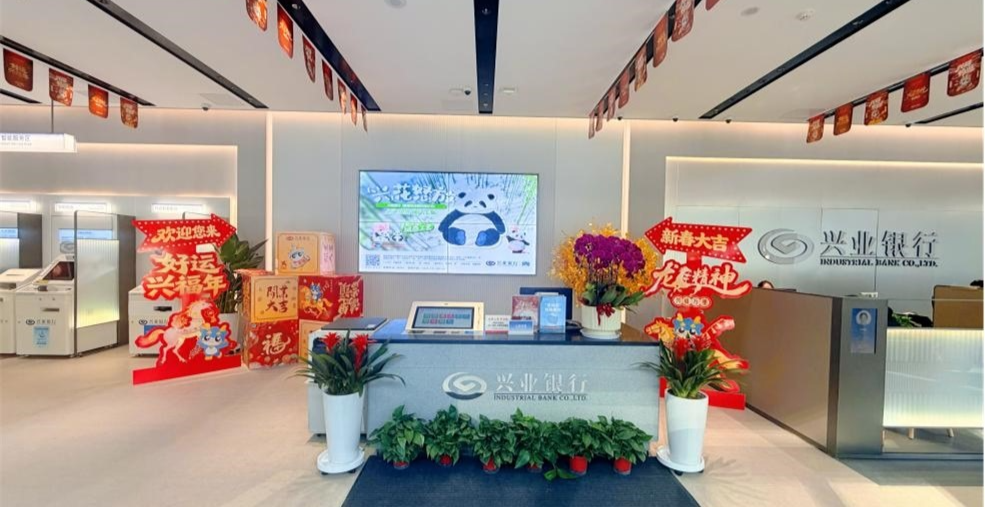
转自:新华财经 2026年1月22日,兴业银行合肥政务区支行以全面升级的3.0版本网点形象正式亮相。新网点围绕"便民、智能、温馨"三大核心,通过科学规 划与功能融合,致力于为客户提供更优质、便捷、贴心的金融服务。 焕新后的网点布局清晰、动线流畅,设有接待服务区、现金业务区、对公业务区、理财咨询区、金融培训区及休息洽谈区等多个专业区域, 在提升业务办理效率的同时,进一步优化了客户体验。 开业当日,兴业银行合肥分行党委书记、行长王惠斌实地察看了政务区支行网点功能布局、智能设备运行及服务流程,详细了解首日运营情 况。他对政务区支行在网点转型与服务提升方面取得的成效表示肯定,并指出新网点应立足区域特点,发挥示范作用,重点推进以下工作: 一是聚焦科技型中小企业与民生消费,深化普惠金融服务;二是依托智能平台,优化服务流程,推动线上线下协同;三是加强团队建设,打 造专业强、服务暖的人才队伍,持续提升客户满意度与品牌影响力。 以此次升级为起点,兴业银行合肥政务区支行将继续扎根区域、服务地方,围绕客户需求,丰富产品体系,优化服务体验,积极履行社会责 任,努力成为市民与企业身边可信赖的金融伙伴。(江海燕) 编辑:胡晨曦 ...
上市银行首批2025业绩快报来了!多家净利润正增长,三大特点值得关注
券商中国· 2026-01-24 05:32
Core Viewpoint - The first batch of 2025 performance reports from listed banks indicates significant improvement in performance metrics, with asset quality remaining stable [1][2]. Group 1: Performance Highlights - As of January 23, 2025, eight listed banks have released performance reports, with all achieving positive growth in net profit [2]. - Notably, the net profit of China Merchants Bank reached 150.18 billion yuan, showing a slight year-on-year increase, while Hangzhou Bank's net profit grew approximately 12% [1][2]. - Among the eight banks, the majority reported a slowdown in revenue growth, with only CITIC Bank experiencing a slight revenue decline of 0.55% [2]. Group 2: Asset Quality and Loan Performance - All eight listed banks demonstrated steady asset expansion, with smaller banks leading in growth rates [1][4]. - The non-performing loan (NPL) ratio remained favorable, with five banks maintaining NPL ratios below 1% [6][8]. - The NPL ratio for several banks improved, with Shanghai Pudong Development Bank showing the largest decline of 10 basis points to 1.26% [6][8]. Group 3: Provisioning and Coverage Ratios - Many banks increased their provisioning efforts, although the provision coverage ratios generally declined, indicating a strategy to use provisions to support profits [6][9]. - Among the eight banks, seven experienced a decrease in provision coverage ratios, with declines ranging from 5.82 to 58.77 percentage points [9][10]. Group 4: Future Outlook - Analysts predict that the net interest margin (NIM) for banks in 2026 will benefit from monetary policy, with a stabilization in the decline of NIM expected [1][10]. - Revenue and net profit growth for banks in 2026 is anticipated to improve, driven by NIM recovery and reduced credit costs [10][11]. - The banking sector is expected to maintain a stable dividend profile and benefit from economic recovery dynamics in 2026 [11].

新浪财经资讯AI速递:昨夜今晨财经热点一览 丨2026年1月24日
Xin Lang Cai Jing· 2026-01-23 23:31
Group 1 - US stock market showed mixed results with Nasdaq and S&P slightly up while Dow Jones declined, Intel's stock plummeted by 17% due to poor earnings guidance, while Nvidia and other chip stocks provided support [1] - The dollar index continued to weaken, and gold futures reached an all-time high, with silver breaking the $100 mark for the first time, driven by severe weather that caused US natural gas prices to surge by 70% in a week [1] - European countries hold approximately $3.6 trillion in US Treasury bonds, representing 40% of the overseas total, which could be used as leverage against the US amid tariff pressures, although coordinated selling may lead to significant losses [2][19] Group 2 - Japanese Prime Minister Fumio Kishida's tax cut promises have raised market concerns, leading to a massive sell-off of Japanese government bonds, causing long-term bond yields to soar to multi-year highs [3][20] - The US oil service giant SLB stated it could quickly expand operations in Venezuela if permitted, being the only international oil service company currently operating there, with competitors like Halliburton also looking to re-enter the market [4][21] - Canadian billionaire Eric Sprott has significantly profited from investing in the struggling Hycroft Mining Company, with a return on investment of 678%, capitalizing on the bull market for gold and silver [5][22] Group 3 - Silver prices have historically surpassed $100 per ounce, with a year-to-date increase of 40%, driven by strong industrial demand and ongoing structural supply shortages [6][23] - Economists have revised their expectations, indicating that the Federal Reserve may delay interest rate cuts until June, with inflation pressures and a robust labor market reducing the urgency for rate reductions [7][24] - Nomura's chief economist suggested gradually increasing farmers' pensions to 1,000 yuan per month, which could significantly improve rural elderly income expectations and stimulate consumption [8][25] Group 4 - The A-share market saw a surge in the photovoltaic sector, with major investment from well-known funds in commercial aerospace and semiconductor industries, indicating a strong institutional interest [10][26] - Musk's support for space-based solar power has led to a significant rally in photovoltaic stocks, with over 30 stocks hitting the daily limit up, although the industry still faces substantial technical and cost challenges [11][28] - China Merchants Bank has become the first bank to surpass 13 trillion yuan in total assets, indicating a potential turning point in its financial performance, while other banks also reached significant asset milestones [12][29]



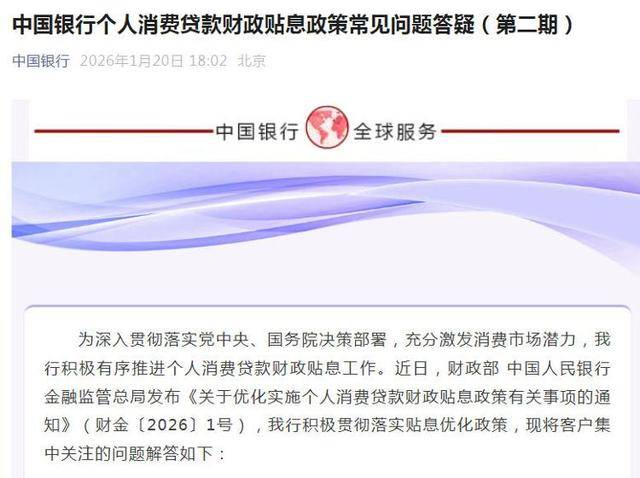
多家银行公告!落实个人消费贷款最新财政贴息政策
Sou Hu Cai Jing· 2026-01-23 19:43
Core Viewpoint - The implementation of the latest fiscal interest subsidy policy for personal consumption loans aims to boost consumption and expand domestic demand, with several major banks actively participating in this initiative [1][6][7][8][9]. Group 1: Policy Implementation - The fiscal interest subsidy policy for personal consumption loans has been extended until December 31, 2026, covering the period from September 1, 2025, to December 31, 2026 [6][10]. - The credit card installment payment subsidy policy will be effective from January 1, 2026, to December 31, 2026 [6]. Group 2: Policy Optimization - The policy has been optimized to include credit card installment payments, expanding the support range [9][11]. - The subsidy criteria have been broadened by removing the restriction on single transactions of 50,000 yuan and above [9][12]. - The subsidy standards have been improved by eliminating the 500 yuan cap on single transaction subsidies and the 1,000 yuan cap for individual borrowers at the same financial institution [9][12]. - Customers who have previously signed the personal consumption loan subsidy agreement will automatically benefit from the new subsidy policy starting January 1, 2026, without needing to re-sign the agreement [12].