INDUSTRIAL BANK(601166)

Search documents
5亿元绿色贷款助力有色企业低碳转型
Da Zhong Ri Bao· 2025-12-10 01:50
Core Viewpoint - The article highlights the successful issuance of a 500 million yuan green loan by Industrial Bank's Jinan branch to a major non-ferrous metal smelting enterprise, supporting its project for the harmless treatment and resource utilization of industrial solid waste, aligning with the national "dual carbon" strategy [1] Group 1: Financial Support and Strategy - The green loan is part of a tailored financial service plan designed to meet the transformation needs of the enterprise, focusing on compliance with environmental regulations [1] - The bank implemented special policies for green loans, including interest rate subsidies and optimized risk asset allocation, to empower compliant environmental projects [1] Group 2: Environmental and Economic Impact - The project aims to significantly reduce environmental pollution while enhancing production efficiency through resource recycling, achieving a simultaneous increase in ecological and economic value [1] - The collaboration between the bank and the enterprise exemplifies the financial sector's role in promoting the national "dual carbon" strategy and demonstrates the bank's commitment to facilitating green economic transformation [1]

上市银行中期分红阵营扩容 高股息价值催生“资产引力”
Zhong Guo Zheng Quan Bao· 2025-12-09 20:27
Core Viewpoint - The announcement of interim dividends by major banks reflects their robust operational resilience and mature shareholder return mechanisms, which may act as catalysts for valuation recovery in the banking sector [1][5][6] Group 1: Dividend Announcements - Industrial and Commercial Bank of China and Agricultural Bank of China announced interim dividends totaling CNY 503.96 billion and CNY 418.23 billion respectively, with both distributing over CNY 300 billion in cash dividends [1] - As of December 9, 26 A-share listed banks have disclosed their 2025 interim or quarterly dividend plans, with a total proposed payout exceeding CNY 260 billion [1][2] - The six major state-owned banks are the primary contributors to dividends, proposing a total cash dividend of CNY 2,046.57 billion, accounting for over 70% of the total disclosed dividends [2] Group 2: Trends in Dividend Distribution - The six major banks, including ICBC, CCB, ABC, and BOC, have maintained a stable dividend payout ratio around 30% [2] - Regional banks are increasingly participating in dividend distributions, with several institutions like Ningbo Bank and Changsha Bank announcing their first interim dividends [2] - The introduction of interim dividends by banks like Industrial Bank marks a significant step in enhancing the high-dividend landscape among joint-stock banks [2] Group 3: Regulatory and Market Influences - The expansion of the interim dividend landscape is attributed to regulatory policies, solid operational fundamentals, and market demand [3] - Recent policies encourage listed banks to optimize their dividend strategies, with measures to enhance dividend stability and predictability [3] - The Shanghai Stock Exchange is actively promoting higher dividend payouts and increased frequency of distributions to enhance company valuations [3] Group 4: Investment Implications - Bank stocks are characterized by stable performance, low valuations, high dividends, and low volatility, making them attractive for institutional investors seeking low-risk dividend assets [4] - The recent stability in bank stock performance and the appeal of high-dividend stocks are expected to attract more long-term capital, reinforcing the positive cycle of management, dividends, and valuation recovery [5][6] - Analysts believe that the ongoing high dividend policies and stock buybacks will continue to attract long-term investors, enhancing the overall investment value of bank stocks [6]





上市银行中期分红阵营扩容高股息价值催生“资产引力”
Zhong Guo Zheng Quan Bao· 2025-12-09 20:22
Core Viewpoint - The mid-term dividend announcements from major Chinese banks reflect a robust financial performance and a commitment to shareholder returns, with a total proposed payout exceeding 2,600 billion yuan across 26 listed banks, indicating a trend towards higher dividends in the banking sector [1][2][4] Group 1: Major Banks' Dividend Announcements - Industrial and Commercial Bank of China and Agricultural Bank of China announced mid-term dividends of 503.96 billion yuan and 418.23 billion yuan respectively, with both distributing over 300 billion yuan in cash dividends [1] - The six major state-owned banks are the primary contributors to the dividend payouts, collectively proposing cash dividends of 2,046.57 billion yuan, accounting for over 70% of the total disclosed dividends [1] - The dividend payout ratio for these major banks remains stable at around 30%, continuing their tradition of high and stable returns [1] Group 2: Participation of Other Banks - Industrial Bank introduced its first mid-term dividend plan, proposing a payout of 119.57 billion yuan, which is 30.02% of its net profit for the first half of 2025 [2] - Other regional banks, such as Ningbo Bank and Changsha Bank, have also joined the mid-term dividend initiative, indicating a growing trend among smaller banks [2] - Chongqing Bank plans to distribute cash dividends of 5.85 million yuan, representing 11.99% of its net profit attributable to ordinary shareholders [2] Group 3: Regulatory and Market Influences - The expansion of mid-term dividends among listed banks is driven by regulatory policies, solid operational fundamentals, and market demand [2] - Recent policies encourage banks to optimize their dividend strategies, with the new "National Nine Articles" emphasizing cash dividend regulations and incentivizing high-dividend companies [2] - The Shanghai Stock Exchange is actively promoting higher dividend payouts and increased frequency to enhance company valuations [3] Group 4: Market Reactions and Future Outlook - The banking sector has shown stable performance since November, with high-dividend stocks attracting investor interest, suggesting that current valuations do not fully reflect their intrinsic value [3][4] - The implementation of mid-term dividends is seen as a signal of financial strength and a strategy to attract long-term capital, creating a positive cycle of management, returns, and valuation recovery [4] - Analysts believe that the increased dividend payouts and stock buybacks will stabilize market expectations and highlight the long-term investment value of bank stocks [4]
2025年国家开发银行


Shang Hai Zheng Quan Bao· 2025-12-09 18:53
Core Insights - The awards for financial bond underwriting and market-making have been announced, recognizing various banks and securities firms for their outstanding performance in the industry [1][2][3][4][5][6][7] Group 1: Outstanding Underwriters - The title of "Outstanding Underwriter" was awarded to several banks, including CITIC Bank, Shanghai Pudong Development Bank, and Industrial and Commercial Bank of China [1][2] - A total of 10 banks were recognized as "Excellent Underwriters," highlighting their contributions to the financial bond market [1] Group 2: Excellent Market Makers - The "Excellent Market Maker" category included firms such as Huatai Securities and CITIC Securities, showcasing their role in enhancing market liquidity [2][4] - A diverse range of banks, including Ping An Bank and Industrial Bank, were acknowledged for their market-making capabilities [2][4] Group 3: Special Awards - Special awards were given for various categories, including "Debt Sea Rising Award" and "Green Low Carbon Award," recognizing banks like Agricultural Bank of China and Postal Savings Bank of China for their innovative approaches [3] - The "Technology Innovation Award" was awarded to banks that demonstrated significant advancements in financial technology [3] Group 4: Individual Recognitions - Individual awards were presented to key personnel from various banks, such as CITIC Bank's Sun Wei and China Everbright Bank's Liu Yan, acknowledging their leadership in driving financial bond initiatives [4][5] - The "Outstanding Underwriting Supervisor" category highlighted individuals from major banks, emphasizing the importance of leadership in underwriting processes [5]
兴业银行济南分行:依托资金流信息平台,赋能科创企业发展
Qi Lu Wan Bao· 2025-12-09 14:02
Core Insights - The funding flow information platform effectively breaks the "information island" between banks and enterprises, enabling banks to better understand the real operational status of companies, thereby reducing credit risk identification costs and encouraging lending [1] - The platform allows technology innovation enterprises to convert their technical value and operational stability into credit support, facilitating quantifiable credit and accessible financing [1] Group 1: Challenges Faced by Enterprises - A specific automotive parts technology company in Rizhao has three major financing challenges: significant "light asset" characteristics, high R&D expenditure (12% of revenue), and dispersed operating funds across three banks, leading to difficulties in traditional credit assessments [1] - The company holds 14 utility model patents and has created jobs for over 50 local technicians, positioning it as a "specialized, refined, distinctive, and innovative" enterprise within the regional automotive industry chain [1] Group 2: Innovative Financing Solutions - After obtaining authorization from the enterprise, the Jinan branch of Industrial Bank utilized the funding flow information platform to access multi-dimensional data, overcoming traditional credit limitations [2] - The bank integrated cross-bank transaction data and analyzed indicators such as transaction frequency and payment cycles over the past 12 months to assess the company's operational stability [2] - A three-dimensional credit model was constructed, incorporating operational capability, R&D potential, and credit status, ultimately determining a credit loan limit of 5 million yuan without requiring any collateral from the enterprise [2]
兴业银行拦截“游戏账户买卖”骗局,成功守护客户资金
Nan Fang Du Shi Bao· 2025-12-09 13:01
Group 1 - The core event highlights the successful interception of a new type of fraud targeting gaming account transactions by Industrial Bank's Dongguan branch, which helped a customer avoid a loss of over 16,000 yuan [2] - The bank's intelligent anti-fraud system detected a high-risk transaction related to an "overseas transportation card recharge" and issued a warning, leading to immediate action by the fraud prevention team [2] - The customer, Mr. Zhu, was targeted by scammers posing as customer service representatives, who attempted to manipulate him into sharing sensitive information and downloading malicious software [2] Group 2 - The incident demonstrates the effective collaboration between technology and human response, as well as the quick coordination between the head office and branch to contain the risk at an early stage [3] - The bank has issued reminders to customers about the importance of not trusting unfamiliar transaction requests, avoiding unknown links, and safeguarding personal and banking information [3] - Customers are advised to report any suspicious activities immediately to the bank's official customer service or visit a branch for verification to protect their finances [3]


银行数字化抢蛋糕比赛,胜负已分?
Tai Mei Ti A P P· 2025-12-09 12:21
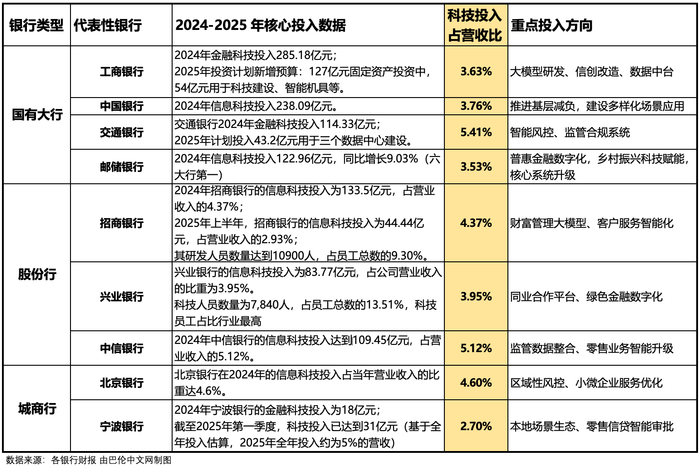
Core Insights - The digital transformation of China's banking industry is entering a "deep water zone" by 2025, characterized by market expansion, technological upgrades, and intensified competition [1] - The IT investment in the banking sector is projected to reach 169.315 billion yuan in 2024, with a growth rate of 3.6%, and is expected to exceed 266.2 billion yuan by 2028 [1] - The digital bidding landscape shows that successful digitalization in banking relies not only on investment scale but also on precise alignment with the bank's positioning and strategic partnerships [1] Investment Trends - In 2024, the six major state-owned commercial banks are expected to invest a total of 125.459 billion yuan in fintech, accounting for 52% of the total banking sector investment [2] - By 2025, the banking sector's fintech investment is anticipated to reach 333.85 billion yuan, representing a 38% increase from 2024 [2] Bank Types and Investment Focus - State-owned banks are leading in digital investment, with major banks like ICBC planning to invest 285.18 billion yuan in fintech in 2024, while smaller banks are focusing on localized services and specific pain points [3][5] - The investment focus for state-owned banks includes large model development, data platforms, and intelligent risk control systems [3] - Regional banks are prioritizing local economic services and optimizing processes for small and medium enterprises, with some banks investing over 6% of their revenue in technology [5] Digital Bidding Characteristics - The digital bidding projects are categorized into four main tracks: risk management, compliance control, data services, and technology platforms, each with varying technical requirements and budget allocations [7][8] - Risk management projects are rated the highest in complexity, requiring a deep understanding of financial logic and AI technology [7] - Compliance control projects are driven by regulatory requirements and have a high degree of standardization, making them easier to replicate [7] Competitive Landscape - A dual-competitive landscape is emerging between bank technology subsidiaries, which excel in understanding financial regulations, and internet technology companies, which leverage general technology capabilities [10][11] - The collaboration between bank technology subsidiaries and internet technology companies is becoming a mainstream approach, combining business understanding with technological innovation [17] Future Outlook - The investment landscape is expected to become more differentiated, with large banks focusing on systematic construction while smaller banks target essential local needs [18] - The emphasis will shift towards practical technologies that address compliance issues and enhance operational efficiency, with a growing trend of collaboration between different types of technology providers [18]

兴业银行呼和浩特分行全力保障自治区“六个工程”建设
Zhong Guo Jin Rong Xin Xi Wang· 2025-12-09 06:52
Core Viewpoint - The financial institutions in the region are actively supporting the implementation of the "Six Projects" as outlined in the government work report, focusing on sustainable development and economic growth through various financial services [1][3]. Group 1: Financial Support for "Six Projects" - The financial office of the regional party committee is guiding financial institutions to effectively utilize financial policies and tools to support the "Six Projects" [1]. - The total green loan balance of the bank reached 14.113 billion, with an increase of 2.701 billion since the beginning of the year [2]. - The bank has invested 4.24 billion in a 300,000 kW photovoltaic project in 2024, in addition to the previously committed 500 million [2]. Group 2: Specific Project Financing - For the "Warm Project," the bank provided 599 million in financing to eight key heating enterprises, with 361 million disbursed this year [2]. - The bank utilized big data to assist loan decisions for small and micro enterprises, resulting in an online financing business balance of 1.433 billion, including 294 million in tax-interactive loans [2]. - The bank supported 274 technology-based enterprises with a technology finance loan balance of 33.858 billion, an increase of 8.081 billion since the beginning of the year [2]. Group 3: International Business Support - The bank provided comprehensive financial services for over 100 international business clients, with a total foreign currency payment volume of 1.28 billion, including over 3.5 billion in cross-border RMB payments [2]. Group 4: Future Plans - The financial office will continue to coordinate and strengthen the work of financial institutions, directing resources towards key areas to ensure the successful implementation of the "Six Projects" and promote high-quality economic and social development [3].
兴业银行济南分行高效落地亿元国际信用证业务助企跨境采购拓市场
Qi Lu Wan Bao· 2025-12-09 05:42
Core Insights - The article highlights the successful completion of a 100 million yuan international letter of credit business by Industrial Bank's Jinan branch, which supports a key manufacturing enterprise in Zouping in its overseas raw material procurement and reduces cross-border settlement costs [1][2] - The collaboration exemplifies the bank's commitment to serving the real economy and enhancing local enterprises' cross-border development [2] Group 1: Business Impact - The enterprise involved is a key manufacturer in Zouping, focusing on metal products, and has increasing demands for efficient and low-cost cross-border settlement services due to accelerated overseas market expansion [1] - The bank established a specialized service team to tailor an international letter of credit solution based on the enterprise's needs, including procurement processes, cash flow cycles, and exchange rate risk management [1] Group 2: Operational Efficiency - The Jinan branch implemented a green approval channel and a "branch linkage + cross-border financial task force" model to ensure rapid business execution, improving efficiency by over 50% compared to conventional processes [1] - The 100 million yuan international letter of credit not only aids in cost savings for cross-border procurement but also locks in forward exchange rates, effectively mitigating risks from international market fluctuations [1] Group 3: Future Outlook - The Jinan branch aims to continue leveraging its cross-border financial advantages to provide diverse and high-quality financial services, supporting regional enterprises in global competition and contributing to local economic development [2]
九卦 | 一步之遥:股份制银行集体逼近全球系统重要性银行门槛
Sou Hu Cai Jing· 2025-12-08 13:40
Core Viewpoint - The Financial Stability Board (FSB) has released the 2025 list of Global Systemically Important Banks (G-SIBs), which includes 29 banks globally, with China's five major state-owned banks maintaining their positions. Notably, Industrial and Commercial Bank of China (ICBC) has moved from Group 2 to Group 3 for the first time [1][5][10]. Group 1: G-SIBs List and Rankings - The 2025 G-SIBs list remains consistent with 2024, but there are changes in group classifications. The third group has increased from 2 to 4 banks, including ICBC and others [5][10]. - In the "Bucket 0" category, which does not incur additional capital requirements, China Merchants Bank has improved its ranking from 34th to 30th, closely approaching the G-SIBs threshold [5][6][10]. - Other Chinese banks, such as Industrial Bank and CITIC Bank, are also nearing the G-SIBs threshold, indicating a shift in the global financial stability focus [3][5][9]. Group 2: Factors Influencing Rankings - The rise in rankings for Chinese banks is attributed to improvements in interconnectedness and complexity metrics rather than size, which has traditionally been the focus [3][8]. - For instance, China Merchants Bank's total score increased significantly from 103 to 122, with interconnectedness and complexity contributing 31 and 60 points, respectively [7][8]. Group 3: Implications of G-SIBs Inclusion - Being classified as a G-SIB entails stricter capital regulatory requirements, which could compress the Return on Equity (ROE) for these banks [3][10]. - The additional capital requirements for G-SIBs range from 1% to 3.5% depending on the group, which could impact the capital strategies of banks approaching the threshold [10][11]. Group 4: Future Considerations for Chinese Banks - Chinese banks need to enhance their capital buffers and risk management frameworks to prepare for potential G-SIBs inclusion, as this could lead to increased systemic risk distribution [12][13]. - The banks are encouraged to diversify their capital tools and optimize asset structures to improve capital efficiency [12][13]. Group 5: Cross-Border Business Development - There is a need for Chinese banks to accelerate their cross-border business development to adapt to low-interest-rate environments and reduce reliance on single markets [15][14]. - Despite some progress, the density of overseas branches and subsidiaries remains low, indicating a need for strategic growth in international operations [15][14].