
BOB(601169)

Search documents
险企“长股投”增厚利润惹争议
2 1 Shi Ji Jing Ji Bao Dao· 2025-11-10 23:10
Core Viewpoint - The insurance industry is increasingly turning to long-term equity investments, particularly in undervalued bank stocks, to achieve asset-liability matching and stable returns amid a low-interest-rate environment and asset scarcity [1][11]. Summary by Sections Long-term Equity Investment Strategy - Insurance companies are seeking stable, long-term returns through long-term equity investments, which are seen as a strategic choice to smooth out volatility and achieve stable ROE and dividend returns [1][11]. - However, this strategy has sparked controversy, as some companies may misuse it as a financial engineering tool to quickly create profits and net assets, masking operational pressures [1][2]. Accounting Practices and Implications - Long-term equity investments are intended to reflect a long-term holding and stable return logic, but they can transform into a "reporting magic" under specific accounting rules, especially when investing in undervalued stocks [3][4]. - The new accounting standards allow insurance companies to classify investments as long-term equity investments if they have "significant influence," enabling them to use the equity method for accounting [6][9]. Financial Engineering Concerns - The equity method allows for initial measurement based on the higher of the payment amount or the share of the investee's net assets, which can lead to significant one-time profits being recognized on the income statement [7][9]. - This practice can create a disconnect between reported profits and actual cash flows, raising concerns about the sustainability of such financial engineering [17]. Market and Regulatory Pressures - The low-interest-rate environment and asset scarcity have intensified pressure on insurance companies, particularly smaller firms, to seek quick fixes for profitability and solvency metrics [11][12]. - Regulatory scrutiny is increasing as the misuse of long-term equity investments for short-term financial gains becomes more apparent, leading to calls for clearer standards and stricter oversight [20][21]. Recommendations for Improvement - To mitigate risks associated with long-term equity investments, it is suggested that insurance companies enhance internal controls, focus on sustainable cash flows, and separate short-term profits from long-term investment strategies [21][22]. - Expanding into alternative assets that align with long-term liabilities, such as infrastructure REITs and policy bonds, is recommended to reduce reliance on equity market fluctuations [21][22].

北京银行发生大宗交易 成交溢价率8.73%
Zheng Quan Shi Bao Wang· 2025-11-10 13:58
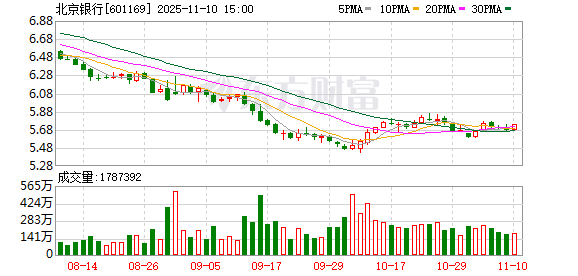
Group 1 - Beijing Bank executed a block trade on November 10, with a transaction volume of 770,000 shares and a transaction amount of 4.7971 million yuan, at a price of 6.23 yuan, representing an 8.73% premium over the closing price of the day [2][3] - The stock's closing price on the same day was 5.73 yuan, reflecting a 1.06% increase, with a turnover rate of 0.85% and a total trading volume of 1.019 billion yuan, indicating a net inflow of 147 million yuan from main funds [2] - Over the past three months, the stock has recorded three block trades with a total transaction amount of 15.4506 million yuan [2] Group 2 - The latest margin financing balance for the stock is 3.331 billion yuan, with an increase of 74.3446 million yuan over the past five days, representing a growth of 2.28% [3] - In terms of institutional ratings, three institutions have provided ratings for the stock in the past five days, with the highest target price estimated by GF Securities at 6.57 yuan [3] - Beijing Bank was established on January 29, 1996, with a registered capital of 21.14298427 billion yuan [3]

北京银行今日大宗交易溢价成交77万股,成交额479.71万元
Xin Lang Cai Jing· 2025-11-10 09:35
Group 1 - Beijing Bank executed a block trade of 770,000 shares on November 10, with a transaction value of 4.7971 million yuan, accounting for 0.47% of the total trading volume for the day [1][2] - The transaction price was 6.23 yuan, representing an 8.73% premium over the market closing price of 5.73 yuan [1][2]

城商行板块11月10日涨0.96%,厦门银行领涨,主力资金净流入7750.91万元
Zheng Xing Xing Ye Ri Bao· 2025-11-10 08:48
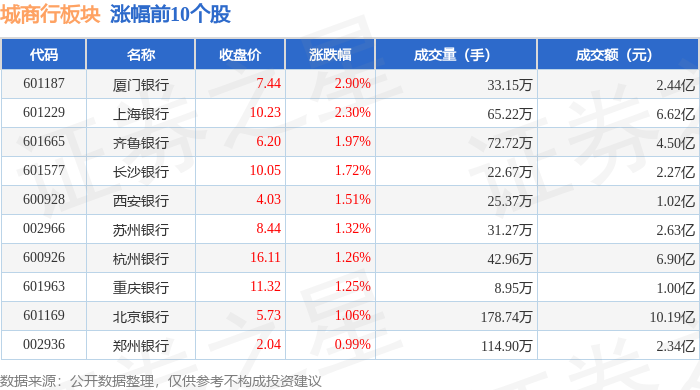
Market Performance - The city commercial bank sector increased by 0.96% on November 10, with Xiamen Bank leading the gains [1] - The Shanghai Composite Index closed at 4018.6, up 0.53%, while the Shenzhen Component Index closed at 13427.61, up 0.18% [1] Individual Bank Performance - Xiamen Bank's closing price was 7.44, with a rise of 2.90% and a trading volume of 331,500 shares, amounting to 2.44 billion yuan [1] - Shanghai Bank closed at 10.23, up 2.30%, with a trading volume of 652,200 shares and a transaction value of 660 million yuan [1] - Qilu Bank saw a closing price of 6.20, increasing by 1.97%, with a trading volume of 727,200 shares and a transaction value of 450 million yuan [1] - Other notable banks include Changsha Bank, Xi'an Bank, and Suzhou Bank, with respective increases of 1.72%, 1.51%, and 1.32% [1] Capital Flow Analysis - The city commercial bank sector experienced a net inflow of 77.51 million yuan from institutional investors, while retail investors saw a net outflow of 10.29 million yuan [1] - Beijing Bank had a significant net inflow of 1.35 billion yuan from institutional investors, but a net outflow of 582.22 million yuan from retail investors [2] - Jiangsu Bank also reported a net inflow of 103 million yuan from institutional investors, with retail investors experiencing a net outflow of 91.58 million yuan [2]




险企“长期股权投资”增厚利润惹争议 报表魔术有风险
2 1 Shi Ji Jing Ji Bao Dao· 2025-11-10 08:48
Core Viewpoint - The insurance industry is facing asset-liability matching pressures due to declining interest rates and an "asset shortage," prompting companies to seek long-term equity investments, particularly in undervalued bank stocks, to achieve stable returns and balance sheet improvements [1][3][12]. Group 1: Long-term Equity Investment Strategy - Insurance companies are increasingly turning to long-term equity investments as a strategy to achieve stable returns and match their liabilities [3][12]. - This strategy has sparked controversy, as it is seen as a means to smooth out volatility and achieve stable return on equity (ROE) and dividend returns, but some companies misuse it as a financial engineering tool to mask operational pressures [3][4][15]. - The shift to long-term equity investments is driven by the need for stable, high returns in a low-interest-rate environment, where traditional fixed-income assets are yielding insufficient returns [12][13]. Group 2: Accounting Practices and Implications - The accounting treatment of long-term equity investments allows insurance companies to recognize significant profits through accounting adjustments, particularly when investing in undervalued stocks [5][9]. - By applying the equity method of accounting, companies can report initial investment costs based on the fair value of the net assets of the investee, leading to inflated profits on their financial statements [7][10]. - This practice can create a disconnect between reported profits and actual cash flows, raising concerns about the sustainability of these earnings [11][19]. Group 3: Risks and Challenges - The reliance on long-term equity investments as a financial strategy can lead to systemic distortions in profit, net assets, and risk disclosures, potentially masking underlying financial health issues [4][20]. - Companies face pressures from regulatory requirements and internal assessments of solvency and profitability, which may drive them to prioritize short-term financial reporting over long-term strategic investments [14][15]. - The misuse of long-term equity investments can result in significant risks, including mismatches in capital and liquidity, potential valuation declines, and loss of market trust [20][21]. Group 4: Recommendations for Improvement - To mitigate the risks associated with long-term equity investments, regulatory bodies should establish clearer standards for recognizing significant influence and tighten rules around accounting for goodwill and fair value assessments [21][22]. - Insurance companies should enhance internal controls and focus on sustainable cash flow as a primary measure of investment success, rather than relying on one-time accounting gains [22]. - Expanding investment opportunities into infrastructure REITs, preferred stocks, and other long-term assets can help reduce dependence on equity investments and improve asset-liability matching [22].


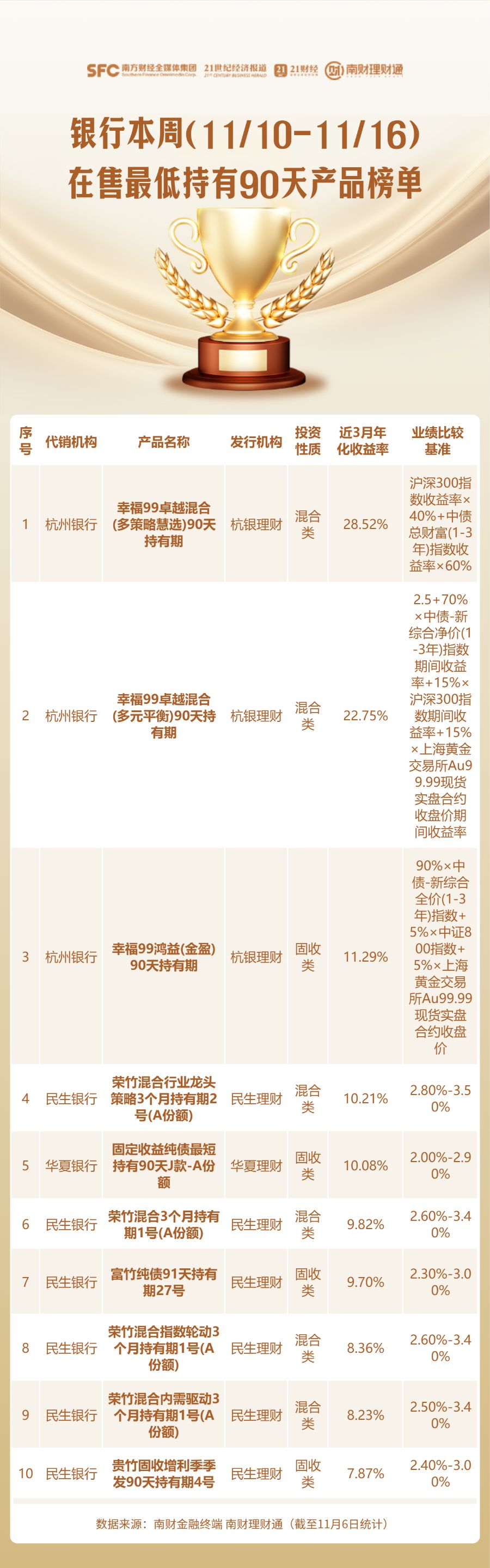
本周在售最低持有期产品哪家强?
2 1 Shi Ji Jing Ji Bao Dao· 2025-11-10 08:44
Core Insights - The article emphasizes the importance of distinguishing between various bank wealth management products, which often have similar names and vague characteristics, to help investors make informed choices [1] - The South Finance Wealth Management team compiles a weekly performance ranking of wealth management products available through different distribution channels, focusing on those with the best performance [1] Product Performance Summary - The report categorizes products based on minimum holding periods of 90 days, 180 days, and 365 days, calculating annualized returns for each category [1] - A total of 28 distribution institutions are involved in the ranking, including major banks such as Industrial and Commercial Bank of China, Bank of China, and Agricultural Bank of China [1] - The ranking is based on the assumption of the product's "on-sale" status, but actual availability may vary due to factors like sold-out quotas or differences in product listings for different customers [1] 90-Day Holding Period Products - The top-performing product for a 90-day holding period is from Hangzhou Bank, with an annualized return of 22.75% [4] - Other notable products include those from Minsheng Bank and Huaxia Bank, with returns of 10.21% and 10.08%, respectively [5] 180-Day Holding Period Products - For the 180-day holding period, Hangzhou Bank's product leads with a return of 14.04% [7] - Minsheng Bank also features prominently with products yielding 12.26% and 10.26% [7] 365-Day Holding Period Products - The report indicates that products with a 365-day holding period are also being evaluated, with specific performance data yet to be detailed in the provided excerpts [9]





从增量扩面到提质控险 银行业普惠金融迈向差异化精准服务
2 1 Shi Ji Jing Ji Bao Dao· 2025-11-10 04:21
Core Insights - The report highlights the significant growth and development of inclusive finance in China, particularly focusing on small and micro enterprises and rural areas, with a notable annual growth rate of over 20% in inclusive micro loans during the 14th Five-Year Plan period [1][2] - As of June 2025, the balance of inclusive micro loans reached 36 trillion yuan, which is 2.3 times that of the end of the 13th Five-Year Plan, with a decrease in interest rates by 2 percentage points [1][2] - The average interest rate for newly issued inclusive micro loans was 3.48% as of June 2025, reflecting a decrease of 66 basis points year-on-year [1][2] Group 1: Digital Empowerment - Digital technology has been a key driver for the development of inclusive finance, with banks utilizing big data and AI to enhance loan approval efficiency and reduce financing costs [2][7] - The market structure among banks is changing, with large commercial banks holding a 45.11% share of inclusive micro loans, while rural financial institutions have seen a decline in their market share [2][3] - The average growth rate of inclusive micro loans has been slowing down, with a decrease from 30.9% in 2020 to 12.3% by mid-2025 [2][3] Group 2: Performance of Listed Banks - Among listed banks, Agricultural Bank of China, Industrial and Commercial Bank of China, and Beijing Bank reported the highest growth rates in inclusive micro loans at 18.50%, 17.30%, and 17.27% respectively [3][4] - In contrast, some banks, including Shanghai Bank and Zhengzhou Bank, experienced negative growth rates of -3.97% and -2.06% [3][4] - The performance of different banks varies significantly, with state-owned banks generally showing stronger growth in inclusive micro loans compared to smaller banks [3][4] Group 3: Interest Rates and Risk Management - The interest rates for newly issued inclusive micro loans have decreased across various banks, with the highest rate at 4.20% and the lowest at 2.94% [7][8] - The gap in interest rates between large and small banks is narrowing, with some large banks' rates aligning closely with those of smaller banks [8][9] - The report emphasizes the importance of risk management in the inclusive finance sector, with several banks focusing on improving asset quality and managing non-performing loans [9][10]


中国区域性银行_2025 年第三季度回顾_核心盈利稳步复苏,我们偏好宁波银行和南京银行-China regional banks_ 3Q25 review_ Steady recovery in core earnings, we prefer BoNB and BoNJ
2025-11-10 03:34
Summary of China Regional Banks 3Q25 Review Industry Overview - The report focuses on the performance of China Regional Banks (CRBs) in the third quarter of 2025 (3Q25) - Overall profits for CRBs grew by 6% year-over-year (y/y), a decrease from 9% y/y in 2Q25, primarily due to a decline in non-fee income [1][3] Core Earnings and Profitability - CRBs demonstrated a core earnings recovery of 12% y/y, outperforming large banks which only saw a 1% y/y increase in core earnings [1][3] - Net Interest Income (NII) for CRBs grew by an average of 7% y/y, improving from 5% y/y in 2Q25, while large banks averaged only 0.4% growth [3][7] - Fee income increased by 16% y/y, reversing a contraction trend, supported by agency fee growth as market sentiment improved [3][7] - Non-fee income saw a significant decline of 32% y/y, primarily due to fair value losses in bond investments [3][7] Asset Quality - Asset quality remained stable, with the average Non-Performing Loan (NPL) ratio declining by 1 basis point (bps) q/q to 0.96% in 3Q25 [1][21] - The Special Mention Loan (SML) ratio increased by 3 bps q/q, indicating some pressure on asset quality compared to large banks [21] - The NPL coverage ratio decreased slightly by 1 bps q/q, suggesting a cautious approach to provision releases [21] Capital and Growth Constraints - The Common Equity Tier 1 (CET1) ratio for CRBs decreased by 11 bps q/q, raising concerns about growth constraints due to lower capital levels [3][21] - CRBs reported a 2% q/q loan growth, consistent with industry trends, but with significant variations among banks [20] - Deposit growth was flat on average, with BoNB experiencing the highest contraction at -1.4% q/q [20] Investment Recommendations - Top picks among regional banks include BoNB and BoNJ, both showing double-digit growth in core earnings and stable asset quality [1][3] - BoBJ's performance was the weakest, with a profit contraction of 2% y/y and a low CET1 ratio, although its high dividend yield of 5.8% provides some downside protection [1][3] - Caution is advised regarding CSRCB until clearer signs of improvement in SME asset quality are observed [1][3] Valuation Insights - The report includes a valuation comparison of various regional banks, highlighting differences in price-to-earnings (P/E) ratios, price-to-book (P/B) ratios, and return on equity (ROE) [5] - The average P/E for CRBs is projected at 6.1 for FY25E and 5.7 for FY26E, with an average dividend yield of 5.0% for FY25E [5] Conclusion - The overall performance of China Regional Banks in 3Q25 indicates a steady recovery in core earnings, although challenges remain in non-fee income and capital levels. The investment outlook is cautiously optimistic for select banks, particularly BoNB and BoNJ, while caution is warranted for others like CSRCB and BoBJ.




多家银行关停信用卡与直销银行App,中国银行缤纷生活功能迁移
Shan Xi Ri Bao· 2025-11-10 01:31
Core Viewpoint - The banking industry is experiencing a wave of app shutdowns, particularly in the credit card and direct banking sectors, as banks consolidate their services to enhance user experience and reduce operational costs [1][5][12]. Group 1: App Shutdown Trends - Multiple banks, including state-owned and leading city commercial banks, have announced the closure of various banking apps, leading to discussions among users about the necessity of so many banking applications [1][4]. - The shutdown trend is particularly evident in credit card apps, with China Bank recently announcing the migration of its "Colorful Life" app functions to its main app, marking a significant shift as previously, such closures were mainly among smaller banks [5][6]. - In 2023, at least 21 banks have ceased operations of their direct banking apps, with only about 10 remaining in the market, a significant drop from their peak [2][6]. Group 2: User Experience and Market Dynamics - Users have expressed frustration over the multitude of banking apps, which they find unnecessary for infrequent financial transactions, leading to a high number of inactive apps on their devices [1][11]. - The average daily usage time for mobile banking apps has decreased from 4.93 minutes to 2.70 minutes, indicating a decline in user engagement [11]. - The banking sector is shifting focus from acquiring new customers to retaining existing ones, as evidenced by the decline in credit card numbers over the past three years [15][16]. Group 3: Regulatory and Operational Considerations - Regulatory pressures are driving the consolidation of banking apps to enhance risk management and consumer protection, with over 25 banks reported for privacy issues in 2024 [13][14]. - The operational costs associated with maintaining multiple apps are becoming unsustainable, prompting banks to streamline their offerings to improve efficiency and reduce compliance burdens [15][16]. - The future of banking apps is expected to evolve towards a more integrated ecosystem, focusing on user-centric services rather than merely serving as transaction channels [18].

北京银行(601169):利息收入以量补价 利润增长平稳 资产质量持续改善
Xin Lang Cai Jing· 2025-11-10 00:30
Core Viewpoint - Beijing Bank reported a slight decline in revenue and a modest increase in net profit for Q3 2025, indicating mixed performance amid market fluctuations and changing interest rates [1][2]. Revenue Summary - Revenue for Q3 2025 decreased by 0.3% year-on-year, a decline of 2.2 percentage points compared to the first half of 2025 [1]. - Net interest income increased by 1.8% year-on-year, with a quarterly growth of 1.1%, driven by an expansion in the asset base [1][2]. - Fee income grew by 16.9%, although this was a slowdown from 20.4% in the first half of 2025 [1][2]. - Other non-interest income saw a significant decline of 12.8% year-on-year, worsening from a decline of 0.8% in the first half of 2025 [1][2]. Profit Summary - Net profit for the first three quarters of 2025 increased by 2.2% year-on-year, down from 3.3% in the first half of 2025 [1][2]. - The contribution from scale, interest margin, costs, provisions, and taxes improved marginally, while the contributions from fees and other non-interest income declined [1][2]. Asset and Liability Management - The bank's interest-earning assets increased by 3.2% quarter-on-quarter, but there was a contraction in credit issuance during Q3 2025, with a reduction of 17.81 billion [2]. - Total loans as a percentage of interest-earning assets decreased by 1.9 percentage points to 49% [2]. - Deposits decreased by 19.515 billion in Q3 2025, with a year-on-year reduction of 76.022 billion [2]. Asset Quality - The non-performing loan (NPL) ratio improved to 1.29%, with a quarterly decrease of 1 basis point [2]. - The cumulative NPL generation rate for the first three quarters was 0.90%, down 10 basis points from the first half of 2025 [2]. - The provision coverage ratio increased to 195.79%, up 5 basis points quarter-on-quarter [2]. Profit Forecast and Valuation - Revenue forecasts for 2025, 2026, and 2027 are projected at 70.304 billion, 72.539 billion, and 76.075 billion respectively, with year-on-year growth rates of 0.6%, 3.2%, and 4.9% [3]. - Net profit forecasts for the same years are 26.423 billion, 27.575 billion, and 28.535 billion, with year-on-year growth rates of 2.3%, 4.4%, and 3.5% [3]. - The bank's price-to-book (PB) ratio is estimated at 0.43X, 0.39X, and 0.36X for 2025, 2026, and 2027, indicating a favorable valuation compared to peers [4]. Investment Recommendations - The bank's competitive advantages include a leading asset scale among listed city commercial banks, a strong regional presence, and a focus on technology-driven financial services [4]. - The low cost of liabilities positions the bank well to maintain its expansion capabilities in a low-interest-rate environment [4]. - The bank is recommended for an "overweight" rating based on its solid fundamentals and growth prospects [4].