
AGRICULTURAL BANK OF CHINA(601288)

Search documents
超2000亿元,六大行出手!
Jin Rong Shi Bao· 2025-12-14 03:03
Group 1 - Six major state-owned banks in China have initiated the distribution of mid-term dividends for 2025, with total dividends exceeding 200 billion yuan [1] - The dividend distribution dates for A-shares and H-shares have been announced, with specific dates set for each bank [1][2] - The dividend payout ratios for all six banks are maintained at 30% or above of their net profit attributable to shareholders [2] Group 2 - Industrial and Commercial Bank of China (ICBC) will distribute a cash dividend of 0.1414 yuan per share, totaling approximately 503.96 billion yuan [2] - Agricultural Bank of China (ABC) will distribute a cash dividend of 0.1195 yuan per share, totaling approximately 418.23 billion yuan [2] - Bank of China (BOC) will distribute a cash dividend of 0.1094 yuan per share, totaling approximately 352.50 billion yuan [2] - China Construction Bank (CCB) will distribute a cash dividend of 0.1858 yuan per share, totaling approximately 486.05 billion yuan [2] - Bank of Communications (BoCom) will distribute a cash dividend of 0.1563 yuan per share, totaling approximately 138.11 billion yuan [3] - Postal Savings Bank of China (PSBC) will distribute a cash dividend of 0.1230 yuan per share, totaling approximately 147.72 billion yuan [3] Group 3 - The encouragement from financial regulatory authorities has led to an increase in mid-term dividends among listed banks, reflecting a policy direction aimed at enhancing cash dividends [3] - Experts believe that mid-term dividends can boost investor confidence in bank stocks and foster long-term value investment concepts [3]






A股上市银行密集派发中期分红,总额超2600亿元引关注
Huan Qiu Wang· 2025-12-14 02:53
Group 1 - The core viewpoint of the article highlights that as of December 13, 26 A-share listed banks have disclosed their mid-term or quarterly dividend plans for 2025, surpassing the 24 banks that did so in the same period of 2024, with total dividends expected to exceed 260 billion yuan [1][3] - The banks disclosing dividend plans include 6 large state-owned banks, 6 joint-stock banks, and 14 small and medium-sized banks, with the six major state-owned banks expected to contribute over 200 billion yuan in cash dividends [3] - Industrial and Commercial Bank of China leads with an estimated dividend of approximately 50.4 billion yuan, followed by China Construction Bank, Agricultural Bank of China, Bank of China, Postal Savings Bank of China, and Bank of Communications [3] Group 2 - Joint-stock banks such as Industrial Bank and CITIC Bank are expected to have mid-term dividends exceeding 10 billion yuan, while China Everbright Bank and Minsheng Bank are projected to exceed 5 billion yuan [3] - Some small and medium-sized banks, like Shanghai Bank and Nanjing Bank, also show significant dividend amounts, with several banks like Industrial Bank and Ningbo Bank introducing mid-term dividend plans for the first time [3] - The increase in dividend frequency among commercial banks is a response to the new "National Nine Articles" aimed at promoting multiple dividends per year for listed companies, enhancing the connection between company profits and investor returns [3] Group 3 - More frequent dividends can directly enhance shareholder satisfaction, allowing investors to share in the banks' operational success in a timely manner [4] - Stable cash returns align well with the investment needs of long-term funds such as social security funds, pension funds, and insurance capital, helping to attract these funds for long-term holding [4] - The positioning of banks as dividend-oriented can create a virtuous cycle of attracting long-term capital, enhancing stock price stability, and reducing abnormal price fluctuations caused by short-term speculation [4]




4 张表看信用债涨跌(12/8-12/12)
SINOLINK SECURITIES· 2025-12-13 13:06
Report Summary 1. Core Viewpoint Among AA-rated urban investment bonds with the highest discount rates, "25 Gaomi 01" had the largest deviation in valuation price; among the top 50 bonds with the largest net price declines, "24 SDIC MTN002" had the largest deviation; among the top 50 bonds with the largest net price increases, "23 Vanke MTN002" had the largest deviation; among the top 50 Tier 2 and perpetual bonds with the largest net price increases, "25 ABC Tier 2 Capital Bond 01B(BC)" had the largest deviation [2]. 2. Summary by Directory Discount - Leading AA Urban Investment Bonds (Subject Rating) - The report listed 40 AA-rated urban investment bonds with high discount rates, including "25 Gaomi 01" with a 4.27-year remaining term, a valuation price deviation of -0.28%, a valuation net price of 105.07 yuan, and a valuation yield of 3.93% [4]. Top 50 Bonds with the Largest Net Price Declines - The report presented 50 bonds with significant net price drops, such as "24 SDIC MTN002" with a 28.76-year remaining term, a valuation price deviation of -0.40%, a valuation net price of 98.10 yuan, and a valuation yield of 2.58% [6]. Top 50 Bonds with the Largest Net Price Increases - It included 50 bonds experiencing substantial net price increases. For example, "23 Vanke MTN002" had a 0.42-year remaining term, a valuation price deviation of 2.30%, a valuation net price of 16.85 yuan, and a valuation yield of 1067.74% [9]. Top 50 Tier 2 and Perpetual Bonds with the Largest Net Price Increases - The report listed 50 Tier 2 and perpetual bonds with large net price increases, like "25 ABC Tier 2 Capital Bond 01B(BC)" with a 9.53-year remaining term, a valuation price deviation of 0.29%, a valuation net price of 96.65 yuan, and a valuation yield of 2.50% [13].

东莞个人信用报告自助查询服务实现32个镇街全覆盖
Nan Fang Du Shi Bao· 2025-12-13 11:02
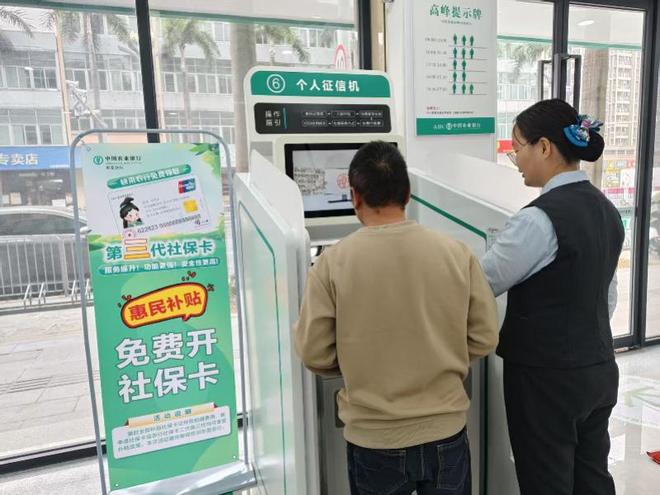
Core Viewpoint - The launch of self-service credit report query machines in three branches of Agricultural Bank in Dongguan marks the extension of personal credit report services to all 32 towns and streets in the city, enhancing convenience for residents [1][3]. Group 1: Service Expansion - The new self-service machines are strategically placed in three previously underserved towns, significantly reducing the need for residents to travel to other areas for credit report inquiries [3]. - A total of 54 query points in Dongguan are now equipped with self-service devices, allowing residents to obtain detailed credit reports in under one minute without the need for forms or queues [3]. Group 2: Technological Integration - The self-service machines support original ID card reading and facial recognition, streamlining the process for users [3]. - Residents can utilize the "Guangdong Credit Appointment" WeChat mini-program to locate nearby query points, make appointments, and receive navigation assistance [3]. Group 3: Future Plans - The People's Bank of China Dongguan Branch aims to enhance public awareness of the new credit report query channels and will continue to optimize the layout based on foot traffic at various query points [5]. - The initiative aligns with the bank's commitment to serve the real economy and improve the business environment in Dongguan [5].
中央经济工作会议后,明年如何谋篇布局?多家金融机构集体表态
Mei Ri Jing Ji Xin Wen· 2025-12-13 08:55
中央经济工作会议12月10日至11日在北京举行。会议提出,明年经济工作在政策取向上,要坚持"稳中 求进、提质增效",并用"八个坚持"划出了明年经济工作的重点任务。 会后,多家金融机构集体表态对标对表明年经济工作"八个坚持"重点任务,并结合自身实际谋划好2026 年和"十五五"期间工作。 《每日经济新闻》记者注意到,多家金融机构强调,要突出主责主业,持续优化重点领域金融供给,包 括支持扩大内需、科技创新、中小微企业、民生保障等方面。此外,多家机构表态坚持守牢底线,积极 稳妥化解重点领域风险。 聚焦主责主业,推动金融资源向重点领域和薄弱环节集聚 多家机构表态,要聚焦主责主业,做好金融"五篇大文章",推动金融资源向经济社会发展的重大战略、 重点领域和薄弱环节集聚,提升服务实体经济质效。记者注意到,多家机构在科技创新领域重点着墨。 工商银行表示,要发挥主力军作用,持续发力促进高质量发展。围绕服务"四稳",突出主责主业,提供 全面金融解决方案。积极融入强大国内市场,加力支持扩大内需、科技创新、中小微企业等重点领域, 精准服务"两重一薄"、制造业、区域协调、"双碳"引领、民生保障等,努力为人民群众多办实事。 农业银行提及 ...

农行广东分行发放市场首笔依托粤澳跨境数据验证平台的澳门居民内地消费贷款
Sou Hu Cai Jing· 2025-12-13 06:45
Core Insights - Agricultural Bank of China Guangdong Nansha Branch has successfully issued the first consumption loan for Macau residents in mainland China, utilizing the Guangdong-Macau cross-border data verification platform, marking significant progress in cross-border credit recognition and data verification between Guangdong and Macau [1][3] Group 1: Cross-Border Data Verification Platform - The Guangdong-Macau cross-border data verification platform is the first of its kind established through coordination between the two governments, aimed at serving financial institutions in both regions as a digital infrastructure [1][5] - The platform allows users to transfer data based on personal information portability rights, employing blockchain technology for secure verification without collecting or storing original document data, thus ensuring compliance with information protection regulations [1][5] Group 2: Loan Issuance and Financial Services - The Guangdong branch of Agricultural Bank of China, in collaboration with its Macau branch, efficiently verified the credit data of a Macau resident, successfully issuing a consumption loan of 300,000 yuan to a young individual employed in Guangzhou Nansha [2][5] - This initiative reflects the bank's commitment to "finance for the people" and is a practical implementation of the "Nansha Financial 30 Measures," enhancing financial services in the social welfare sector [2][5] Group 3: Future Developments - The bank plans to leverage the newly established "Cross-Border Financial Service Center" in Nansha to explore more innovative business measures under the "Nansha Financial 30 Measures," aiming to create a comprehensive and multi-layered business system for residents and enterprises in the Guangdong-Hong Kong-Macau Greater Bay Area [5]

工行、建行、农行、中行集体表态
21世纪经济报道· 2025-12-13 03:43
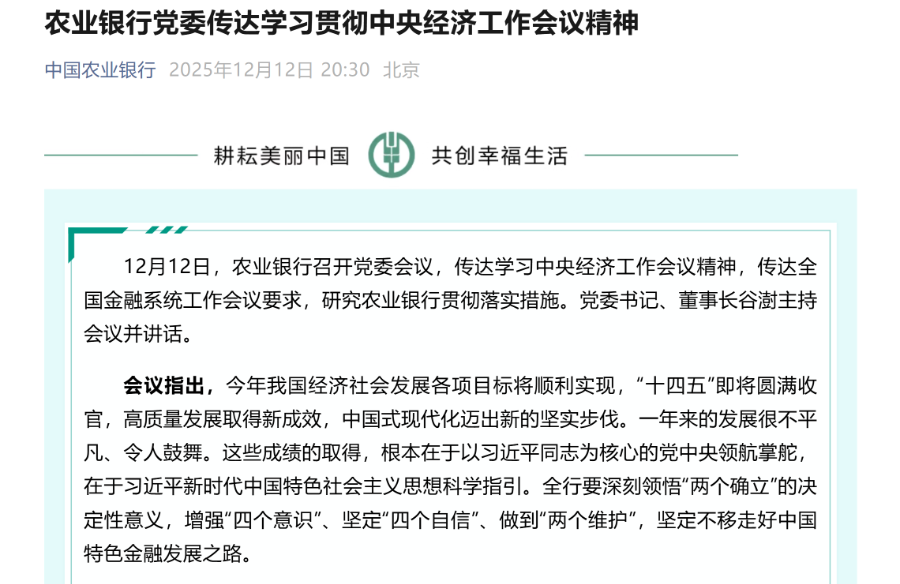
记者丨张欣 编辑丨曾芳 12月12日,全国金融系统工作会议在京召开,中共中央政治局委员、中央金融委员会办公室主 任何立峰出席会议并讲话,为2026年金融系统工作划定核心方向。 同日,工行、建行、农行、中行等国有大行召开党委会议,传达学习中央经济工作会议精神, 结合全国金融系统工作会议要求,研究部署贯彻落实措施,明确2026年及 "十五五" 时期工作 重点,为助力经济高质量发展、服务金融强国建设提供金融支撑。 四家国有大行在贯彻落实会议精神过程中形成明确共识,均紧扣"防风险、强监管、促高质量 发展"工作主线,锚定三大核心方向推进2026年工作: 一是坚持党中央对金融工作的集中统一领导。 工行、农行、建行、中行均强调要深刻领悟 "两个确立" 的决定性意义,坚决做到"两个维 护"。其中,工行和农行还强调要增强 "四个意识"、坚定 "四个自信"。 工行和中行提出要牢固树立和践行正确政绩观、业绩观,持之以恒推进全面从严治党,抓好中 央巡视整改常态化长效化。农行、建行也明确要加强党的建设,树立正确业绩观,确保中央决 策部署落地见效。 二是聚焦主责主业,做深做实金融"五篇大文章"。 四家银行均提出要全面做好金融 "五篇大文 ...
四大行集体表态!传达学习中央经济工作会议精神
2 1 Shi Ji Jing Ji Bao Dao· 2025-12-12 23:05
Core Viewpoint - The national financial system work conference outlined the core directions for the financial system's work in 2026, emphasizing the importance of risk prevention, strong regulation, and promoting high-quality development [1][3]. Group 1: Core Directions for 2026 - The four major state-owned banks have reached a consensus on three core directions: maintaining centralized leadership from the Party, focusing on their main responsibilities, and ensuring the balance between development and safety [3][6]. - The banks emphasized the significance of understanding and implementing the "two establishments" and "two safeguards" to ensure effective execution of central policies [3][4]. Group 2: Focus on Main Responsibilities - The banks aim to enhance financial support in key areas such as expanding domestic demand, technological innovation, and support for small and micro enterprises [4][5]. - Agricultural Bank of China (ABC) plans to align with new policies and projects to boost consumption and stabilize investment through significant credit allocations [5][9]. - The banks are committed to improving financial services for the real economy, particularly in areas like green finance and support for small and micro enterprises [4][5]. Group 3: Risk Prevention and Management - All four banks prioritize the prevention and resolution of financial risks, with a focus on maintaining asset quality and managing various risks effectively [6][7]. - The banks are dedicated to ensuring that systemic risks do not occur, particularly in sectors like real estate and local government debt [7][8]. Group 4: Differentiated Work Focus - Each bank has defined its unique focus areas: Industrial and Commercial Bank of China (ICBC) emphasizes its role as a mainstay in the market, while China Construction Bank (CCB) focuses on digital transformation [8][9]. - Bank of China (BOC) aims to leverage its cross-border financial advantages to enhance global competitiveness and support international trade [9]. - ABC is committed to strengthening rural financing and supporting the high-quality development of rural economies [9].
金融赋能强根基 绘就发展新图景
Jing Ji Ri Bao· 2025-12-12 22:24
Core Viewpoint - China Agricultural Bank's Jieyang Branch has been deeply integrated with local development for over 30 years, providing precise and efficient financial services to empower the real economy, rural revitalization, and livelihood security, thus becoming a financial backbone for regional high-quality development [1][2] Group 1: Empowering the Real Economy - The bank has established a comprehensive financing service system for major projects, offering tailored solutions for specific industries, which supports the "one industry, one plan" approach for industrial clusters [1] - Credit support has been directed towards traditional manufacturing sectors such as stainless steel, textiles, and footwear, with a special service plan for technology-oriented small and micro enterprises [1] - The loan coverage for specialized and innovative enterprises has increased to 43.3% [1] Group 2: Rural Revitalization - A four-tier service system has been developed, covering branches, sub-branches, townships, and villages, with an average daily balance of agricultural loans reaching 12.3 billion yuan, ranking among the industry leaders [1] - Unique products like "Agricultural Leading Loans" and "Grain Planting Loans" have been launched, with a net increase of 530 million yuan in rural industry loans by the end of November 2025 [1] - The bank has implemented a "Party Building + Finance + Technology" model, establishing 192 "Credit Villages" and completing records for 40,000 farming households [1] Group 3: Expanding Inclusive Financial Services - The bank has maintained its commitment to inclusive finance by organizing various public welfare activities and collaborating with local departments to create a micro-financing platform [2] - The balance of inclusive loans has surpassed 7 billion yuan, with a total credit of 9.17 billion yuan granted to 3,568 small and micro enterprises, leading the industry in key metrics [2] - The financing cost for inclusive small and micro enterprises has decreased by 43 basis points compared to 2024 [2]
农业银行大宗交易成交219.57万股 成交额1695.08万元
Zheng Quan Shi Bao Wang· 2025-12-12 15:45
12月12日农业银行大宗交易一览 | 成交量 (万股) | 成交金额 (万元) | 成交价格 (元) | 相对当日 收盘折溢价 (%) | 买方营业部 | 卖方营业部 | | --- | --- | --- | --- | --- | --- | | 219.57 | 1695.08 | 7.72 | 0.00 | 国泰海通证券股份有限公司总部 | 机构专用 | 注:本文系新闻报道,不构成投资建议,股市有风险,投资需谨慎。 进一步统计,近3个月内该股累计发生3笔大宗交易,合计成交金额为2450.08万元。 证券时报•数据宝统计显示,农业银行今日收盘价为7.72元,下跌2.65%,日换手率为0.18%,成交额为 44.49亿元,全天主力资金净流出6.18亿元,近5日该股累计下跌1.28%,近5日资金合计净流出7.73亿 元。 两融数据显示,该股最新融资余额为9.68亿元,近5日减少1.32亿元,降幅为12.01%。 据天眼查APP显示,中国农业银行股份有限公司成立于1986年12月18日,注册资本34998303.3873万人 民币。(数据宝) (原标题:农业银行大宗交易成交219.57万股 成交额1695.0 ...