
PING AN OF CHINA(601318)

Search documents
中国平安H股涨超3%,股价创2021年6月以来新高
Ge Long Hui· 2025-12-08 07:12
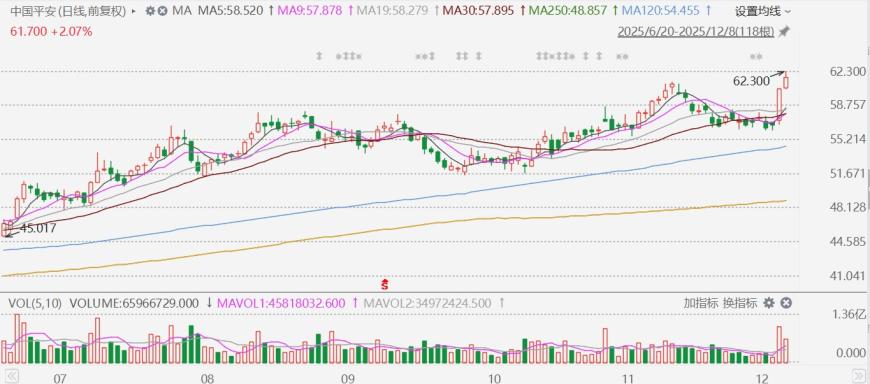
12月8日,港股市场保险股今日再度集体走强,其中,中国平安H股午后涨幅扩大至涨3%,报62.3港元,股价创2021年6月以 来新高。 消息面上,金融监管总局近日发布《关于调整保险公司相关业务风险因子的通知》,对保险公司相关业务风险因子进行下 调。此调整涵盖长期持有沪深300指数成分股、中证红利低波动100指数成分股、科创板普通股、及出口信用保险业务的保 费和准备金风险三大领域。金融监理总局相关司局负责人表示,此举旨在培养壮大耐心资本、支持科技创新。 股票频道更多独家策划、专家专栏,免费查阅>> 责任编辑:山上 有分析认为,松绑措施可为保险公司后续进一步投资操作或增持股票提供更大空间。 ...


服务450个百千万工程项目,中国平安四向发力支持广东乡村振兴——"三村工程"调研活动走进潮州汕头
Huan Qiu Wang· 2025-12-08 07:04
来源:环球网 【环球网财经综合报道】为积极响应广东省委省政府号召,助力"百县千镇万村高质量发展工程"和"绿 美广东"全面落地,近日,中国平安在潮州、汕头两地开展了以"金融守护产业强 科技赋能振兴路"为主 题的三村工程调研活动。活动中,平安集团董事长马明哲一行先后调研了潮州"红绿灯"道路安全风险减 量项目、古茶树救治保险、汕头蔬菜生产基地等项目。这是马明哲第五次去广东省内机构调研访谈,也 是平安集团高管层数十场在全国各地推动乡村振兴调研的一部分。 据悉,自广东省推动城乡区域协调发展、开展"百千万工程"以来,中国平安以自身的"三村工程"为支 点,围绕"金融支持、绿美广东、乡村治理、消费帮扶"四大重点方向,累计服务"百千万工程"项目超 450个,直接投入资金超6000万,向广东省普惠小微客户提供4亿元利率补贴,融资授信超135亿元支持 广东涉农、县域、基建等方面发展,累计减费让利金额超1亿元。 推进"红绿灯"公益行动,累计捐赠196套交通安全设施 当日上午,调研团首先来到潮州市枫溪镇山边村,了解"红绿灯"道路安全风险减量公益行动(简称"红 绿灯"公益行动)在该地的实施情况,并为"交通安全平安共建路"揭牌。 当日下午 ...
大摩:内地调整保险相关业务风险因子 料进一步惠及保险股及股市 重申首选中国平安(02318)
智通财经网· 2025-12-08 05:54
Core Viewpoint - Morgan Stanley reports that the National Financial Regulatory Administration has issued a notice adjusting risk factors for insurance companies, providing a 10% discount for eligible stocks in the CSI 300 and the Shanghai Stock Exchange's STAR Market [1] Group 1: Regulatory Changes - The new measures may alleviate capital requirements for insurance companies, encouraging them to participate as long-term investors in the stock market [1] - This regulatory adjustment is expected to benefit the equity market, as insurance companies are major investors [1] Group 2: Market Impact - Morgan Stanley anticipates continued inflow of insurance funds into the stock market next year [1] - The firm reaffirms its preference for China Ping An (02318), believing the company will further benefit from the new regulatory framework [1]
建议持续关注非银板块向上弹性
Changjiang Securities· 2025-12-08 05:46
Investment Rating - The report maintains a "Positive" investment rating for the non-bank financial sector [7]. Core Insights - The non-bank financial sector has shown strong overall performance this week, with brokerages expected to maintain high growth trends in 2025. The report suggests focusing on the sector's future allocation value [2][4]. - The China Banking and Insurance Regulatory Commission (CBIRC) has issued a notice adjusting risk factors related to insurance companies' business, which is expected to enhance the certainty of ROE improvement and accelerate valuation recovery in the medium to long term [4][6]. - The report recommends companies with stable profit growth and dividend rates, including Jiangsu Jinzu, China Ping An, and China Pacific Insurance, as well as those with significant advantages in business models and market positions [4]. Market Performance - The non-bank financial index increased by 2.3% this week, outperforming the CSI 300 by 1.0%. Year-to-date, the non-bank financial index is up 5.9%, but underperformed the CSI 300 by 10.6% [5][17]. - The average daily trading volume in the market decreased to 16,961.78 billion yuan, down 2.35% week-on-week, while the margin financing balance rose to 2.48 trillion yuan, up 0.48% [5][39]. Key Industry News & Company Announcements - The CBIRC has adjusted risk factors for insurance companies, which is expected to support the growth of patient capital and enhance service quality to the real economy [6][64]. - Companies such as Zhongtai Securities and New China Life have announced their respective stock issuance and dividend distribution plans for the first half of 2025 [6].


服务超450个“百千万工程”项目,中国平安四向发力支持广东乡村振兴 "三村工程"调研活动走进潮州汕头
Zheng Quan Shi Bao Wang· 2025-12-08 05:03
Core Viewpoint - China Ping An is actively supporting the "Three Villages Project" in Guangdong, focusing on financial support, environmental improvement, rural governance, and consumer assistance, with significant investments and initiatives aimed at rural revitalization [1] Group 1: Financial Support and Investment - China Ping An has served over 450 projects under the "Hundred Counties, Thousand Towns, and Ten Thousand Villages" initiative, with direct investments exceeding 60 million yuan [1] - The company has provided 4 billion yuan in interest subsidies to small and micro enterprises in Guangdong, with financing credit exceeding 13.5 billion yuan to support agricultural, county-level, and infrastructure development [1] - The total amount of fee reductions and benefits provided by the company has surpassed 100 million yuan [1] Group 2: Traffic Safety Initiatives - The "Red and Green Light" public welfare action has been launched to address high-risk road sections in rural areas, with over 700 high-risk road modifications completed and more than 4,700 traffic safety facilities donated nationwide [3] - In Guangdong, 89 high-risk road modifications have been completed, with 196 traffic safety facilities donated, resulting in a 29% decrease in average monthly incident rates at modified intersections [3] Group 3: Agricultural Support and Technology - China Ping An has provided insurance for 8,269 ancient tea trees in the Phoenix Town area, with a total insurance amount reaching 208 million yuan [4] - The company is utilizing IoT and AI technologies to monitor the growth environment of ancient tea trees, establishing a unique "microclimate" model for scientific management and timely rescue [4] - The "Science and Technology Loan" program has been launched, with over 10 billion yuan allocated to agricultural enterprises, supporting 260 agricultural companies [6] Group 4: Educational Initiatives - The "Ping An Rural Classroom" was inaugurated to enhance agricultural science education for students, promoting immersive learning experiences in agriculture [7] - The company has been recognized for its contributions to poverty alleviation and rural revitalization, receiving the "Red Cotton Cup" for three consecutive years [7]
A股午评 | 指数高开高走,创指涨超3%“牛市旗手”冲锋 多只算力硬件股创新高
智通财经网· 2025-12-08 03:49
Market Overview - The market showed a clear recovery signal with major indices rising: Shanghai Composite Index up 0.62%, Shenzhen Component Index up 1.55%, and ChiNext Index up 3.02% [1] - Over 3,500 stocks increased in value, with trading volume surging by over 298 billion compared to the previous day [1] Policy Impact - Recent regulatory changes, including adjustments to risk factors for insurance companies, are expected to release more margin, providing a boost to the market [1] - The Chairman of the China Securities Regulatory Commission (CSRC) indicated that regulatory measures will enhance capital space and leverage limits for brokerages, improving capital efficiency [1] Sector Performance Financial Sector - The financial sector, particularly securities and insurance, experienced significant gains, with major firms like Industrial Securities leading the rise [2][5] - The CSRC's announcement regarding the expansion of capital space for brokerages is anticipated to benefit their margin trading and derivative businesses [5] Commercial Aerospace - The commercial aerospace sector saw strong performance, with companies like Longzhou Co. and Shunhao Co. achieving consecutive gains [4] - The sector is buoyed by positive news regarding the upcoming launch of a satellite manufacturing facility in Wenchang, aiming for significant revenue growth by 2027 [4] CPO Concept - The CPO (Cloud-based Processing Operations) concept surged, with companies like Dongtian Micro and Tianfu Communication hitting historical highs [6] - The demand for AI computing power is driving the global optical module industry towards significant upgrades, creating opportunities in this sector [6] Institutional Insights - Citic Securities noted that before any unexpected changes in domestic demand, market fluctuations and structural opportunities will be common [8] - Guojin Securities highlighted that the market's main line will gradually become clearer, with a positive cycle expected between the relaxation of non-bank financial institutions' constraints and the recovery of overall profitability [8]


衢州监管分局同意 平安产险浙江分公司常山支公司变更营业场所
Jin Tou Wang· 2025-12-08 03:46
二、中国平安财产保险股份有限公司浙江分公司应按照有关规定及时办理变更及许可证换领事宜。 2025年12月5日,国家金融监督管理总局衢州监管分局发布批复称,《中国平安财产保险股份有限公司 浙江分公司关于变更中国平安财产保险股份有限公司浙江分公司常山支公司营业场所的请示》(平保产 浙分发〔2025〕43号)及相关说明解释材料收悉。经审核,现批复如下: 一、同意中国平安财产保险股份有限公司浙江分公司常山支公司的营业场所变更为:浙江省衢州市常山 县紫港街道北滨江路777号杉杉天地1幢1004室。 ...

ETF盘中资讯 | 券商股狂欢,兴业证券飙涨8%!高股息蓝筹强势崛起,价值ETF(510030)盘中涨近1%!
Sou Hu Cai Jing· 2025-12-08 02:46
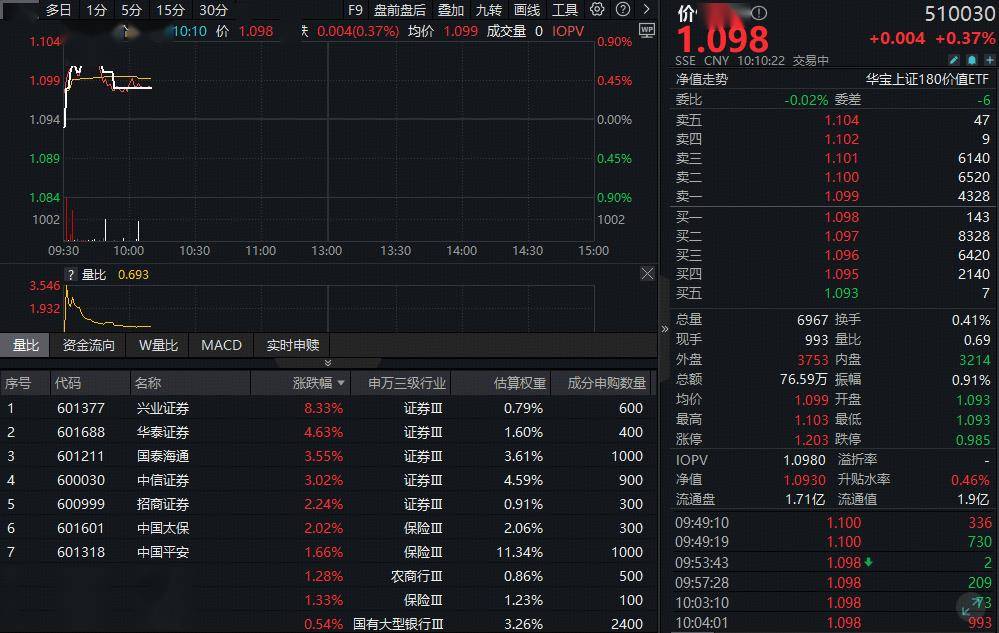
Core Viewpoint - High dividend stocks are showing strong performance, particularly focusing on "high dividend + low valuation" large-cap blue-chip stocks, with the value ETF (510030) experiencing a price increase of nearly 1% during trading [1] Group 1: Market Performance - The value ETF (510030) rose by 0.37% as of the report, indicating a positive market sentiment towards high dividend stocks [1] - Key sectors leading the gains include brokerage and insurance, with notable increases in stocks such as Industrial Securities (up 8.33%) and Huatai Securities (up 4.63%) [1] Group 2: Valuation Insights - As of the last trading day (December 5), the value ETF's underlying index, the 180 Value Index, had a price-to-book ratio of 0.84, which is at a relatively low level compared to the past decade [3] - The current market risk appetite is near the rolling five-year average, suggesting that high dividend sectors, particularly banks and oil, are performing well [3] Group 3: Investment Strategy - The value ETF closely tracks the 180 Value Index, which selects the top 60 stocks based on value factor scores, primarily from the financial sector [4] - The index constituents are characterized by "low valuation + high dividend" attributes, providing defensive qualities in volatile markets [4]




券商股狂欢,兴业证券飙涨8%!高股息蓝筹强势崛起,价值ETF(510030)盘中涨近1%!
Xin Lang Ji Jin· 2025-12-08 02:45
Core Viewpoint - High dividend stocks are showing strong performance, particularly focusing on "high dividend + low valuation" large-cap blue-chip stocks, with the value ETF (510030) experiencing a price increase of 0.37% as of the report time [1]. Group 1: Market Performance - The value ETF (510030) saw an intraday price increase of nearly 1%, closing up 0.37% [1]. - Key stocks in the ETF include securities and insurance companies, with notable gains from firms like Industrial Securities (up 8.33%) and Huatai Securities (up 4.63%) [1]. Group 2: Valuation Insights - As of the last trading day (December 5), the value ETF's underlying index, the 180 Value Index, had a price-to-book ratio of 0.84, which is at a relatively low level compared to the past decade, indicating strong medium to long-term investment value [3]. Group 3: Sector Analysis - The securities industry is expected to experience high-quality development during the 14th Five-Year Plan, playing a core role in serving the real economy and optimizing household wealth allocation [1]. - Policies from the China Securities Regulatory Commission are anticipated to create structural investment opportunities and long-term value reconstruction in the securities sector [1]. - The high dividend sector, particularly banks and oil companies, has shown strong performance, with expectations for market risk preferences to recover in December [4].

保险因子下调,场内稀缺双板块配置工具,保险证券ETF(515630)涨超3%
Xin Lang Cai Jing· 2025-12-08 02:45
Group 1 - The core viewpoint of the news is that the recent regulatory adjustments by the National Financial Regulatory Administration are aimed at encouraging insurance capital to enter the market, which has led to a significant increase in the performance of the securities and insurance sector, as evidenced by the rise in the CSI 800 Securities and Insurance Index by 2.91% [1] - The adjustment of risk factors for insurance companies' long-term holdings in specific indices, including a 10% reduction in solvency risk factors, is expected to slightly improve solvency and reflects a supportive regulatory attitude towards long-term investments [1] - The emphasis on dividend stocks in the notification aligns with the current trend of insurance companies focusing on dividend stock investments, indicating a strategic direction for the insurance industry [1] Group 2 - The CSI 800 Securities and Insurance Index is designed to provide investors with a diversified investment target by selecting securities from the securities and insurance industry based on the CSI 800 Index [2] - As of November 28, 2025, the top ten weighted stocks in the CSI 800 Securities and Insurance Index account for 63.12% of the index, with major companies including China Ping An, Dongfang Wealth, and CITIC Securities [2]

