PING AN OF CHINA(601318)

Search documents
非银金融行业周报:行业周报稳字当头,逆周期调节促健康发展-20260119
GOLDEN SUN SECURITIES· 2026-01-19 02:59
Investment Rating - The report maintains an "Accumulate" rating for the non-bank financial sector [4]. Core Insights - The report emphasizes a focus on stability and counter-cyclical adjustments to promote healthy development in the non-bank financial sector. It highlights the need for regulatory measures in the derivatives market and the importance of risk management to support the real economy [1][2]. Summary by Sections 1. Industry Dynamics - The non-bank financial sector, including securities and insurance, showed varied performance with indices changing by +1.34% for non-bank financials and -2.63% for insurance during the week of January 12-16, 2026. The overall market indices, such as the Shanghai Composite Index, decreased by -0.57% [9][11]. 2. Insurance - The insurance sector is entering an upward cycle in both liabilities and assets. The long-term benefits from the trend of bank deposit migration and the stabilization of long-term interest rates are noted. The report remains optimistic about the insurance sector, particularly due to the "reporting and operation integration" strategy that enhances industry concentration [12][27]. 3. Securities - The securities sector is experiencing heightened market risk appetite and trading activity. The report indicates that securities firms and IT companies are benefiting from this environment, with a recommendation to focus on companies like China Ping An and Huatai Securities. Recent adjustments in financing margin requirements are aimed at stabilizing market leverage and protecting investor rights [16][19][27]. 4. Investment Recommendations - The report suggests a positive outlook for the insurance sector, driven by favorable trends in both the liability and asset sides. It also highlights the securities sector's potential for growth due to increased trading activity and market confidence. Specific companies to watch include China Ping An, China Life, and Guotai Junan [27].




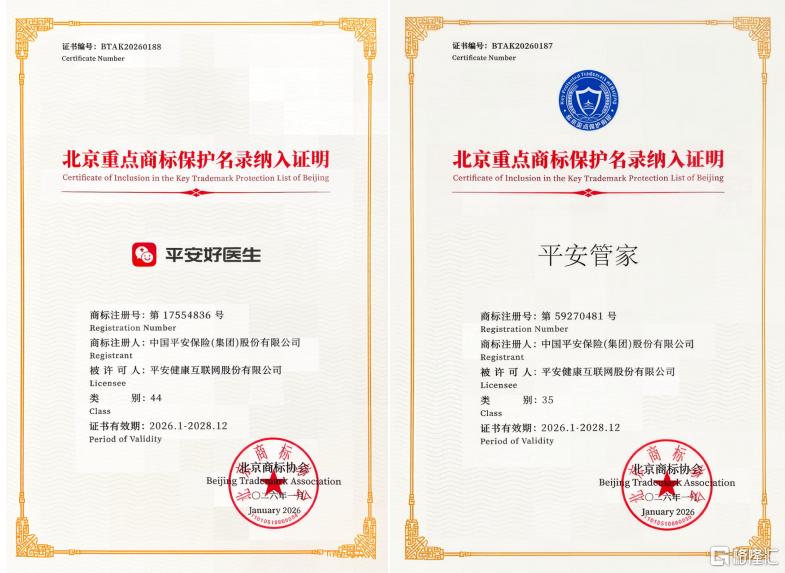
双誉加冕!平安好医生与平安管家荣登2025"北京重点商标保护名录"
Ge Long Hui· 2026-01-19 02:25
Core Viewpoint - The "First Beijing Trademark Brand Ceremony" highlighted the inclusion of "Ping An Good Doctor" and "Ping An Housekeeper" in the 2025 "Beijing Key Trademark Protection List," recognizing their brand value and market influence [1][2]. Group 1: Trademark Protection - The establishment of the "Beijing Key Trademark Protection List" aims to protect registered trademarks with high recognition and market leadership in Beijing [2]. - The evaluation process for the list is organized by the Beijing Trademark Association, utilizing a strict selection from an expert pool composed of industry associations and academic institutions [2]. Group 2: Ping An Good Doctor - "Ping An Good Doctor" has built significant market recognition since its establishment in 2014, becoming synonymous with professionalism and reliability in the healthcare sector [3]. - The company aims to create a unique Chinese-style Health Maintenance Organization (HMO) model, leveraging its extensive medical management experience and a global service network [4]. - The company has developed a comprehensive service network that includes "to line, to hospital, to home, and to enterprise" services, forming a closed-loop healthcare service system [4]. - The AI-driven services of "Ping An Good Doctor" have served over 10 million users, with daily consultations exceeding 300,000 and a satisfaction rate above 98% [4]. Group 3: Ping An Housekeeper - Launched in 2022, "Ping An Housekeeper" focuses on the core needs of the elderly, providing a comprehensive home care solution throughout their life cycle [5]. - The brand offers three major service plans: management during illness, safety assistance, and elder care, supported by a team of doctors and specialists [5]. - "Ping An Housekeeper" has established six group standards in the home care sector, becoming a significant reference for industry standardization [6]. - The service has achieved a 100% response rate for its "smart guardian" alerts and has covered 100 cities, serving nearly 240,000 clients [6].

76股获杠杆资金净买入超亿元
Zheng Quan Shi Bao Wang· 2026-01-19 01:55
Group 1 - As of January 16, the total market financing balance reached 2.71 trillion yuan, an increase of 131.93 billion yuan from the previous trading day, marking ten consecutive days of increases in financing balance [1] - The financing balance in the Shanghai market was 1.36 trillion yuan, up by 130.57 billion yuan, while the Shenzhen market's financing balance was 1.34 trillion yuan, increasing by 2.93 billion yuan. The North Exchange saw a decrease of 1.57 billion yuan, bringing its financing balance to 89.81 billion yuan [1] - On January 16, a total of 1,911 stocks received net financing purchases, with 735 stocks having net purchases exceeding 10 million yuan, and 76 stocks exceeding 100 million yuan. China Ping An topped the list with a net purchase of 1.33 billion yuan [1] Group 2 - The average ratio of financing balance to circulating market value for stocks with significant net purchases was 4.11%. Jianghuai Automobile had the highest ratio at 10.80%, followed by Guokewi, Yunnan Zhiye, and Maigemi Te, with ratios of 9.81%, 8.06%, and 7.99% respectively [2] - The top net purchases on January 16 included China Ping An (-1.60% change), TBEA (-2.67% change), and Kweichow Moutai (-0.50% change), with net purchases of 1.33 billion yuan, 1.12 billion yuan, and 1.03 billion yuan respectively [2] - The sectors with the highest concentration of stocks receiving net purchases over 100 million yuan included electronics, power equipment, and communications, with 29, 10, and 6 stocks respectively [1][2]


两融余额较上一日增加127.86亿元 电子行业获融资净买入额居首
Sou Hu Cai Jing· 2026-01-19 01:41
Group 1 - As of January 16, the margin trading balance in A-shares reached 27,315.37 billion yuan, an increase of 127.86 billion yuan from the previous trading day, accounting for 1.65% of the A-share circulating market value [1] - The trading volume for margin transactions on the same day was 3,364.9 billion yuan, which is an increase of 184.47 billion yuan from the previous trading day, representing 10.99% of the total A-share trading volume [1] - Among the 31 primary industries, 20 experienced net financing inflows, with the electronics sector leading at a net inflow of 10.279 billion yuan [1] Group 2 - The top individual stocks with net financing inflows exceeding 1 billion yuan included China Ping An, which had a net inflow of 1.332 billion yuan, followed by TBEA, Kweichow Moutai, and others [1] - The report from Huawei indicates that by 2035, the total computing power in society is expected to grow by up to 100,000 times, suggesting a significant upward trend in the semiconductor cycle driven by artificial intelligence [2] - The research from Huajin Securities recommends focusing on the entire semiconductor industry chain, from design and manufacturing to packaging testing and upstream equipment materials [2]


23股获融资净买入额超3亿元 中国平安居首
Zheng Quan Shi Bao Wang· 2026-01-19 01:36
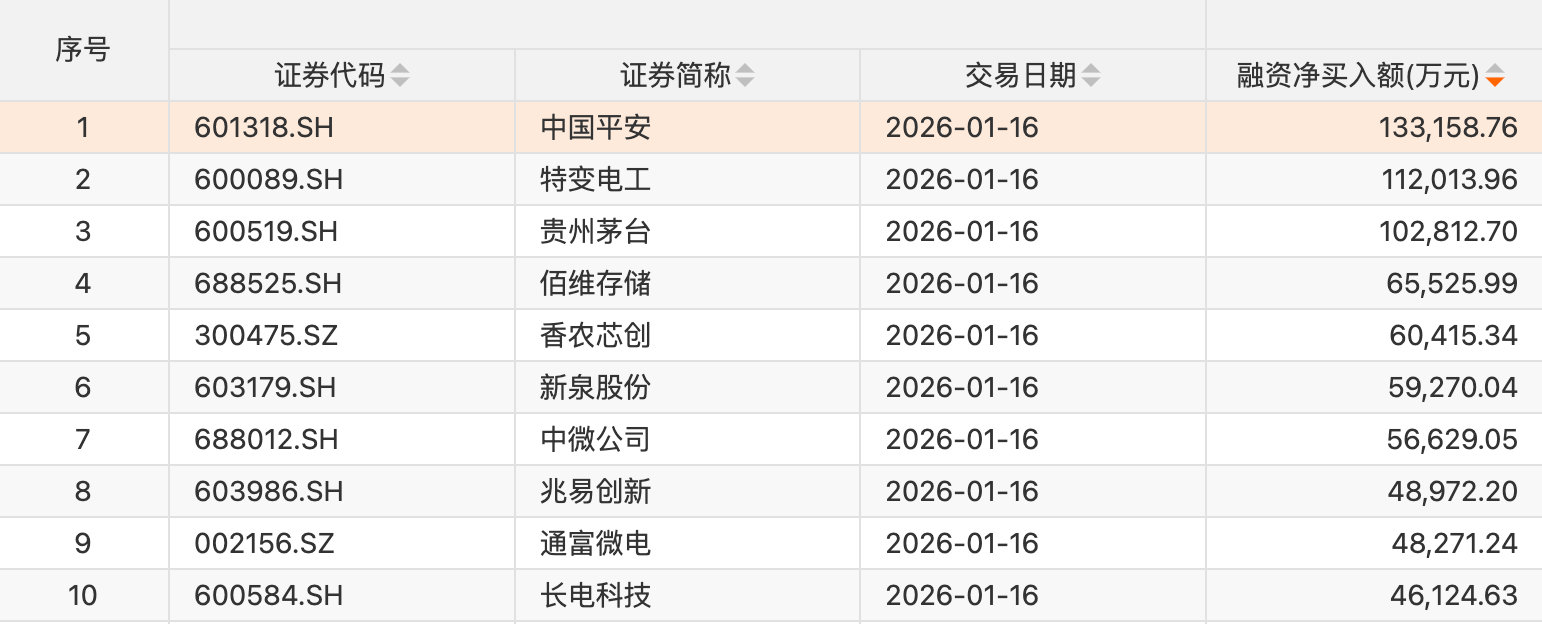
Group 1 - On January 16, among the 31 primary industries tracked by Shenwan, 20 industries experienced net financing inflows, with the electronics sector leading at a net inflow of 10.279 billion yuan [1] - Other industries with significant net financing inflows included power equipment, non-bank financials, food and beverage, banking, machinery, and construction decoration [1] Group 2 - A total of 1,912 stocks received net financing inflows on January 16, with 76 stocks having net inflows exceeding 100 million yuan [1] - Among these, 23 stocks had net inflows over 300 million yuan, with China Ping An leading at a net inflow of 1.332 billion yuan [1] - Other notable stocks with high net financing inflows included TBEA, Kweichow Moutai, Baiwei Storage, Shannon Microelectronics, Xinquan Co., Zhongwei Company, Zhaoyi Innovation, and Tongfu Microelectronics [1]
晨会纪要-20260119
Guoxin Securities· 2026-01-19 01:35
Group 1: Outdoor Apparel Industry - The outdoor footwear and apparel industry has maintained rapid growth since 2021, with a CAGR of 25.3% for outdoor apparel and 18.4% for outdoor footwear, projected to grow by 24.5% and 16.3% year-on-year in 2025 respectively [24][26] - Online sales of outdoor footwear are growing faster than apparel, with outdoor footwear online sales growth maintaining over 40%, while certain apparel categories like jackets and sun-protective clothing are experiencing slower growth [24][26] - Key outdoor brands such as Kailas and Berghaus are showing strong momentum, while brands like The North Face are underperforming; the market is becoming more diversified with new brands emerging [25][26] Group 2: AI Application in Computing Industry - Major international companies are focusing on AI application in vertical scenarios, with OpenAI and Anthropic launching healthcare-focused AI models, enhancing compliance and professional services [28] - Domestic companies are also advancing in AI applications, with Alibaba upgrading health services and Tencent providing comprehensive support for mini-programs, indicating a strong push towards AI integration [28] - The market for AI applications is expected to see significant growth, with predictions indicating that the GEO market will reach $24 billion globally by 2026, driven by high consumer trust in AI applications in China [30][32] Group 3: Public Utilities Industry - The public utilities sector, including electricity, gas, and water, is characterized by its "essential" nature, with stable long-term growth prospects [32] - The transition to low-carbon energy sources is accelerating, with the share of clean energy consumption expected to reach 28.6% of total energy consumption by 2024, up 2.2 percentage points year-on-year [32][33] - There is a growing trend of overseas funds over-allocating to the public utilities sector, with significant increases in holdings by institutional investors in this industry [33]




738股获融资买入超亿元,中际旭创获买入33.09亿元居首
Mei Ri Jing Ji Xin Wen· 2026-01-19 01:25
Group 1 - On January 16, 2023, a total of 3,762 stocks in the A-share market received financing funds, with 738 stocks having a buy amount exceeding 100 million yuan [1] - The top three stocks by financing buy amount were Zhongji Xuchuang, TBEA, and Xinyisheng, with buy amounts of 3.309 billion yuan, 3.307 billion yuan, and 3.102 billion yuan respectively [1] - Four stocks had financing buy amounts accounting for over 30% of the total transaction amount, with Liaoning Energy, Changyou Technology, and Sichuan Meifeng leading at 35.91%, 33.95%, and 33.03% respectively [1] Group 2 - A total of 76 stocks had a net financing buy amount exceeding 100 million yuan, with China Ping An, TBEA, and Kweichow Moutai ranking the highest with net buys of 1.332 billion yuan, 1.12 billion yuan, and 1.028 billion yuan respectively [1]


738股获融资买入超亿元 中际旭创获买入33.09亿元居首
Di Yi Cai Jing· 2026-01-19 01:20
Group 1 - On January 16, a total of 3,762 A-shares received financing funds, with 738 stocks having a buying amount exceeding 100 million [1] - The top three stocks by financing buying amount were Zhongji Xuchuang, Tebian Electric Apparatus, and Xinyi Sheng, with amounts of 3.309 billion, 3.307 billion, and 3.102 billion respectively [1] - Four stocks had financing buying amounts accounting for over 30% of the total transaction amount, with LiaoNing Energy, Changyou Technology, and Sichuan Meifeng leading at 35.91%, 33.95%, and 33.03% respectively [1] Group 2 - A total of 76 stocks had a net financing buying amount exceeding 100 million, with China Ping An, Tebian Electric Apparatus, and Kweichow Moutai ranking the highest at 1.332 billion, 1.12 billion, and 1.028 billion respectively [1]
重疾出险最小仅2岁 赔付最高超2100万
Nan Fang Du Shi Bao· 2026-01-18 23:13
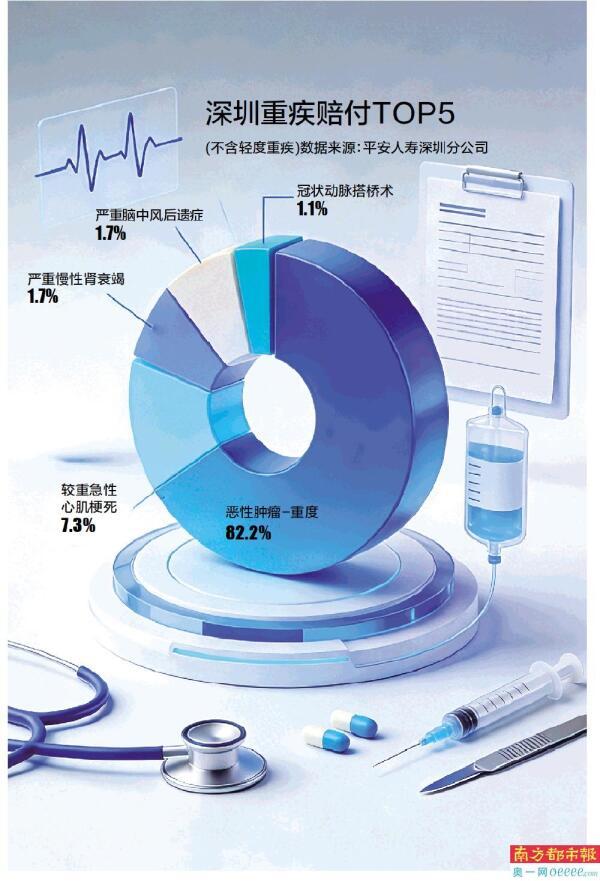
Core Insights - The annual claims reports from leading insurance institutions in Shenzhen reveal significant health trends among residents, particularly highlighting the prevalence of critical illnesses and the demographic most affected [2][3][4] Group 1: Health Trends and Critical Illnesses - The primary demographic for critical illness claims in Shenzhen is individuals aged 30-50, with a notable increase in cases of thyroid, lung, and breast cancers, indicating a trend towards younger patients [2][3] - Malignant tumors account for over 80% of critical illness claims, making them the leading health threat to residents, with leukemia being the most common critical illness among children [3][4] - The total number of claims in Shenzhen reached approximately 150,000 last year, with a growth rate of about 10%, and the total payout amounting to approximately 1.17 billion yuan, nearly half of which was attributed to critical illnesses [3] Group 2: Claims and Payouts - The highest claim in Shenzhen's life insurance sector last year was related to cancer, with a payout exceeding 21.25 million yuan for a policyholder who succumbed to breast cancer [5][6] - Tencent's micro-insurance platform reported a total claim amount of 8.4 billion yuan in 2025, with over 25.7 million claims processed, indicating a significant volume of insurance activity [4][6] - The average claim processing time has improved significantly, with some claims being settled in as little as 8 seconds due to advancements in AI and digital processing [7][8] Group 3: Technological Advancements in Claims Processing - The integration of AI in the claims process has led to faster and more efficient claim settlements, with some claims being processed in seconds, enhancing customer experience [7][8] - The introduction of a "one-stop settlement" service allows for simultaneous completion of medical insurance reimbursements and commercial insurance claims, significantly reducing the time required for claim processing [8]


非银金融周报:融资保证金比例上调,金监总局部署2026年监管工作-20260118
HUAXI Securities· 2026-01-18 14:52
Investment Rating - The industry rating is "Recommended" [5] Core Insights - The adjustment of the financing margin ratio from 80% to 100% aims to cool down excessive leverage and maintain market stability. This change will take effect on January 19, 2026, and applies only to new financing contracts [3][4][15][7] - As of January 14, 2026, the total market financing balance reached a historical high of 2.68 trillion yuan, with the margin balance accounting for 2.59% of the A-share market capitalization, indicating an increase from the average level of 2.40% in 2025 [4][15] - The non-bank financial sector index fell by 2.63%, underperforming the CSI 300 index by 2.06 percentage points, ranking 26th among all primary industries. The securities sector decreased by 2.21%, while the financial technology sector increased by 1.34% [2][13] Summary by Sections Market and Sector Performance - The average daily trading volume of A-shares for the week of January 11-17, 2026, was 34.651 billion yuan, a 21.5% increase week-on-week and a 189.4% increase year-on-year. The average trading volume for the first quarter of 2026 is 31.585 billion yuan, up 107.7% from the same period in 2025 [19] - In the same week, three new stocks were issued, raising 2.025 billion yuan, while two new stocks were listed, raising 1.484 billion yuan. Year-to-date, three A-share IPOs have raised 3.039 billion yuan [19] Financing Margin Ratio Adjustment - The financing margin ratio adjustment is a regulatory measure to prevent systemic risks and protect investors' rights. The increase in the minimum margin requirement is intended to curb market overheating and ensure a smooth market transition [4][7][15] Regulatory Developments - The National Financial Supervision Administration held a regulatory work meeting on January 15, 2026, outlining five key tasks for the year, including risk resolution for small and medium-sized financial institutions and enhancing regulatory quality. The focus for 2026 is on preventing systemic risks and ensuring high-quality industry development [8][16][17]