
PICC(601319)

Search documents
非银上半年业绩喜人,看好板块后续表现
East Money Securities· 2025-09-01 11:54
Investment Rating - The report maintains an "Outperform" rating for the non-bank financial sector, indicating a positive outlook for future performance [2]. Core Insights - The non-bank financial sector has shown impressive performance in the first half of 2025, with significant improvements in brokerage and insurance companies' earnings, driven by favorable market conditions and policy support [8][9]. - The report highlights the potential for continued growth in the sector, particularly in brokerage firms, as they adapt to new market opportunities, including cryptocurrency trading services [16]. Summary by Sections 1. Securities Business Overview and Weekly Review - In the first half of 2025, 42 comparable listed brokerages reported a total revenue of CNY 251.9 billion, a year-on-year increase of 31%, and a net profit of CNY 104 billion, up 65% [15]. - The second quarter alone saw revenues of CNY 125.9 billion, reflecting a 37% year-on-year growth, while net profits increased by 50% [15]. - The report notes a significant rise in self-operated and brokerage business revenues, with self-operated income growing by 52% and brokerage income by 44% [15]. 2. Insurance Business Overview and Weekly Review - The five listed insurance companies reported a combined net profit of CNY 178.2 billion in the first half of 2025, marking a 3.7% increase year-on-year [38]. - The new business value for life insurance showed substantial growth, with increases of 39.8% for China Ping An and 58.4% for New China Life [39]. - The report indicates that the insurance sector is experiencing a robust growth trajectory, driven by improvements in cost management and investment returns [41]. 3. Market Liquidity Tracking - The report notes that the central bank conducted a net withdrawal of CNY 4.339 billion in the week of August 25-29, 2025, indicating a tightening of liquidity conditions [51]. - The issuance of interbank certificates totaled CNY 557.2 billion, with a net withdrawal of CNY 1.945 billion [51]. 4. Industry News - The report discusses the launch of cryptocurrency trading services by Guotai Junan International, marking a significant step in expanding the brokerage's service offerings and tapping into new revenue streams [16]. - It emphasizes the ongoing reforms in the capital market and the expected positive impact on the brokerage sector's performance [15].



2025中报综述:投资驱动Q2利润改善,财寿险承保端均表现优异
SINOLINK SECURITIES· 2025-09-01 11:51
Investment Rating - The report indicates a positive outlook for the insurance sector, recommending strong beta stocks and companies with good business quality, particularly focusing on leading life insurance companies and those with favorable dividend policies [4]. Core Insights - The combined net profit of five A-share listed insurance companies increased by 3.7% in H1 2025, with Q2 showing a year-on-year growth of 5.9%, primarily driven by improvements in the asset side [1][11]. - The growth rates of net profit for major companies in H1 2025 were as follows: Xinhua 33.5%, China Property & Casualty 32.3%, PICC 16.9%, Taiping 12.2%, Taikang 11.0%, Sunshine 7.8%, China Life 6.9%, Ping An -8.8%, and AIA -23.1% [1][11]. - The operating profit for Ping An and Taiping grew by 3.7% and 7.1% respectively, with all listed insurance companies achieving positive growth in operating profit [2][16]. Financial Performance - **Net Profit**: The net profit of five listed insurance companies increased by 3.7% in H1 2025, with Q2 showing a 5.9% increase [1][11]. - **Contract Service Margin**: The contract service margin showed positive growth across the board, with the highest growth rates seen in PICC (+12.0%) and Sunshine (+10.3%) [19]. - **Net Assets**: The growth rates of net assets varied, with PICC leading at +6.1%, while Sunshine and Xinhua experienced declines of -10.1% and -13.3% respectively [1][23]. Revenue Analysis - **Insurance Service Performance**: The insurance service performance showed overall growth, with notable increases in companies like Sunshine (+13.3%) and PICC (+1.7%) [25]. - **Investment Performance**: Investment performance varied significantly, with Ping An and Taiping showing declines, while companies like Xinhua and PICC reported positive investment results [26]. Life Insurance - **New Business Value (NBV)**: The NBV growth rates for listed insurance companies in H1 2025 were led by PICC (+62.7%), Sunshine (+47.2%), and Ping An (+39.8%) [29][30]. - **Margin Improvement**: The margin for new business improved due to strong demand for savings products and a reduction in the preset interest rate [29]. Non-Life Insurance - **Premium Growth**: The non-auto insurance premium growth was mixed, with overall low growth in the property and casualty insurance sector [4]. - **Combined Operating Ratio (COR)**: The COR improved year-on-year, with China Property & Casualty showing the best performance at 94.8% [4]. Investment Recommendations - The report recommends focusing on leading life insurance companies with good business quality, strong beta stocks like Xinhua Insurance, and companies with favorable dividend policies such as China Taiping [4].

济南人保财险千佛山营业部:家庭财产保险,守护您的“家”倍安心
Qi Lu Wan Bao· 2025-09-01 11:25
Group 1 - The core idea emphasizes the importance of home protection against unexpected risks such as water pipe bursts, fires, burglaries, and extreme weather events [1][3] - Jinan People's Insurance Company offers tailored home property insurance solutions, leveraging over 70 years of expertise in professional protection [1] - The insurance coverage includes repair costs for the house and renovations, compensation for losses of household appliances, furniture, and clothing, as well as rental cost subsidies and third-party personal injury compensation due to accidents [1] Group 2 - Choosing Jinan People's Insurance Company signifies a commitment to reliable protection, with convenient reporting and transparent claims processes available both online and offline [3] - The insurance plans are customizable based on factors such as house area, property value, and living environment, allowing customers to select from basic or upgraded coverage without unnecessary expenses [3] - The company provides comprehensive service from insurance consultation to claims assistance, ensuring a worry-free experience for customers regarding property risks [3]


保险行业2025年中报回顾与展望:分红转型缓解利差压力,增配OCI股票提升投资韧性
Soochow Securities· 2025-09-01 11:03
Investment Rating - The report maintains an "Overweight" rating for the insurance sector [1] Core Insights - The insurance industry is experiencing a transformation towards dividend products, which is helping to alleviate interest spread pressures and enhance investment resilience through increased allocation to OCI stocks [1] Summary by Sections 1. Overall Performance of Listed Insurance Companies in H1 2025 - The total net profit of major listed insurance companies in H1 2025 reached CNY 188.5 billion, a year-on-year increase of 4.4% [11] - The net profit growth was primarily driven by improved investment returns, with a notable performance from New China Life, which saw a 33.5% increase [11][12] - The net assets of listed insurance companies increased by 0.8% compared to the beginning of the year, reaching CNY 21,954 billion [14] 2. Life Insurance: NBV Growth and Contribution from Bank Insurance Channels - New business value (NBV) continued to grow rapidly, with New China Life's new single premium insurance seeing a year-on-year increase of 100.5% [22] - The proportion of dividend insurance in new business has significantly increased, with China Life's dividend insurance accounting for over 50% of its new single premium [29] - The bank insurance channel has shown explosive growth, contributing significantly to new business and NBV growth [22][34] 3. Property Insurance: Steady Premium Growth and Improved Cost Ratios - Property insurance premiums grew steadily, with a year-on-year increase of 4% for listed companies [3] - The comprehensive cost ratio improved to an average of 96.1%, benefiting from reduced disaster claims and better expense management [3] 4. Investment: Increased Allocation to Stock Investments - Listed insurance companies have significantly increased their stock investments, with the proportion of FVOCI stocks rising by 7.2 percentage points to approximately 41% [4] - The total investment assets of listed insurance companies grew by 7.5% compared to the beginning of the year [4] - The average net investment return decreased by 0.2 percentage points, primarily due to declining interest rates, while total investment returns showed a mixed performance [4] 5. Investment Recommendations - The report suggests that the fundamental improvements in the insurance sector indicate a positive investment outlook for insurance stocks, with valuations at historical lows [5]
中国人保(601319) - H股公告
2025-09-01 10:30
股份發行人及根據《上市規則》第十九B章上市的香港預託證券發行人的證券變動月報表 截至月份: 2025年8月31日 狀態: 新提交 致:香港交易及結算所有限公司 公司名稱: 中國人民保險集團股份有限公司 呈交日期: 2025年9月1日 I. 法定/註冊股本變動 | 1. 股份分類 | 普通股 | 股份類別 | H | | 於香港聯交所上市 (註1) | | 是 | | | --- | --- | --- | --- | --- | --- | --- | --- | --- | | 證券代號 (如上市) | 01339 | 說明 | | | | | | | | | | 法定/註冊股份數目 | | | 面值 | | 法定/註冊股本 | | | 上月底結存 | | | 8,726,234,000 | RMB | | 1 RMB | | 8,726,234,000 | | 增加 / 減少 (-) | | | 0 | | | RMB | | 0 | | 本月底結存 | | | 8,726,234,000 | RMB | | 1 RMB | | 8,726,234,000 | FF301 FF301 由於本公司於中華人民 ...
社保基金最新持仓超5000亿元!32股二季度末以来涨超50%
Sou Hu Cai Jing· 2025-09-01 09:52
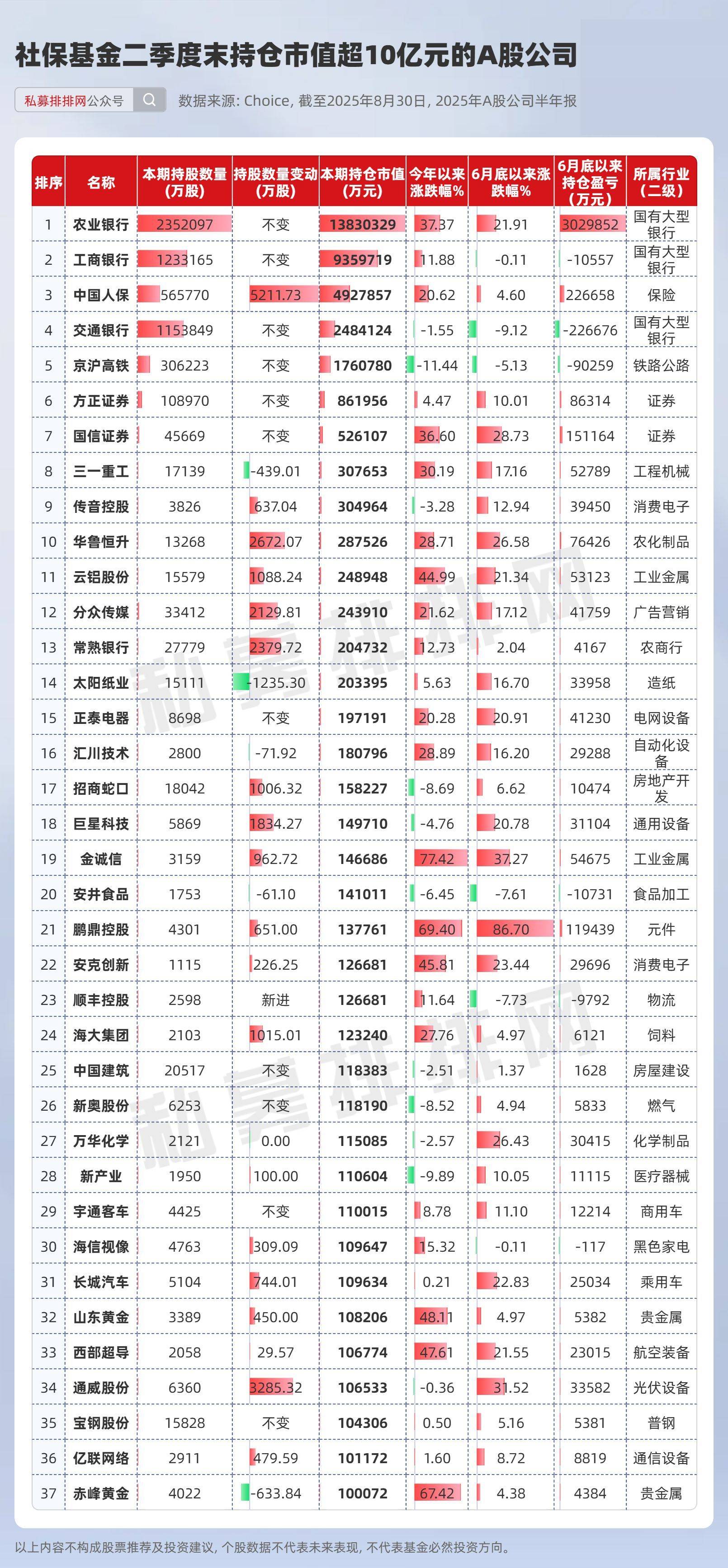
Group 1 - As of August 30, 2025, a total of 582 A-share companies are included in the top ten heavy positions of the social security fund, with a total holding market value of 502.91 billion yuan [1] - The social security fund has new positions in 158 stocks, increased positions in 171 stocks, decreased positions in 126 stocks, and maintained positions in 127 stocks [1] - The sectors with significant holdings include chemical products, semiconductors, chemical pharmaceuticals, automotive parts, general equipment, specialized equipment, and medical devices, each with more than 15 stocks [1] Group 2 - Among the 582 companies, 104 stocks have holdings exceeding 500 million yuan, and 37 stocks have holdings exceeding 1 billion yuan, accounting for 76.47% of the total holding market value [3] - Agricultural Bank is the largest heavy position stock of the social security fund, with a holding market value exceeding 138.3 billion yuan and a year-to-date increase of approximately 37% [7] - The average increase of the 582 A-share companies this year is 27.62%, with 32 stocks increasing over 50% since the end of June [8] Group 3 - The top five stocks by holding market value all exceed 10 billion yuan, with four of them maintaining their holding market value [6] - The average holding ratio of the 582 A-share companies is approximately 1.8%, with 28 stocks having a holding ratio exceeding 5%, accounting for 51.83% of the total holding market value [14] - The stocks with the highest holding ratios include China Life Insurance, Founder Securities, and Bank of Communications, each exceeding 10% [16]




A股五大险企上半年业绩披露:净利润突破1780亿元
Guan Cha Zhe Wang· 2025-09-01 08:51
Core Viewpoint - The performance of five major listed insurance companies in China showed a mixed result in net profit for the first half of the year, with an overall increase of 3.7% year-on-year, totaling 178.19 billion yuan [1] Group 1: Net Profit Performance - China Life Insurance achieved a net profit of 40.93 billion yuan, a year-on-year increase of 6.9% [1] - China Pacific Insurance reported a strong net profit of 27.88 billion yuan, up 11% year-on-year [1] - New China Life Insurance recorded a significant net profit of 14.8 billion yuan, reflecting a 33.5% year-on-year growth [1] - China Property & Casualty Insurance's net profit reached 26.53 billion yuan, marking a 16.9% increase year-on-year [1] - China Ping An's net profit was 68.05 billion yuan, showing a decline of 8.8% year-on-year due to several factors including accounting adjustments and stock allocations [1] Group 2: Investment Income - China Property & Casualty Insurance reported total investment income of 41.48 billion yuan, a year-on-year increase of 42.7% [2] - New China Life Insurance's total investment income reached 45.29 billion yuan, up 43.3% year-on-year [2] - China Life Insurance's total investment income was 127.51 billion yuan, reflecting a 4.2% increase year-on-year [2] - China Pacific Insurance's total investment income was 56.89 billion yuan, a 1.5% increase year-on-year [2] - China Ping An's total investment income was 96.22 billion yuan, showing a decline of 1.8% year-on-year [2] Group 3: Cash Dividend Plans - China Property & Casualty Insurance plans to distribute a cash dividend of 0.75 yuan per share, totaling approximately 3.32 billion yuan [3] - China Life Insurance intends to distribute a cash dividend of 0.238 yuan per share, amounting to about 6.73 billion yuan [3] - China Ping An will distribute a cash dividend of 0.95 yuan per share, totaling approximately 17.20 billion yuan [3] - New China Life Insurance plans to distribute a cash dividend of 0.67 yuan per share, totaling around 2.09 billion yuan [3]
中国人保上半年净利润同比增17.8% 优化结构布局新能源车险
Zhong Guo Jing Ying Bao· 2025-09-01 08:49
Core Viewpoint - The insurance sector in A-shares has seen significant stock price increases, with several companies reaching new highs following the disclosure of their mid-year operating results for 2025. China Pacific Insurance and China Life Insurance have also reported strong performance metrics, indicating a robust recovery and growth in the industry [1][2]. Group 1: Financial Performance - China Life Insurance achieved a total premium income of 454.6 billion yuan, a year-on-year increase of 6.4%, and a net profit of 35.888 billion yuan, up 17.8% [1]. - The total assets of China Life Insurance reached approximately 1.88 trillion yuan, growing by 6.3% compared to the end of the previous year [1]. - The investment performance of China Life Insurance was 17.5 billion yuan, reflecting a substantial year-on-year growth of 78.3% [1]. Group 2: Property Insurance Business - China Property Insurance reported original insurance premium income of 323.282 billion yuan, a 3.6% increase, maintaining a market share of 33.5% [2]. - The comprehensive expense ratio for motor vehicle insurance decreased by 4.1 percentage points to 21.1%, while the overall cost ratio fell by 2.2 percentage points to 94.2% [2]. - The underwriting profit for China Property Insurance was 8.726 billion yuan, marking a significant year-on-year increase of 67.7% [2]. Group 3: New Energy Vehicle Insurance - The new energy vehicle insurance project is a key component of China Life Insurance's international strategy, with successful launches in Hong Kong and Thailand [2][3]. - The project has already insured over a thousand Chinese brand new energy vehicles in Hong Kong, with a current claim rate of approximately 50%, which is better than expected [2]. Group 4: Life Insurance Business - China Life Insurance's life insurance segment reported original premium income of 90.513 billion yuan, a 14.5% increase, with new business value rising by 71.7% year-on-year [5][6]. - The first-year premium income grew by 25.6%, while renewal premiums increased by 11.7% [5]. - The proportion of first-year premiums to total premium income was 79.5%, up 0.9 percentage points from the previous year [5]. Group 5: Health Insurance and Service - The health insurance segment achieved premium income of 40.7 billion yuan, a 12.2% increase, and net profit of 5.128 billion yuan [7]. - New business value in the health insurance sector grew by 51% year-on-year [7]. Group 6: Strategic Initiatives - The company aims to build a world-class insurance financial group, focusing on enhancing protection functions, improving development quality, and deepening six key reforms [8][9]. - The company has made significant progress in digital transformation and resource sharing, with a reported 8.9% increase in collaborative premium income [9].
保险板块9月1日跌2.48%,新华保险领跌,主力资金净流出5.28亿元
Zheng Xing Xing Ye Ri Bao· 2025-09-01 08:46
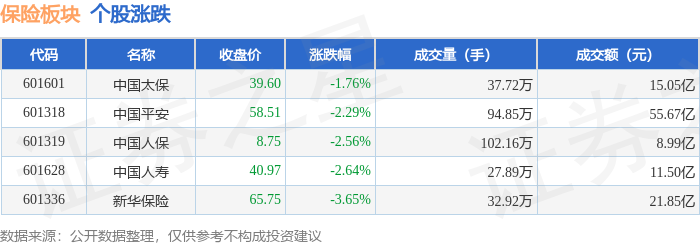
Core Insights - The insurance sector experienced a decline of 2.48% on September 1, with New China Life Insurance leading the drop [1] - The Shanghai Composite Index closed at 3875.53, up 0.46%, while the Shenzhen Component Index closed at 12828.95, up 1.05% [1] Insurance Sector Performance - Major insurance stocks showed the following closing prices and percentage changes: - China Pacific Insurance: 39.60, down 1.76% - Ping An Insurance: 58.51, down 2.29% - China Life Insurance: 40.97, down 2.64% - New China Life Insurance: 65.75, down 3.65% [1] Capital Flow Analysis - The insurance sector saw a net outflow of 528 million yuan from institutional investors, while retail investors contributed a net inflow of 270 million yuan [1] - Detailed capital flow for major insurance stocks: - China Life Insurance: 85.44 million yuan net inflow from institutions, but 77.02 million yuan net outflow from retail investors [2] - China Pacific Insurance: 52.42 million yuan net inflow from institutions, with a net outflow of 69.32 million yuan from retail investors [2] - Ping An Insurance: 608 million yuan net outflow from institutions, but 373 million yuan net inflow from retail investors [2]
中国人民保险集团(01339) - 截至二零二五年八月三十一日止月份之股份发行人的证券变动月报表
2025-09-01 08:34
股份發行人及根據《上市規則》第十九B章上市的香港預託證券發行人的證券變動月報表 截至月份: 2025年8月31日 狀態: 新提交 致:香港交易及結算所有限公司 公司名稱: 中國人民保險集團股份有限公司 呈交日期: 2025年9月1日 I. 法定/註冊股本變動 | 1. 股份分類 | 普通股 | 股份類別 | H | | 於香港聯交所上市 (註1) | | 是 | | | --- | --- | --- | --- | --- | --- | --- | --- | --- | | 證券代號 (如上市) | 01339 | 說明 | | | | | | | | | | 法定/註冊股份數目 | | | 面值 | | 法定/註冊股本 | | | 上月底結存 | | | 8,726,234,000 | RMB | | 1 RMB | | 8,726,234,000 | | 增加 / 減少 (-) | | | 0 | | | RMB | | 0 | | 本月底結存 | | | 8,726,234,000 | RMB | | 1 RMB | | 8,726,234,000 | | 2. 股份分類 | 普通股 | A 股份 ...