
PICC(601319)

Search documents
保险板块10月20日涨2.15%,中国人寿领涨,主力资金净流入3.68亿元
Zheng Xing Xing Ye Ri Bao· 2025-10-20 08:27
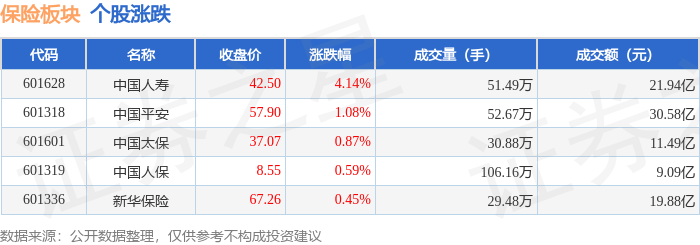
Core Viewpoint - The insurance sector experienced a notable increase of 2.15% on October 20, with China Life leading the gains, while the overall market indices also showed positive performance [1]. Group 1: Market Performance - The Shanghai Composite Index closed at 3863.89, up by 0.63% [1]. - The Shenzhen Component Index closed at 12813.21, up by 0.98% [1]. Group 2: Individual Stock Performance - China Life (601628) closed at 42.50, with a rise of 4.14%, and a trading volume of 514,900 shares, amounting to a transaction value of 2.194 billion yuan [1]. - Ping An Insurance (601318) closed at 57.90, up by 1.08%, with a trading volume of 526,700 shares, totaling 3.058 billion yuan [1]. - China Pacific Insurance (601601) closed at 37.07, increasing by 0.87%, with a trading volume of 308,800 shares, and a transaction value of 1.149 billion yuan [1]. - China Reinsurance (601319) closed at 8.55, up by 0.59%, with a trading volume of 1,061,600 shares, amounting to 909 million yuan [1]. - New China Life (601336) closed at 67.26, with a rise of 0.45%, and a trading volume of 294,800 shares, totaling 1.988 billion yuan [1]. Group 3: Capital Flow Analysis - The insurance sector saw a net inflow of 368 million yuan from institutional investors, while retail investors experienced a net outflow of 225 million yuan [1]. - Among individual stocks, Ping An Insurance had a net inflow of 18.5 million yuan from institutional investors, but a net outflow of 182 million yuan from retail investors [2]. - New China Life recorded a net inflow of 139 million yuan from institutional investors, with a net outflow of 125 million yuan from retail investors [2].





又一险企预告:业绩大增!
Jin Rong Shi Bao· 2025-10-20 07:46
Core Viewpoint - China Life Insurance Company expects a significant increase in net profit for the first three quarters of 2025, projecting a range of approximately 156.79 billion to 177.69 billion yuan, representing a year-on-year growth of about 50% to 70% compared to the same period in 2024 [1] Group 1: Performance Forecasts - China Life is the third listed insurance company to announce a profit increase for the third quarter [1] - People's Insurance Company of China (PICC) anticipates a net profit of 26.75 billion yuan for the first three quarters, with an expected increase of 40% to 60% year-on-year [1] - New China Life Insurance forecasts a net profit between 29.99 billion and 34.12 billion yuan, expecting a year-on-year increase of 45% to 65% [1] Group 2: Reasons for Performance Increase - Reason One: Enhancing the supply-side structural reform of insurance through the "Five Major Articles" in finance, focusing on value creation and efficiency improvement [2] - China Life emphasizes its role as an economic stabilizer and is committed to deepening product and business diversification [2] - PICC aims to optimize management and enhance strategic layout in key areas, leading to significant growth in underwriting profits [2] - New China Life focuses on improving market competitiveness and advancing high-quality, sustainable development [2] Group 3: Investment Strategies - Reason Two: Actively promoting long-term capital market investments, resulting in a substantial increase in investment returns [3] - China Life adheres to long-term, value, and stable investment principles, enhancing investment portfolio stability and long-term return potential [3] - PICC is increasing its allocation to high-quality equity assets while maintaining liquidity safety margins [3] - New China Life is optimizing asset allocation to counter low-interest rate challenges, solidifying its long-term return foundation [3] - All three companies benefited from the capital market's rise in the first three quarters, leading to significant growth in net profits [3]
上市险企三季报接连“预喜”,中国人寿最高预增70%
Nan Fang Du Shi Bao· 2025-10-20 05:07
随着上市险企三季报披露季临近,行业业绩向好态势逐步显现。自10月13日晚新华保险率先披露三季 报"预告"以来,人保财险、中国人寿亦相继发布2025年前三季度业绩预增公告,净利润同比增幅均保持 在40%以上。其中,中国人寿以50%-70%的增幅领跑。 受业绩利好提振,今日早盘,保险板块高开。截至发稿,中国人寿涨4.09%报42.48元,中国太保涨 2.18%报37.55元,中国平安涨1.61%报58.2元,中国人保涨1.53%报8.63元,新华保险涨1.22%报67.78 元。 多家上市险企三季报"预喜" 从具体业绩表现来看,头部险企盈利规模与增速双双亮眼。作为行业"头雁",中国人寿在高基数基础上 实现高增长。10月19日晚,中国人寿公告称,经初步测算,2025年前三季度,中国人寿预计实现归属于 母公司股东的净利润约1567.85亿元到1776.89亿元,与2024年同期相比,将增加约522.62亿元到731.66亿 元,同比增长约50%到70%;扣除非经常性损益后,净利润预计为1570.11亿元-1779.46亿元,同比增幅 同样维持在50%-70%区间,盈利稳定性凸显。 10月13日晚,新华保险公告称,经过 ...
投资收益大幅提升,险企龙头三季度利润大超预期
Xuan Gu Bao· 2025-10-20 00:31
Group 1 - The core viewpoint of the news is that China Life Insurance expects a significant increase in net profit for the first three quarters of 2025, with estimates ranging from 156.8 billion to 177.7 billion yuan, and a projected net profit for Q3 between 115.9 billion and 136.8 billion yuan, reflecting a year-on-year growth of 75% to 106% [1] - The company is actively promoting long-term capital market entry and increasing equity investment, with a notable investment scale of 970.8 billion yuan in stocks and funds in the first half of the year, a 36% increase compared to the same period in 2024 [1] - The insurance sector is experiencing improvements on both the asset and liability sides, with low valuations and public fund holdings, which are expected to support the recovery of insurance stock valuations [1] Group 2 - The company anticipates a steady growth in new business value (NBV) for the year, with a downward adjustment in the preset interest rate accelerating the transformation of dividend insurance, which will further improve liability costs [1] - The current valuation of the insurance sector and public fund holdings remain at historical lows, indicating potential for future growth [1] - China Ping An is also mentioned as having a strong performance due to the gradual resolution of real estate risks and robust growth in bancassurance [1]
中国人保 五年来累计赔付支出超1.7万亿元 多领域发展成果显著
Ren Min Ri Bao· 2025-10-19 22:00
Core Insights - China People's Insurance Group (China P&C) has demonstrated significant operational strength and has played a leading role in serving national strategies, safeguarding public needs, and mitigating financial risks since the "14th Five-Year Plan" period [2] Financial Performance - In 2024, China P&C achieved original insurance premium income of 693 billion yuan, a 24% increase compared to 2020; net profit attributable to shareholders reached 42.9 billion yuan, up 114% from 2020 [2] - By June 2025, total assets managed by China P&C exceeded 4 trillion yuan, with total assets at 1.9 trillion yuan [2] Insurance Functionality - During the "14th Five-Year Plan" period, China P&C undertook insurance responsibilities amounting to 12.104 trillion yuan and paid out claims totaling 1.7814 trillion yuan, with an average daily payout of 1.1 billion yuan, a 32% increase from the "13th Five-Year Plan" period [3] - The company has developed a comprehensive technology insurance product system covering over 200 products across 13 categories, and has launched several innovative insurance products for technology enterprises [3] Investment in Real Economy - China P&C has established private equity funds and innovation funds in major cities to support technological innovation and modern industrial system construction, focusing on sectors like new energy and biotechnology, with investment assets exceeding 1.7 trillion yuan, a 56% increase from the end of the "13th Five-Year Plan" [4] High-Quality Development - China P&C is committed to high-quality development through structural optimization and value enhancement, with core property insurance premium income surpassing 500 billion yuan, ranking among the top in Asia [5] - The life insurance segment reported premium income exceeding 100 billion yuan, with a year-on-year growth of 14.5% in the first half of 2025, marking the fastest growth in nearly nine years [5] Service Enhancement - China P&C has achieved comprehensive development in green insurance, inclusive insurance, and digital insurance, providing insurance coverage and financial support in areas like green energy and climate change [7] - In 2024, the company provided agricultural risk protection for 55.42 million households, covering 2.1 trillion yuan, and expanded insurance supply for new citizens and small enterprises [8] New Business Model - The company is constructing a new business model of "insurance + service + technology," focusing on risk reduction services and enhancing the insurance service value chain [9] - In health insurance, China P&C has integrated health management services, collaborating with numerous healthcare institutions to provide comprehensive service networks [10] Risk Management - China P&C has prioritized risk prevention and control, enhancing its risk management framework and compliance measures to address potential risks effectively [11] - The company has implemented a comprehensive risk management upgrade action plan, improving risk compliance levels through various regulatory measures [12]
非银金融行业跟踪周报:保险Q3业绩高基数下仍高增长,市场成交量维持高位-20251019
Soochow Securities· 2025-10-19 12:22
Investment Rating - The report maintains an "Overweight" rating for the non-bank financial sector [1] Core Insights - The insurance sector continues to show high growth despite a high base in Q3, driven by regulatory support for high-quality health insurance development [5][22] - The securities sector has seen a year-on-year increase in trading volume, with significant growth in margin financing balances [5][15] - The multi-financial sector is transitioning into a stable growth phase, with trust assets increasing but profits declining significantly [5][32] Summary by Sections Non-Bank Financial Subsector Performance - In the recent five trading days (October 13-17, 2025), only the insurance sector outperformed the CSI 300 index, rising by 3.73%, while the overall non-bank financial sector declined by 1.09% [10][11] Non-Bank Financial Subsector Views Securities - Trading volume has increased year-on-year, with the average daily trading amount in October reaching 27,366 billion yuan, up 22.33% from the previous year [5][15] - The China Securities Regulatory Commission has revised the corporate governance guidelines for listed companies, enhancing oversight and accountability [17][20] Insurance - Major insurers like New China Life and China Property & Casualty are expected to report significant profit increases for Q3, with New China Life's net profit projected between 30 billion to 34.1 billion yuan, a year-on-year growth of 45% to 65% [5][22] - Regulatory initiatives are promoting the development of health insurance, with a focus on integrating new medical technologies and improving long-term care insurance [26][30] Multi-Financial - The trust industry is experiencing a stable transition, with total trust assets reaching 29.56 trillion yuan by the end of 2024, but profits have dropped significantly [5][32] - The futures market saw a year-on-year increase in transaction volume and value, indicating a potential recovery in trading activity [5][37] Industry Ranking and Key Company Recommendations - The report ranks the sectors as follows: Insurance > Securities > Other Multi-Financial [5][47] - Key company recommendations include China Ping An, New China Life, China Pacific Insurance, CITIC Securities, Tonghuashun, and Jiufang Zhitu Holdings, highlighting the low average valuations and safety margins in the non-bank financial sector [5][47]


中证A500指数承压,ETF规模跌破2000亿元
2 1 Shi Ji Jing Ji Bao Dao· 2025-10-17 11:53
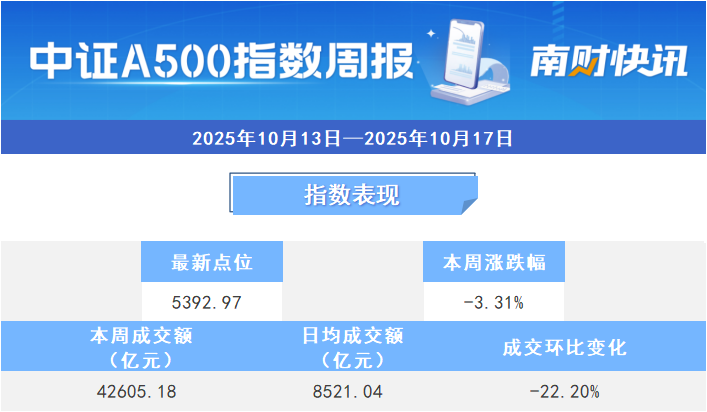
Index Performance - The CSI A500 Index decreased by 3.31% this week, closing at 5392.97 points on October 17 [5] - The average daily trading volume for the week was 8521.04 billion yuan, reflecting a 22.20% decrease compared to the previous week [5] Top Performers - The top ten gainers in the CSI A500 index included: 1. Shanghai Pudong Development Bank (600000.SH) with a gain of 12.50% 2. Agricultural Bank of China (601288.SH) with a gain of 11.57% 3. Huatian Technology (002185.SZ) with a gain of 10.02% 4. Shanghai Jahwa United Co., Ltd. (600315.SH) with a gain of 9.42% 5. Hainan Airport (600515.SH) with a gain of 8.96% 6. Shaanxi Coal and Chemical Industry (601225.SH) with a gain of 8.61% 7. Jiangsu Bank (600919.SH) with a gain of 8.60% 8. Tongwei Co., Ltd. (600438.SH) with a gain of 8.31% 9. Air China (601111.SH) with a gain of 7.63% 10. China Pacific Insurance (601319.SH) with a gain of 7.32% [2] Bottom Performers - The top ten losers in the CSI A500 index included: 1. Shengquan Group (605589.SH) with a loss of 18.04% 2. Wentai Technology (600745.SH) with a loss of 17.17% 3. Betta Pharmaceuticals (300558.SZ) with a loss of 16.98% 4. Leo Group (002131.SZ) with a loss of 16.55% 5. Jinlang Technology (300763.SZ) with a loss of 15.40% 6. Tongfu Microelectronics (002156.SZ) with a loss of 14.98% 7. Yake Technology (002409.SZ) with a loss of 14.35% 8. Lens Technology (300433.SZ) with a loss of 14.26% 9. Zhongding Sealing Parts (000887.SZ) with a loss of 13.99% 10. Robot Technology (300757.SZ) with a loss of 13.95% [2] Fund Performance - All 40 CSI A500 ETFs experienced declines, with notable drops in Huatai-PB's CSI A500 Enhanced ETF and Guolian's A500 Enhanced ETF, both falling over 4% [5] - The total scale of the CSI A500 ETFs fell below 200 billion yuan, with Huatai-PB's fund at 249.03 billion yuan, Guotai's at 226.56 billion yuan, and E Fund's at 221.29 billion yuan [5] Market Insights - Pacific Securities research team suggests a balanced allocation towards low-position sectors, particularly banks and insurance with dividend protection attributes, as well as coal and agriculture sectors benefiting from domestic demand recovery [6] - Guohai Securities research team indicates that uncertainties from trade frictions may lead to a rotation in market styles, with a shift from overvalued growth sectors to undervalued sectors [6]





2024年寿险产品盘点:增额终身寿依然是市场第一名,已经连续三年夺冠,有一款单品超过500亿!
13个精算师· 2025-10-17 11:04
Core Insights - The core viewpoint of the article emphasizes the dominance of whole life insurance products in the market, highlighting their sustained growth in sales and premium income over recent years [2][20][26]. Group 1: Market Trends - In 2024, whole life insurance remains the top-selling product, continuing its three-year streak as the market leader, with one product exceeding 50 billion in premium income [2][20]. - The total premium income for the top five insurance products in the life insurance industry reached 1.22 trillion yuan, accounting for 38.4% of the total original insurance premium income [26][29]. - The concentration of premium income among the top five products has decreased from 48.4% in 2017 to 38.4% in 2024, indicating a trend towards diversification in product offerings [29]. Group 2: Product Performance - The number of whole life insurance products in the top five has increased significantly, with 188 products generating a total premium income of approximately 72.23 billion yuan in 2024 [22]. - The average premium income for whole life insurance products is 38.4 million yuan per product, which is the highest among all product categories [22]. - In 2024, 42 companies reported that their top premium-generating product was whole life insurance, although this number decreased by two companies compared to the previous year [20][24]. Group 3: Cash Flow Metrics - The cash flow payout to income ratio for the top five products in 2024 was 2.3%, a decrease of 0.4 percentage points year-on-year [10][39]. - The average cash flow payout to income ratio for the top seven companies was 2.1%, while smaller companies had an average of 2.4% [10][39]. - Among 323 products with payout amounts, the simple average cash flow payout to income ratio was 3.6%, with a weighted average of 2.3% [41][42].
保险板块10月17日跌2.76%,XD中国人领跌,主力资金净流出12.03亿元
Zheng Xing Xing Ye Ri Bao· 2025-10-17 08:35
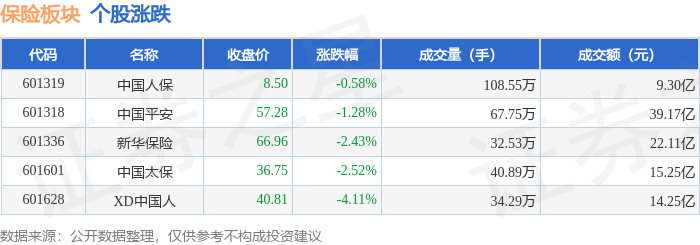
Core Viewpoint - The insurance sector experienced a decline of 2.76% on October 17, with XD China Life leading the drop. The Shanghai Composite Index closed at 3839.76, down 1.95%, while the Shenzhen Component Index closed at 12688.94, down 3.04% [1]. Group 1: Market Performance - The insurance sector's individual stock performance showed declines across major companies, with China Life Insurance (China Life) down 4.11% to a closing price of 40.81, and China Ping An down 1.28% to 57.28 [1]. - The total net outflow of funds from the insurance sector was 1.203 billion yuan, while retail investors saw a net inflow of 1.064 billion yuan [1]. Group 2: Fund Flow Analysis - XD China Life had a net outflow of 171 million yuan from institutional investors, while retail investors contributed a net inflow of 140 million yuan [2]. - China Ping An experienced a net outflow of 489.17 million yuan from institutional investors, with retail investors contributing a net inflow of 331 million yuan [2]. - China Pacific Insurance saw a significant net outflow of 218 million yuan from institutional investors, while retail investors had a net inflow of 163 million yuan [2].
人保财险降彩石:中国人保今年前8个月绿色保险提供风险保障金额186亿元 同比增长33%
Xin Lang Cai Jing· 2025-10-17 08:14
Core Insights - The 2025 Sustainable Global Leaders Conference is being held from October 16 to 18 in Shanghai, focusing on sustainable development and green finance [1] - The company, China People's Property Insurance Co., Ltd., is actively implementing new development concepts and aligning with national strategic deployments [1] Green Insurance and Investment - In 2024, the company is expected to provide risk coverage through green insurance exceeding 175 trillion yuan [1] - The scale of green investments by the company is projected to reach 39 billion yuan [1] - In the first eight months of this year, the amount of risk coverage provided by green insurance reached 18.6 billion yuan, marking a year-on-year increase of 33% [1]