
BANK COMM(601328)

Search documents
前三季度上市银行稳健运行 多维度赋能经济发展大局
Jin Rong Shi Bao· 2025-11-06 03:47
Group 1: Banking Sector Performance - A-share listed banks reported stable performance in the first three quarters of the year, showcasing a steady operational trend with notable highlights [1] Group 2: Urban-Rural Integration and Regional Development - The banking sector is actively supporting urban-rural integration and regional coordinated development as part of a significant national strategy [2] - Industrial and Commercial Bank of China (ICBC) has allocated nearly 3.5 trillion yuan in loans for new urbanization projects and over 5 trillion yuan for agricultural loans, with significant investments in poverty alleviation counties [2] - Agricultural Bank of China has increased its loan balance in key rural revitalization counties to 481.2 billion yuan, marking a growth of 10.21%, and in poverty-stricken counties to 2.52 trillion yuan, with a growth of 10.66% [3] Group 3: High-Level Opening Up - The banking sector is contributing to high-level opening up, which is a strategic choice to enhance national security and respond to external uncertainties [4] - Bank of China has been actively involved in the Belt and Road Initiative, maintaining a leading position in the issuance of panda bonds and offshore RMB bonds, with a global custody scale of 4.8 trillion yuan [5] - Construction Bank has enhanced its international competitiveness and supported cross-border e-commerce, with settlement volumes exceeding 400 billion yuan [5] Group 4: Digital Transformation - Digital transformation is a critical focus for banking institutions, with ongoing efforts to enhance digital infrastructure and service efficiency [6] - Bank of Communications has improved its digital service capabilities, achieving significant user engagement with its mobile banking applications and open banking interfaces [7] - Postal Savings Bank is leveraging digital technology to enhance operational efficiency and customer experience through initiatives like remote services and digital personnel [8]






六大行探索支持新质生产力新路径
Jin Rong Shi Bao· 2025-11-06 02:12
Core Insights - The key to China's modernization lies in technological modernization, which is supported by financial resources, as evidenced by the recent performance reports from major banks [1] - The six major state-owned banks have shown significant growth in loans to technology enterprises and the number of clients, indicating a positive trend in technology finance [2][3] Group 1: Performance of Major Banks - As of the end of September, Industrial and Commercial Bank of China (ICBC) had a strategic emerging industry loan balance exceeding 4.2 trillion yuan, with technology enterprise loans surpassing 2.7 trillion yuan [2] - Agricultural Bank of China reported a technology loan balance exceeding 4.7 trillion yuan, while China Bank's technology loan balance was approximately 4.7 trillion yuan, supporting over 160,000 clients [2] - Postal Savings Bank's technology loan balance exceeded 940 billion yuan, and the total number of technology enterprises supported by various banks has seen notable increases [2][3] Group 2: Financial Product Innovation - The banks are increasingly adopting a comprehensive approach to technology finance, focusing on "equity, loans, bonds, and insurance" to support technology enterprises [2][3] - ICBC has initiated a pilot program for equity investment in 18 regions, establishing 38 funds with a total subscription amount exceeding 45 billion yuan [2] - China Construction Bank has registered 21 pilot funds in 15 cities and has seen a more than fourfold increase in the investment volume of technology innovation bonds [3] Group 3: Addressing Financing Challenges - The introduction of a "technology flow" evaluation system is helping to address the financing difficulties faced by technology SMEs, moving away from traditional asset-based lending [4][6] - Postal Savings Bank has successfully implemented this new evaluation model, transforming the "technology credit" of enterprises into "financing credit," which has led to significant improvements in operational efficiency for supported companies [6][7] - The focus on innovative financial products aims to alleviate the challenges of financing for light-asset technology enterprises, with banks exploring various models to meet the unique needs of these companies [8]
前三季度上市银行稳健运行
Jin Rong Shi Bao· 2025-11-06 02:06
Group 1: Overall Performance of the Banking Sector - The A-share listed banks have reported a steady performance in their operations for the first three quarters of the year, showcasing resilience and emerging highlights in the banking industry [1] Group 2: Support for Urban-Rural Integration and Regional Development - The banking sector is actively supporting the national strategy for urban-rural integration and regional coordinated development, with financial resources being allocated to key areas [2] - Industrial and Commercial Bank of China (ICBC) has reported a loan balance of nearly 3.5 trillion yuan in the new urbanization sector and over 5 trillion yuan in agricultural loans, with significant investments in poverty alleviation counties [2] - Agricultural Bank of China has increased its loan balance in key rural revitalization counties to 481.2 billion yuan, reflecting a growth rate of 10.21%, and in poverty-stricken counties to 2.52 trillion yuan, with a growth rate of 10.66% [3] Group 3: High-Level Opening Up - The banking sector is contributing to high-level opening up, which is a strategic choice to enhance national security and respond to external uncertainties [4] - Bank of China has been actively involved in the Belt and Road Initiative, maintaining a leading position in the issuance of panda bonds and offshore RMB bonds, with a global custody scale of 4.8 trillion yuan [5] - Construction Bank has enhanced its international competitiveness and supported high-level opening up, with cross-border e-commerce settlement exceeding 400 billion yuan [5] Group 4: Digital Transformation - The banking industry is undergoing a significant digital transformation, which is essential for current financial institutions [6] - Bank of Communications is focusing on strengthening digital infrastructure and enhancing service quality through technology, achieving a monthly active user count of over 53 million for its mobile banking app [7] - Postal Savings Bank is leveraging digital technology to improve operational efficiency and customer experience, enhancing its resource integration and smart-driven capabilities [8]
交通银行连续五年获上交所信息披露A级评价
Quan Jing Wang· 2025-11-06 01:34
Core Insights - The recent evaluation results of information disclosure for listed companies in Shanghai, Shenzhen, and Beijing have been released, indicating a focus on transparency and compliance in the market [1] Group 1: Evaluation Results - A total of 89 listed companies in the Shanghai jurisdiction received an A rating for their information disclosure, including 44 from the Shanghai main board, 4 from the Shenzhen main board, 12 from the ChiNext board, 25 from the Sci-Tech Innovation board, and 4 from the Beijing Stock Exchange [1] - Among these, 44 companies have received an A rating for three consecutive years, while 17 companies have achieved this for five consecutive years [1] Group 2: Notable Companies - Bank of Communications (601328) has been recognized for receiving an A rating for information disclosure from the Shanghai Stock Exchange for five consecutive years [1]


六大行日赚39亿,农行利润增速领跑,中行营收增长第一
3 6 Ke· 2025-11-05 23:51
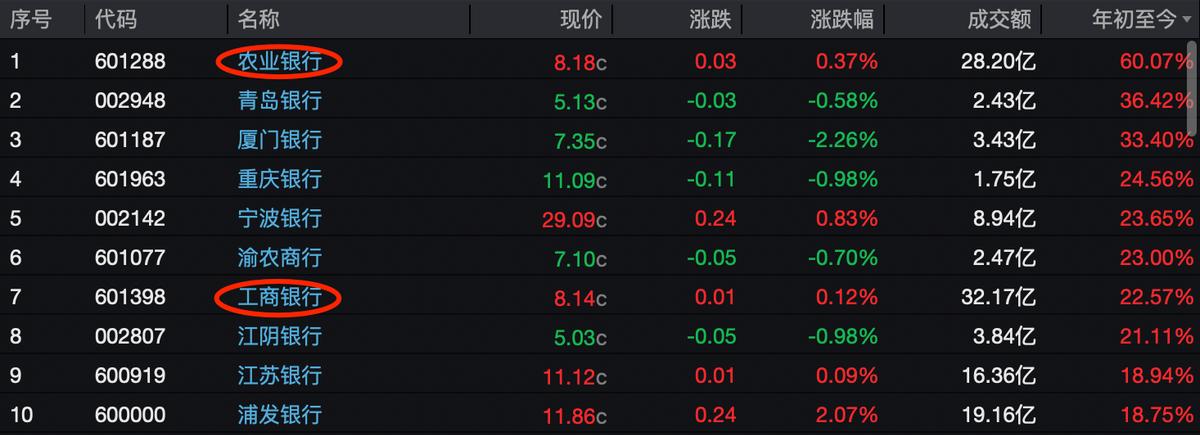
Core Insights - The six major state-owned banks in China reported a total operating income of 27,205.35 billion yuan for the first three quarters of 2025, representing a year-on-year growth of 1.87% [1] - The total net profit attributable to shareholders reached 10,723.43 billion yuan, with a year-on-year increase of 1.22%, equivalent to an average daily profit of 39.14 billion yuan [1] - Agricultural Bank led in net profit growth at 3.03%, while China Bank had the highest revenue growth at 2.69% [1][4] Financial Performance - The total asset size of the six banks reached 217.97 trillion yuan by the end of Q3 2025, marking a 9.16% increase from the previous year [2][9] - Total loans amounted to 127.14 trillion yuan, up 8.54%, while total deposits were 149.76 trillion yuan, reflecting a 6.92% growth [2][12] - The net interest margin for the banks faced pressure, with a decline noted across the board, although non-interest income showed growth, with five banks achieving double-digit increases [1][7] Revenue and Profit Breakdown - In terms of revenue, the banks achieved the following figures: Industrial Bank (6,400.28 billion yuan), Construction Bank (5,737.02 billion yuan), and Agricultural Bank (5,508.76 billion yuan) [4][5] - Non-interest income for the banks was as follows: Industrial Bank (1,666.12 billion yuan), Construction Bank (1,460.96 billion yuan), and Agricultural Bank (1,235.68 billion yuan), with Agricultural Bank showing the highest growth rate at 20.65% [7] - Investment income also saw significant growth, with Construction Bank leading at 150.55% year-on-year [8] Asset Quality and Capital Adequacy - The overall asset quality remained stable, with five banks reporting a decrease in non-performing loan ratios compared to the end of the previous year [15] - The highest non-performing loan ratio was recorded by Postal Savings Bank at 0.94%, while Agricultural Bank had the highest provision coverage ratio at 295.08% [16][17] - Core Tier 1 capital adequacy ratios were robust, with Construction Bank at 14.36%, the highest among the six banks [18] Dividend and Shareholder Returns - The rolling dividend yield for the banks was above 2.5%, significantly higher than the 5-year fixed deposit rates, with the highest yield from the Transportation Bank at 4.10% [1][18]
五家银行跻身绿色信贷“万亿俱乐部” 绿色债券存量规模近2万亿
2 1 Shi Ji Jing Ji Bao Dao· 2025-11-05 23:42
Core Insights - Green finance has transitioned from an optional choice to a mandatory requirement for the banking industry, serving as a new engine for strategic transformation and a blue ocean market for future growth [1] - The balance of green financing at Industrial Bank has reached nearly 2.5 trillion yuan, with green loans exceeding 1 trillion yuan and a non-performing loan rate of only 0.57% [1] - The People's Bank of China and other departments have issued a unified policy framework for green finance, effective from October 1, 2025, to standardize various financial products [2] Group 1: Green Credit Growth - As of the end of 2024, the total balance of green credit among 42 A-share listed banks exceeded 27 trillion yuan, reflecting a year-on-year growth of approximately 20% [3] - State-owned banks dominate the green credit market, with the six major state-owned banks accounting for over 21 trillion yuan, representing 77.6% of the total [3] - Industrial Bank's green loan balance has risen to 1.08 trillion yuan, joining the "trillion club" [3] Group 2: Performance and Sector Focus - The average growth rate of green credit for A-share listed banks in 2024 was 20.6%, a slowdown from approximately 28% in 2023, yet leading institutions maintained strong growth [4] - The focus of green credit issuance is concentrated in four key areas: clean energy, green transportation, energy conservation and environmental protection, and green buildings [4] - The Yangtze River Delta, Guangdong-Hong Kong-Macau Greater Bay Area, and Chengdu-Chongqing Economic Circle are identified as core regions for green credit [4] Group 3: Product Innovation - A-share listed banks are deepening innovation in green financial products, creating a multi-dimensional product system that includes loans, bonds, asset securitization, insurance, and carbon finance [5] - Sustainable Development Linked Loans (SLL), carbon emission rights pledge financing, and environmental rights collateral loans are gaining traction [5] - Industrial Bank has launched the first green loan with biodiversity protection insurance, while Bohai Bank introduced a green loan linked to data center energy efficiency [6] Group 4: Broader Financial Tools - The issuance of green bonds has expanded, with the cumulative issuance of labeled green bonds in 2024 surpassing 4 trillion yuan [6] - Banks are actively participating in green wealth management and fund products, enhancing investor engagement through innovative offerings [6] - Carbon finance tools are transitioning from pilot programs to broader applications, with various banks introducing carbon emission rights pledge financing products [6] Group 5: Future Directions - The banking industry is expected to continue innovating green financial products to support sustainable economic development, moving beyond traditional green credit [7] - The development of ESG-linked loans and financing models using carbon emission rights as collateral will be explored [7] - These innovations will not only assist in achieving national carbon reduction goals but also cultivate new growth momentum for banks [7]


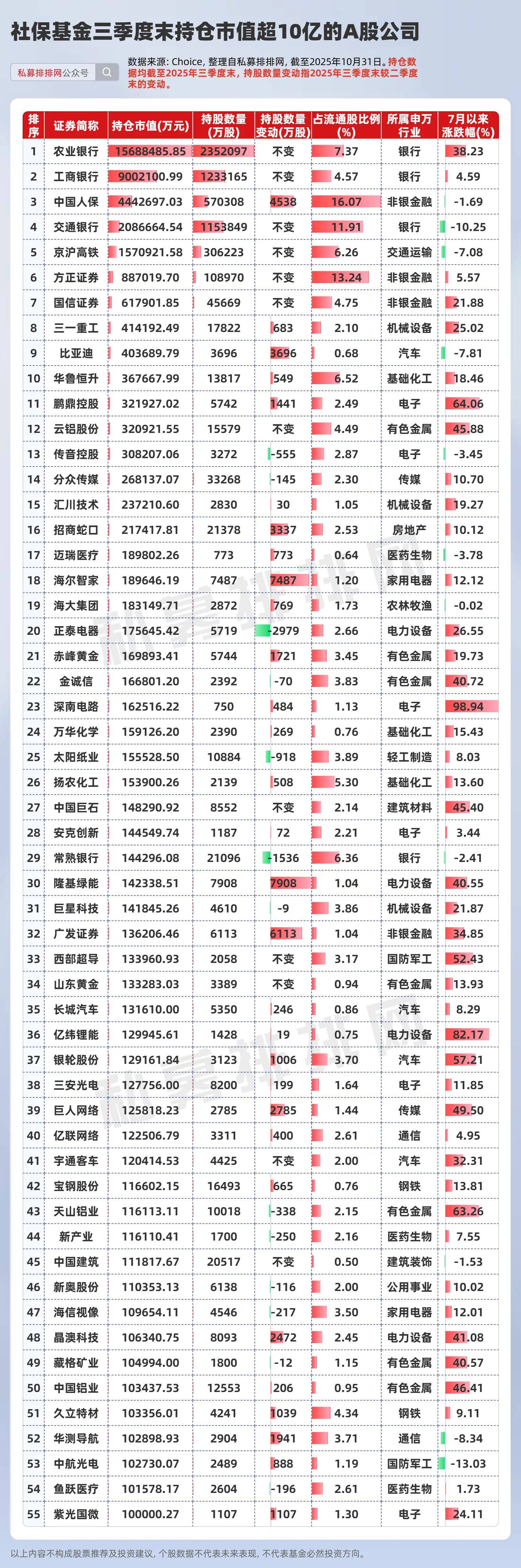
社保基金最新重仓股揭晓!新进比亚迪、隆基绿能等226只个股!
Sou Hu Cai Jing· 2025-11-05 10:26
Core Viewpoint - The Social Security Fund's latest holdings in A-shares reveal significant investment activity, with a total market value of approximately 552.72 billion yuan, reflecting an increase of about 49.81 billion yuan from the previous quarter [1]. Holdings Overview - As of the end of Q3 2025, the Social Security Fund was listed among the top ten shareholders in 622 A-share companies, with a total holding value of approximately 552.72 billion yuan, up from 502.91 billion yuan at the end of Q2 2025 [1]. - The fund initiated positions in 226 new stocks, increased holdings in 153 stocks, reduced holdings in 135 stocks, and maintained positions in 108 stocks [1][19]. Sector Allocation - The majority of the fund's holdings were concentrated in the banking sector, with a market value of 270.06 billion yuan, followed by the non-bank financial sector at approximately 63.04 billion yuan [1]. - The electronics sector, which was ranked sixth in holdings at the end of Q2, moved up to third place by the end of Q3, indicating a shift in investment focus [1]. Major Holdings - Among the 622 companies, 55 had a holding value exceeding 1 billion yuan, accounting for approximately 76.67% of the total holdings [2]. - The top five stocks with holdings exceeding 10 billion yuan were primarily financial stocks, including Agricultural Bank of China, Industrial and Commercial Bank of China, China Life Insurance, and Bank of Communications [2][3]. Performance Insights - The banking sector has shown strong performance in the first half of the year, with Agricultural Bank of China leading with a 38.23% increase [2]. - The Social Security Fund's holdings in the insurance sector saw an increase in shares for China Life Insurance, with a market value of 44.43 billion yuan, despite a slight decline in stock price since July [3]. New Energy Sector Focus - The fund has maintained a significant allocation to the new energy sector, particularly in lithium battery and photovoltaic companies, with 20 new energy companies having a market value exceeding 300 million yuan [9]. - Stocks such as Yiwei Lithium Energy and Sanyuan Electric have seen substantial price increases, with average gains of 45.92% since July [9]. Notable Stock Movements - The fund's adjustments included significant increases in holdings for companies like Guangxin Co., with a 277.97% increase in shares, reflecting a strategic focus on traditional industries [23]. - The fund's new investments included companies in the AI computing and lithium battery supply chain, with some stocks experiencing over 100% price increases since July [13].



交通银行推出“蕴通管账”服务,以高效支付结算赋能企业业财融合
财联社· 2025-11-05 10:19
Core Viewpoint - The article discusses the launch of "交银蕴通·管账" by Bank of Communications, focusing on enhancing corporate payment and settlement services to address pain points such as complex settlement tools, low reconciliation efficiency, and challenging fund supervision, thereby transitioning from a traditional service provider to a value-creating ecosystem enabler [1][2]. Group 1: Service Model and Capabilities - The "蕴通管账" service model is built around four key components: "scene, customer, account, and fund," creating a data-driven management system that integrates financial services with business operations [2]. - The service model leverages three core capabilities: payment and settlement, reconciliation, and fund supervision, offering advantages such as integrated payment solutions, intelligent reconciliation, and effective fund management [2][5]. - The service aims to automate the entire payment process, enhancing efficiency in various business operations, including sales, procurement, and non-operational management scenarios [3][5]. Group 2: Economic Scenarios and Applications - "蕴通管账" provides tailored financial solutions for four major economic scenarios: real economy, livelihood economy, platform economy, and park economy, injecting digital vitality into various sectors [6]. - For the real economy, the service focuses on supply chain collaboration and operational efficiency across procurement, production, and sales processes [6]. - In the livelihood economy, it facilitates seamless payment solutions for public utilities and retail consumption, enhancing user experience through digital channels [6]. - The platform economy is addressed by offering flexible account management and efficient fund distribution solutions for e-commerce and internet finance platforms [6]. - The park economy is supported through integrated financial services for enterprises within parks, enhancing operational management and payment processes [6]. Group 3: Market Position and Future Outlook - Bank of Communications has developed customized solutions for over 30 industries, serving nearly 160,000 government and enterprise clients, showcasing its strong market presence in corporate payment and settlement [7]. - The bank aims to leverage its expertise and financial technology to drive product innovation and ecosystem collaboration, supporting enterprises in achieving financial and operational integration as well as digital transformation [7].

乔宏军任交行金融机构部总经理,徐铁拟任交银理财总裁
Xin Lang Cai Jing· 2025-11-05 08:25
Core Viewpoint - The recent leadership changes at the Bank of Communications indicate a strategic shift in its asset management and financial institution departments, with new appointments aimed at enhancing operational efficiency and governance [1] Group 1: Leadership Changes - The position of General Manager of the Financial Institutions Department and President of the Asset Management Business Center at the Bank of Communications has been filled after a recent vacancy [1] - Xu Tie, previously the General Manager of the Asset Custody Department, has been appointed to lead the Financial Institutions Department and the Asset Management Business Center [1] - Qiao Hongjun, the current President of the Anhui Branch, is set to take over as General Manager of the Financial Institutions Department and President of the Asset Management Business Center [1] Group 2: Transition Details - The previous head, Yuan Qingwei, was reassigned to manage the Bank of Communications Schroder Fund in June, leading to the vacancy [1] - Xu Tie's transition to the role of Deputy Secretary of the Party Committee at the Bank of Communications Wealth Management is pending regulatory approval for his appointment as President [1]
21独家|乔宏军任交行金融机构部总经理,徐铁拟任交银理财总裁
2 1 Shi Ji Jing Ji Bao Dao· 2025-11-05 08:20
Core Insights - The recent personnel changes at Bank of Communications include the appointment of Qiao Hongjun as the new General Manager of the Financial Institutions Department and President of the Asset Management Business Center, following the vacancy left by Yuan Qingwei's transfer to a different role [1][4] - Xu Tie, who previously held the position, has been appointed as the Deputy Secretary of the Party Committee at Bank of Communications Wealth Management, pending regulatory approval for his new role as President [1][2] Group 1: Personnel Changes - Qiao Hongjun, an experienced economist with a PhD, has held various significant positions within the bank since joining in 2002, including roles in the Financial Markets Department and as Vice President of the Asset Management Business Center [2][3] - The recent appointments are part of a broader trend of frequent personnel changes within the bank, particularly at the mid-to-senior management levels [5] Group 2: Background of Key Personnel - Qiao Hongjun has a strong background in financial market management, investment trading, risk management, and financial system development, which likely influenced his appointment [3] - Xu Tie has extensive experience in asset custody and has held several key positions within the bank, contributing to his recent appointment [3][4]