
NCI(601336)

Search documents
一则大消息!这个板块掀“涨停潮”
天天基金网· 2026-01-13 05:19
Market Overview - On January 13, the A-share market saw a collective decline in the three major indices, with the Shanghai Composite Index closing at 4163.84 points, down 0.03% [2] - The Shenzhen Component Index fell by 0.31%, and the ChiNext Index decreased by 0.83% [2][3] - A total of 2427 stocks rose while 2862 stocks fell, indicating a mixed market sentiment [3] Sector Performance - The healthcare services, lithium mining, precious metals, and insurance sectors showed strong performance, while sectors such as commercial aerospace, communication equipment, and shipbuilding faced declines [3][4] - Lithium mining stocks experienced a significant surge, with companies like Tibet Summit reaching a 10% limit up, and others like Salt Lake Co. and Ganfeng Lithium rising over 7% [6][7] Lithium Mining Sector - The lithium mining sector saw a notable rally, with the main contract for lithium carbonate futures on the Shanghai Futures Exchange surpassing 170,000 yuan per ton, marking a rise of over 9% [6] - Key stocks in this sector include: - Tibet Summit: 19.49 yuan, up 9.99%, market cap of 17.8 billion yuan - Ganfeng Lithium: 72.83 yuan, up 7.15%, market cap of 144.5 billion yuan - Salt Lake Co.: 34.24 yuan, up 7.13%, market cap of 181.2 billion yuan [7] Insurance Sector - The financial sector was active, with the insurance sector showing strength. China Life Insurance rose over 3%, reaching 50.94 yuan per share, with a market cap of 1.2794 trillion yuan [10] - China Ping An increased by over 2%, priced at 68.92 yuan per share, with a market cap of 1.2034 trillion yuan [12] - Analysts predict that by 2026, new premium income for listed insurance companies will achieve double-digit growth, driven primarily by the bancassurance channel [15] AI Healthcare Sector - AI healthcare stocks were notably active, with several companies hitting the daily limit up. Notable performers included: - Nossg: 76.48 yuan, up 20.01%, market cap of 7.4 billion yuan - Pruis: 72.24 yuan, up 20.00%, market cap of 5.7 billion yuan - Hongbo Medicine: 56.64 yuan, up 20.00%, market cap of 7.9 billion yuan [18] - Nvidia announced a joint investment of $1 billion with Eli Lilly to establish an AI drug laboratory, which is expected to accelerate medical discoveries [17] Precious Metals Sector - The precious metals sector saw a significant rise, with spot gold prices reaching a record high of $4630.28 per ounce [20] - Key stocks in this sector include: - Hunan Silver: 9.21 yuan, up 9.90%, market cap of 26 billion yuan - Xiaocheng Technology: 38.54 yuan, up 8.72%, market cap of 10.6 billion yuan [21]





A股午评:沪指微跌0.03%、创业板指跌0.83%,AI应用概念股活跃,商业航天及可控核聚变概念走低
Jin Rong Jie· 2026-01-13 03:41
Market Overview - The A-share market experienced a narrow fluctuation with the Shanghai Composite Index down 0.03% at 4163.84 points, the Shenzhen Component down 0.31% at 14321.8 points, and the ChiNext Index down 0.83% at 3360.23 points, as well as the STAR Market Index down 1.77% at 1485.01 points, with a total trading volume of 2.44 trillion yuan and over 2800 stocks declining [1] Hot Sectors - The AI application sector led the market, with stocks like Easy Point World, Liou Shares, and Gravity Media hitting the daily limit, while AI medical concepts remained active with companies like Meian Health and Dean Diagnostics achieving three consecutive limit-ups [2][1] - The innovative drug sector saw significant gains, with Hongbo Pharmaceutical hitting the daily limit and other companies like Chengdu Xian Dao and Rui Zhi Pharmaceutical rising over 10% [3] - The insurance sector remained active, with China Life rising over 4% and other major insurers following suit, driven by policy support and macroeconomic changes [4] Securities Sector - The securities sector showed a rising trend, with Huayin Securities hitting the limit and other firms like Founder Securities and GF Securities also experiencing gains [5] Trading Volume - The trading volume in the Shanghai and Shenzhen markets reached a record high of 3.6 trillion yuan, indicating strong market activity [6] Institutional Insights - Zhongtai Securities noted that the market may maintain active trading under policy support, with long-term funds providing a necessary liquidity condition [7] - Dongfang Securities commented on the current healthy market trend, despite concerns about potential adjustments due to increased trading volume [8][9] - CITIC Securities highlighted the potential impact of the cancellation of export tax rebates for the photovoltaic industry, suggesting short-term challenges but long-term opportunities for high-quality development [10]






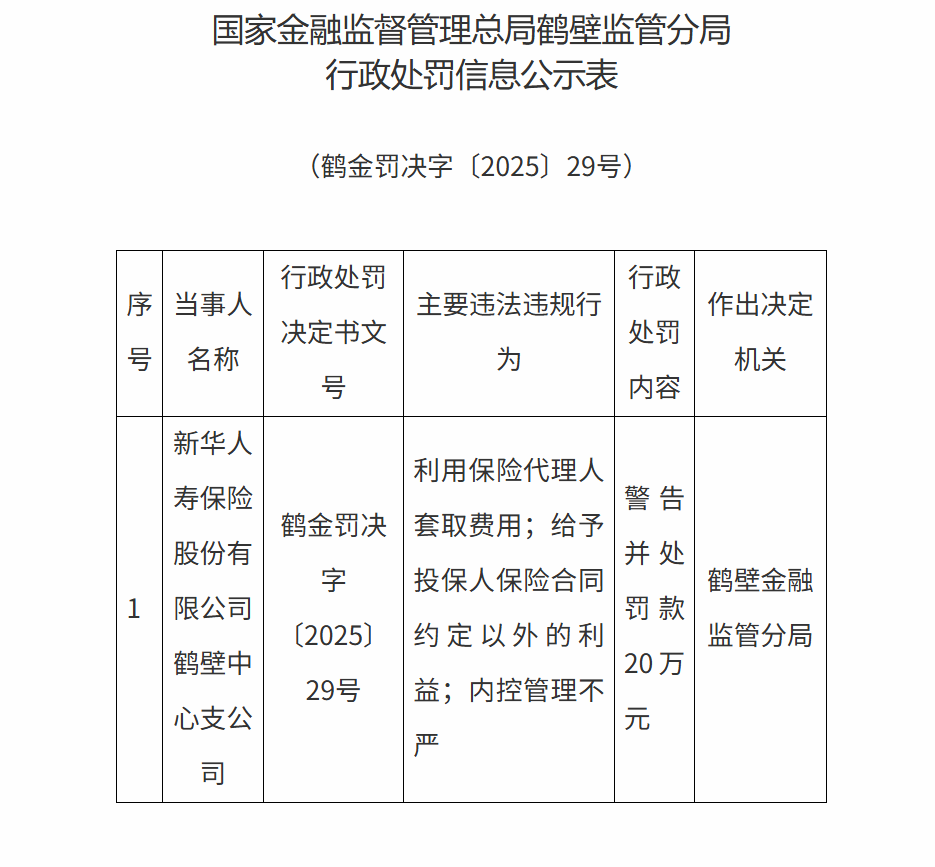
新华人寿鹤壁中心支公司被罚款20万元 因利用保险代理人套取费用等3项违规
Feng Huang Wang Cai Jing· 2026-01-13 03:10
Group 1 - The core point of the article is that Xinhua Life Insurance's Hebi branch has been penalized for regulatory violations, including the misuse of insurance agents to extract fees and providing benefits outside of the insurance contract to policyholders, resulting in a warning and a fine of 200,000 yuan [1][3]. Group 2 - The administrative penalty includes a warning and a fine of 200,000 yuan imposed by the regulatory authority [1][3]. - The violations identified include the use of insurance agents to extract fees and offering benefits to policyholders that were not stipulated in the insurance contracts, as well as inadequate internal control management [1][3].

内险股表现强势 2026年开门红数据超预期 到期存款有望向保险配置转移
Zhi Tong Cai Jing· 2026-01-13 02:33
Core Viewpoint - The strong performance of insurance stocks is driven by better-than-expected data for the 2026 New Year sales, with leading insurance companies showing significant growth in new policies [1] Group 1: Stock Performance - China Ping An (601318) rose by 2.85% to HKD 70.45 [1] - China Pacific Insurance (02328) increased by 2.52% to HKD 16.66 [1] - China Life (601628) saw a rise of 2.32% to HKD 32.62 [1] - New China Life (601336) grew by 2.14% to HKD 62.15 [1] Group 2: Market Drivers - Huaxi Securities reported that the strong performance in new policy sales during the 2026 New Year period, with some leading insurers showing over 70% year-on-year growth in new policies, is a direct catalyst for the current rise in insurance stocks [1] - The low base from the previous year contributes to the strong momentum observed in the leading insurance companies this year [1] Group 3: Investment Trends - Insurance products are expected to attract part of the funds from savings due to their relative yield advantages [1] - Concerns regarding interest margin losses have significantly eased, leading to a gradual elimination of valuation pressures on the sector [1] Group 4: Future Projections - Guojin Securities anticipates that the shift of bank insurance will drive high growth in new policies and new business value (NBV) in 2026 [1] - Since 2020, residents have increased their precautionary savings, with new deposits consistently exceeding CNY 10 trillion, particularly in 2021, 2023, and 2024, with new deposits of CNY 9.9 trillion, CNY 16.67 trillion, and CNY 14.26 trillion respectively [1] - A significant portion of these high-interest deposits is expected to mature in 2026, with a potential shift of funds towards insurance products amid declining deposit rates and a shortage of medium to long-term deposit supply [1]


保险板块短线拉升,中国人保涨超2%
Mei Ri Jing Ji Xin Wen· 2026-01-13 02:12
每经AI快讯,1月13日,保险板块短线拉升,中国人保、新华保险、中国人寿、中国平安均涨超2%。 每日经济新闻 ...

香港 & 中国保险 -2026 展望:回归有效估值框架-Hong KongChina Insurance-2026 Outlook - Returning to an Effective Valuation Framework
2026-01-13 02:11
Summary of the Conference Call on Hong Kong/China Insurance Industry Industry Overview - The insurance industry in Asia Pacific, particularly in China, is viewed as Attractive, with expectations for continued re-rating driven by strong sales growth, improved quality, and a favorable investment environment [1][7] - Concerns regarding interest rate spread loss risks are anticipated to ease further, supporting the positive outlook for insurers [1][2] Core Insights - The insurance segment outperformed the market in 2024-25, primarily due to asset-side catalysts and stabilized interest rates since the second half of 2025 [2] - For 2026, a dual boost is expected from both asset and liability sides, with strong Value of New Business (VNB) growth anticipated, improved product mix, channel margins, and productivity [2] - The market sentiment remains healthy, contributing to expectations of improved underlying earnings and enterprise value (EV) for China insurers [2] Investment Trends - In 2025, insurers increased their stock market allocations significantly, with over Rmb1 trillion of new inflows estimated [3] - A similar trend is expected in 2026, with regulatory modifications potentially allowing for further relaxation of equity investment capital consumption [3] Stock Preferences - The preference order for stocks is: Ping An (Top Pick), followed by China Life, CPIC, AIA, and PICC P&C [4] - Ping An is highlighted for its strong performance potential, while China Life H and CPIC H are also expected to benefit from industry-wide tailwinds [4] Risks - Identified downside risks include lower interest rates, a sluggish stock market, and unexpected regulatory tightening [5] Performance Metrics - The insurance sector saw a broad-based re-rating in 2025, with notable stock performance: New China Life (+130%), China Life (+87%), Prudential (+93%), and PICC Group (+74%) [13] - H-shares outperformed broader benchmarks, with significant gains compared to the Hang Seng Index (HSI) and the Hang Seng China Enterprises Index (HSCEI) [13] Valuation Insights - Valuation upside is anticipated through Price-to-Book (P/B), Price-to-Enterprise Value (P/EV), and Price-to-Earnings (P/E) ratios, with expectations for mid-teens return on equity (ROE) and double-digit VNB growth [2][52] - The current P/B for H-share life names is around 1.0-1.3x, with potential to rise to 1.3-1.5x [53] Regulatory Environment - The regulatory environment is seen as supportive, with favorable policies emerging since late 2023 to mitigate risks and encourage long-term investments in the stock market [61] - Upcoming modifications to solvency rules are expected, which could impact capital levels and investment strategies [67][69] Key Drivers of Demand - The expansion of household financial assets in China is a significant multi-year demand tailwind, projected to grow to Rmb440 trillion by 2030 [19] - Increasing demand for senior care and healthcare services is expected to drive insurance product appeal and retention [20] Conclusion - The outlook for the Hong Kong/China insurance industry remains positive, with strong growth potential driven by favorable market conditions, regulatory support, and evolving consumer needs in financial and healthcare services [1][2][61]
保险股集体走强,中国人寿涨超4%
Ge Long Hui· 2026-01-13 02:10
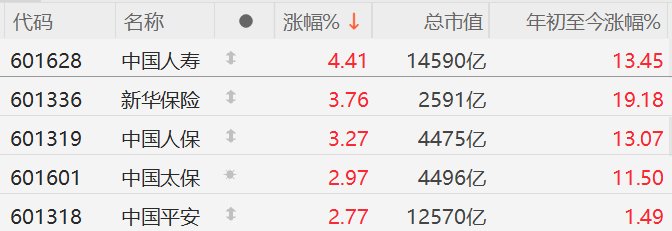
Core Viewpoint - The A-share market saw a collective rise in insurance stocks on January 13, with notable increases in major companies' stock prices [1] Group 1: Company Performance - China Life Insurance experienced a stock price increase of over 4% [1] - New China Life Insurance and China Pacific Insurance both saw stock price rises of over 3% [1] - China Insurance and Ping An Insurance recorded stock price increases of nearly 3% [1]
A股保险股集体走强,中国人寿涨超4%
Ge Long Hui A P P· 2026-01-13 02:05
格隆汇1月13日|A股市场保险股集体走强,其中,中国人寿涨超4%,新华保险、中国人保涨超3%,中 国太保、中国平安涨近3%。 MACD金叉信号形成,这些股涨势不错! | 代码 | 名称 | . | 涨幅%↓ | 总市值 | 年初至今涨幅% | | --- | --- | --- | --- | --- | --- | | 601628 | 中国人寿 | 1 | 4.41 | 14590亿 | 13.45 | | 601336 | 新华保险 | + | 3.76 | 2591亿 | 19.18 | | 601319 | 中国人保 | 1 | 3.27 | 4475亿 | 13.07 | | 601601 | 中国太保 | 安 | 2.97 | 4496亿 | 11.50 | | 601318 | 中国平安 | 1 | 2.77 | 12570亿 | 1.49 | ...
保险板块短线拉升,中国人保等股涨超2%
Xin Lang Cai Jing· 2026-01-13 01:53
1月13日金融一线消息,保险板块短线拉升,中国人保、新华保险、中国人寿、中国平安均涨超2%。 责任编辑:王馨茹 1月13日金融一线消息,保险板块短线拉升,中国人保、新华保险、中国人寿、中国平安均涨超2%。 责任编辑:王馨茹 ...
保险股接下来怎么看
2026-01-13 01:10
Summary of Conference Call on Insurance Sector Industry Overview - The insurance sector is currently experiencing low valuations, with China Pacific Insurance (CPIC) and Ping An Insurance (Group) Company of China, Ltd. (Ping An) having P/EV ratios of approximately 0.7 and 0.8 respectively for 2026, indicating rapid growth in intrinsic value [1][2] - China Life Insurance Company Limited (China Life) has a higher valuation in the A-share market at around 0.9 times P/EV, attributed to its faster growth in intrinsic value, but the Hong Kong-listed version is recommended due to significant discounts compared to A-shares [3][4] Key Insights and Arguments - The quality of pre-receipt data from late 2025 to early 2026 is strong, with a decline in bank deposit rates leading to increased funds flowing into insurance products. It is expected that premium growth will be high in the first quarter of 2026 but may face pressure in the third quarter [1][5] - Rising interest rates are beneficial for insurance companies' fixed-income investments, alleviating risks associated with interest spread losses. The yield on 10-year government bonds has risen to approximately 1.9%, an increase of 30 basis points from the previous year [5][7] - The proportion of equity assets in insurance companies is around 15.5%. A strong stock market will enhance insurance companies' earnings [5][7] Impact of Dividend Insurance Products - Dividend insurance products have a shorter effective duration, allowing insurance companies to be more flexible in their fixed-income asset allocation and increasing their risk appetite. It is anticipated that dividend insurance will constitute a significant portion of new premium growth [6][9] Investment Strategies and Profit Expectations - Insurance companies are focusing on increasing their equity allocation to benefit from stock market gains. Despite a solid profit outlook for 2025, the primary profit source is expected to be in the third quarter, with a relatively low profit base in the first half of 2026 [8] - The anticipated performance for the first quarter of 2026 is optimistic, with expectations that even if the market's growth in the third quarter is lower than the previous year, profits will remain stable [8] Market Performance and Forecasts - Recent performance of insurance stocks has been strong, with notable increases in share prices for Xinhua Insurance and CPIC at the start of 2026. However, Ping An's performance has been more volatile [2] - By the end of January, major insurance companies are expected to release profit forecasts. China Life and Xinhua Insurance are likely to announce forecasts, while Ping An's profit growth is projected to be lower than 50% for the year [11] Industry Valuation and Future Outlook - The overall outlook for the insurance industry in the first half of 2026 is optimistic, with no significant negative factors affecting the asset and liability sides. Valuations could reach 1.5 times PEV under favorable market conditions, while they may drop to 0.7 to 0.8 times PEV under poor conditions [12] - The policy environment remains supportive, and large listed companies are expected to continue outperforming smaller firms in premium growth, enhancing their market share [12]