
NCI(601336)

Search documents
银保渠道锁定26年新单增长主阵地
Ge Long Hui· 2026-01-13 00:08
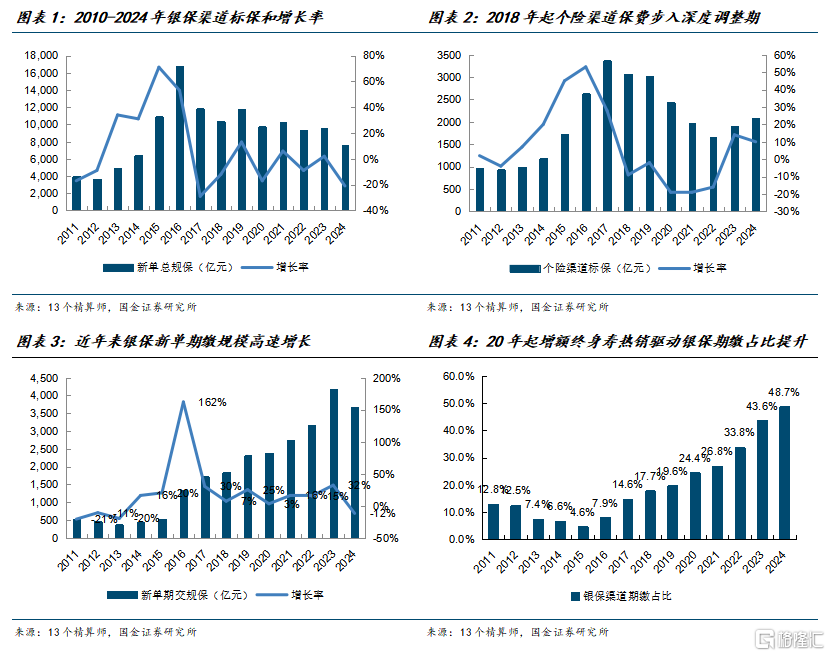
Investment Logic - The core view is that new individual insurance premiums for listed insurance companies are expected to achieve double-digit growth by 2026, primarily driven by the bancassurance channel [1][18] - The individual insurance channel is anticipated to maintain steady growth, while the bancassurance channel will benefit from the migration of deposits, leading to an increase in market share for large insurance companies [1][18] - The growth in the bancassurance channel is expected to dilute fixed costs, significantly enhancing overall profitability [1][18] Bancassurance Channel - Since 2020, leading insurance companies have refocused on the bancassurance channel, transitioning from scale compensation to value pursuit, resulting in a rise in market share [2][8] - The bancassurance channel has seen a compound annual growth rate (CAGR) of 16.2% from 2019 to 2023, while individual insurance premiums have declined [9] - The "reporting and banking integration" policy implemented in August 2023 has significantly reduced costs, enhancing the value rate of the bancassurance channel [14][9] Customer Deposit Analysis - A survey of 88 frontline bank wealth managers indicates that a significant portion of residents' deposits will mature in 2026, with expectations of low renewal rates due to the withdrawal of high-yield time deposits [3][25] - The majority of maturing depositors are aged 45 and above, indicating a lower risk appetite, with insurance products being the second choice for reallocating maturing deposits [4][30] - Wealth managers believe that bank wealth management products will be the most accepted option for maturing deposits, followed by insurance products [30][27] Sales Logic for Insurance Products - Wealth managers prioritize customer returns and the brand of insurance companies when recommending insurance products [5][33] - The core advantages of participating in dividend insurance sales include stable returns, capital safety, and alignment with long-term financial planning [36][40] - Challenges in selling dividend insurance include uncertainty in returns and the long duration of products, which may deter potential customers [40][36] Market Forecast - The insurance industry is projected to see new single premium growth exceeding 25% in 2026, driven by the bancassurance channel [42][44] - The expected influx of maturing deposits into insurance products will be significant, with estimates of new funds in the bancassurance channel reaching 11,150 billion by the end of 2026 [44][44] - The concentration trend among leading insurance companies is expected to continue, with larger firms benefiting from improved profitability in the bancassurance channel [47][48]




保险板块1月12日跌0.47%,中国太保领跌,主力资金净流出26.61亿元
Zheng Xing Xing Ye Ri Bao· 2026-01-12 09:04
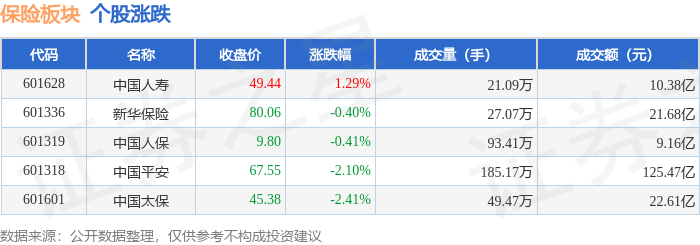
Group 1 - The insurance sector experienced a decline of 0.47% on January 12, with China Pacific Insurance leading the drop [1] - The Shanghai Composite Index closed at 4165.29, up 1.09%, while the Shenzhen Component Index closed at 14366.91, up 1.75% [1] - Key individual stock performances included China Life Insurance up 1.29% to 49.44, while China Pacific Insurance fell 2.41% to 45.38 [1] Group 2 - The insurance sector saw a net outflow of 2.661 billion yuan from institutional investors, while retail investors had a net inflow of 1.387 billion yuan [1] - Specific stock fund flows indicated that China Life Insurance had a net outflow of 89.416 million yuan from institutional investors [2] - China Pacific Insurance experienced a net outflow of 114 million yuan from institutional investors, with a retail net inflow of 107 million yuan [2]


春季行情启动如何配置,如何交易?
ZHONGTAI SECURITIES· 2026-01-12 07:53
Group 1 - The current market uptrend is supported by long-term capital inflows and strong performance from the insurance sector, with the A500 ETF seeing significant net inflows of nearly 100 billion RMB in December 2025, contributing to market buoyancy [4][8][12] - The "spring rally" is characterized by a seasonal pattern in the A-share market, typically occurring from late December to the first quarter, driven by macroeconomic policies, liquidity conditions, and the timing of financial reports [5][22][24] - Historical data from 2016 to 2025 indicates that the spring rally usually starts in late January and lasts about 30 trading days, with an average index increase of approximately 15% [24][25][31] Group 2 - The macroeconomic environment for 2026 is expected to remain in a weak recovery phase, with structural support for technology-related sectors likely to continue, as policies emphasize growth and technological advancement [33][37][38] - The transition from old to new economic drivers is showing initial results, with several high-tech companies moving from policy-driven growth to performance validation, which is crucial for sustained investment confidence [40][41][45] - The market is likely to experience active trading with structural opportunities rather than a broad-based rally, as long-term capital and policy support create a conducive environment for thematic investments [48][49][50] Group 3 - Investment recommendations suggest prioritizing small-cap growth and innovation-driven sectors, as these areas are expected to benefit from improved liquidity and risk appetite [57][58] - The strategy should focus on short-term trend tracking and rapid rotation among themes, as the market dynamics are driven more by policy and industry expectations than by fundamental improvements [60][61] - The securities and financial technology sectors are expected to benefit from increased trading volumes and active leverage, while the insurance sector is positioned for long-term growth due to favorable market conditions and improved investment returns [63][64]
存款搬家与市占率提升双重加持,银保渠道锁定26年新单增长主阵地
SINOLINK SECURITIES· 2026-01-12 05:16
Investment Rating - The report maintains a positive investment rating, recommending continued active investment in the insurance sector due to expected double-digit growth in new premiums driven by the bancassurance channel [5]. Core Insights - The insurance industry is projected to achieve double-digit growth in new premiums by 2026, primarily driven by the bancassurance channel, which benefits from the migration of deposits and the competitive advantages of large insurance companies [1][26]. - The bancassurance channel has seen a significant increase in market share, with the "old seven" insurance companies' new premium market share rising from 8.2% in 2019 to 23.8% in 2023, and expected to reach 26.0% in 2024 [2][22]. - A survey of 88 frontline bank wealth managers indicates that a substantial portion of household deposits will mature in 2026, with expectations that many will not be renewed, leading to a shift towards insurance products [3][35]. - The demographic of clients with maturing deposits is predominantly older, with a lower risk appetite, making insurance products a preferred option for reallocating funds [4][40]. - The report highlights that the bancassurance channel's growth will significantly enhance the overall profitability of large insurance companies by spreading fixed costs over a larger premium base [1][26]. Summary by Sections Bancassurance Channel - The bancassurance channel is identified as the main driver of value growth in the insurance industry for 2026, with a compound annual growth rate of 16.2% from 2019 to 2023 [12]. - The report notes that the shift in focus from individual insurance channels to bancassurance began in 2020, driven by the need to compensate for declining individual premium growth [2][12]. Bank Wealth Manager Survey Analysis - The survey indicates that a significant portion of maturing deposits will not be renewed, with expectations that 50% of clients will have deposits maturing in the 10%-30% and 30%-50% ranges [3][35]. - Wealth managers believe that the most acceptable financial products for clients will be bank wealth management and insurance, with insurance ranking second [4][40]. Projections for 2026 - The report estimates that the new premium growth rate for the bancassurance channel will exceed 25% in 2026, with expected incremental funds of 3,057 billion in January, 5,094 billion in Q1, and 11,150 billion for the entire year [5][62]. - The anticipated growth is attributed to the large volume of maturing deposits and the expected shift towards insurance products due to lower renewal rates for traditional bank deposits [60].
2025年保险业两千余张罚单罚超4亿,百万级“大单”频出,49人遭终身禁业
Xin Lang Cai Jing· 2026-01-12 01:40
Core Viewpoint - The insurance industry in 2025 continues to experience strict regulation, with approximately 2300 fines issued totaling around 407 million yuan, primarily for violations such as providing benefits outside of contracts, false financial data, and fabricating business to extract funds [2][3][16]. Regulatory Actions - In 2025, the regulatory body issued about 2300 fines affecting approximately 1381 insurance companies and branches, with a total penalty amount of about 407 million yuan [3][17]. - The number of fines decreased compared to 2024, but the total amount of fines significantly increased [3][17]. - The distribution of fines shows that property insurance companies received 1018 fines (43.9%), while life insurance companies received 968 fines (41.74%) [3][17]. Penalty Details - The first quarter saw 600 fines totaling 108 million yuan, the second quarter had 453 fines totaling 62 million yuan, the third quarter had 632 fines totaling 134 million yuan, and the fourth quarter had 634 fines totaling 103 million yuan [4][18]. - Major companies like People's Insurance Company and Taikang Online received fines exceeding 10 million yuan, while others like Dadi Insurance and Beida Fangzheng Life received fines over 2 million yuan [6][20]. Individual Accountability - The "double penalty system" has become the norm, with 2268 warnings and 2239 fines issued to individuals, totaling approximately 83.76 million yuan in penalties [9][22]. - A total of 119 individuals were banned from the insurance industry, with 49 receiving lifetime bans [9][22]. Violations and Compliance Issues - Common violations include providing benefits outside of contracts, false financial data, and fabricating business to extract funds [6][19]. - Experts indicate that the root cause of persistent violations is the tendency of some institutions, especially leading ones, to prioritize scale over compliance, leading to practices that disrupt market order and undermine the industry's solvency [6][19]. Impact of Regulatory Changes - The increase in penalties, particularly lifetime bans for key personnel, aims to shift the focus from institutional penalties to individual accountability, enhancing compliance within the industry [12][22]. - The regulatory environment is evolving towards a more quality-focused and accountability-driven approach, compelling institutions to abandon lax operational practices [5][19].

资负两端全面改善,保险迎开年行情
HUAXI Securities· 2026-01-11 12:27
Investment Rating - The report rates the insurance industry as "Recommended" [1] Core Insights - The insurance sector has shown significant improvement, with the Insurance II index rising by 19.5% and the Hong Kong Insurance index by 13.5% from December 4, 2025, to January 9, 2026 [1] - Major insurance companies have reported strong new business growth, with some top firms seeing over 70% year-on-year growth in new policies during the first three days of 2026 [2] - The overall premium income for life insurance from January to November 2025 increased by 9.1% year-on-year, indicating a recovery in the liability side of the business [2] - The decline in deposit rates and the scarcity of large-denomination time deposits are expected to drive more funds into insurance products, which offer relatively higher returns [2] Summary by Sections Stock Performance - China Pacific Insurance led A-share gains with a 32.1% increase, followed by New China Life at 25.4%, China Life at 12.5%, and others [1][8] - In H-shares, New China Life also led with a 30.9% increase, while China Ping An and China Pacific Insurance followed with 23.6% and 21.7% respectively [1][8] Valuation and Earnings Forecast - The average Price to Embedded Value (PEV) for major A-share insurers ranges from 0.76 to 0.93, while H-share PEVs range from 0.54 to 0.76, indicating that valuations are still below historical averages [4] - The report forecasts earnings per share (EPS) growth for key companies, with China Ping An expected to reach an EPS of 8.08 in 2026, while China Pacific Insurance is projected at 4.80 [6][9] Investment Recommendations - The report suggests a positive outlook for leading insurers due to improved fundamentals and the potential for valuation recovery, particularly for China Ping An, China Pacific Insurance, and New China Life [4]
非车险“报行合一”最权威解释出炉;利明光接任中国人寿法人;中国人寿2025年理赔金额超1004亿|13精周报
13个精算师· 2026-01-10 03:04
Regulatory Dynamics - The Financial Regulatory Bureau has provided the most authoritative explanation for the "reporting and operation integration" of non-auto insurance [6] - The Guangdong Financial Regulatory Bureau is promoting the establishment of private equity securities investment funds by insurance companies in Guangdong [11] - The Jiangxi government supports insurance institutions in enhancing risk reduction service levels and providing comprehensive insurance solutions for technology-based enterprises [14] Company Dynamics - Ping An Life has made its fourth stake increase in China Merchants Bank H-shares, reaching a holding ratio of over 20% [18] - Ping An Life has also increased its stake in Agricultural Bank of China H-shares to over 20% [19] - Sunshine Life plans to reduce its stake in Huakang Clean by 3% [22] - China Life has reported over 62.24 million claims in 2025, with total payouts exceeding 100.4 billion [32] - New China Life reported a maximum payout of 10.5 million in 2025 [33] - People's Insurance Company of China reported over 2 billion claims in 2025, with a year-on-year growth of over 10% [36] Industry Dynamics - The short-term large-denomination deposit rates have entered the "0" range, with experts predicting a continued downward trend [47] - Insurance stocks have collectively surged, with Ping An, New China Life, and China Pacific Insurance reaching historical highs [49][50] - The issuance scale of insurance companies' bonds has exceeded 100 billion for three consecutive years [54] - 93.4% of combination-type insurance asset management products achieved positive returns in 2025 [55] - The insurance industry has entered a new cycle of predetermined interest rates, with significant changes in pricing logic [56]

45-59岁重疾出险高达五成,国寿、人保、新华理赔年报出炉
2 1 Shi Ji Jing Ji Bao Dao· 2026-01-09 12:04
Core Insights - The insurance industry in China has shown a significant increase in claims payments for 2025, indicating a shift in the role of commercial insurance towards becoming a more integral part of daily healthcare payments [1][3][4] Group 1: Claims Payment Trends - The total claims amount for China Life Insurance exceeded 100.4 billion yuan, a year-on-year increase of 10% [1] - New China Life Insurance reported a total claims amount of 14.7 billion yuan, averaging 40.29 million yuan per day [1] - The number of medical claims has surged, with Fude Life Insurance reporting 319,700 medical claims out of a total of 351,100 claims, representing 91.06% of their total claims [3] Group 2: Health Risks and Demographics - Malignant tumors remain the leading health risk, accounting for 69.84% of critical illness claims, with a higher incidence in women [3][4] - The age group of 45 to 59 years represents 55.48% of critical illness claims, highlighting a significant protection gap for this demographic [4] Group 3: Technological Advancements in Claims Processing - The adoption of AI and big data technologies has led to significant improvements in claims processing efficiency, with some companies achieving claims processing times in minutes or even seconds [5][6] - Fude Life Insurance reported an average claims processing time of 1.17 days, with a review time of only 0.36 days [6] Group 4: Support for National Strategies and Social Welfare - The insurance sector is increasingly involved in supporting national strategies, such as rural revitalization and disaster reduction, with China Life Insurance serving over 4.54 million rural residents and paying out over 15.8 billion yuan [7][8] - Insurance companies are also focusing on aging populations, with China Life Insurance providing services to over 15.17 million elderly clients and paying out over 11.3 billion yuan [8] Group 5: Emergency Response and Risk Management - The insurance industry has demonstrated its role as a "social stabilizer" by activating emergency claims services in response to natural disasters and accidents, with Fude Life Insurance initiating emergency claims services 31 times in 2025 [9] - China Pacific Insurance responded to 244 natural disasters and accidents, paying out over 13 billion yuan in disaster claims [9]

金融行业双周报(2025/12/26-2026/1/8):2025年证券行业多项核心指标创历史新高-20260109
Dongguan Securities· 2026-01-09 12:03
Investment Ratings - Banking: Overweight (Maintain) [1] - Securities: Market Weight (Maintain) [1] - Insurance: Overweight (Maintain) [1] Core Insights - The banking sector shows a continued growth trend in social financing, with a marginal decrease in the contribution of government bonds. Corporate bonds increased by 178.8 billion yuan year-on-year, becoming the main increment in social financing. However, the demand for loans remains weak, with a year-on-year decrease of 190 billion yuan in new RMB loans in November [5][44]. - The securities industry has seen multiple core indicators reach historical highs in 2025, with total stock fund transaction volume exceeding 500 trillion yuan, a year-on-year increase of over 70%. The primary market has rebounded, with IPO and refinancing scales increasing by 95.64% and 326.17% respectively, indicating improved market liquidity and financing conditions [3][46]. - The insurance sector reported a total original premium income of 57,629 billion yuan in the first 11 months of 2025, a year-on-year growth of 7.6%. Life insurance companies saw a 9.1% increase in premium income, while property insurance companies grew by 3.9% [4][47]. Summary by Sections Market Review - As of January 8, 2026, the banking, securities, and insurance indices changed by -0.87%, +0.91%, and +1.95% respectively, while the CSI 300 index increased by +2.05%. Among 31 industries, the banking and non-banking sectors ranked 29th and 21st in performance [5][13]. Valuation Situation - As of January 8, 2026, the PB ratio for the banking sector is 0.74, with state-owned banks, joint-stock banks, city commercial banks, and rural commercial banks having PB ratios of 0.79, 0.61, 0.71, and 0.63 respectively. Notably, China Merchants Bank, Agricultural Bank of China, and Ningbo Bank have the highest valuations at 0.96, 0.95, and 0.87 [22][24]. Recent Market Indicators - The one-year MLF operation rate is 2.0%, with LPR rates at 3.0% for one year and 3.50% for five years. The average interbank borrowing rates for one day, seven days, and fourteen days are 1.33%, 1.50%, and 1.60% respectively [29][30]. Industry News - The China Banking and Insurance Regulatory Commission has released guidelines for data classification and grading in the insurance asset management industry, effective January 1, 2026, aimed at enhancing data security management standards [39][40].


金融行业双周报(2025、12、26-2026、1、8)-20260109
Dongguan Securities· 2026-01-09 10:32
Investment Ratings - Banking: Overweight (Maintain) [1] - Securities: Market Weight (Maintain) [1] - Insurance: Overweight (Maintain) [1] Core Insights - The banking sector shows a continued growth trend in social financing, with a marginal decrease in the contribution of government bonds. Corporate bonds increased by 178.8 billion yuan year-on-year, becoming the main increment in social financing. However, the demand for loans remains weak, with a year-on-year decrease of 190 billion yuan in new RMB loans in November [5][44]. - The securities industry has seen multiple core indicators reach historical highs in 2025, with total stock fund transaction volume exceeding 500 trillion yuan, a year-on-year increase of over 70%. The primary market has rebounded, with IPO and refinancing scales increasing by 95.64% and 326.17% respectively, indicating improved market liquidity and a favorable financing environment [3][46]. - The insurance sector reported a total original premium income of 57,629 billion yuan in the first 11 months of 2025, a year-on-year growth of 7.6%. Life insurance companies contributed 41,472 billion yuan, up 9.1%, while property insurance companies reported 16,157 billion yuan, up 3.9% [4][47]. Summary by Sections Market Review - As of January 8, 2026, the banking, securities, and insurance indices had respective changes of -0.87%, +0.91%, and +1.95%, while the CSI 300 index increased by 2.05%. Among 31 industries, the banking and non-banking sectors ranked 29th and 21st respectively [5][13]. Valuation Situation - As of January 8, 2026, the PB ratio for the banking sector was 0.74, with state-owned banks, joint-stock banks, city commercial banks, and rural commercial banks having PB ratios of 0.79, 0.61, 0.71, and 0.63 respectively. Notably, China Merchants Bank, Agricultural Bank of China, and Ningbo Bank had the highest valuations at 0.96, 0.95, and 0.87 [22][24]. Recent Market Indicators - The one-year MLF operation rate was 2.0%, with the one-year and five-year LPR at 3.0% and 3.50% respectively. The weighted average interbank borrowing rates for one day, seven days, and fourteen days were 1.33%, 1.50%, and 1.60% respectively [29][32]. Industry News - The China Banking and Insurance Regulatory Commission reported that insurance companies issued bonds totaling 104.2 billion yuan in 2025, driven by high capital replenishment needs and favorable regulatory support [39][40].