Industrial Securities(601377)

Search documents
兴业证券(601377) - 兴业证券股份有限公司募集资金管理办法
2025-12-29 09:31
兴业证券股份有限公司募集资金管理办法 (经公司第六届董事会第三十七次会议审议通过) | 第一章 | 总则 | 2 | | --- | --- | --- | | 第二章 | 募集资金的存放 | 3 | | 第三章 | 募集资金的使用 | 5 | | 第四章 | 募集资金使用情况的报告与监督 | 13 | | 第五章 | 附则 | 14 | 1 第一章 总则 第一条 为了规范兴业证券股份有限公司(以下简称"公司") 募集资金的管理和使用,切实保护投资者利益,根据《中华人民共和 国公司法》《中华人民共和国证券法》《上市公司证券发行注册管理 办法》《上市公司募集资金监管规则》《上海证券交易所股票上市规 则》《上海证券交易所上市公司自律监管指引第1号——规范运作》 等法律、法规、规范性文件的有关规定,结合公司的实际情况,制定 本办法。 第二条 本办法所称募集资金是指公司通过发行股票及其他具有 股权性质的证券,向投资者募集并用于特定用途的资金,但不包括为 实施股权激励计划募集的资金。超募资金是指实际募集资金净额超过 计划募集资金金额的部分。 第三条 公司应当审慎使用募集资金,按照招股说明书或者其他 公开发行募集文件所列 ...

兴业证券(601377) - 兴业证券股份有限公司投资者关系管理制度
2025-12-29 09:31
兴业证券股份有限公司投资者关系管理制度 (经公司第六届董事会第三十七次会议审议通过) 第一章 总则 第一条 为规范兴业证券股份有限公司(以下简称"公司")投 资者关系管理,加强与投资者及潜在投资者(以下统称"投资者") 之间的有效沟通,完善公司治理,切实保护投资者特别是中小投资者 的合法权益,根据《中华人民共和国公司法》、《中华人民共和国证 券法》、《上海证券交易所股票上市规则》、《上市公司投资者关系 管理工作指引》等有关法律、法规的规定,结合本公司的实际情况, 制定本制度。 第二条 投资者关系管理是指公司通过便利股东权利行使、信息 披露、互动交流和诉求处理等工作,加强与投资者之间的沟通,增进 投资者对公司的了解和认同,以提升公司治理水平和企业整体价值, 实现尊重投资者、回报投资者、保护投资者目的的相关活动。 第三条 投资者关系管理的基本原则是: (一)合规性原则。公司投资者关系管理应当在依法履行信息披 露义务的基础上开展,符合法律、法规、规章及规范性文件、行业规 范和自律规则、公司内部规章制度,以及行业普遍遵守的道德规范和 行为准则。 (二)平等性原则。公司开展投资者关系管理活动,应当平等对 待所有投资者, ...
兴业证券(601377) - 兴业证券股份有限公司内幕信息知情人管理制度
2025-12-29 09:31
兴业证券股份有限公司内幕信息知情人管理制度 (经公司第六届董事会第三十七次会议审议通过) 第一章 总则 第一条 为规范兴业证券股份有限公司(以下简称"公司")内 幕信息管理,加强内幕信息保密,维护信息披露的公平原则,保护广 大投资者的合法权益,根据《中华人民共和国证券法》《上市公司信 息披露管理办法》《上市公司监管指引第 5 号—上市公司内幕信息知 情人登记管理制度》《上海证券交易所股票上市规则》《上海证券交 易所上市公司自律监管指引第 2 号—信息披露事务管理》等法律、行 政法规、部门规章、相关监管机构发布的规范性文件以及《兴业证券 股份有限公司信息披露事务管理制度》,结合公司实际制定本制度。 第四条 本制度所称内幕信息是指涉及公司的经营、财务或者对 公司证券的市场价格有重大影响的,尚未在证券交易场所网站和符合 国务院证券监督管理机构规定条件的媒体发布的信息。 第五条 本制度所指内幕信息的范围包括但不限于: (一)公司分配股利、高比例送转股份; (二)公司增资计划、重大资产重组、要约收购、发行证券、回 购股份等事项; 第二条 公司董事会应当保证内幕信息知情人档案及重大事项进 程备忘录的真实、准确和完整,并按 ...
兴业证券(601377) - 兴业证券股份有限公司董事会审计委员会议事规则
2025-12-29 09:31
第二条 审计委员会是按照公司章程设立的董事会专门工作机 构,根据公司章程和董事会的授权行使职权,向董事会报告工作,并 对董事会负责。 第二章 审计委员会的构成与运行 第三条 审计委员会由不少于三名董事组成,经董事长提名,由 董事会审议通过。成员应当为不在公司担任高级管理人员的董事,其 中独立董事应当过半数,且至少含一名会计专业独立董事。董事会成 员中的职工代表可以成为审计委员会成员。 | | | 第一章 总 则 第一条 为健全和规范兴业证券股份有限公司(以下简称公司) 董事会审计委员会(以下简称审计委员会)的议事和决策程序,提高 审计委员会的工作效率和科学决策水平,保证审计委员会工作的顺利 开展,根据《公司法》《证券法》《上市公司审计委员会工作指引》 等法律、行政法规、部门规章、规范性文件、自律规则和《兴业证券 股份有限公司章程》(以下简称公司章程)有关规定,并结合公司实 际情况,特制定本规则。 第四条 审计委员会设召集人一名,由公司董事会指定一名独立 董事中的会计专业人士担任。 第五条 审计委员会成员的任期与公司其他董事相同,每届任期 不得超过三年,任期届满,连选可以连任,但独立董事成员连续任职 不得超过六 ...
兴业证券(601377) - 兴业证券第六届董事会第三十七次会议决议公告
2025-12-29 09:30
证券代码:601377 证券简称:兴业证券 公告编号:临 2025-048 一、《兴业证券股份有限公司关于反洗钱专项审计报告的议案》 表决结果:同意 11 票;反对 0 票;弃权 0 票。 本议案已经公司第六届董事会审计委员会第十九次会议事前审核通过。 二、《兴业证券股份有限公司关于呆账核销的议案》 表决结果:同意 11 票;反对 0 票;弃权 0 票。 兴业证券股份有限公司 第六届董事会第三十七次会议决议公告 本公司及董事会全体成员保证公告内容不存在虚假记载、误导性陈述或 者重大遗漏,并对其内容的真实性、准确性和完整性承担个别及连带责任。 兴业证券股份有限公司(以下简称"公司")第六届董事会第三十七次会议 于 2025 年 12 月 19 日以电子邮件方式发出会议通知,于 2025 年 12 月 29 日以通 讯方式召开。公司现有董事 11 名,全体董事参加会议。会议的召集、召开及表 决程序符合《公司法》及《兴业证券股份有限公司章程》的相关规定。 本次会议审议通过了以下议案: 本议案已经公司第六届董事会审计委员会第十九次会议事前审核通过。 三、《关于修订<兴业证券股份有限公司信息披露事务管理制度>的议案》 ...
中国证券行业2025年十大新闻
证券时报· 2025-12-29 08:48
Core Viewpoint - 2025 is a pivotal year for the Chinese securities industry, focusing on deepening functional positioning and high-quality development, with an emphasis on mergers and acquisitions, international expansion, and technological innovation [2][4]. Group 1: Industry Development Strategy - The industry development strategy is projected in two dimensions: internally, to create a first-class investment bank through mergers and acquisitions; externally, to recommend the value of Chinese assets to global markets [2]. - High-quality development is the main theme, requiring securities firms to act as both market participants and builders, as well as to become "boosters" of technological innovation and "guardians" of residents' wealth [2]. Group 2: Mergers and Acquisitions - 2025 marks a critical year for mergers and acquisitions in the Chinese securities industry, with major firms merging and smaller institutions seeking transformation [4]. - Notable mergers include the formation of "Guotai Haitong Securities" from Guotai Junan and Haitong Securities, and the merger of Guolian Securities and Minsheng Securities, which has significantly improved their profitability rankings [4][5]. - The merger wave is reshaping the competitive landscape, with the top firms now dominating profit rankings [4]. Group 3: Classification Evaluation - The classification evaluation of securities firms is undergoing significant revisions in 2025, emphasizing the need for firms to enhance their functional roles and professional capabilities [6]. - New regulations remove the revenue bonus while increasing the emphasis on return on equity (ROE), guiding firms to focus on operational efficiency rather than mere scale [6][7]. Group 4: Margin Trading and Financing - The margin trading market is heating up, with a record balance of 2.54 trillion yuan, reflecting a 36.6% increase from the beginning of the year [9]. - Competition among firms has intensified, with some lowering financing rates below 4% to attract clients, indicating a shift towards long-term client retention strategies [9][10]. Group 5: Investment Banking and Technology - The securities industry is adapting to the "hard technology" era, with reforms aimed at providing more inclusive financing paths for tech companies [11]. - Firms are establishing research institutes focused on emerging industries and enhancing their service capabilities through collaboration and talent development [13]. Group 6: AI Integration - The adoption of AI technologies is rapidly transforming the securities industry, with firms implementing AI across various business functions, significantly improving efficiency [15]. - The shift towards AI-driven services is seen as a critical factor in maintaining competitive advantage, with some firms fully committing to AI integration [15]. Group 7: Internationalization - Chinese securities firms are deepening their internationalization efforts, expanding their service offerings beyond traditional roles to include cross-border wealth management and derivatives trading [17]. - The internationalization process is driven by both market demand and strategic goals, positioning firms as key players in the global market [17][18]. Group 8: Asset Management Transformation - The public offering process for asset management is reaching a turning point, with firms reassessing their roles in the broader asset management landscape [19]. - The transition of collective investment products is a priority, with many firms adapting to regulatory changes and focusing on private equity and other specialized products [20][21]. Group 9: Capital Space Optimization - Regulatory changes are encouraging firms to optimize capital management, with a focus on enhancing capital utilization efficiency [25]. - The average leverage ratio of listed securities firms is currently at 3.45 times, indicating room for improvement compared to other financial institutions [25]. Group 10: Name Changes Reflecting Strategic Shifts - A wave of name changes among securities firms signals strategic realignments and resource restructuring following mergers and acquisitions [26]. - The name changes often reflect deeper integration and new strategic directions, indicating a shift in focus and operational capabilities [26][28].




兴业证券跌2.09%,成交额9.16亿元,主力资金净流出1.39亿元
Xin Lang Zheng Quan· 2025-12-29 05:18
Core Viewpoint - The stock of Industrial Securities has experienced fluctuations, with a recent decline of 2.09%, while the company shows a year-to-date increase of 22.59% in stock price, indicating a mixed performance in the market [1]. Group 1: Stock Performance - As of December 29, Industrial Securities' stock price is reported at 7.49 CNY per share, with a total market capitalization of 646.84 billion CNY [1]. - The stock has seen a year-to-date increase of 22.59%, with a 2.46% rise over the last five trading days, 9.99% over the last 20 days, and 19.08% over the last 60 days [1]. Group 2: Financial Performance - For the period from January to September 2025, Industrial Securities achieved an operating income of 9.277 billion CNY, reflecting a year-on-year growth of 5.30%, and a net profit attributable to shareholders of 2.521 billion CNY, which is a significant increase of 90.98% year-on-year [2]. Group 3: Shareholder Information - As of October 31, the number of shareholders for Industrial Securities is reported at 198,300, a decrease of 4.35% from the previous period, while the average number of circulating shares per person has increased by 4.55% to 43,550 shares [2]. - The company has distributed a total of 11.122 billion CNY in dividends since its A-share listing, with 3.541 billion CNY distributed in the last three years [3]. - The top ten circulating shareholders include significant entities such as China Securities Finance Corporation and Hong Kong Central Clearing Limited, with notable changes in their holdings [3].
中国证券行业2025年十大新闻
券商中国· 2025-12-29 04:28
Core Viewpoint - 2025 is a pivotal year for the Chinese securities industry, focusing on deepening functional positioning and high-quality development, with an emphasis on mergers and acquisitions, international expansion, and technological innovation, particularly through AI applications [1][2]. Mergers and Acquisitions - The year marks a critical phase for mergers and acquisitions in the securities industry, with major firms like Guotai Junan and Haitong Securities merging to form Guotai Haitong Securities, and other significant consolidations such as Guolian Securities and Minsheng Securities [3][4]. - The competitive landscape is shifting, with Guotai Haitong leading in net profit, and Guolian Minsheng's ranking improving significantly from around 40th to the top 20 [3]. - New merger cases are emerging, such as CICC's plan to merge with Xinda Securities and Dongxing Securities, potentially creating a new entity with over 1 trillion yuan in total assets [3]. Industry Integration Logic - Two main integration strategies are evident: resource consolidation under the same actual controller and market-driven mergers aimed at enhancing national influence [4]. - Analysts suggest that resource integration may become the most important way for securities firms to quickly enhance scale and comprehensive strength [4]. Classification Evaluation Reform - A significant revision of the classification evaluation for securities firms is underway, emphasizing the need for firms to enhance their functional roles and professional capabilities [5][6]. - The new regulations aim to shift focus from revenue expansion to improving operational efficiency and professional skills, thereby enhancing overall industry competitiveness [5]. Margin Trading Market - The margin trading market is heating up, with a record balance of 2.54 trillion yuan, reflecting a 36.6% increase from the beginning of the year [7]. - Several firms have raised their margin trading limits, and a price war on interest rates has begun, with some firms offering rates below 4% [8][9]. Investment Banking and Technology - The securities industry is adapting to a new era of "hard technology," with reforms aimed at providing more inclusive financing paths for tech companies [10][11]. - Securities firms are establishing research institutes focused on emerging industries and enhancing their service capabilities through collaboration and talent development [11]. AI Integration - The adoption of AI technologies is rapidly transforming the industry, with applications expanding across various business functions, significantly improving efficiency [12][13]. - Firms are moving towards an "AI-native" model, enhancing client engagement and operational management through AI tools [12]. Internationalization of Securities Firms - The internationalization of Chinese securities firms is accelerating, with a focus on comprehensive service capabilities and participation in global market competition [14][15]. - This trend is driven by the growing demand for cross-border services and the strategic goal of building first-class investment banks [14]. Asset Management Transformation - The public offering process for asset management is at a turning point, with firms reassessing their positioning in the broader asset management landscape [16][17]. - The industry is witnessing a decline in the rush for public fund licenses, with many firms withdrawing applications, indicating a shift in focus towards existing business optimization [16]. Impact of Fund Fee Reforms - The implementation of public fund fee reforms is pushing securities firms to enhance their research and wealth management capabilities, with a notable decline in commission revenues [18]. - Firms are transitioning towards a buyer advisory model, focusing on asset management and providing comprehensive solutions rather than merely selling products [18]. Regulatory Environment - Regulatory signals indicate a potential easing of capital requirements for high-quality institutions, aimed at improving capital utilization efficiency [19]. - Analysts suggest that enhancing leverage and capital efficiency could drive growth in high-value capital-intensive businesses [19]. Name Changes Reflecting Strategic Shifts - A wave of name changes among securities firms signifies strategic realignments and resource restructuring following mergers and acquisitions [20][21]. - These changes reflect deeper integration and the influence of new stakeholders, indicating a shift in strategic focus and operational capabilities [20].

2025年收官倒计时,沪指放量八连阳!证券ETF(159841)跟踪指数涨近1%,助力把握券商板块左侧布局机遇
Sou Hu Cai Jing· 2025-12-29 01:45
Core Insights - The securities ETF (159841) has shown a turnover of 4.1% with a transaction volume of 426 million yuan, while the CSI All Share Securities Index (399975) increased by 0.67%, marking a three-day consecutive rise [1] - The market is experiencing a "wealth effect" as the stock market strengthens, presenting investment opportunities in the securities industry [1] - The A-share market is entering a critical phase with the Shanghai Composite Index achieving eight consecutive gains, focusing on the 4000-point level as the year-end approaches [1] Product Highlights - The securities ETF (159841) is linked to the off-market connection funds (A: 008590, C: 008591) [1] - The ETF is positioned to capitalize on the ongoing market opportunities as liquidity in the Shenzhen market remains strong [1] Market Trends - The financing balance in the Shanghai and Shenzhen markets has shown a slight upward trend, surpassing 2.5 trillion yuan, indicating a significant increase in risk appetite for leveraged funds [2] - The overall trading volume has consistently remained around 2 trillion yuan, providing ample liquidity support for the market [2] Institutional Perspectives - According to Everbright Securities, the market outlook for 2026 is characterized by a "slow bull pattern" with structural opportunities emerging, driven by policy, industry, and capital [2] - Xiangcai Securities notes that the brokerage industry's performance is recovering, benefiting from long-term capital inflows and international business opportunities, which will support mid-to-long-term performance [2] - The brokerage sector is currently at a low price-to-book (PB) ratio, suggesting a high safety margin and potential for left-side layout opportunities [2]



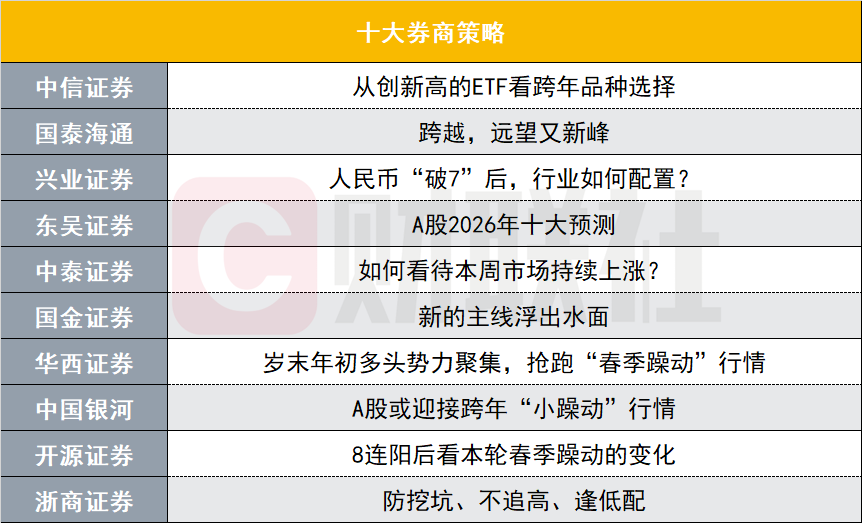
跨越2025 年终行情能否连涨收官?请看本周十大券商策略
智通财经网· 2025-12-28 23:37
Core Viewpoint - The Chinese stock market is experiencing a positive trend as it approaches the end of 2025, with significant movements in various sectors and a focus on potential investment opportunities for 2026 [1][30]. Group 1: Market Trends and Predictions - The Shanghai Composite Index has achieved an "eight consecutive days of gains" [1]. - The total scale of Chinese ETFs has surpassed 6 trillion, setting a new historical high [1]. - Major brokerages have provided insights on market trends, with predictions for 2026 focusing on sectors that may dominate [2][5][13]. Group 2: Sector Analysis - Citic Securities highlights that 39 out of 360 industry/theme ETFs reached new highs in December, with a focus on telecommunications, non-ferrous metals, and commercial aerospace as key sectors [3]. - Industry sectors such as chemicals, engineering machinery, and new energy are expected to see increased attention and potential growth due to their long-term return on equity (ROE) improvement [4]. - Guotai Junan emphasizes the importance of capital markets in driving social confidence and investment, marking a shift from traditional investment methods to more capital-intensive approaches [5]. Group 3: Currency and Economic Factors - The recent appreciation of the Renminbi is attributed to a weaker US dollar and seasonal capital inflows, which may support the Chinese stock market [9][30]. - The potential for a significant influx of capital back into China is anticipated, driven by the reversal of previous trends in currency valuation and investment sentiment [9][10]. - The structural transformation of the Chinese economy is expected to reduce uncertainty and enhance investment opportunities, particularly in technology and manufacturing sectors [7][24]. Group 4: Investment Strategies - Investment strategies are shifting towards sectors that benefit from the current economic environment, including AI hardware, renewable energy, and consumer services [19][31]. - Brokers suggest focusing on thematic trading opportunities in sectors like robotics, commercial aerospace, and healthcare, which are expected to gain traction in the upcoming year [19][31]. - The market is advised to adopt a cautious approach, emphasizing low-cost entry points and avoiding high-risk positions as the market stabilizes [35][36].