ICBC(601398)

Search documents
雄安新区落地河北省首个数币智慧企业园区场景
Zhong Guo Jin Rong Xin Xi Wang· 2025-12-31 06:28
Core Insights - The People's Bank of China has guided the Industrial and Commercial Bank of China (ICBC) to launch the first digital RMB smart enterprise park in Hebei Province, introducing a new direction for digital financial services through a nationwide first "Aerospace Information" series digital RMB hard wallet [1][2] Group 1 - The project is based on the successful launch of the "Xiong'an No. 1" satellite by Hongqing Technology, addressing the visitor management needs of the satellite intelligent manufacturing pilot base [1] - The digital RMB application integrates payment, identity verification, and access control through a super SIM card and hard wallet, enhancing user experience [2] - The scenario allows employees and visitors to use the super SIM card for various services, including access verification, dining, and self-service vending, while also supporting "tap-to-pay" in over 300 cities [2] Group 2 - For visitors without a super SIM card, ICBC's Xiong'an Innovation Branch can issue a themed digital RMB hard wallet on-site, enabling quick recharge via WeChat or the digital RMB app [2] - The hard wallet can be used across various consumption points in Xiong'an New Area, ensuring compatibility with Apple, Android, and Harmony operating systems [2] - The implementation of anonymous digital identity verification technology enhances visitor privacy while achieving a seamless payment experience [2]

多家银行宣布:2026年起数字人民币钱包余额可计付利息
Sou Hu Cai Jing· 2025-12-31 05:40
Group 1 - The core announcement is that starting from January 1, 2026, major Chinese banks including Agricultural Bank of China, Postal Savings Bank, and others will pay interest on digital RMB wallet balances according to the same rates as regular demand deposits [1][4][8] - The interest calculation rules for digital RMB wallets will align with those of demand deposits, indicating a significant shift in how digital currency is treated [1][8] - This transition marks the evolution of digital RMB from a "digital cash era" to a "digital deposit currency era," following a decade of research and pilot programs [8] Group 2 - The People's Bank of China has introduced a plan to enhance the management and service system for digital RMB, which will officially launch on January 1, 2026 [8] - The new framework will include a measurement system, management structure, operational mechanism, and ecosystem for digital RMB [8]






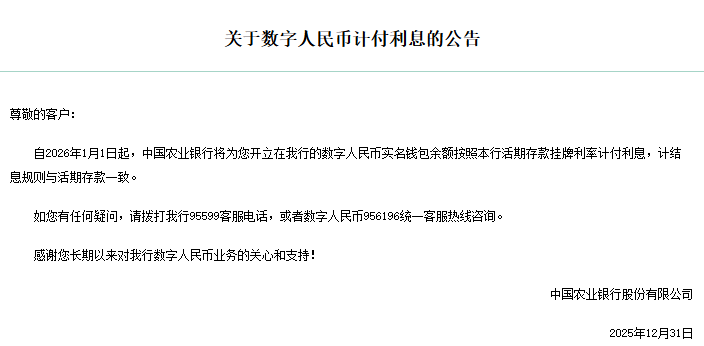
多家银行官宣:2026年1月1日起,为数字人民币实名钱包余额计付利息
Bei Jing Shang Bao· 2025-12-31 05:25
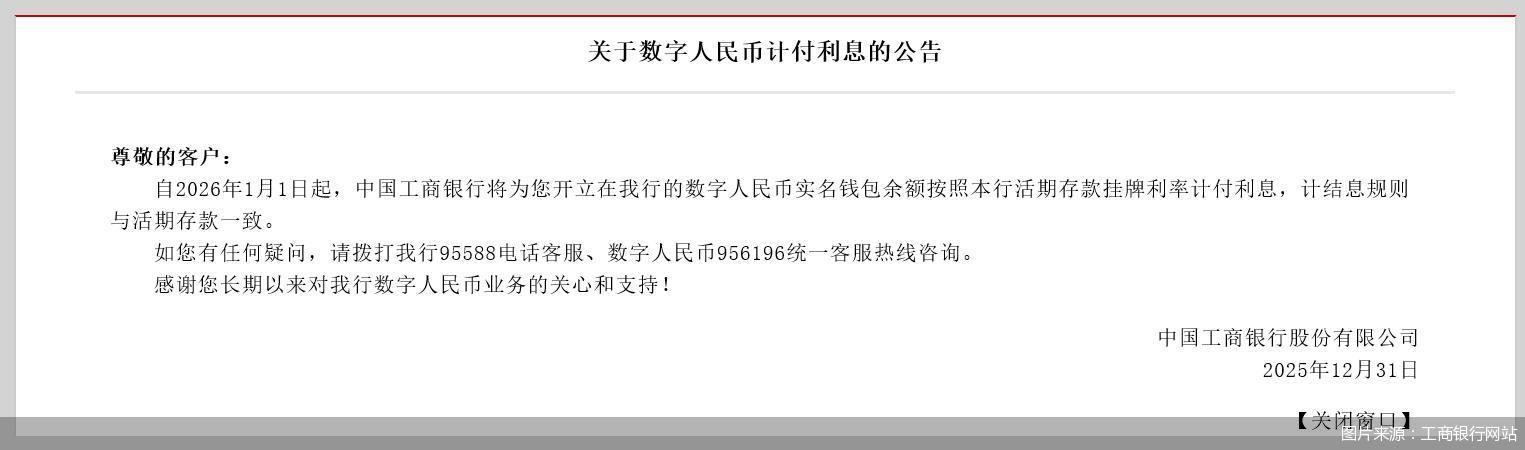
Core Viewpoint - Major Chinese banks including Industrial and Commercial Bank of China, Agricultural Bank of China, Postal Savings Bank of China, Bank of Communications, and China Construction Bank will start paying interest on digital RMB wallet balances at the same rate as current deposit rates from January 1, 2026, marking a significant transition in the digital currency landscape in China [1][4][5] Group 1: Bank Announcements - Industrial and Commercial Bank of China, Agricultural Bank of China, and Postal Savings Bank of China will apply interest to digital RMB wallet balances according to the current deposit rate, with interest calculation rules consistent with those for current deposits [4] - Bank of Communications will also apply the current deposit rate to digital RMB wallet balances, including various types of personal and corporate wallets, while balances in type four wallets will not earn interest [4] - China Construction Bank will revise its customer service agreement to reflect that digital RMB wallet balances will earn interest based on the current deposit rate starting January 1, 2026 [4] Group 2: Digital RMB Framework - The People's Bank of China has introduced a plan to enhance the management and service system for digital RMB, which will officially implement a new measurement framework and operational mechanism on January 1, 2026 [5] - This transition signifies a shift from the "digital cash era" to the "digital deposit currency era" after a decade of research and pilot programs [5]
数说A股2025: 十大亮点绘制市场新图景
Zheng Quan Shi Bao Wang· 2025-12-31 05:00
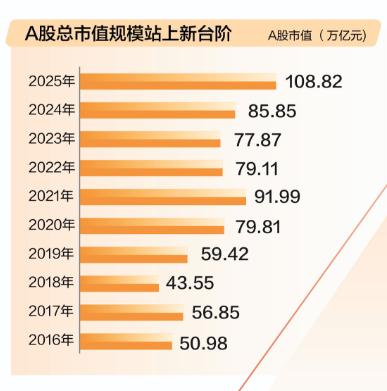
2025年A股注定载入中国资本市场发展史册:总市值首破百万亿元大关,实现历史性体量跨越;科技板 块强势回归重塑市场主线,成为行情核心引擎。从规模跃升的"量"的突破,到结构优化的 "质" 的飞 跃,资本市场以全方位的进阶,清晰映射出中国经济高质量发展新格局。 2025年A股市场今日收官。回顾这一年,市场在经济复苏、产业政策深化与投资者结构变迁的共同驱动 下,演绎了一场深刻而又充满活力的结构性行情。这一年,A股不仅实现了规模的跨越式增长,更在产 业结构、资金流向与投资生态上,呈现出标志性的新特征。本文将从十大角度逐一展开,解读数据背后 的趋势与信号。 亮点一 A股总市值突破100万亿元 市场体量迈入新纪元 2025年以来,A股市场体量迈向新台阶。据证券时报·数据宝统计,截至12月30日收盘,A股总市值达到 108.82万亿元,创历年来新高。8月18日,A股总市值首次突破100万亿元。南开大学金融发展研究院院 长田利辉接受证券时报记者采访时表示:"A股总市值突破100万亿元,标志着中国资本市场迈入高质量 发展新阶段。这不仅是规模扩张的体现,更是市场结构优化、服务实体经济能力提升的标志。" 1990年,上交所正式开业 ...




中国金融机构绿色贷款43.5万亿 上市银行创新服务助力“双碳”征程
Chang Jiang Shang Bao· 2025-12-30 23:21
Core Viewpoint - Under the national "dual carbon" strategy, China's listed banks are integrating Environmental, Social, and Governance (ESG) principles into their development strategies, focusing on building a green financial system to promote a low-carbon economic transformation [1][3]. Green Credit - Green credit serves as the main channel for directing financial resources towards green industries, with banks shifting funds from high-energy and high-emission sectors to clean energy and environmentally friendly industries [1]. - As of the end of Q3 2025, the balance of green loans in China reached 43.51 trillion yuan, a 17.5% increase from the beginning of the year, with an increase of 6.47 trillion yuan in the first three quarters [1]. - The breakdown of green loans by purpose includes 19.29 trillion yuan for infrastructure upgrades, 8.32 trillion yuan for energy transition, and 5.01 trillion yuan for ecological protection, with respective increases of 2.65 trillion yuan, 662 billion yuan, and 620.4 billion yuan in the first three quarters [1]. Green Bonds - By the end of 2024, the cumulative issuance of labeled green bonds in China exceeded 4 trillion yuan, with a stock of nearly 2 trillion yuan [3]. - Among the 42 listed banks, 29 disclosed green bond issuance data, holding a total of approximately 1.2 trillion yuan in green bonds, with major banks like ICBC and CCB leading in holdings [3]. ESG Investment and Wealth Management - The rise of green wealth management and asset management indicates banks are expanding their ESG influence, actively issuing ESG-themed financial products and establishing green industry funds [3]. - This shift encourages both individual and institutional investors to direct their wealth towards sustainable development, transforming the concept from "savers" to "green investors" [3]. ICBC's Role - ICBC has taken significant steps in green finance, with a green loan balance exceeding 6 trillion yuan as of mid-2025, maintaining a leading position in the industry [5]. - The bank has also issued green bonds, including the first floating-rate green financial bond in the domestic market, and has a total green bond issuance of 980 billion yuan in the domestic interbank market [6]. - ICBC's green investment in wealth management exceeded 40 billion yuan in the first half of 2025, with a year-on-year growth of over 40% [6]. Green Leasing - ICBC's leasing subsidiary, ICBC Financial Leasing, focuses on providing financial support for key sectors such as manufacturing and green industries, with a green leasing balance of 602.24 billion yuan, accounting for 50.65% of its domestic financing leasing business [7][8].
“不赚钱也要抢单”低息经营贷背后的银行账本
Zhong Guo Zheng Quan Bao· 2025-12-30 21:11
Core Viewpoint - The personal operating loan interest rates have generally entered the "2" range, with some banks offering rates as low as 2.3%, driven by competition and a strategy of attracting customers through lower prices [1][4]. Group 1: Current Loan Rates - Many banks are now offering personal operating loan rates below 2.5%, with slight variations based on region and product type [1][2]. - For instance, the lowest rate for personal mortgage operating loans at one bank is 2.35%, with a loan term of 3 years and a credit limit of up to 30 million yuan [1]. - Another bank reports that the minimum rate for collateralized personal operating loans is 2.5%, while credit-based products start at 2.55% [2]. Group 2: Loan Approval Criteria - Borrowers must meet strict criteria, including having a local household registration and a minimum duration of social security payments [3]. - The collateral property must be within the local jurisdiction, not older than 35 years, and the borrower must have owned it for at least 3 months [3]. - Additionally, the borrowing entity must be a small or micro enterprise with a good credit record and normal operating cash flow [3]. Group 3: Market Dynamics and Risks - The current low interest rates are a result of multiple factors, including policy guidance, industry competition, and reduced funding costs for banks [4][5]. - While lower rates can stimulate demand and reduce interest expenses for borrowers, there are concerns about potential risks, such as narrowing interest margins and the possibility of unhealthy competition [4][5]. - Experts warn that aggressive pricing strategies could lead to a decline in banks' profitability and their ability to support the real economy effectively [4][5]. Group 4: Strategic Responses from Banks - Different banks have varying perspectives on the sustainability of low-interest operating loans, with some viewing it as a necessary strategy to gain market share despite thin margins [5][6]. - Larger banks may benefit from cross-selling additional services to clients attracted by low rates, while smaller banks face challenges in maintaining competitiveness without engaging in price wars [6][7]. - There is a call for financial institutions to adopt differentiated strategies and focus on enhancing product quality and service rather than solely competing on price [6][7].

东方红消费研选混合型发起式证券投资基金基金份额发售公告
Shang Hai Zheng Quan Bao· 2025-12-30 20:01
Group 1 - The fund is named "Oriental Red Consumer Research Mixed Initiation Securities Investment Fund" with codes A: 026495 and C: 026496 [3][16] - The fund is a contractual open-ended, initiation, mixed-type securities investment fund [2][16] - The minimum total subscription amount is 10 million units (excluding interest) and the minimum fundraising amount is 10 million RMB (excluding interest) [21] Group 2 - The fundraising period starts on January 7, 2026, and can be extended by up to 3 months based on actual fundraising conditions [5][24] - The fund is open to individual investors, institutional investors, and qualified foreign investors [20][21] - The fund's investment objective is to achieve long-term stable appreciation of net assets while strictly controlling investment portfolio risks [19] Group 3 - The fund's subscription price is set at 1.00 RMB per unit [18][24] - Investors can subscribe through direct sales centers or authorized sales institutions [22][39] - The minimum subscription amount through the direct sales center is 10 RMB (including subscription fees) [25] Group 4 - The fund management company is Shanghai Oriental Securities Asset Management Co., Ltd., and the custodian is Industrial and Commercial Bank of China [4][58] - The fund's effective subscription funds will earn interest during the fundraising period, which will be converted into corresponding fund shares if the fund contract becomes effective [4][54]
“消失”的银行监事长
Shang Hai Zheng Quan Bao· 2025-12-30 19:26
Core Viewpoint - The bank supervisory board system, in operation for nearly 30 years, is approaching its end as banks begin to abolish this structure in favor of audit committees, following new regulations from the China Securities Regulatory Commission (CSRC) and the Financial Regulatory Bureau [2][3][4]. Regulatory Framework for Reform - The new Company Law, effective from July 2024, allows financial institutions to replace supervisory boards with audit committees, fundamentally changing the requirement for supervisory boards as mandatory entities [3][4]. - The Financial Regulatory Bureau has issued policies that support the transition, allowing financial institutions to choose between retaining supervisory boards or establishing audit committees to perform supervisory functions [3][4]. Differences in Implementation - There is a differentiation in the approach to abolishing supervisory boards between listed and non-listed banks, with listed banks required to eliminate supervisory boards by 2026, while non-listed banks have the option to retain them [4][5]. - Major state-owned banks have already initiated the process of abolishing supervisory boards, with the five largest banks voting to remove them in April 2025 [5]. Effectiveness and Challenges of Supervisory Boards - The supervisory board has been criticized for its lack of independence, professionalism, and efficiency, often leading to overlapping functions and ineffective oversight [6][7]. - The costs associated with maintaining a supervisory board are significant, with estimates suggesting that listed banks could save millions annually by abolishing this structure [7]. Transition Paths for Supervisory Board Members - Former supervisory board members may transition to roles within the audit committee, take on positions in other financial institutions, or retire from the industry [8]. - The governance mechanism is expected to become more efficient, with fewer decision-making layers and a more direct oversight structure through audit committees [8].




制度韧性的增长与转型 – 中国香港经济2025年回顾及2026年展望-中国工商银行
Sou Hu Cai Jing· 2025-12-30 17:57
Group 1 - Hong Kong's economy is expected to grow beyond expectations in 2025, with a projected GDP growth of 3.2%, up from 2.5% in 2024, indicating a recovery to pre-pandemic levels [1][8] - The key growth drivers identified are "funds flow" and "logistics," contributing approximately 1.2 and 1.1 percentage points to GDP growth, respectively [1][9] - The capital market has seen significant activity, with the Hang Seng Index rising 28.9% in the first 11 months, and Hong Kong's IPO fundraising returning to the top globally for the first time in six years [1][32] Group 2 - For 2026, a positive scenario suggests a GDP growth of 3.0%, driven by continued strength in "logistics" and "funds flow," while "human flow" is expected to remain active due to optimized talent policies and tourism events [2][13] - The logistics sector is anticipated to benefit from reduced tariff uncertainties and strong demand for AI-related products, supporting robust growth in trade and logistics activities [2][21] - The financial sector is expected to remain a key driver of growth, with active capital markets and favorable policies from the Federal Reserve and local government enhancing market conditions [2][30] Group 3 - The report highlights the importance of monitoring international geopolitical situations and Federal Reserve policy rhythms, which could impact Hong Kong's economic growth [3][6] - The ongoing transformation of Hong Kong's economy towards a more diversified and multi-polar structure is expected to deepen, enhancing its competitiveness as an international financial center [2][16] - The government is expected to achieve fiscal balance earlier than anticipated, which will provide more room for policy support and economic transformation initiatives [6][16]

涉嫌严重违纪违法!王世明,被查!
中国基金报· 2025-12-30 15:53
【导读】中国工商银行山东淄博分行原党委书记、行长王世明接受纪律审查和监察 调查 根据公开报道,2015年左右,王世明曾多次代表工商银行淄博分行出席活动。2016年1月, 工商银行淄博分行曾上榜"2015年度淄博市纳税百强名单",王世明作为法人曾出席活动。 公开资料显示,王世明于2012年9月正式担任工商银行淄博分行负责人,并于2016年4月卸 任,随后由王学俭接替。 工商银行淄博分行成立于1984年10月1日,是工商银行在山东地区的重要分支机构。 近日,工商银行体系内多位干部被处理。 12月29日,据中央纪委国家监委驻中国工商银行纪检监察组、贵州省纪委监委消息,中国工 商银行云南省分行原党委书记、行长许海被开除党籍。 中国 基金报记者 李智 金融反腐又有新进展。 12月30日, 据山东省纪委监委 消息 ,中国工商银行山东淄博分行原党委书记、行长王世明 涉嫌严重违纪违法,目前正接受中国工商银行山东省分行纪委纪律审查;经山东省纪委监委 指定管辖,枣庄市监察委员会对其监察调查。 版权声明 《中国基金报》对本平台所刊载的原创内容享有著作权,未经授权禁止转载,否则将追究法律责任。 授权转载合作联系人:于先生(电话:07 ...