ICBC(601398)

Search documents
黄金大消息!又一国有大行宣布,上调
Zhong Guo Ji Jin Bao· 2026-02-11 15:37
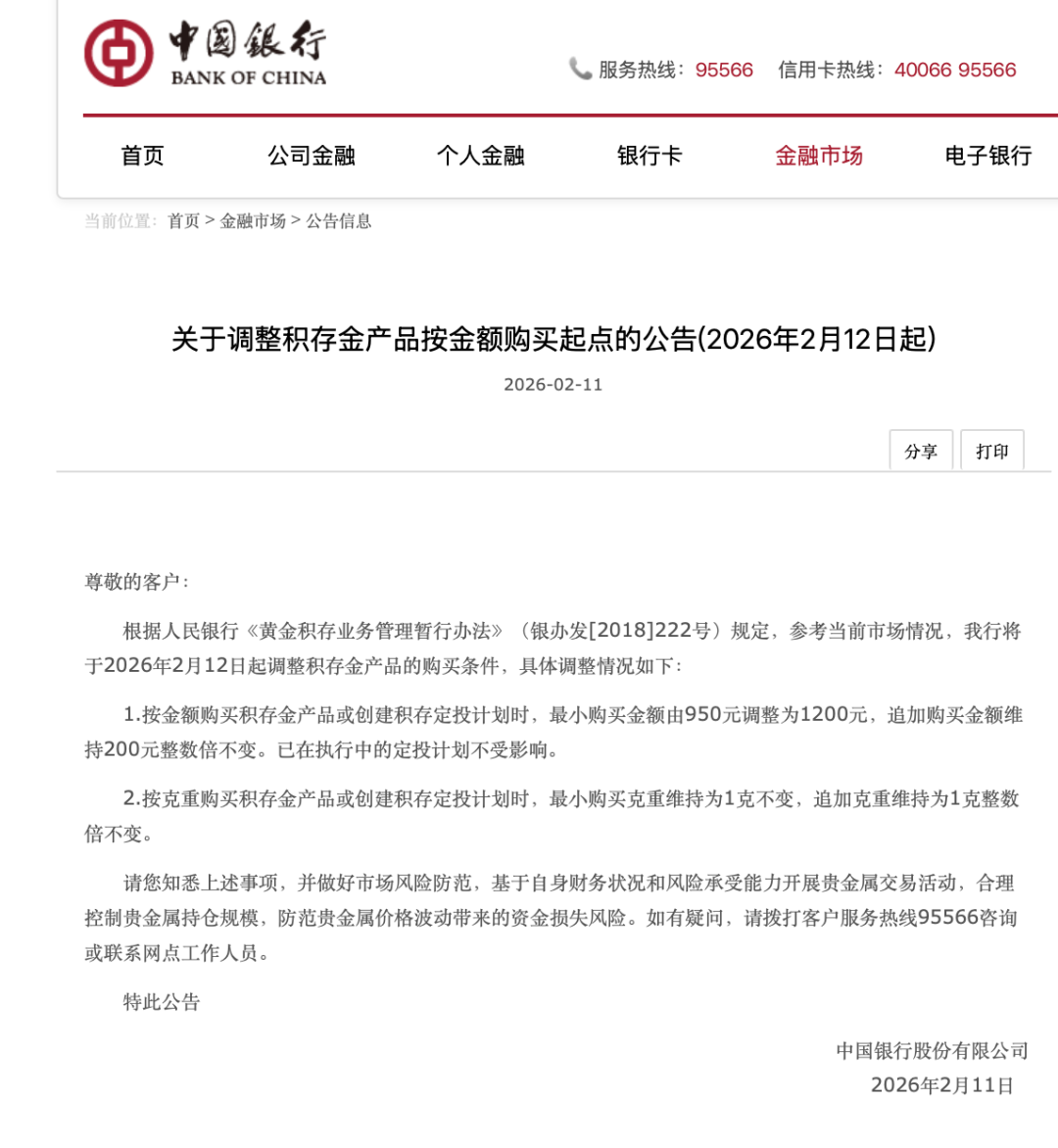
Core Viewpoint - China Bank has raised the minimum purchase amount for its gold accumulation products from 950 yuan to 1200 yuan, effective February 12, 2026, following similar adjustments by other major banks [1][4]. Group 1: Adjustments in Gold Accumulation Products - The minimum purchase amount for gold accumulation products at China Bank will increase to 1200 yuan, while the additional purchase amount remains unchanged at 200 yuan [1]. - The minimum weight for purchasing gold accumulation products will remain at 1 gram, with additional purchases also in 1 gram increments [1]. - Other banks, such as Industrial and Commercial Bank of China (ICBC) and Agricultural Bank of China, have also raised their minimum purchase amounts for gold accumulation products in early 2026 [4]. Group 2: Market Context and Trends - The gold price has experienced significant fluctuations, with a notable increase in January 2026, leading to a general upward trend in February, surpassing 5000 USD per ounce [5][6]. - The adjustments in minimum purchase amounts by banks are seen as a response to the volatile gold market and regulatory requirements aimed at protecting investors [4]. - Analysts suggest that the current economic conditions, including inflation and geopolitical uncertainties, may continue to support a bullish outlook for gold prices in the medium to long term [9].


1月银票承兑市场分析:仅国有大行增长
Xin Lang Cai Jing· 2026-02-11 10:16
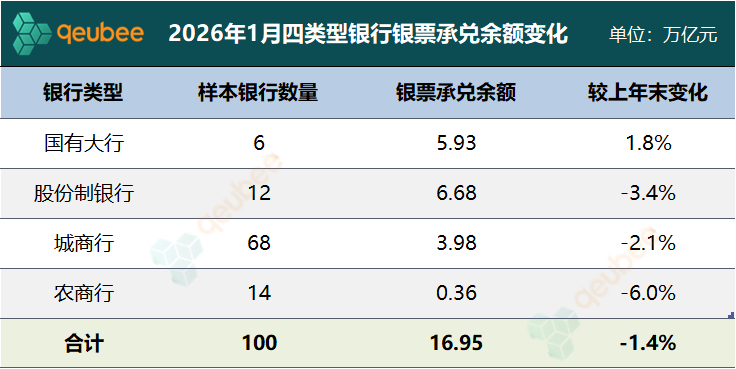
Overall Situation of Bank Acceptance Bills - As of the end of January 2026, the total acceptance balance of bank bills among the top 100 banks is 16.95 trillion yuan, a decrease of 237.9 billion yuan compared to the end of the previous year, representing a decline of 1.4% [1][8] - The state-owned banks are the only category to show growth in acceptance balance, increasing by 1.8% to 5.93 trillion yuan, while other bank types experienced negative growth [2][9] - The share of state-owned banks, joint-stock banks, city commercial banks, and rural commercial banks in the acceptance balance is 93%, with rural commercial banks having a relatively low proportion [1][8] Changes by Bank Type - In January 2026, the acceptance balance for joint-stock banks decreased by 3.4%, city commercial banks by 2.1%, and rural commercial banks by 6.0% [8][9] - The state-owned banks' acceptance balance increased by 107.3 billion yuan month-on-month, while joint-stock banks saw a decrease of 238 billion yuan [2][11] Major Banks' Acceptance Situation - Among banks with an acceptance balance exceeding 60 billion yuan, there are 33 banks, with a total acceptance balance of 14.82 trillion yuan, down 183.8 billion yuan from the previous month, a decline of 1.2% [4][11] - Agricultural Bank, Bank of China, and Industrial and Commercial Bank rank as the top three banks in acceptance balance, with Agricultural Bank showing a growth of 5.5% to 1.818 trillion yuan [4][12] - The ranking of major banks indicates that Agricultural Bank remains the leader, followed by Bank of China and Industrial and Commercial Bank, with the latter experiencing a decline of 2.3% [5][12] Performance of Joint-Stock and City Commercial Banks - Most joint-stock banks have seen a decline in acceptance balance, with notable decreases in banks like Shanghai Pudong Development Bank and Ping An Bank, while only Guangfa Bank and Bohai Bank showed slight growth [6][14] - City commercial banks exhibit significant variability, with major banks like Beijing, Jiangsu, Shanghai, and Tianjin experiencing substantial declines, while Nanjing and Guangxi Beibu Bay banks showed growth [7][14]



多家银行下调大额存单利率 部分期限产品利率跌破1%
Zhong Guo Ji Jin Bao· 2026-02-11 06:34
Core Viewpoint - A new round of deposit interest rate cuts has begun, with major banks reducing rates on large-denomination certificates of deposit (CDs), indicating a shift in the banking sector aimed at alleviating interest margin pressure and better serving the real economy [1][5]. Group 1: Interest Rate Changes - Major state-owned banks have lowered the annualized interest rates on 1-month and 3-month large-denomination CDs to below 1%, with some products seeing a maximum reduction of 35 basis points [1][2]. - The latest rates for China Bank's CDs are 0.9% for 1-month and 3-month terms, and 1.1% for 6-month terms, marking a significant decrease from previous rates [2][3]. - Other banks, including Industrial and Agricultural Banks, have also reduced their 1-month and 3-month CD rates to 0.9% [4]. Group 2: Implications for Banks and Investors - The reduction in deposit rates is expected to help stabilize banks' net interest margins, which have been under pressure, as evidenced by a 9 basis point decline to 1.43% in the first quarter of this year [5][6]. - Analysts suggest that investors should adjust their expectations for investment returns and consider a diversified asset allocation strategy, including cash management products and government bonds, in light of declining deposit rates [6].
超50家银行宣布暂停各类无卡业务
2 1 Shi Ji Jing Ji Bao Dao· 2026-02-11 06:34
Core Viewpoint - Several banks in China are tightening their no-card deposit and withdrawal services, with over 50 banks having announced the suspension of various no-card services in the past year, citing reasons such as optimizing financial services, risk management, and cost efficiency [1][2]. Group 1: Bank Actions - China Merchants Bank will stop its ATM QR code deposit service starting April 9, requiring customers to use bank cards for deposits [1]. - Major state-owned banks, including Industrial and Commercial Bank of China, have already suspended no-card cash withdrawal services since April 2022, with other banks like Bank of Communications following suit [3]. - In the second half of last year, several joint-stock banks and leading city commercial banks, such as Minsheng Bank and Industrial Bank, also announced the cessation of no-card withdrawal functionalities [4]. Group 2: Reasons for Changes - The shift away from no-card services is attributed to the low security of identity verification methods used in these transactions, as well as the limited demand from customers for such services [6]. - The rise of mobile payments has led to a decrease in cash usage, prompting banks to close ATM QR code deposit functions to enhance customer fund security and streamline service processes [5]. Group 3: Industry Implications - The adjustments in no-card services are expected to have a minimal impact on banks, as customers can still utilize other methods for deposits and withdrawals [6]. - The changes are seen as a way for banks to improve risk management and reduce operational costs, while also exploring digital technology to enhance service levels and optimize ATM functionalities [6].




助贷新规出台在即 规范三大助贷模式 要求银行加强自主风控
2 1 Shi Ji Jing Ji Bao Dao· 2026-02-11 06:33
Core Viewpoint - The upcoming "Loan Assistance Regulations" aim to enhance banks' risk control capabilities and standardize three main loan assistance models, while encouraging banks to diversify their risk sources through third-party guarantee institutions [1][2]. Group 1: Loan Assistance Models - The three main models for internet loans through commercial banks include: Joint Loan Model, Financing Guarantee Model, and Profit Sharing Model [2]. - In the Joint Loan Model, the lending bank and the platform's licensed institutions jointly provide loans, with the bank's contribution not exceeding 70% [2]. - The Financing Guarantee Model involves the assistance platform providing guarantees for borrowers, with the platform conducting initial risk assessments and recommending clients to banks [2]. - The Profit Sharing Model allows the assistance platform to provide customer acquisition and data analysis services, with banks handling funding and risk control independently, thus being referred to as a "light asset model" [2]. Group 2: Regulatory Context - The introduction of the Loan Assistance Regulations reflects a broader trend of stringent regulation in the internet loan sector [5]. - Since the 2020 issuance of the "Interim Measures for the Management of Internet Loans by Commercial Banks," a series of regulatory documents have been released to standardize the roles of all parties involved in internet loans [6]. - These regulations aim to enhance the self-capacity of banks and other financial institutions, thereby reducing risks associated with collaborative entities [6]. Group 3: Market Dynamics - The regulatory changes are expected to increase the operational costs for third-party platforms and push down financing rates [6]. - The industry is witnessing a growing divide, with weaker banks facing consolidation pressures, as evidenced by nearly 200 small banks ceasing operations in 2024 [7]. - The number of small loan companies has decreased from 5,500 at the end of 2023 to 5,385 by September 2024, indicating a trend of market exit among non-compliant entities [7].

这场金融科技发展经验交流会,银行都谈了这些→
Jin Rong Shi Bao· 2026-02-11 06:00
Core Viewpoint - The integration of financial technology is essential for the high-quality development of the financial industry, serving as a critical driver to address the challenges posed by the "five major articles" in finance [3][5][6]. Group 1: Financial Technology Development - The meeting organized by the Financial Times focuses on the innovative breakthroughs and practical applications of financial technology, showcasing how digital technology enhances the quality and efficiency of financial services [1]. - Financial technology is no longer an optional enhancement but a necessary component for the sustainable development of the financial sector, as emphasized by the recent Central Financial Work Conference [3][5]. - The Financial Times has been a key player in promoting financial discourse and collaboration within the industry since its inception in 1987, aiming to build an efficient communication platform [3][4]. Group 2: Industry Collaboration and Experience Sharing - The event aims to foster collaboration and experience sharing among industry leaders, including representatives from major banks like ICBC, ABC, and CCB, who presented successful applications of financial technology [5]. - The Financial Times plans to leverage its media capabilities to report comprehensively on the event, ensuring that innovative practices are recognized and can be replicated across the industry [5][6]. Group 3: Specific Bank Initiatives - ICBC is developing a comprehensive AI-driven financial model called "工银智涌," which aims to integrate AI with financial services, enhancing productivity and supporting the "five major articles" in finance [10][12]. - ABC has initiated a digital transformation strategy focusing on a data-driven enterprise architecture to improve service quality and operational efficiency, addressing key challenges in the financial sector [16][19]. - CCB is building an integrated service system for technology finance, emphasizing collaboration across its branches and subsidiaries to support technology-driven enterprises [21][23]. - PSBC is innovating its credit granting process through a data-driven approach, enhancing its service capabilities in rural finance and supporting the national strategy for rural revitalization [26][28]. - CITIC Bank is focusing on creating a digital ecosystem for inclusive finance, addressing the unique needs of small and micro enterprises through innovative product offerings and risk management solutions [30][32].


中国黄金等调整节假日黄金回购业务,多家银行清退三无客户
Cai Jing Wang· 2026-02-11 03:36
Core Viewpoint - Multiple gold retailers in China are adjusting their gold repurchase policies, limiting operations during weekends and public holidays, while banks are actively clearing "three no" clients to mitigate risks [1] Group 1: Gold Repurchase Policy Changes - China Gold announced that starting from February 7, 2026, it will suspend gold repurchase services on weekends and public holidays, which are non-trading days on the Shanghai Gold Exchange [1] - Beijing Caishikou Department Store Co., Ltd. will also adjust its gold repurchase rules, effective February 6, 2026, by halting repurchase services on non-trading days and reducing the daily gold repurchase limit from 200 kilograms to 100 kilograms [1] Group 2: Bank Actions on "Three No" Clients - To avoid risks, multiple banks are proactively clearing "three no" clients (those with no positions, no inventory, and no debts) [1] - The Industrial and Commercial Bank of China will strengthen its management of personal precious metal transactions, transferring the margin account balances of such clients to their linked settlement accounts starting December 19, 2025, and closing related business functions [1] - Similarly, China Construction Bank has advised similar clients to withdraw their margin balances and terminate their contracts promptly [1]



多家银行清退贵金属三无客户
21世纪经济报道· 2026-02-11 02:51
Core Viewpoint - The article discusses the significant fluctuations in gold prices and the resulting adjustments in gold repurchase policies by various companies and banks to manage risks and operational pressures [1][4][5]. Group 1: Gold Price Fluctuations - As of February 11, 2026, spot gold prices increased by 0.34% to $5044.7 per ounce, while spot silver rose over 1% [1]. - Year-to-date, London gold has risen by 16.82%, and London silver has increased by 14.47% [2]. Group 2: Adjustments in Repurchase Policies - Starting February 7, 2026, China Gold will suspend gold repurchase services on non-trading days, including weekends and public holidays, to adapt to market risk management requirements [4]. - Beijing Caishikou Department Store has also updated its repurchase rules, halving the daily gold repurchase limit from 200 kilograms to 100 kilograms [4]. Group 3: Risk Management Measures - The adjustments in repurchase policies are primarily due to the significant volatility in gold prices, which complicates fair pricing and increases operational pressures on gold retailers [5][6]. - Analysts expect more gold retailers to follow suit in tightening repurchase policies, focusing on risk control and operational efficiency [6]. Group 4: Bank Policies on "Three No" Clients - Several banks have begun to limit services for "Three No" clients (no positions, no inventory, no debts), reflecting a broader trend of tightening regulations in the gold trading sector [7][9]. - Since September 2025, at least 11 banks have announced adjustments to their gold trading services, including suspending new trades and closing accounts for inactive clients [9].

工商银行取得隐匿签名方法相关专利
Sou Hu Cai Jing· 2026-02-11 02:12
Group 1 - The core point of the article is that the Industrial and Commercial Bank of China (ICBC) has obtained a patent for a method and device related to "hidden signature methods and verification" with the announcement number CN114584968B, applied for in March 2022 [1] - ICBC was established in 1985 and is headquartered in Beijing, primarily engaged in monetary financial services [1] - The registered capital of ICBC is approximately 35.64 billion RMB [1] Group 2 - According to data analysis from Tianyancha, ICBC has invested in 28 companies and participated in 5,000 bidding projects [1] - The bank holds 965 trademark information entries and 5,000 patent information entries, along with 79 administrative licenses [1]
多家银行 推出年终奖专属理财
Jin Rong Shi Bao· 2026-02-11 01:43
Core Insights - The year-end bonus wealth management market is heating up as banks launch exclusive products and services tailored for year-end bonuses, reflecting a shift towards more diversified asset allocation strategies [1][2] Group 1: Market Trends - Major banks, including state-owned and joint-stock banks, are introducing specialized financial products for year-end bonuses, focusing on low investment thresholds and diverse strategies [1] - The traditional focus on single product yield competition is changing, with financial institutions now emphasizing one-stop asset allocation services that combine wealth management, deposits, and funds [1][2] Group 2: Consumer Behavior - Year-end bonuses are characterized by concentrated amounts, flexible terms, and a tendency towards conservative risk preferences, prompting banks to offer tailored solutions [2] - The rise in year-end bonus wealth management reflects a rational upgrade in residents' financial awareness and behavior, with consumers prioritizing stability and liquidity in their investment choices [2][3] Group 3: Investment Strategies - A three-tier investment framework is recommended: cash management tools for short-term liquidity, stable products for mid-term planning, and disciplined investments for long-term goals [3] - Investors are advised to understand that performance benchmarks do not guarantee returns and to carefully assess the underlying assets and historical volatility of products [3] Group 4: Market Outlook - The wealth management market in China, with a scale of approximately 33 trillion yuan, is entering a mature development phase, expected to experience structural deepening and quality growth [3][4] - The shift in asset allocation from real estate to financial assets indicates a solid foundation for the growth of wealth management products, with a competitive focus on asset allocation capabilities and customer service [4]