China Life(601628)

Search documents
险资三季度大幅加仓A股,投资收益助推业绩创新高
Huan Qiu Wang· 2025-11-03 05:33
Group 1 - Insurance funds have significantly increased their investment in A-shares, with a 14% growth in the number of heavily held A-share circulating stocks by insurance institutions compared to the previous quarter, and a total market value exceeding 650 billion yuan [1] - The market value of insurance funds' heavily held stocks has increased by approximately 100 billion yuan compared to the end of last year, indicating a double-digit growth in both stock quantity and market value [1] - Financial stocks remain the cornerstone of insurance funds, with a market value exceeding 300 billion yuan, accounting for nearly 50% of their holdings [1] Group 2 - The proactive adjustment of insurance funds in the third quarter led to over 300 new heavily held stocks, with a total market value exceeding 100 billion yuan, primarily in the manufacturing sector [1] - Notable new investments include Ping An Life's significant stake in Agricultural Bank, valued at 32.773 billion yuan, marking it as the most substantial new investment in the third quarter [1] - Several A-share listed insurance companies reported record high net profits in the first three quarters, with China Life's net profit increasing by 60.5% year-on-year and New China Life's net profit rising by 58.9% [3] Group 3 - The growth in stock market value directly impacts current profits under new accounting standards, enhancing the investment returns for insurance companies [3] - The increasing premium income from floating yield products like dividend insurance is expected to further boost the equity investment ratio of insurance companies, making investment returns a more significant driver of performance [3]



嘉兴监管分局同意中国人寿平湖市支公司乍浦镇营销服务部变更营业场所
Jin Tou Wang· 2025-11-03 05:15
二、中国人寿保险股份有限公司应按照有关规定及时办理变更及许可证换领事宜。 2025年10月30日,国家金融监督管理总局嘉兴监管分局发布批复称,《中国人寿(601628)保险股份有 限公司浙江省分公司关于变更中国人寿保险股份有限公司平湖市支公司乍浦镇营销服务部营业场所的请 示》(国寿人险浙发〔2025〕364号)收悉。经审核,批复如下: 一、同意中国人寿保险股份有限公司平湖市支公司乍浦镇营销服务部将营业场所变更为:浙江省嘉兴市 港区乍浦镇外环东路333号、335号二层。 ...
“国家队”资金 最新持仓曝光
Zhong Guo Zheng Quan Bao· 2025-11-03 04:54
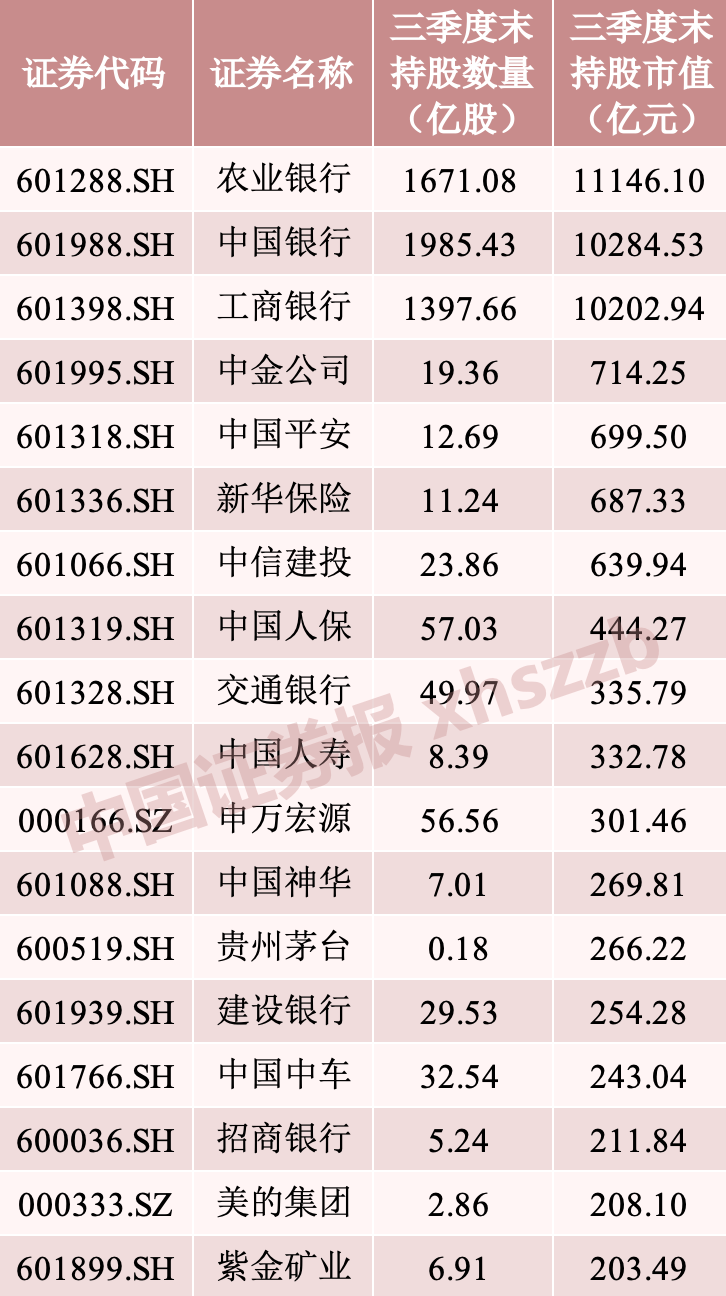
Core Insights - "National Team" funds held over 800 A-shares as of the end of Q3, with significant investments in Agricultural Bank of China, Bank of China, and Industrial and Commercial Bank of China, each exceeding 1 trillion yuan in market value [1][3] - The "National Team" increased holdings in sectors such as insurance, resources, consumer goods, electronics, and telecommunications, with some stocks doubling in price during Q3 [1][8] - The funds exited from the top ten shareholders in sectors like securities, banking, electricity, real estate, and pharmaceuticals [1][8] Holdings Overview - As of the end of Q3, "National Team" funds were among the top ten shareholders in over 800 A-share companies, with 33 companies having a market value exceeding 10 billion yuan [3] - The top three holdings by market value were Agricultural Bank of China (1.11 trillion yuan), Bank of China (1.03 trillion yuan), and Industrial and Commercial Bank of China (1.02 trillion yuan) [3][5] - Other significant holdings included China International Capital Corporation, China Ping An, and New China Life Insurance, each with market values above 60 billion yuan [3][5] Sector Adjustments - In Q3, "National Team" funds entered the top ten shareholders of nearly 180 new listed companies, with notable investments in Mindray Medical, Giant Network, and Unisoc, each exceeding 1 billion yuan in market value [6] - The funds increased their positions in financial stocks such as New China Life Insurance and China Pacific Insurance, as well as resource stocks like Baosteel and China Aluminum [8] - Growth-oriented stocks that saw increased holdings included electronic companies like Pengding Holdings and Sanan Optoelectronics, with some stocks like Deep South Circuit and EVE Energy experiencing price increases around 100% [9]





中国人寿(02628) - 截至2025年10月31日止股份发行人的证券变动月报表
2025-11-03 03:00
股份發行人及根據《上市規則》第十九B章上市的香港預託證券發行人的證券變動月報表 截至月份: 2025年10月31日 狀態: 新提交 致:香港交易及結算所有限公司 公司名稱: 中國人壽保險股份有限公司 呈交日期: 2025年11月3日 I. 法定/註冊股本變動 | 1. 股份分類 | 普通股 | 股份類別 | H | | | 於香港聯交所上市 (註1) | | 是 | | | --- | --- | --- | --- | --- | --- | --- | --- | --- | --- | | 證券代號 (如上市) | 02628 | 說明 | | | | | | | | | | | 法定/註冊股份數目 | | | 面值 | | | 法定/註冊股本 | | | 上月底結存 | | | 7,441,175,000 | RMB | | | 1 RMB | | 7,441,175,000 | | 增加 / 減少 (-) | | | | | | | RMB | | | | 本月底結存 | | | 7,441,175,000 | RMB | | | 1 RMB | | 7,441,175,000 | | 2. 股份分 ...
中国人寿黔西南分公司被罚17万元 因以虚构保险中介业务套取费用等2项违规
Feng Huang Wang Cai Jing· 2025-11-03 02:18
| 序号 | 当事人名称 | 行政处罚决定书 | 主要违法违规行为 | 行政 | | --- | --- | --- | --- | --- | | | | 文号 | | | | 1 | 中国人寿保 | | 以虚构保险中介亚 | 词 | | | 险股份有限 | 黔西南金罚决字 | 务方式套取费用; | | | | 公司黔西南 | (2025) 16号 | 误导投保人、被保 | | | | 分公司 王悦(时任 | | 险人 | | | 2 | 中国人寿保 险股份有限 公司黔西南 分公司营销 | | | 馨告, | | | | 黔西南金罚决字 | 误导投保人、被保 | | | | | (2025) 17号 | 险人 | | | | 发展部经 | | | | | | 理) | | | | | 3 | 李桑匾(时 保险股份有 限公司黔西 | 黔西南金罚决字 | 以虚构保险中介业 | 警告, | | | 任中国人寿 | | | | | | 南分公司银 | (2025) 18号 | 务方式套取费用 | | | | 行保险部副 | | | | | | 经理(主持工 作)) | | | | 凤凰网财经讯 10月31日,据国家 ...

中国人寿财险持续完善服务体系 全力守护秋粮丰收
Zheng Quan Ri Bao Zhi Sheng· 2025-11-03 02:13
Core Viewpoint - China Life Property & Casualty Insurance Co., Ltd. focuses on agricultural risk prevention, establishing a multi-level agricultural insurance system, shifting services from "post-disaster compensation" to "pre-disaster prevention," and enhancing technological empowerment and product innovation to support national food security and rural revitalization strategies [1] Group 1: Agricultural Insurance Initiatives - The company has launched an emergency response mechanism for agricultural insurance in Jiangxi Province, focusing on drought and ensuring autumn grain harvests as a priority task [2] - In Shandong Province, the company mobilized staff to assist farmers in water drainage and harvesting during the Mid-Autumn Festival and National Day holidays, providing timely support to mitigate losses [3] - Customized services are implemented based on regional agricultural characteristics, such as innovative insurance products for peanuts and corn in Jiangsu Province, providing 11.24 million yuan in risk protection for 192 farmers [3][4] Group 2: Technological Integration in Services - The company utilizes satellite remote sensing technology for disaster loss assessment, enhancing efficiency in claims processing through "drone inspections + app assessments" [5][6] - A comprehensive monitoring network has been established, combining real-time weather monitoring and field inspections to identify and address agricultural risks promptly [6] Group 3: Risk Coverage and Financial Support - By the third quarter of 2025, the company insured over 10 million acres of major crops such as rice, wheat, and corn, providing risk coverage exceeding 100 billion yuan, stabilizing grain income expectations [7]
中国人寿董秘刘晖荣获第二十七届上市公司金牛奖“金牛董秘奖”
Zhong Zheng Wang· 2025-11-03 02:05
Core Viewpoint - The 2025 High-Quality Development Forum for Listed Companies and the 27th Golden Bull Award Ceremony took place in Nantong, Jiangsu, highlighting the achievements of listed companies in China [1] Group 1: Event Overview - The forum was themed "Moving Towards New Horizons, Achieving Practical Goals, and Enlightening the Future" [1] - The Golden Bull Award, established in 1999, is organized by China Securities Journal and aims to create a credible platform for communication and brand display in the capital market [1] Group 2: Award Highlights - Liu Hui, Vice President, Board Secretary, and Chief Investment Officer of China Life Insurance (601628), received the "Golden Bull Board Secretary Award" [1] - The Golden Bull Award recognizes outstanding contributions in corporate governance, information disclosure, and investor relations management among listed company board secretaries [1]
养老+金融 守护“夕阳红”(深度观察·做好金融“五篇大文章”) ——从不同群体看养老金融发展实践
Ren Min Ri Bao· 2025-11-02 22:02
Core Insights - The article emphasizes the importance of elderly healthcare and pension services, highlighting the role of pension finance in providing better services for the aging population [1] - It discusses the development of a multi-tiered pension insurance system as proposed in the 15th Five-Year Plan, focusing on the diversification of financial products to meet varying needs [1][4] Financial Product Optimization - The introduction of exclusive commercial pension insurance in Chongqing allows individuals to invest with lower premiums and flexible payment options, reflecting a shift towards more accessible pension products [3][4] - The growth in the number of young people purchasing pension insurance indicates an increasing awareness and proactive planning for retirement among younger demographics [4][5] Long-Term Care Insurance (LTCI) - LTCI has been implemented to alleviate the financial burden on families caring for disabled elderly individuals, with significant government support and funding [6][7] - The LTCI program has covered nearly 190 million people, with over 100 billion yuan raised and more than 85 billion yuan spent on benefits, demonstrating its impact on reducing care costs [7][8] Community and Home-Based Elderly Care - Community-based elderly care services are being enhanced, providing a comfortable and supportive environment for seniors, which is preferred over institutional care [10][11] - Financial institutions are exploring home care service models, integrating various resources to improve service quality for elderly clients [11][12] Financial Support for Elderly Care Facilities - Low-cost credit funding has significantly supported the construction of elderly care facilities, allowing for a balance between public welfare and sustainable development [13][14] - The collaboration between different financial institutions and social entities is crucial for the growth of the elderly care sector, ensuring quality services are accessible to more seniors [15][16]
围绕做好金融“五篇大文章” 头部险企研究谋划“十五五”时期重点工作
Shang Hai Zheng Quan Bao· 2025-11-02 17:53
Core Viewpoint - Major insurance companies in China are focusing on the "Five Major Financial Articles" and planning key work for the "14th Five-Year Plan" period, emphasizing the political and people-oriented nature of financial work [1][2]. Group 1: Company Strategies - China Life is in a critical phase of deepening reforms and promoting high-quality development, aiming to become a world-class financial insurance group [1]. - China Ping An is committed to a comprehensive financial strategy that integrates banking, insurance, securities, and funds, focusing on meeting the growing needs of the people for a better life [1][2]. - China Taiping is planning to develop its "14th Five-Year" development plan, aligning with central financial work meeting spirits and focusing on high-quality development [2][3]. Group 2: Financial Services Focus - China Ping An aims to serve key areas such as small and micro enterprises, agriculture, and people's livelihood needs, ensuring financial services flow to critical sectors [2]. - China Taiping emphasizes the importance of developing inclusive insurance products and services, supporting technology innovation, advanced manufacturing, and green development [3]. Group 3: Risk Management and Compliance - China Taiping is enhancing risk awareness and compliance management, focusing on proactive and targeted risk prevention measures [3]. - The companies are committed to leveraging insurance funds as long-term capital to stabilize the capital market and support economic development [3].


炒股赚翻!上市险企前三季度净利4260亿元,已超去年全年
第一财经· 2025-11-02 14:04
Core Viewpoint - The listed insurance companies in A-shares have achieved a record high in net profit attributable to shareholders for the third quarter, driven primarily by significant investment income growth and strong performance in new business value [3][5][14]. Group 1: Financial Performance - The total net profit attributable to shareholders of the five major listed insurance companies reached 426.04 billion yuan in the first three quarters, representing a year-on-year increase of over 30% compared to the previous year's high growth of 80% [5][6]. - The third quarter alone contributed nearly 60% of the total net profit for the first three quarters, with a year-on-year increase of 68.34% [7][8]. - China Life and New China Life reported the highest year-on-year growth rates in net profit for the first three quarters, both around 60% [6][7]. Group 2: Investment Income - The average investment income of listed insurance companies grew by over 35% in the first three quarters, with the third quarter seeing a nearly 67% increase [3][9]. - The total investment income for the first three quarters amounted to 887.5 billion yuan, with the third quarter contributing 542.4 billion yuan [9][10]. - The rise in investment income has led to an increase in investment yield, with New China Life reporting an annualized total investment yield of 8.6%, up by 1.8 percentage points year-on-year [10][12]. Group 3: New Business Value - The new business value for listed insurance companies continued to show strong growth, with increases ranging from over 30% to more than 70% year-on-year [13]. - The growth in new business value is primarily driven by the increase in new single premium insurance policies and improvements in new business value rates [13][14]. - The bancassurance channel has been a significant contributor to the growth of new single premium insurance policies, with notable increases reported by several companies [13].