China Life(601628)

Search documents
炒股赚翻!上市险企前三季度净利4260亿元,已超去年全年
Di Yi Cai Jing· 2025-11-02 12:35
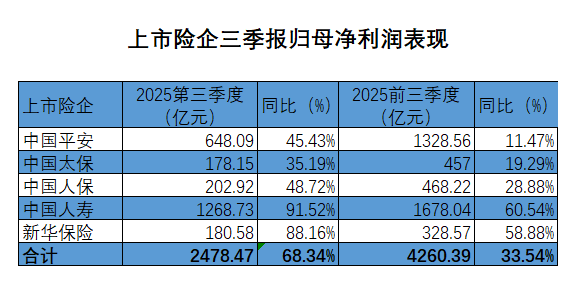
Core Insights - The listed insurance companies in A-shares achieved a record net profit attributable to shareholders of 426.04 billion yuan in the first three quarters, marking a year-on-year increase of over 30% compared to the previous year's high growth of 80% [2][3] - The significant increase in net profit is primarily driven by a surge in investment income, with an average growth of over 35% in total investment income for the first three quarters [2][7] - The new business value also saw a year-on-year increase of over 30%, with the bancassurance channel continuing to be a major contributor to new premium growth [2][11] Investment Performance - The total investment income for the listed insurance companies reached 887.5 billion yuan in the first three quarters, reflecting a year-on-year growth of 35.64%, with the third quarter alone contributing 542.4 billion yuan, a 66.64% increase [7][8] - The annualized total investment return for companies like New China Life reached 8.6%, up 1.8 percentage points year-on-year, while other companies also reported returns exceeding 5% [8] Accounting Strategies - Different accounting classification strategies among insurance companies have led to varying sensitivities of net profit to fluctuations in equity asset prices, with companies like China Life and New China Life having higher proportions of FVTPL (Fair Value Through Profit or Loss) assets [10] - The higher the FVTPL proportion, the greater the potential for net profit increases during market upswings, but also greater volatility during downturns [10] New Business Value - The new business value for the listed insurance companies continued to show widespread growth, with increases ranging from 30% to over 70% year-on-year [11] - The growth in new business value is primarily driven by the increase in new premium sales, with significant contributions from the bancassurance channel [11][12]




2025三季报综述:中短期视角下,资产端依旧是主逻辑:保险行业周报(20251027-20251031)-20251102
Huachuang Securities· 2025-11-02 09:44
Investment Rating - The report maintains a "Recommendation" rating for the insurance industry, indicating an expected increase in the industry index by more than 5% over the next 3-6 months compared to the benchmark index [21]. Core Insights - The insurance index decreased by 0.96% this week, underperforming the market by 0.54 percentage points. Individual stock performances varied significantly, with AIA up by 6.19% and Sunshine down by 6.82% [1]. - For the first three quarters of 2025, major listed insurance companies reported a total net profit of 426 billion yuan, reflecting a year-on-year increase of 34%. The growth was primarily driven by the investment side, benefiting from a bullish stock market [4]. - The report highlights that the net profit growth rates for major companies are as follows: China Life +60.5%, New China Life +58.9%, China Property +50.5%, China Insurance +28.9%, China Pacific +19.3%, and Ping An +11.5% [2][4]. Summary by Sections Weekly Dynamics - China Life achieved a net profit of 167.8 billion yuan, up 60.5% year-on-year, with net assets reaching 625.8 billion yuan, a 22.8% increase from the end of the previous year [2]. - New China Life reported a net profit of 32.9 billion yuan, up 58.9%, with net assets at 100.5 billion yuan, a 4.4% increase [2]. - China Property's net profit was 40.3 billion yuan, reflecting a 50.5% increase, with net assets at 289.9 billion yuan, up 12.3% [2]. - China Insurance reported a net profit of 46.8 billion yuan, up 28.9%, with net assets at 314.1 billion yuan, a 16.9% increase [2]. - China Pacific's net profit was 45.7 billion yuan, up 19.3%, with net assets at 284.2 billion yuan, down 2.5% [2]. - Ping An's net profit reached 132.9 billion yuan, up 11.5%, with net assets at 986.4 billion yuan, a 6.2% increase [2]. Performance Overview - The report indicates that the investment return rates for the first three quarters of 2025 are as follows: New China Life 8.6%, China Life 6.42%, China Insurance 5.4%, China Pacific 5.2%, and Ping An 2.8% [4]. - The report notes that the net profit growth for life insurance remains strong, with significant increases in new business value (NBV) for major companies: China Insurance 77%, New China Life 51%, Ping An 46%, China Life 42%, and China Pacific 31% [5]. Investment Recommendations - The report suggests that if the equity market maintains its current momentum, insurance companies are likely to continue experiencing high growth in performance. It recommends focusing on companies with strong earnings elasticity, specifically New China Life, China Property, China Life, and China Pacific for short-term investments [10]. - For long-term investments, it recommends China Pacific, China Property, and Ping An based on fundamental performance and valuation [10].


保险Ⅱ行业点评报告保险行业9月保费:寿险单月保费增速回落,财险各险种全面向好
Soochow Securities· 2025-11-02 06:04
Investment Rating - The report maintains an "Overweight" rating for the insurance industry [1] Core Insights - In September, the growth rate of life insurance premiums declined, while all types of property insurance showed improvement [1] - The report anticipates that the high growth pattern of premiums for the year has been largely established, with optimistic expectations for new premium growth in 2026 due to sustained market demand [5] - The health insurance sector saw a positive growth rate in Q3, with September showing an increase compared to August [5] - The property insurance sector reported a year-on-year premium growth of 4.9% for the first nine months of 2025, with significant improvements in both auto and non-auto insurance [5] - The report highlights that both liability and asset sides of the insurance companies are continuously improving, indicating substantial upward valuation potential [5] Summary by Sections Life Insurance - Q3 saw a year-on-year premium growth of 25%, but September's growth rate turned negative at -4.2% due to short-term demand effects from product switching [5] - For the first nine months of 2025, the original premium income for life insurance reached CNY 40,895 billion, a year-on-year increase of 10.2% [5] Health Insurance - Health insurance premiums increased by 2.5% year-on-year for the first nine months, with Q3 showing a positive growth rate of 2.8% [5] - The China Banking and Insurance Regulatory Commission's recent guidelines are expected to stimulate further growth in the health insurance market [5] Property Insurance - Property insurance premiums reached CNY 13,712 billion for the first nine months, with a year-on-year growth of 4.9% [5] - The report notes a significant improvement in non-auto insurance premiums, with September showing a year-on-year increase of 9.6% [5] Market Outlook - The report suggests that the market demand remains strong, with expectations of continued optimization in liability costs and improved profitability for leading companies [5] - Current valuations for the insurance sector are at historical lows, with estimates for 2025E PEV ranging from 0.56 to 0.92 times and PB from 1.07 to 2.07 times [5]
汇金、证金持仓动向揭秘
财联社· 2025-11-02 02:19
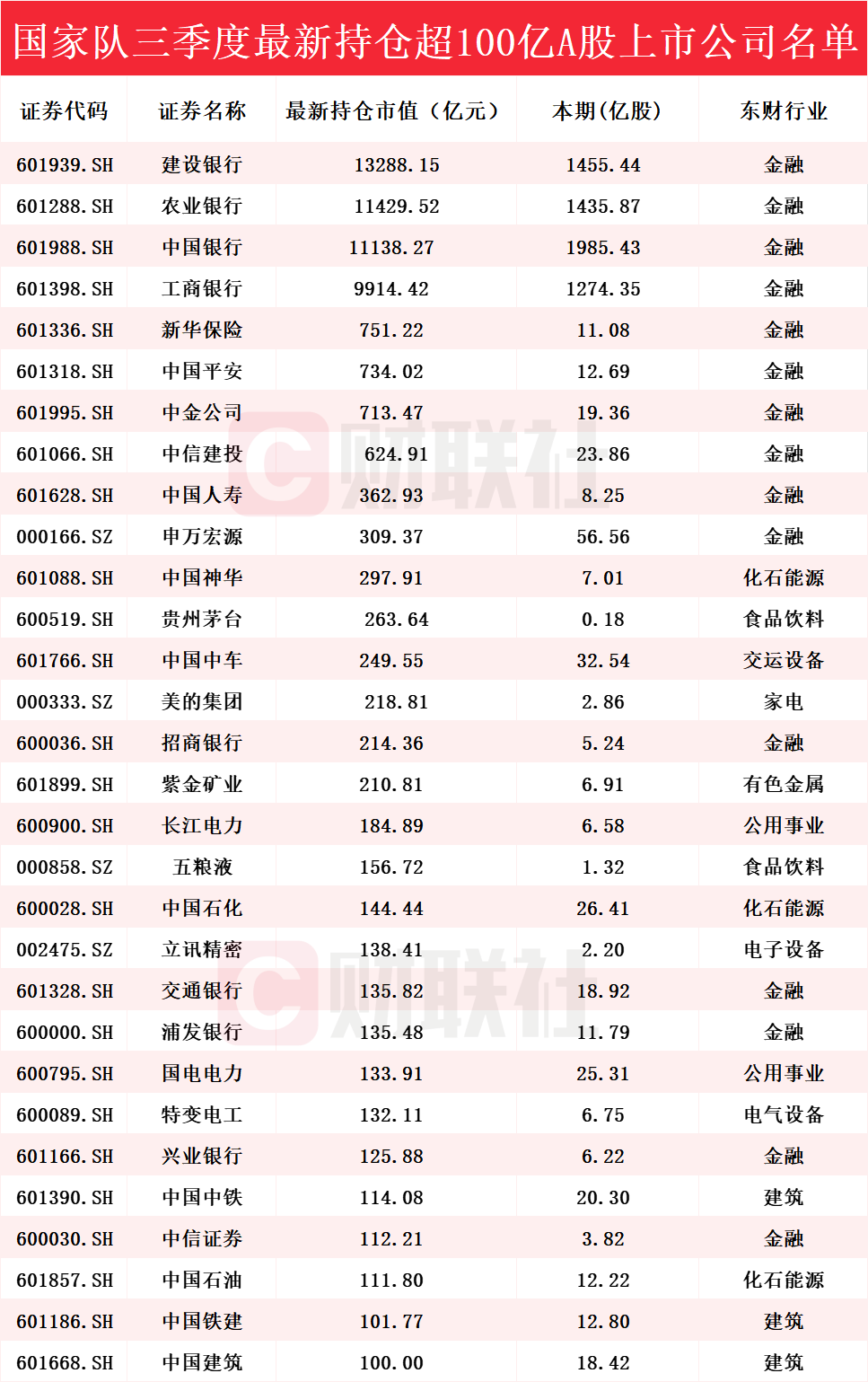
Core Viewpoint - The latest holdings of the "national team" in A-share listed companies have been revealed, with significant investments in major financial institutions and other sectors, indicating a strategic focus on stability and growth in the market [1][2]. Group 1: National Team Holdings - A total of 233 A-share listed companies have the "national team" (China Securities Finance Corporation and Central Huijin) among their top ten shareholders [1]. - There are 30 stocks with a holding value exceeding 10 billion yuan, including major banks like China Construction Bank, Agricultural Bank of China, and Bank of China, with holdings valued at 1.3288 trillion yuan, 1.1429 trillion yuan, and 1.1138 trillion yuan respectively [1][2]. - The top holdings also include companies from various sectors such as insurance, food and beverage, and energy, showcasing a diversified investment strategy [1][2]. Group 2: New Additions and Performance - Farah Electronics has been newly added to the "national team" holdings, with a market value of 158 million yuan [3]. - For the third quarter, Farah Electronics reported a revenue of 3.944 billion yuan, a year-on-year increase of 14.69%, and a net profit of 888 million yuan, also up by 14.58% [3]. - The company’s capacitor products are utilized in ultra-high voltage transmission applications, indicating a focus on high-demand technology sectors [3].







“国家队”持仓动向揭秘!Q3持仓超100亿A股上市公司名单一览
Xin Lang Cai Jing· 2025-11-02 00:45
Core Insights - The latest holdings of the "national team" in A-share listed companies have been revealed, with 233 companies having the "national team" as one of their top ten shareholders [1][2] - In the third quarter, the "national team" held over 10 billion yuan in market value in 30 stocks, including major banks and insurance companies [1] Group 1: Major Holdings - The top three holdings by market value are: - China Construction Bank: 13,288.15 billion yuan - Agricultural Bank of China: 11,429.52 billion yuan - Bank of China: 11,138.27 billion yuan [1] - Other significant holdings include: - Industrial and Commercial Bank of China: 9,914.42 billion yuan - New China Life Insurance: 751.22 billion yuan - Ping An Insurance: 734.02 billion yuan [1][2] Group 2: New Additions - Farah Electronics is a new addition to the "national team" holdings, with a market value of 1.58 billion yuan [2] - The company reported a revenue of 3.944 billion yuan for the first three quarters, a year-on-year increase of 14.69%, and a net profit of 888 million yuan, also up 14.58% [2] - In the third quarter alone, Farah Electronics achieved a revenue of 1.445 billion yuan, reflecting a year-on-year growth of 9.31% [2]
大摩:中国人寿多项数据表现优于同行 新业务价值增长强劲
Zhi Tong Cai Jing· 2025-11-01 17:21
Core Viewpoint - Morgan Stanley reports that China Life Insurance (601628)(02628) has the highest profit growth among peers for the third quarter, with a year-to-date growth of 60.5% [1] Financial Performance - The annual Return on Equity (ROE) for the third quarter and the first nine months stands at 88.3% and 39.4% respectively [1] - The new business value for the first nine months accelerated to a growth of 41.8%, compared to 20.3% in the first half of the year [1] Market Position - China Life's performance metrics are superior to most of its competitors, indicating a strong market position [1] - The management's outlook for the company in the coming year is positive, suggesting confidence in future growth [1] Analyst Rating - Morgan Stanley sets a target price of HKD 25.7 for China Life and maintains an "Overweight" rating [1]
赵宇龙任保险业协会党委书记;邱智坤拟接任董事长;赵雪军辞任总经理;第四套生命表自2026年1月1日起实施;|13精周报
13个精算师· 2025-11-01 04:03
Regulatory Dynamics - Five departments are promoting the implementation of a long-term care insurance system, supporting the inclusion of qualified medical and nursing institutions as designated service providers [6] - As of the end of September, the cumulative balance of three social insurance funds reached 9.85 trillion yuan, with total income of 6.69 trillion yuan and total expenditure of 6.04 trillion yuan for the first nine months [7] - The Financial Regulatory Bureau announced that the fourth set of life tables will be implemented starting January 1, 2026, which includes various tables for different insurance products [9] - The Financial Regulatory Bureau supports domestic insurance companies in issuing "sidecar" insurance-linked securities in the Hong Kong market [10] - The Financial Regulatory Bureau expects insurance premium income to reach 6 trillion yuan this year [24] Company Dynamics - Ping An Life increased its stake in China Merchants Bank H-shares to 18.02% [30] - China Life plans to invest 2 billion yuan in a private equity investment plan focusing on semiconductors, digital energy, and smart electric vehicles [31] - China Life reported a strong growth of 41.8% in new business value for the first three quarters [32] - China Ping An's net profit attributable to shareholders grew by 45.4% year-on-year in the third quarter [33] - China Reinsurance achieved a net profit of 51.97 billion yuan, a significant increase of 131.49% year-on-year [39] - AIA Group's new business value rose by 25% to 1.476 billion USD in the third quarter [40] Industry Dynamics - The five major insurance companies in A-shares collectively earned over 426 billion yuan in net profit for the first three quarters, a year-on-year increase of 33.5% [53][54] - The first report on reinsurance business in China showed that the ceded business exceeded 200 billion yuan, covering 14 countries and regions [55] - The insurance industry is expected to see a gradual stabilization or decrease in premium rates for new energy vehicle insurance in the short to medium term [26] - The insurance sector is exploring a comprehensive grading system for insurance models to reduce costs across the entire lifecycle of vehicles [26] - The comprehensive expense ratio of the property insurance industry reached a 20-year low, while the comprehensive cost ratio hit a 10-year low in the first nine months of this year [27]

中国人寿长沙支公司积极参与社会治理
Chang Sha Wan Bao· 2025-11-01 01:27
Core Points - The establishment of the "Legal Protection for Enterprises Workstation" by China Life Insurance in Changsha marks a new phase in collaboration with local government to enhance legal services and optimize the business environment [1][3] Group 1: Workstation Overview - The workstation operates under a mechanism of "government-led, legal protection, multi-party collaboration, and enterprise benefits," providing integrated legal services such as legal consultation and financial dispute mediation [3] - A "three offices and one court" linkage mechanism has been established, involving mediation centers, judicial offices, police stations, law firms, and grassroots courts to efficiently resolve financial disputes at low costs [3] Group 2: Social Responsibility and Governance - The initiative reflects a shift of financial institutions from traditional service providers to active participants in social governance, aligning with the implementation of the "Hunan Province Multi-Prevention and Resolution of Conflicts and Disputes Regulations" [3] - China Life's management emphasizes the company's commitment to social responsibility and legal construction, leveraging internal legal and compliance resources to support grassroots governance and create a stable, fair, and transparent business environment [3] Group 3: Local Government Support - The local government is committed to supporting the workstation's operations, focusing on enterprise needs and enhancing the legal satisfaction and sense of gain for businesses [3]

中国人寿(601628)2025年三季报点评:关注Q4低基数下业绩或持续高增
Xin Lang Cai Jing· 2025-11-01 00:27
Core Insights - The company achieved a net profit attributable to shareholders of 167.8 billion yuan in Q1-Q3 2025, representing a year-on-year increase of 60.5% [1] - The company’s new business value (NBV) grew by 41.8% year-on-year, with a significant improvement in growth rate compared to the previous quarter [2] - Total investment return rate increased by 1.04 percentage points to 6.42% year-on-year, driven by a favorable stock market [3] Financial Performance - Total premium income reached 669.6 billion yuan in Q1-Q3 2025, up 10.1% year-on-year, with new single premium income increasing by 10.4% [2] - The company’s investment assets amounted to 7.28 trillion yuan, a growth of 10.2% compared to the end of the previous year [3] - The net profit growth rate for Q3 2025 was particularly strong at 91.5% year-on-year, contributing to a total net profit of 167.8 billion yuan for the first three quarters [3] Strategic Initiatives - The company is actively transforming its product offerings, with a notable increase in the proportion of floating income-type business in first-year premium income, which rose by 45 percentage points year-on-year [2] - The workforce in individual insurance increased to 607,000, reflecting ongoing improvements in recruitment and retention efforts [2] - The company is expected to maintain a high growth trend in Q4 2025, benefiting from a low base effect from Q4 2024 [3] Investment Outlook - The company has adjusted its earnings per share (EPS) forecasts for 2025-2027 to 6.34, 4.1, and 4.74 yuan respectively, with a target price of 54.6 yuan for 2026 based on a price-to-earnings value (PEV) of 0.85x [3] - The performance of the insurance sector is anticipated to be positively influenced by the recovery in the equity market, allowing the company to leverage its asset flexibility for high growth [3]
【中国人寿(601628.SH、2628.HK)】盈利超预期高增,NBV增幅进一步走阔——2025年三季报点评(王一峰/黄怡婷)
光大证券研究· 2025-11-01 00:05
Core Viewpoint - The article highlights the significant growth in China Life's financial performance for the first three quarters of 2025, driven by increased investment income and improved business quality [5][6]. Financial Performance - In the first three quarters of 2025, China Life reported operating revenue of 537.9 billion yuan, a year-on-year increase of 25.9% [5]. - The net profit attributable to shareholders reached 167.8 billion yuan, reflecting a substantial year-on-year growth of 60.5% [5]. - The net assets attributable to shareholders stood at 625.83 billion yuan, up 22.8% from the beginning of the year [5]. - The weighted average return on equity was 29.3%, an increase of 9.3% year-on-year [5]. - The comparable new business value grew by 41.8% year-on-year [5]. - The annualized total investment return rate was 6.4%, up by 1.0 percentage point year-on-year [5][9]. Investment Income - The total investment income for the first three quarters increased by 41.0% to 368.55 billion yuan, significantly contributing to the net profit growth [6]. - The third quarter alone saw a remarkable net profit increase of 91.5% year-on-year, amounting to 126.87 billion yuan [6]. Sales Force and Business Quality - As of the end of Q3 2025, the total sales force comprised 657,000 individuals, a decrease of 5.3% year-on-year [7]. - The individual insurance sales force also decreased by 5.3% year-on-year but showed a quarter-on-quarter increase of 2.5% [7]. - The retention rate and quality of the sales team improved, with a stable business quality reflected in a retention rate of 0.7%, unchanged year-on-year [7]. Premium Income and New Business Value - Premium income for the first three quarters reached 669.65 billion yuan, a year-on-year increase of 10.1% [8]. - The new single premium income was 218.03 billion yuan, up 10.4% year-on-year, with a notable improvement in growth rates across the quarters [8]. - The proportion of floating income-type business in the first-year premium income increased by over 45 percentage points, indicating a successful transformation [8]. - The new business value saw a year-on-year increase of 41.8%, with a significant expansion in growth compared to the first half of the year [8]. Investment Assets - By the end of Q3 2025, the total investment assets reached 7.3 trillion yuan, an increase of 10.2% from the beginning of the year [9].