China Life(601628)

Search documents
老年群体健康险市场迎变,“照护服务纳入赔付权益”求解结构性矛盾
Xin Lang Cai Jing· 2026-01-20 01:04
Group 1 - The health insurance purchasing difficulties faced by the elderly population are gradually being addressed, with policies encouraging the introduction of dedicated health insurance products for this demographic [1][2] - Shanghai's recent measures highlight the need for specialized health insurance for the elderly, acknowledging the unique health risks they face and advocating for differentiated product designs rather than generic offerings [1][2][4] Group 2 - The current health insurance market for the elderly is characterized by structural contradictions, with limited product availability and high restrictions, leading to a mismatch between existing offerings and the actual needs of older adults [2][5] - Existing products like "惠民保" provide broad coverage but primarily address immediate medical expenses rather than the ongoing care and management needs of the elderly, indicating a gap in the market [4][5] Group 3 - The introduction of care services as a compensation right in health insurance represents a significant innovation, allowing for earlier intervention in chronic disease management and rehabilitation, which aligns more closely with the needs of the elderly [6][7] - Major insurance companies are increasingly focusing on health management and care services, expanding their offerings to better serve the elderly population [7][8] Group 4 - The insurance industry faces challenges in product innovation for the elderly, with a tendency to replicate Western models without adequately addressing local needs [8][9] - Companies are encouraged to balance profitability with policy compliance by adopting a layered approach to product design, integrating health management as a risk control tool, and collaborating with public services to mitigate risks [9][10]


非银行业周报(2026年第二期)中信发布25年业绩快报,看好券商业绩增长
AVIC Securities· 2026-01-20 00:30
Investment Rating - The industry investment rating is "Overweight," indicating that the growth level of the industry is expected to exceed that of the CSI 300 index over the next six months [3][37]. Core Insights - The report highlights that the securities sector experienced a decline of 2.21% during the week, underperforming the CSI 300 index by 1.64 percentage points. The current price-to-book (PB) ratio for the brokerage sector is 1.38 times [1][2]. - CITIC Securities reported a net profit of 30.051 billion yuan for 2025, marking a year-on-year growth of 38.46%, and its operating revenue reached 74.83 billion yuan, up 28.75% year-on-year. This performance is attributed to the overall upward trend in the domestic capital market and increased investor confidence [2][35]. - The report emphasizes that the growth drivers for the industry in 2025 will be diverse, with traditional businesses showing resilience and investment banking benefiting from a recovery in the equity financing market [2][6]. Summary by Sections Securities Weekly Data Tracking - The brokerage sector's performance is closely monitored, with traditional businesses like brokerage and proprietary trading showing high elasticity in growth due to increased market activity [2][9]. Insurance Weekly Data Tracking - The insurance sector saw a decline of 3.59%, underperforming the CSI 300 index by 3.02 percentage points. China Life Insurance reported over 62.24 million claims in 2025, with a total claim amount exceeding 100.4 billion yuan, reflecting a 10% year-on-year increase [7][8]. - The overall insurance industry achieved a premium income of 576.29 billion yuan in November 2025, with a year-on-year growth of 7.56% [25][8]. Industry Dynamics - The report notes that regulatory encouragement for industry consolidation is present, with mergers and acquisitions seen as effective means for brokerages to achieve external growth. This consolidation is expected to enhance industry competitiveness and resource allocation [3][6][30].





2025年度保险理赔报告密集出炉:“直付”服务打通壁垒,重疾出险年轻化、仍存较大保障缺口
Xin Lang Cai Jing· 2026-01-20 00:13
Core Insights - The insurance industry is witnessing a significant shift in claims and service models, with a focus on digitalization and direct payment services, enhancing the efficiency of claims processing [1][8] - Total claims paid by life insurance companies reached 1.18 trillion yuan, while property insurance companies paid 1.03 trillion yuan in 2025, both showing an increase compared to the previous year [1] - Medical insurance remains the dominant category in terms of claim numbers, while critical illness insurance accounts for a significant portion of claim amounts, highlighting a growing awareness of health risks among residents [5][6] Group 1: Claims Data Overview - Major insurance companies reported substantial increases in claims for 2025, with China Life processing over 62.24 million claims, a 7% increase year-on-year, and total claims amounting to over 100.4 billion yuan, a 10% increase [2] - China Pacific Life reported 4.24 million claims with a total payout of 20.1 billion yuan, while Ping An Life processed 4.96 million claims totaling 41.51 billion yuan [3] - China Property & Casualty Insurance processed over 200 million claims, with a total payout exceeding 380 billion yuan, marking a growth of over 10% [2] Group 2: Critical Illness and Medical Insurance Trends - Medical insurance claims accounted for over 90% of total claims in many companies, while critical illness insurance represented over 50% of the total payout amounts [5][6] - The trend of younger individuals being diagnosed with critical illnesses is rising, with significant claims from the 40-60 age group, and the 18-40 age group showing a high incidence rate [6][7] - Despite the increase in awareness and claims, the average payout for critical illness insurance remains insufficient to cover the high costs of treatment, with many claims below 100,000 yuan [7] Group 3: Digitalization and Service Improvements - The introduction of direct payment services has streamlined the claims process, allowing patients to avoid upfront costs, with China Life reporting 8.17 million direct payment claims totaling over 4.3 billion yuan [8][9] - The digital transformation in the insurance sector has led to over 90% of claims being processed online for several companies, significantly improving efficiency [8][9] - Companies are leveraging technology, including IoT and automated claims processing, to enhance service delivery and customer experience [9]



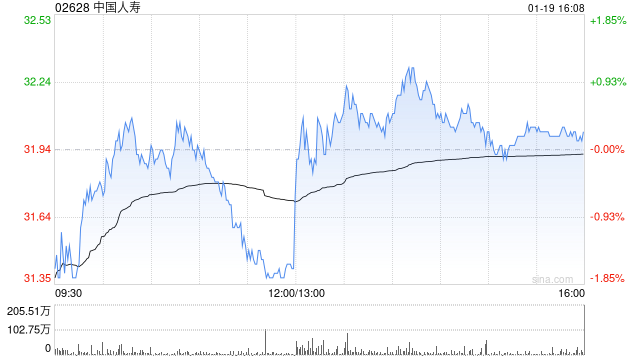
中国人寿遭贝莱德减持约2079.18万股 每股作价约32.69港元
Xin Lang Cai Jing· 2026-01-19 23:58
香港联交所最新资料显示,1月13日,贝莱德减持中国人寿(02628)2079.1754万股,每股作价32.6945 港元,总金额约为6.8亿港元。减持后最新持股数目约为5.16亿股,最新持股比例为6.94%。 责任编辑:卢昱君 责任编辑:卢昱君 热点栏目 自选股 数据中心 行情中心 资金流向 模拟交易 客户端 热点栏目 自选股 数据中心 行情中心 资金流向 模拟交易 客户端 香港联交所最新资料显示,1月13日,贝莱德减持中国人寿(02628)2079.1754万股,每股作价32.6945 港元,总金额约为6.8亿港元。减持后最新持股数目约为5.16亿股,最新持股比例为6.94%。 ...

多家险企发布2025年度理赔报告 信息技术助力服务效率提升
Zhong Guo Zheng Quan Bao· 2026-01-19 23:17
Core Insights - The insurance industry has shown a stable claims scale for 2025, with major insurers enhancing their protection capabilities and many small to medium-sized insurers experiencing significant business growth [2][3] Claims Scale Stability - The total number of claims for China Life exceeded 62.24 million, a year-on-year increase of 7%, with total claims amounting to over 100.4 billion yuan, up 10% [2] - Ping An Life reported 4.958 million claims with a total payout of 41.51 billion yuan, while Xinhua Insurance had 5.01 million claims totaling 14.7 billion yuan [2] - Smaller insurers like Zhongyou Insurance saw customer service numbers exceed 2.49 million, a growth of over 370%, with claims amounting to 3.2 billion yuan, up over 90% [2] - The claims acceptance rates for several insurers remained high, with China Life, CITIC Prudential, and Ping An Life at 99.8%, 99.7%, and 99.2% respectively [2] High Payouts in Critical Illness Insurance - Critical illness claims accounted for a significant portion of total payouts, with Ping An Life reporting 261,000 claims totaling over 20.86 billion yuan, representing over 50% of total claims [3] - The average payout for critical illness and death claims was notably high, with Zhonghong Insurance reporting average payouts of 181,500 yuan and 184,500 yuan respectively [3] - There exists a substantial coverage gap between critical illness payouts and treatment costs, with Zhongyou Insurance indicating an average payout of 100,000 yuan against an average treatment cost of 400,000 yuan for malignant tumors [3] Growth Potential in Critical Illness Insurance - Analysts predict that the aging population and increasing demand for better medical resources will expand the potential customer base for critical illness insurance, leading to a sales growth period [4] - Medical claims accounted for the highest proportion of total claims for China Life at 60.6%, and over 65% for Cigna Life [4] Technological Empowerment in Claims Services - The integration of information technology has significantly accelerated claims processing times, with Xinhua Insurance reporting an average processing time of 0.5 days for small medical claims under 5,000 yuan [5] - Ping An Life's "111 Fast Claims" service has improved efficiency, with 93% of automated claims being processed within 60 seconds [5] - China Life has implemented a "one-day claim" service for critical illness claims, allowing for same-day processing for eligible cases [6] - The focus on IT in the insurance sector has shifted towards intelligent underwriting and claims systems, with major insurers adopting digital solutions to replace manual processes [6]
信息技术助力服务效率提升
Zhong Guo Zheng Quan Bao· 2026-01-19 21:11
Core Insights - The insurance industry has shown a stable claims scale for 2025, with major insurers enhancing their protection capabilities and small to medium-sized insurers experiencing significant business growth [1][2] - Critical illness insurance and medical insurance exhibit complementary characteristics, with high claim amounts and high frequency of claims respectively [1] Claims Scale Stability - In 2025, China Life Insurance reported over 62.24 million claims, a year-on-year increase of 7%, with total claims exceeding 100.4 billion yuan, up 10% [1] - Ping An Life had 4.958 million claims totaling 41.51 billion yuan, while Xinhua Insurance reported 5.01 million claims with a payout of 14.7 billion yuan [1] - Smaller insurers like China Post Insurance saw customer service numbers exceed 2.49 million, a growth of over 370%, with claims amounting to 3.2 billion yuan, up over 90% [1] High Claim Amounts in Critical Illness Insurance - Critical illness claims accounted for a significant portion of total payouts, with Ping An Life reporting 261,000 claims totaling over 20.86 billion yuan, representing over 50% of total claims [2][3] - Other insurers like Xinhua Insurance and Zhonghong Insurance also reported critical illness claims as the highest payout category in 2025 [2] High Average Payouts - Zhonghong Insurance reported average payouts for critical illness and death claims at 181,500 yuan and 184,500 yuan respectively [3] - Sunshine Life indicated average payouts for death and critical illness claims at 143,000 yuan and 90,000 yuan respectively [3] - There exists a significant protection gap between critical illness payouts and treatment costs, with China Post Insurance noting an average payout of 100,000 yuan against an average treatment cost of 400,000 yuan for malignant tumors [3] Technology Empowering Claims Service Upgrades - Many insurers have significantly accelerated payout speeds due to technological advancements, with Xinhua Insurance reporting an average processing time of 0.5 days for small medical claims under 5,000 yuan [4] - Ping An Life's "111 Fast Claim" service has improved, with 93% of automated claims being processed within 60 seconds, and the fastest payout occurring in just 8 seconds [4] - China Life Insurance has implemented a "one-day payout" green channel for critical illness claims, allowing eligible cases to be processed on the same day [4] IT Developments in Insurance - Analysts note that insurers are increasingly focusing on IT developments in smart underwriting and claims systems, with leading insurers adopting digital employees and intelligent audits to replace manual processes [5]
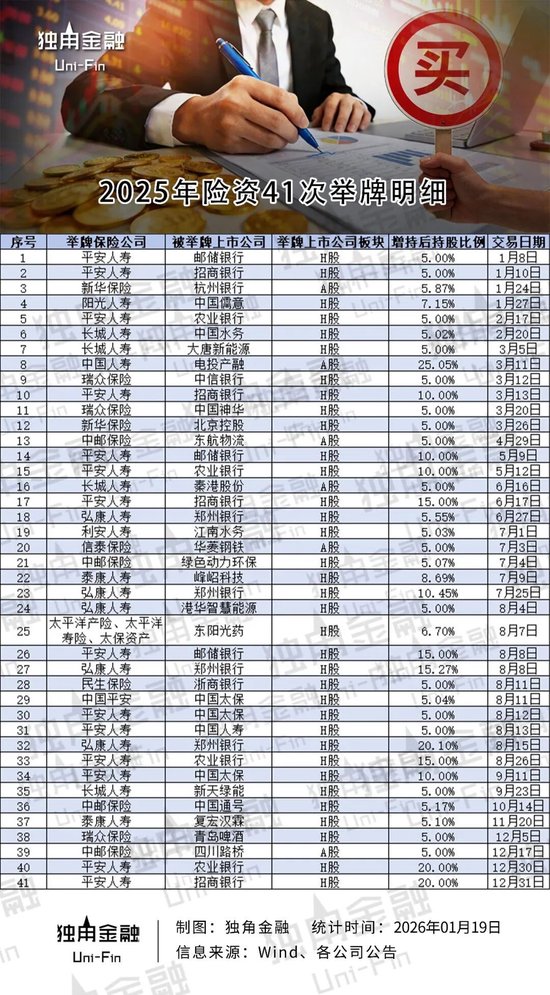
狂揽港股!险资一年41次举牌背后的资本盛宴
Xin Lang Cai Jing· 2026-01-19 12:23
Core Viewpoint - Insurance capital is transitioning from a "barbarian at the gate" to a "strategist in the boardroom," with a focus on long-term investments rather than short-term financial gains, as evidenced by a record 41 public shareholding increases in 2025, the highest in nearly a decade [1][16][19] Group 1: Investment Trends - In 2025, insurance capital engaged in 41 public shareholding increases, more than double the average of recent years, indicating a significant shift in investment strategy [2][16] - The majority of these shareholding increases (over 85%) occurred in H-shares, driven by their substantial valuation discounts and smoother acquisition mechanisms [1][19] - Insurance companies are increasingly focusing on financial stocks, particularly banks, as they seek certainty, safety, and valuation flexibility in a complex market environment [1][9] Group 2: Regulatory Environment - Recent regulatory changes have opened up opportunities for insurance capital in equity investments, shifting from restrictions to encouragement of long-term investments [4][18] - The optimization of solvency regulatory standards has expanded the space for equity investments, allowing insurance companies to better match their long-term liabilities with asset returns [4][18] Group 3: Financial Performance - Insurance companies have reported significant increases in investment income, with 11 companies showing positive growth in 2025, including a remarkable 687.16% increase for New China Life [11][26] - The overall investment yield for major insurers has risen, with Ping An Life and China Life reporting increases exceeding 400% in investment income [12][26] Group 4: Strategic Focus - Insurance capital is not only focusing on traditional financial sectors but is also investing in high-tech fields such as renewable energy, advanced manufacturing, and biotechnology, reflecting a strategic alignment with national economic transformation [9][23] - The long-term nature of insurance capital aligns well with companies that have solid fundamentals and stable cash flows, allowing insurers to share in corporate growth and dividends [3][17]

贝莱德减持中国人寿(02628)约2079.18万股 每股作价约32.69港元
智通财经网· 2026-01-19 11:34
Group 1 - BlackRock reduced its stake in China Life (02628) by 20,791,754 shares on January 13, with a price of HKD 32.6945 per share, totaling approximately HKD 680 million [1] - After the reduction, BlackRock's latest shareholding stands at approximately 516 million shares, representing a holding percentage of 6.94% [1]

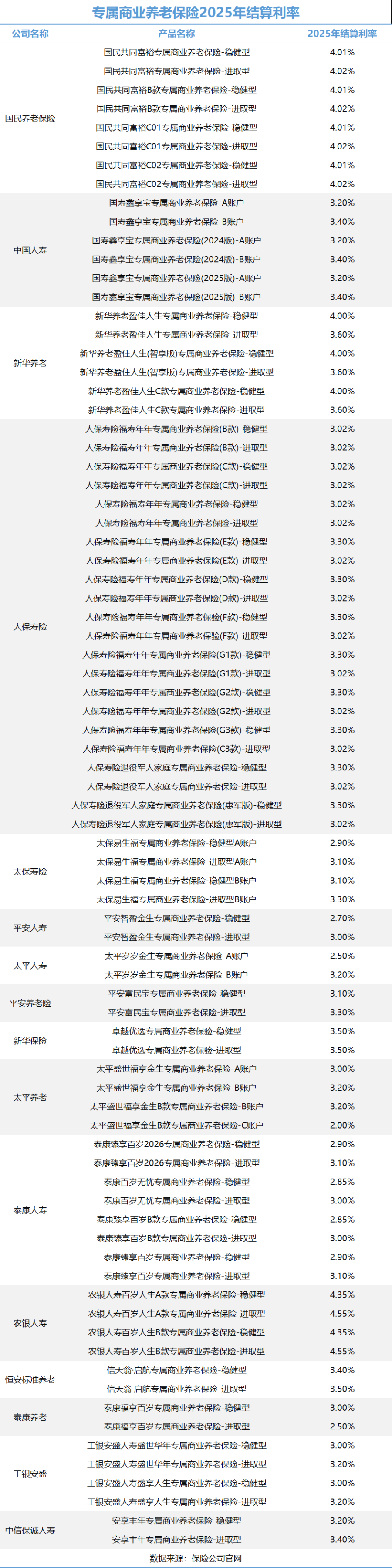
专属商业养老保险利率超存款 八成收益超3%
2 1 Shi Ji Jing Ji Bao Dao· 2026-01-19 10:34
Core Viewpoint - The recent disclosure of 2025 settlement rates for exclusive commercial pension insurance products by multiple insurance institutions highlights a promising investment opportunity amidst declining bank deposit rates and fluctuating wealth management product values. The majority of these products offer competitive returns, with over 80% of them exceeding a 3.00% settlement rate for 2025 [1][2][8]. Summary by Category Insurance Product Performance - A total of 40 exclusive commercial pension insurance products have been reported, with settlement rates for stable accounts ranging from 2.00% to 4.35%, and for aggressive accounts from 2.50% to 4.55% [1][2]. - Among these products, 70 accounts (87.5%) have a settlement rate exceeding 3.00% [1][2]. - Notably, the products from Nongyin Life and Guomin Pension have all their settlement rates above 4.00%, with Nongyin Life's stable and aggressive accounts both at 4.35% and 4.55%, respectively [8]. Market Context - The backdrop of declining deposit rates has led to increased difficulty for investors seeking stable returns, prompting a shift towards pension insurance products as a viable alternative [2][8]. - The trend of "deposit special forces" among young investors reflects the growing demand for higher interest rates, which has become increasingly challenging to find in traditional banking products [2]. Product Structure and Design - Exclusive commercial pension insurance products are designed with both stable and aggressive accounts, allowing for a balance between guaranteed returns and potential higher yields [10][14]. - The unique structure of these products enables insurance companies to adopt long-term investment strategies, optimizing returns despite a low-interest environment [9][10]. - There is a notable phenomenon where some stable accounts are yielding higher returns than aggressive accounts, contrary to typical expectations [11]. Target Audience and Flexibility - These products cater to the needs of flexible employment groups, offering more adaptable payment options compared to traditional annuity insurance [12][14]. - The ability to choose between different account types and adjust contributions provides consumers with a tailored approach to retirement planning [13][14]. Regulatory Environment - The regulatory framework for exclusive commercial pension insurance includes mechanisms for monitoring settlement rates and ensuring financial stability, which enhances consumer confidence in these products [20].
保险公司为什么疯狂买股票?
Xin Lang Cai Jing· 2026-01-19 10:27
Core Viewpoint - In a declining interest rate environment, fixed-income assets like bonds are unable to match the long-duration liabilities of insurance companies, leading them to prefer high-dividend stocks as investment targets [1][10]. Group 1: Insurance Companies' Investment Activities - As of January 18, 2024, 81 insurance institutions conducted over 300 investigations into A-share listed companies, involving 80 companies [1]. - On January 9, 2024, Pacific Life announced a significant increase in its stake in Shanghai Airport, acquiring 72.424 million shares, bringing its total ownership to 4.9994% [1]. - The revival of insurance capital's stake acquisitions began in 2024, with approximately 40 acquisitions expected in 2025, marking a ten-year high [11][12]. Group 2: Premium Income Growth - In the first eleven months of 2025, insurance companies reported premium income of 5.76 trillion, a 7.56% increase compared to the same period in 2024 [3][14]. - Life insurance premiums reached 4.42 trillion, up 9.2% year-on-year, while property insurance premiums totaled 1.34 trillion, a 2.48% increase [3][14]. - China Life's premium income surpassed 700 billion in the first eleven months of 2025, with New China Life reporting a full-year premium income of 195.9 billion in the previous year, reflecting a 15% growth [3][14]. Group 3: Asset and Liability Management - The rapid growth of liabilities in insurance companies necessitates matching quality assets in the market [4][15]. - Unlike insurance companies, banks have shorter liability durations, with most deposits maturing within 1 to 3 years, allowing for quicker adjustments in a declining interest rate environment [4][15]. - By mid-2025, the average net investment return for listed insurance companies is projected to approach the cost of guaranteed liabilities, indicating a concerning downward trend [4][16]. Group 4: Stock Investment Trends - Low-valuation, high-dividend, and high-reliability companies are becoming preferred investment targets for insurance companies, as their dividend yields surpass bond returns [6][18]. - By mid-2025, the total stock investment of the five major listed insurance companies reached 1.85 trillion, accounting for 10.35% of total investment assets [6][18]. - China Life led with a stock investment of 620.1 billion, representing 11.83% of its total assets, followed by New China Life with 199.2 billion, or 11.63% [19]. Group 5: Future Projections - By the end of 2024, insurance companies are expected to have invested 2.43 trillion in stocks, with a projected increase to 5.2 trillion by the end of 2026 if stock investment ratios rise to 11.5% [20]. - If the stock investment ratio only increases to 10%, the total investment could still reach 4.5 trillion, reflecting an increase of 880 billion from the previous year [20]. - High-dividend stocks are anticipated to remain a primary investment direction for insurance capital in 2026, serving as a safety net for equity investments [10][20].