Bank of Chengdu(601838)

Search documents
银行业周报(20251201-20251207):数字人民币定位有望晋级,支付领域大有可为-20251207
Huachuang Securities· 2025-12-07 11:45
Investment Rating - The report maintains a "Recommended" investment rating for the banking sector, indicating a positive outlook for the industry in the near term [1]. Core Insights - The positioning of the digital RMB is expected to advance, with significant potential in the payment sector. The People's Bank of China (PBOC) is working on optimizing the management system for digital RMB, which may evolve from a cash-like payment instrument (M0) to broader monetary categories (M1, M2) [2][8]. - Infrastructure development for digital RMB is progressing, with the establishment of international and operational centers in Shanghai and Beijing, respectively. As of September 2025, the cumulative transaction amount in pilot areas reached 14.2 trillion yuan, with 2.25 billion personal wallets opened [3][8]. - The banking sector is expected to see a systematic recovery in valuations in 2026, transitioning from a defensive to a growth-oriented investment logic. Key investment themes include high dividend yields and low valuations, particularly as risk-free interest rates decline [9]. Summary by Sections Industry Overview - The banking sector comprises 42 listed companies with a total market capitalization of approximately 1.15 trillion yuan, representing 13.04% of the market [4]. - The average daily trading volume for A-shares was 10,583.60 billion yuan, reflecting a 0.65% increase from the previous week [8]. Performance Metrics - The absolute performance of the banking sector over the past month is 5.0%, with a relative performance of 2.8% compared to the benchmark [5]. - The report highlights that the banking index underperformed the CSI 300 index by 2.46 percentage points during the week [8]. Investment Recommendations - The report suggests focusing on three main investment lines: 1. State-owned banks and major commercial banks like China Merchants Bank. 2. Quality joint-stock banks and city commercial banks with improving net interest margins and credit costs. 3. City commercial banks benefiting from regional policies and showing significant performance potential [9]. - Specific banks recommended for investment include China Merchants Bank, CITIC Bank, and several city commercial banks such as Chengdu Bank and Chongqing Bank [9][10].



“地补”添力,消费贷贴息阵营扩容
Zhong Guo Zheng Quan Bao - Zhong Zheng Wang· 2025-12-06 15:52
12月以来,贵阳银行、贵州银行相继发布关于个人消费贷款贴息工作的公告。两家银行均表示,贴息业 务将严格按照"自愿申请、先报先得、额度用尽即止"的规则受理。贵州银行表示,该行可使用的贴息资 金额度按省级财政分配执行,额度用完即止。 此前,消费贷"国补"业务的贷款经办机构并不包括城商行、农商行。近期,中国证券报记者注意到,贵 州、四川等地区域性银行正在地方财政的助力下,加入到消费贷补贴阵营。业内人士表示,消费贷"地 补"不仅能为银行带来业务增长,也能撬动地方消费市场,预计未来会有更多省市加入。 区域性银行推出消费贷款贴息业务 此前,消费贷"国补"业务的贷款经办机构为6家国有银行、12家股份制银行、以及微众银行和4家消金公 司,城商行、农商行并未纳入其中。如今,部分城商行、农商行也加入到消费贷贴息阵营。 12月以来,贵阳银行、贵州银行先后发布关于个人消费贷款贴息工作的公告。其中,贵阳银行表示,可 为个人消费贷款与服务业经营主体贷款,能享受贴息的个人消费贷款,其实际消费对应商户工商登记注 册地应在贵州省内。 上述消费贷"地补"的贴息金额与"国补"力度持平。贵州银行、贵阳银行均表示,每名借款人在该行可享 受的全部个人消 ...
“地补”添力 消费贷贴息阵营扩容
Zhong Guo Zheng Quan Bao· 2025-12-06 15:32
12月以来,贵阳银行、贵州银行相继发布关于个人消费贷款贴息工作的公告。两家银行均表示,贴息业 务将严格按照"自愿申请、先报先得、额度用尽即止"的规则受理。贵州银行表示,该行可使用的贴息资 金额度按省级财政分配执行,额度用完即止。 预计未来会有更多省市加入 值得注意的是,12月4日,成都银行、成都农商行发布关于消费贷款财政贴息实施细则的公告。贴息政 策期间为2025年10月1日至2026年3月31日,个人客户提用成都银行、成都农商行四川省内经办机构发放 的个人消费贷款中实际用于四川省消费,且银行可通过贷款发放账户等识别借款人相关消费交易信息的 部分,可按规定享受四川省财政贴息支持。 公告显示,每位借款人在成都银行、成都农商行可享受的全部个人消费贷款累计贴息上限为1500元,其 中可享受单笔5万元以下的个人消费贷款累计贴息上限为500元。 业内人士表示,《个人消费贷款财政贴息政策实施方案》中的"鼓励地方财政部门结合实际情况对其他 经营个人消费贷款业务的金融机构给予财政贴息支持",给如今多地出台消费贷"地方补贴"政策留下了 空间。 此前,消费贷"国补"业务的贷款经办机构并不包括城商行、农商行。近期,中国证券报记者注 ...
消费贷贴息地方“红包”来了!川黔头部银行已出手 贵州个人最高补贴3000元
Mei Ri Jing Ji Xin Wen· 2025-12-06 05:42
Core Viewpoint - Several local commercial banks in Sichuan and Guizhou, including Chengdu Bank and Guiyang Bank, have launched personal consumption loan interest subsidy programs, focusing on loans issued from late 2025 to early 2026, with a subsidy rate of 1% per annum and a maximum subsidy amount based on the loan interest rate [1][2][4]. Group 1: Policy Implementation - The implementation period for the personal consumption loan interest subsidy is set from October 1, 2025, to March 31, 2026, with the possibility of extension based on effectiveness [2][4]. - The subsidy applies to personal consumption loans used for various categories, including household vehicles, education, and healthcare, with a maximum subsidy of 1,500 yuan in Sichuan and 3,000 yuan in Guizhou [1][6]. Group 2: Loan Details - The subsidy covers loans of up to 50% of the loan contract interest rate, with specific limits on the amount eligible for subsidy based on the loan size [2][6]. - In Sichuan, the cumulative subsidy limit for individual borrowers is 1,500 yuan, corresponding to a total consumption amount of 300,000 yuan [2][4]. Group 3: Bank Participation - Chengdu Bank and Chengdu Rural Commercial Bank are among the first to announce the implementation details, with total assets of 1.38 trillion yuan and nearly 1 trillion yuan, respectively [5]. - Other banks in the region are also encouraged to participate in the subsidy program, expanding the policy's coverage beyond the designated national banks [4][5]. Group 4: Economic Context - The Sichuan province has seen steady growth in consumer markets, with a retail sales total of 2.74 trillion yuan in 2024, reflecting an average annual growth rate of 4.4% from 2021 to 2024, surpassing the national average [4]. - The subsidy program is part of broader efforts by the Sichuan government to stimulate economic recovery and growth through targeted financial policies [4][8].
贴息上限1500元 成都银行推出个人消费贷财政贴息细则
Bei Ke Cai Jing· 2025-12-05 14:32
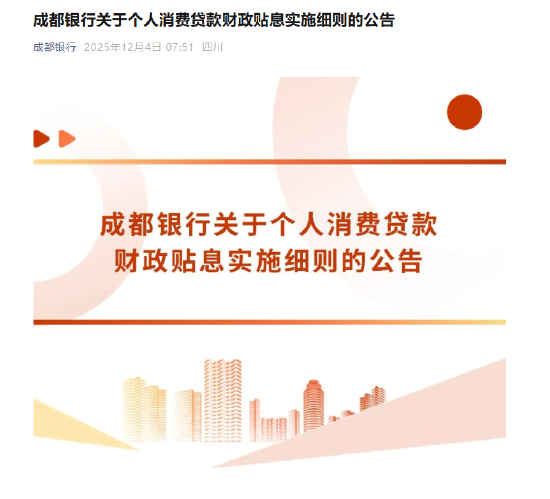
Core Viewpoint - Chengdu Bank has announced the implementation details for personal consumption loan interest subsidies, which will be effective from October 1, 2025, to March 31, 2026, aimed at boosting local consumption in Sichuan Province [1] Group 1: Subsidy Implementation Details - The subsidy applies to personal consumption loans issued by Chengdu Bank for consumption within Sichuan Province, excluding credit card transactions [1] - The subsidy covers various consumption categories, including household vehicles, education, healthcare, and electronics, with a maximum subsidy of 1% per annum, capped at 50% of the loan contract interest rate [2] - Each borrower can receive a total subsidy of up to 1500 yuan, corresponding to a total eligible consumption amount of 300,000 yuan [2] Group 2: Transaction Identification and Application Process - Borrowers must sign a subsidy agreement via Chengdu Bank's mobile app to authorize the bank to access transaction information for subsidy eligibility [3] - For transactions under 50,000 yuan, borrowers need to provide proof of consumption within Sichuan, while transactions above this amount require additional documentation [4] Group 3: Exclusions from Subsidy - The bank has outlined specific scenarios where subsidies will not be granted, including failure to sign the subsidy agreement, transactions occurring more than 30 days after loan disbursement, and misuse of loan funds [5] - Refunds on eligible transactions and loans in default or non-compliance with usage agreements will also disqualify borrowers from receiving subsidies [5] Group 4: Operational Aspects and Market Impact - Chengdu Bank will not charge service fees for processing subsidy applications and will launch the subsidy feature in its mobile banking app soon [6] - The policy aims to stimulate consumer spending by reducing financing costs, with local banks expected to leverage their regional advantages to enhance market penetration [9][10] - The implementation of this policy may increase operational and risk management costs for local banks, necessitating resource allocation to optimize processes [10]
四川、贵州两省出台个人消费贷贴息政策
Zhong Guo Jing Ying Bao· 2025-12-05 09:00
在今年8月23家金融机构"定向"承接消费贷贴息政策之后,地方银行也将迎来政策红利。 12月4日,成都银行、成都农商行分别发布公告称,根据四川省相关政策,个人客户提用省内经办机构 发放且实际用于四川省内消费的贷款部分,可获得贴息,该贴息政策实施期限为2025年10月1日至2026 年3月31日。 12月4日,成都银行公告指出,本行将通过系统识别或人工审核方式对授权账户的交易信息进行识别核 验,贴息协议生效后,本行开始识别客户在政策执行期间使用个人消费贷款进行消费的交易信息,并对 其中符合财政贴息要求的消费交易进行识别认定,按照政策规定予以贴息。 从贴息的范围来看,多家银行公布的政策中具体贴息范围都包括单笔5万元以下消费以及单笔5万元以上 的汽车、教育、健康医疗等重点领域消费。 贴息标准方面,四川及贵州两省年贴息比例1%(按符合条件的实际用于消费的个人消费贷款本金计 算),最高不超过合同利率的50%。 在补贴额度方面,贵州银行和贵阳银行个人消费贷款累计贴息上限为3000元,单笔5万元以下个人消费 贷款贴息累计上限为1000元,叠加大额消费贴息后总额不得突破3000元上限;成都银行及成都农商行个 人消费贷款累计贴息 ...
深耕区域沃土 铸就金融标杆:成都银行“十四五”高质量发展纪实
Sou Hu Cai Jing· 2025-12-05 02:04
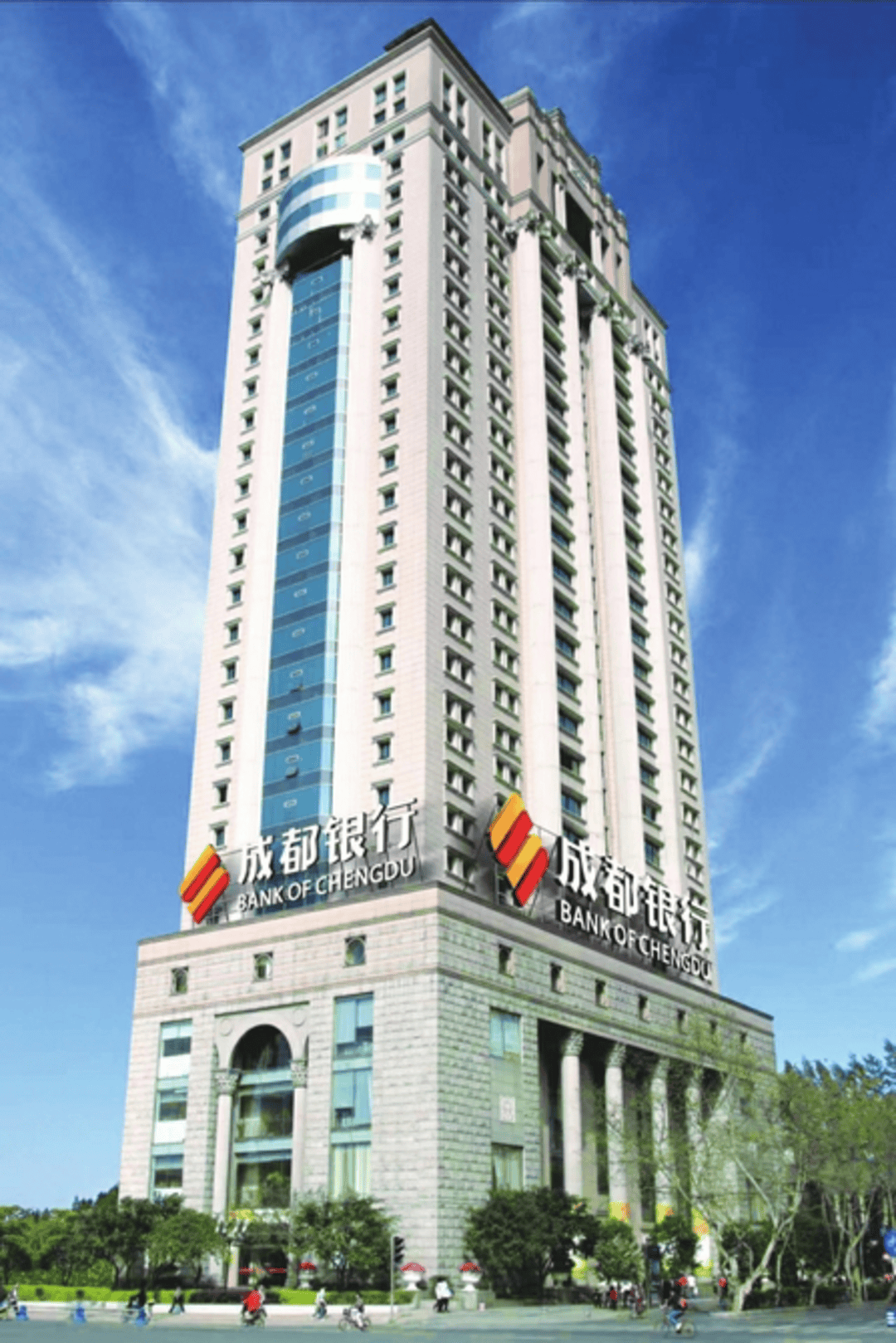
Core Viewpoint - Chengdu Bank is positioned as a key player in the financial sector of Western China, focusing on supporting the real economy and demonstrating resilience and growth potential amid complex economic conditions [2][3]. Group 1: Financial Performance and Growth - As of September 2025, Chengdu Bank's total assets exceeded 1.38 trillion yuan, with deposits of 986.4 billion yuan and loans totaling 847.5 billion yuan, placing it among the top tier in the industry [2]. - The bank achieved a significant loan balance increase of 14.13% in the first three quarters of 2025, outpacing asset growth [3]. - In the first half of 2025, the bank's experience in issuing special bonds exceeded 45 billion yuan, supporting major local projects [3]. Group 2: Innovation and Technology - Chengdu Bank has developed a unique "four specialized" service model for technology finance, covering the entire lifecycle of tech enterprises, with over 80% coverage of national-level specialized and innovative "little giant" companies [4]. - The bank successfully underwrote the first batch of technology innovation bonds in May 2025, directing financial resources to cutting-edge sectors like photonic chips and biomedicine [4]. Group 3: Diverse Financial Services - The bank is actively expanding its services in five key areas: technology finance, green finance, inclusive finance, pension finance, and digital finance, enhancing service quality and capacity [5]. - Chengdu Bank has supported over 530 cultural and creative enterprises with more than 4.7 billion yuan through specialized products like "Growth Loan" and "Cultural Creative Pass" [5]. Group 4: Corporate Governance and Market Confidence - The bank has demonstrated strong corporate governance and market confidence, with a total of 6.11 billion yuan in share buybacks announced by its controlling shareholder [7]. - In July 2025, the bank declared a cash dividend of 3.776 billion yuan, marking a historical high with a dividend yield of approximately 5.22% [7]. - Chengdu Bank has maintained stable dividends for eight consecutive years, totaling 17.856 billion yuan since its listing [7]. Group 5: Future Outlook - Looking ahead to the "15th Five-Year Plan," Chengdu Bank aims to continue its role in supporting the Chengdu-Chongqing economic circle with innovative and stable financial services [8].

成都银行推出个人消费贷财政贴息细则,累计贴息上限1500元/人
Sou Hu Cai Jing· 2025-12-04 16:05
Core Viewpoint - Chengdu Bank has announced the implementation details of a personal consumption loan interest subsidy policy, allowing individual customers to benefit from a subsidy for loans used for consumption within Sichuan Province, with an annual subsidy rate of 1% and a maximum of 50% of the loan contract interest rate [1][5]. Group 1: Policy Implementation Details - The policy execution period is from October 1, 2025, to March 31, 2026, with a total subsidy cap of 1,500 yuan for each borrower, corresponding to a cumulative consumption amount of 300,000 yuan [3][5]. - For loans under 50,000 yuan, the cumulative subsidy cap is 500 yuan, corresponding to a cumulative consumption amount of 100,000 yuan [5][4]. - The subsidy covers daily consumption and key areas such as household vehicles, education, cultural tourism, and health care [4][5]. Group 2: Application Process and Requirements - Borrowers must provide different documentation based on the loan amount; for loans under 50,000 yuan, proof of transaction is required, while loans over 50,000 yuan require a real-name invoice and payment proof [5][6]. - The bank has specified conditions under which subsidies will not be granted, including late transactions, misuse of loan funds, and submission of false materials [5][6]. Group 3: Market Impact and Analysis - The introduction of this subsidy policy marks the official implementation of the provincial personal consumption loan subsidy policy, which is expected to stimulate consumer demand and enhance local bank engagement with customers [8][9]. - Analysts suggest that this model may be replicated in other regions, potentially leading to increased consumption and support for local industries [9].
全球排名提升5位的背后,成都金融如何强支撑?|“十四五”对账本
Sou Hu Cai Jing· 2025-12-04 13:37
Core Insights - Chengdu's capital market has seen significant activity in November, with companies like Canopus Robotics and NobiKan AI filing for Hong Kong Stock Exchange listings, and WoFei ChangKong completing financing of several hundred million yuan [1] - The city aims to enhance its financial sector, targeting a financial industry value-added of over 280 billion yuan by 2025, while maintaining a top-tier position in the global financial center index [1] Financial Growth - By the end of 2024, Chengdu's banking assets and liabilities are projected to exceed 8 trillion yuan, marking over 56% growth since the beginning of the 14th Five-Year Plan [2] - The financial industry's value-added is expected to grow by 9.3% compared to the start of the 14th Five-Year Plan, with total deposits and loans reaching 6.27 trillion yuan and 6.66 trillion yuan respectively [2] Financial Ecosystem Development - Chengdu has seen a 68.42% increase in private equity fund management scale since the start of the 14th Five-Year Plan, with the establishment of a complete financial license system [5] - The city has implemented initiatives to connect financial resources directly to key enterprises and projects, providing substantial financial support for economic growth [5] Financing Initiatives - The "Huirong Loan" program has surpassed 200 billion yuan in loans, significantly alleviating financing pressures for local enterprises [6] - Chengdu Bank has launched the "Cheng Xiaowei" service brand to support small and micro enterprises with comprehensive financial services [6] Customized Financial Solutions - A "Financial Advisory Service Team" has been established to provide tailored solutions for businesses, completing over 950 projects related to supply chain financing and listing guidance [9] - Chengdu has launched a 100 billion yuan future industry fund to invest in emerging sectors, with the first batch of sub-funds totaling approximately 6.5 billion yuan already signed [9] Capital Market Performance - As of October 2025, Chengdu has 153 listed companies with a total market capitalization exceeding 2 trillion yuan, reflecting the city's growing capital strength [10] - The city has developed a comprehensive capital market service ecosystem, facilitating the listing process for local companies and hosting various promotional activities [10] Future Directions - Chengdu's financial authorities plan to continue enhancing support for key industries and small and micro enterprises, focusing on technological innovation and resource integration [11]
成都银行公告个人消费贷款贴息实施细则:年贴息1% 累计上限1500元
Xin Lang Cai Jing· 2025-12-04 07:43
Core Viewpoint - Chengdu Bank announced a personal consumption loan interest subsidy policy in Sichuan Province, effective from October 1, 2023, to March 31, 2026, aimed at supporting consumer spending within the province [1][4]. Summary by Categories Policy Details - The subsidy applies to personal consumption loans issued by local institutions for actual consumption in Sichuan Province [1][4]. - Eligible consumption includes single transactions below 50,000 yuan and significant expenditures in key areas such as automobiles, education, and healthcare [1][4]. - For transactions exceeding 50,000 yuan, the subsidy will be calculated based on a maximum consumption amount of 50,000 yuan [1][4]. Financial Terms - The annual subsidy rate is set at 1%, calculated on the principal of eligible personal consumption loans used for consumption, with a cap of 50% of the contract interest rate [1][4]. - Each borrower can receive a maximum subsidy of 1,500 yuan, corresponding to a total eligible consumption amount of 300,000 yuan [1][4]. - For single transactions below 50,000 yuan, the cumulative subsidy limit is 500 yuan, corresponding to a total eligible consumption amount of 100,000 yuan [1][4].