
Bank of Chengdu(601838)

Search documents
城商行板块11月7日跌0.21%,齐鲁银行领跌,主力资金净流出1.48亿元
Zheng Xing Xing Ye Ri Bao· 2025-11-07 08:37
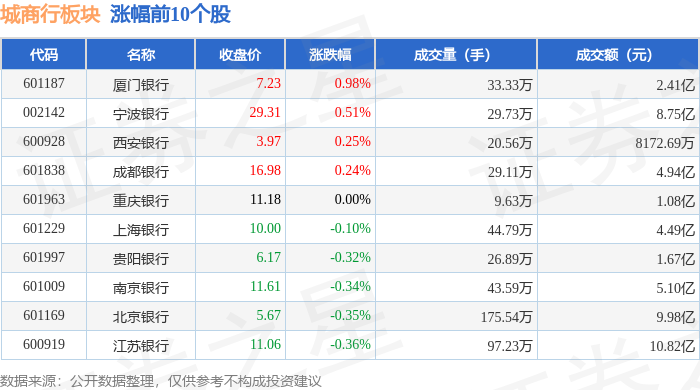
Market Overview - The city commercial bank sector experienced a decline of 0.21% on November 7, with Qilu Bank leading the drop [1] - The Shanghai Composite Index closed at 3997.56, down 0.25%, while the Shenzhen Component Index closed at 13404.06, down 0.36% [1] Individual Bank Performance - Xiamen Bank closed at 7.23, up 0.98% with a trading volume of 333,300 shares and a transaction value of 241 million [1] - Ningbo Bank closed at 29.31, up 0.51% with a trading volume of 297,300 shares and a transaction value of 875 million [1] - Qilu Bank closed at 6.08, down 1.46% with a trading volume of 648,100 shares and a transaction value of 39.86 million [2] - Suzhou Bank closed at 8.33, down 1.07% with a trading volume of 373,400 shares and a transaction value of 314 million [2] Capital Flow Analysis - The city commercial bank sector saw a net outflow of 148 million from institutional investors, while retail investors had a net inflow of 163 million [2] - Jiangsu Bank had a net inflow of 63.24 million from institutional investors, but a net outflow of 39.08 million from speculative funds [3] - Nanjing Bank experienced a net inflow of 24.45 million from institutional investors, with a net outflow of 30.58 million from speculative funds [3]





成都银行的成长韧性:资产规模稳步扩张 资产质量稳居行业前列
Di Yi Cai Jing· 2025-11-07 00:00
Core Viewpoint - Chengdu Bank has demonstrated consistent growth in revenue and net profit for nine consecutive years, establishing a solid foundation for its annual performance, with a focus on the Chengdu-Chongqing economic circle and a strong emphasis on its three main business areas: government finance, entity business, and retail liabilities [1][2]. Financial Performance - For the first three quarters of 2025, Chengdu Bank reported a total asset of 1,385.255 billion yuan, an increase of 135.139 billion yuan, or 10.81% year-on-year [2]. - The bank's total deposits reached 986.432 billion yuan, up 100.573 billion yuan, or 11.35% from the previous year [2]. - The total loan amount was 847.481 billion yuan, reflecting a growth of 104.913 billion yuan, or 14.13% year-on-year [3]. - The net interest income for the first three quarters was 14.725 billion yuan, a year-on-year increase of 8.24% [3]. Asset Quality - Chengdu Bank maintained a low non-performing loan (NPL) ratio of 0.68%, one of the few listed banks in A-shares with an NPL ratio below 0.7% [3]. - The bank's provision coverage ratio stood at 433.08%, indicating a strong buffer against potential loan losses [3]. Business Strategy - The bank is focused on enhancing its role as a key financial institution in the Chengdu-Chongqing economic circle, providing financial support for major projects and urban development [7]. - Chengdu Bank has committed over 1 trillion yuan in credit to the Chengdu-Chongqing economic circle over the past five years, with plans to allocate over 300 billion yuan for major projects in 2024 [7]. - The bank is actively involved in supporting green and low-carbon industries, as well as traditional industry transformations [8]. Market Recognition - Chengdu Bank's stock price has increased by over 140% since its listing in 2018, reflecting strong market confidence [9]. - The bank was ranked 324th in the 2025 Fortune China 500 list, improving by 35 places from the previous year [9][10]. - Chengdu Bank is recognized for its strong asset quality and growth potential, with major securities firms maintaining positive ratings and outlooks for the bank [10].
城商行板块11月6日跌0.11%,厦门银行领跌,主力资金净流出6.08亿元
Zheng Xing Xing Ye Ri Bao· 2025-11-06 08:51
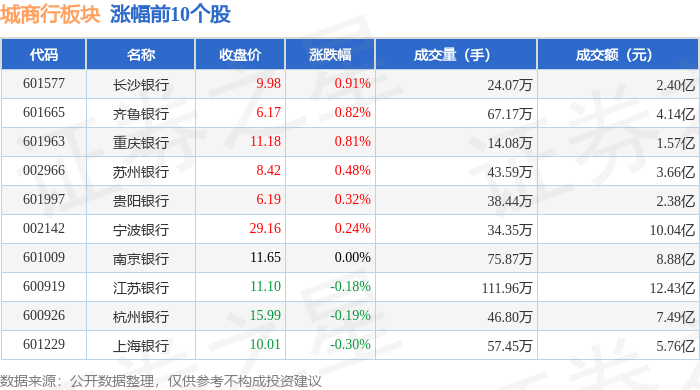
Core Viewpoint - The city commercial bank sector experienced a slight decline of 0.11% on November 6, with Xiamen Bank leading the drop, while the overall market indices showed positive movements with the Shanghai Composite Index up by 0.97% and the Shenzhen Component Index up by 1.73% [1][2]. Group 1: Market Performance - The closing price of Xiamen Bank was 7.16, reflecting a decrease of 2.59% with a trading volume of 539,700 shares and a transaction value of 387 million yuan [2]. - Other notable banks included Changsha Bank, which closed at 9.98 with a rise of 0.91%, and Qilu Bank, which closed at 6.17 with an increase of 0.82% [1]. - The city commercial bank sector saw a net outflow of 608 million yuan from major funds, while retail investors contributed a net inflow of 473 million yuan [2][3]. Group 2: Individual Bank Performance - Beijing Bank had a net inflow from major funds of 20.80 million yuan, while it experienced a net outflow from retail investors of 30.79 million yuan [3]. - Chongqing Bank recorded a net inflow of 11.91 million yuan from major funds but faced a net outflow of 12.20 million yuan from retail investors [3]. - Jiangsu Bank had a net inflow of 202.55 million yuan from major funds, while retail investors contributed a net inflow of 3.33 million yuan [3].

成都银行发布三季度报:信贷扩张量提质优,营收净利双双增长
2 1 Shi Ji Jing Ji Bao Dao· 2025-11-06 00:05
Core Viewpoint - Chengdu Bank reported steady growth in revenue and net profit for the first three quarters of 2025, with a focus on expanding its asset scale and enhancing its financial services to support regional economic development [1][2][3] Financial Performance - For the first nine months of 2025, Chengdu Bank achieved operating income of 17.761 billion yuan, a year-on-year increase of 520 million yuan, representing a growth rate of 3.01% [1] - The net profit attributable to shareholders reached 9.493 billion yuan, up by 454 million yuan, with a growth rate of 5.03% [1] - The bank's net interest income for the first three quarters was 14.725 billion yuan, with a year-on-year growth of 8.2%, and a quarterly growth of 9.5% [1][3] Asset Growth - Chengdu Bank's total assets reached nearly 1.39 trillion yuan by the end of Q3 2025, reflecting a year-on-year increase of 135.139 billion yuan, or 10.81% [1][2] - Total deposits amounted to 986.432 billion yuan, up by 100.573 billion yuan, with an increase of 11.35% [1] - The total loan amount was 847.481 billion yuan, showing a growth of 104.913 billion yuan, or 14.13% [1] Loan Structure and Strategy - The bank's loan growth was primarily driven by corporate lending, with a year-to-date increase of 16.2% as of September 2025 [2] - Chengdu Bank has focused on supporting key industries in Sichuan and Chengdu, achieving 100% coverage of major industrial chains [2] - The bank has developed 20 specialized products for small and micro enterprises, addressing their needs throughout their lifecycle [2] Operational Efficiency - Chengdu Bank's net interest margin is stabilizing, with expectations of improved performance as long-term deposits are repriced [3] - Basic earnings per share for the first three quarters were 2.99 yuan, with an annualized return on assets (ROA) of 0.96% and a return on equity (ROE) of 15.20% [3] Asset Quality - The bank maintained a non-performing loan ratio of 0.68%, indicating strong asset quality compared to industry standards [3] - The provision coverage ratio stood at 433.08%, demonstrating robust risk resistance capabilities [3] Future Outlook - Chengdu Bank is planning a new round of strategic development, focusing on sustainable growth and diversifying its business model to include retail assets and wealth management [3]
五家银行跻身绿色信贷“万亿俱乐部” 绿色债券存量规模近2万亿
2 1 Shi Ji Jing Ji Bao Dao· 2025-11-05 23:42
Core Insights - Green finance has transitioned from an optional choice to a mandatory requirement for the banking industry, serving as a new engine for strategic transformation and a blue ocean market for future growth [1] - The balance of green financing at Industrial Bank has reached nearly 2.5 trillion yuan, with green loans exceeding 1 trillion yuan and a non-performing loan rate of only 0.57% [1] - The People's Bank of China and other departments have issued a unified policy framework for green finance, effective from October 1, 2025, to standardize various financial products [2] Group 1: Green Credit Growth - As of the end of 2024, the total balance of green credit among 42 A-share listed banks exceeded 27 trillion yuan, reflecting a year-on-year growth of approximately 20% [3] - State-owned banks dominate the green credit market, with the six major state-owned banks accounting for over 21 trillion yuan, representing 77.6% of the total [3] - Industrial Bank's green loan balance has risen to 1.08 trillion yuan, joining the "trillion club" [3] Group 2: Performance and Sector Focus - The average growth rate of green credit for A-share listed banks in 2024 was 20.6%, a slowdown from approximately 28% in 2023, yet leading institutions maintained strong growth [4] - The focus of green credit issuance is concentrated in four key areas: clean energy, green transportation, energy conservation and environmental protection, and green buildings [4] - The Yangtze River Delta, Guangdong-Hong Kong-Macau Greater Bay Area, and Chengdu-Chongqing Economic Circle are identified as core regions for green credit [4] Group 3: Product Innovation - A-share listed banks are deepening innovation in green financial products, creating a multi-dimensional product system that includes loans, bonds, asset securitization, insurance, and carbon finance [5] - Sustainable Development Linked Loans (SLL), carbon emission rights pledge financing, and environmental rights collateral loans are gaining traction [5] - Industrial Bank has launched the first green loan with biodiversity protection insurance, while Bohai Bank introduced a green loan linked to data center energy efficiency [6] Group 4: Broader Financial Tools - The issuance of green bonds has expanded, with the cumulative issuance of labeled green bonds in 2024 surpassing 4 trillion yuan [6] - Banks are actively participating in green wealth management and fund products, enhancing investor engagement through innovative offerings [6] - Carbon finance tools are transitioning from pilot programs to broader applications, with various banks introducing carbon emission rights pledge financing products [6] Group 5: Future Directions - The banking industry is expected to continue innovating green financial products to support sustainable economic development, moving beyond traditional green credit [7] - The development of ESG-linked loans and financing models using carbon emission rights as collateral will be explored [7] - These innovations will not only assist in achieving national carbon reduction goals but also cultivate new growth momentum for banks [7]




上市银行2025年三季报综述:盈利温和修复,利息与中收共振回暖
Ping An Securities· 2025-11-05 10:38
Investment Rating - The report maintains a "stronger than the market" rating for the banking sector [1][4]. Core Views - As of the end of October, 42 listed banks reported a 1.5% year-on-year increase in net profit for the first three quarters of 2025, an improvement of 0.7 percentage points compared to the first half of 2025 [4][9]. - The report highlights a continued recovery in profitability, driven by a rebound in interest income and non-interest income [4][10]. - The report anticipates that the positive signals from interest margin and non-interest income will persist into the fourth quarter of 2025, with a focus on the impact of policies aimed at reducing competition and the quality of retail assets [15][4]. Summary by Sections Profitability Analysis - The net interest income for the first three quarters of 2025 decreased by 0.6% year-on-year, while non-interest income from fees and commissions grew by 4.6% [10][6]. - The report notes that the profitability of individual banks varies, with some banks like Shanghai Pudong Development Bank and Agricultural Bank of China showing significant growth rates of 10.2% and 3.0% respectively [4][9]. Operational Breakdown - Total asset growth for the 42 listed banks was 9.3% year-on-year, with loan growth at 7.7% and deposit growth at 7.9% [22][4]. - The annualized net interest margin for the third quarter was stable at 1.36%, with a decrease in the cost of interest-bearing liabilities [4][6]. Investment Recommendations - The report suggests a shift towards reallocation rather than trading, emphasizing the importance of structural changes in funding flows that support valuation recovery in the banking sector [6][4]. - Specific banks such as Chengdu Bank, Jiangsu Bank, and Suzhou Bank are highlighted for their regional advantages and potential for continued profit growth [6][4].




强势股追踪 主力资金连续5日净流入77股
Zheng Quan Shi Bao Wang· 2025-11-05 09:02
Core Insights - A total of 77 stocks in the Shanghai and Shenzhen markets have experienced net inflows of main funds for five consecutive days or more as of November 5, with Cambricon Technologies (寒武纪-U) leading with 50 days of continuous inflow [1] - The total net inflow of main funds for Cambricon Technologies reached 6.325 billion yuan, followed by Shanghai Pudong Development Bank with a net inflow of 777 million yuan over five days [1] - In terms of the proportion of net inflow to trading volume, *ST Baoying ranks first, with a 47.72% increase over the past eight days [1] Summary by Category Stocks with Continuous Net Inflows - Cambricon Technologies (688256) has seen net inflows for 50 days totaling 6.325 billion yuan, with a price increase of 44.33% [1] - Shanghai Pudong Development Bank (600000) recorded net inflows of 777 million yuan over five days, with a price increase of 0.42% [1] - CITIC Bank (601998) had net inflows of 439 million yuan over six days, with a price increase of 3.85% [1] Notable Performers - *ST Baoying had the highest net inflow ratio, with a significant price increase of 47.72% over the last eight days [1] - Other notable stocks include Jiangsu Bank (600919) with a net inflow of 342 million yuan and a price increase of 5.70%, and Yaxing Anchor Chain (601890) with a net inflow of 331 million yuan and a price increase of 10.16% [1] Additional Stocks with Inflows - Other stocks with notable net inflows include: - China Shenhua (601088) with 314 million yuan and a 3.42% increase [1] - Haotian Co., Ltd. (603759) with 166 million yuan and a 64.35% increase over 11 days [1] - Microelectronic Physiology (688351) with 140 million yuan and a 12.94% increase [1]




城商行板块11月5日涨0.12%,宁波银行领涨,主力资金净流入5236.36万元
Zheng Xing Xing Ye Ri Bao· 2025-11-05 08:55
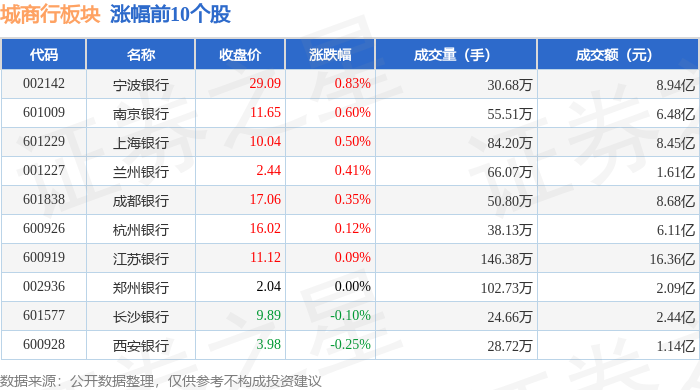
Market Performance - The city commercial bank sector increased by 0.12% on November 5, with Ningbo Bank leading the gains [1] - The Shanghai Composite Index closed at 3969.25, up 0.23%, while the Shenzhen Component Index closed at 13223.56, up 0.37% [1] Individual Stock Performance - Ningbo Bank (002142) closed at 29.09, up 0.83% with a trading volume of 306,800 shares and a transaction value of 894 million [1] - Nanjing Bank (6000000) closed at 11.65, up 0.60%, with a trading volume of 555,100 shares and a transaction value of 648 million [1] - Shanghai Bank (601229) closed at 10.04, up 0.50%, with a trading volume of 842,000 shares [1] - Other notable performances include Chengdu Bank (601838) at 17.06, up 0.35%, and Hangzhou Bank (600926) at 16.02, up 0.12% [1] Capital Flow Analysis - The city commercial bank sector saw a net inflow of 52.36 million from institutional investors, while retail investors contributed a net inflow of 89.18 million [2] - The sector experienced a net outflow of 142 million from speculative funds [2] Detailed Capital Flow for Selected Banks - Jiangsu Bank (600919) had a net inflow of 63.74 million from institutional investors, while it faced a net outflow of 46.26 million from speculative funds [3] - Chengdu Bank (601838) reported a net inflow of 63.42 million from institutional investors, with a net outflow of 57.05 million from speculative funds [3] - Ningbo Bank (002142) had a net inflow of 5.72 million from institutional investors but a significant net outflow of 43.57 million from retail investors [3]



银行业2025年三季报综述:业绩稳健性凸显,引领银行价值回归
Shenwan Hongyuan Securities· 2025-11-04 14:41
Investment Rating - The report maintains a positive outlook on the banking sector, indicating a potential return to a valuation of 1 times net asset value [4][7]. Core Insights - The banking sector has demonstrated steady performance, with a year-to-date revenue growth of 0.8% and a net profit growth of 1.5% for the first nine months of 2025, reflecting a stable regulatory environment supporting bank profitability [10][14]. - The report highlights a shift in focus from scale to balance in credit growth, with banks increasingly pursuing a "quantity-price balance" strategy [4][7]. - The cost of liabilities has improved more significantly than the decline in asset pricing, leading to a stabilization of net interest margins, which is expected to continue into the next year [4][7]. - Asset quality remains stable but shows signs of divergence, particularly with rising risks in small and micro businesses [4][7]. - The report suggests that the current dividend yield of the banking sector has returned to an attractive range, indicating a significant disconnect between stable earnings and stock holdings, which could lead to a value recovery [4][7]. Summary by Sections Performance Overview - The banking sector's performance has been characterized by a steady increase in revenue and profit, with state-owned banks showing better-than-expected stability and regional banks leading in performance [11][12][15]. - The report notes that the revenue growth of state-owned banks has turned positive, with non-interest income contributing significantly to this growth [12][15]. Credit Growth and Strategy - The report indicates a gradual abandonment of scale-driven growth, with banks focusing on achieving a balance between volume and pricing in their lending practices [4][7]. - The credit growth rate for listed banks decreased by 0.3 percentage points to 7.7% in Q3 2025, with state-owned banks maintaining a growth rate of approximately 8.5% [4][7]. Profitability and Asset Quality - The net interest margin for listed banks remained stable at 1.5%, with a slight quarter-on-quarter increase of 3 basis points in Q3 2025 [4][7]. - The overall non-performing loan ratio remained stable at 1.22%, indicating manageable risk levels across the sector [4][7]. Investment Recommendations - The report recommends focusing on leading banks and undervalued regional banks as key investment opportunities, suggesting that the recovery in valuations is supported by stable earnings and attractive dividend yields [4][7].

金工定期报告20251104:预期高股息组合跟踪
Soochow Securities· 2025-11-04 09:34
- The "Expected High Dividend Portfolio" model is constructed using a two-stage process: first, calculating the dividend yield based on annual report profit distribution data, and second, predicting and calculating the dividend yield using historical dividend data and fundamental indicators. Additionally, two short-term factors, the reversal factor and the profitability factor, are used to assist in stock selection. The portfolio is optimized within the CSI 300 constituents, holding 30 stocks per period and rebalancing monthly[3][8][13] - The stock selection process for the "Expected High Dividend Portfolio" involves: (1) excluding suspended and limit-up stocks from the CSI 300 constituents, (2) removing the top 20% of stocks with the highest short-term momentum (21-day cumulative returns), (3) excluding stocks with declining profitability (quarterly net profit growth rate < 0), and (4) ranking the remaining stocks by expected dividend yield and selecting the top 30 stocks to construct an equally weighted portfolio[9][13] - The backtesting results of the "Expected High Dividend Portfolio" from February 2, 2009, to August 31, 2017, show a cumulative return of 358.90% relative to the CSI 300 Total Return Index, with a cumulative excess return of 107.44%. The annualized excess return is 8.87%, the maximum rolling one-year drawdown of excess return is 12.26%, and the monthly excess win rate is 60.19%[11] - In October 2025, the "Expected High Dividend Portfolio" achieved an average return of 5.47%, outperforming the CSI 300 Index by 5.93% and the CSI Dividend Index by 2.50% during the same period[3][14][19]
