
Bank of Chengdu(601838)

Search documents
金工定期报告20251104:预期高股息组合跟踪
Soochow Securities· 2025-11-04 09:34
- The "Expected High Dividend Portfolio" model is constructed using a two-stage process: first, calculating the dividend yield based on annual report profit distribution data, and second, predicting and calculating the dividend yield using historical dividend data and fundamental indicators. Additionally, two short-term factors, the reversal factor and the profitability factor, are used to assist in stock selection. The portfolio is optimized within the CSI 300 constituents, holding 30 stocks per period and rebalancing monthly[3][8][13] - The stock selection process for the "Expected High Dividend Portfolio" involves: (1) excluding suspended and limit-up stocks from the CSI 300 constituents, (2) removing the top 20% of stocks with the highest short-term momentum (21-day cumulative returns), (3) excluding stocks with declining profitability (quarterly net profit growth rate < 0), and (4) ranking the remaining stocks by expected dividend yield and selecting the top 30 stocks to construct an equally weighted portfolio[9][13] - The backtesting results of the "Expected High Dividend Portfolio" from February 2, 2009, to August 31, 2017, show a cumulative return of 358.90% relative to the CSI 300 Total Return Index, with a cumulative excess return of 107.44%. The annualized excess return is 8.87%, the maximum rolling one-year drawdown of excess return is 12.26%, and the monthly excess win rate is 60.19%[11] - In October 2025, the "Expected High Dividend Portfolio" achieved an average return of 5.47%, outperforming the CSI 300 Index by 5.93% and the CSI Dividend Index by 2.50% during the same period[3][14][19]




成都银行2025年三季报:资产质量领跑行业,战略发力激活高质量增长新动能
Jin Rong Jie· 2025-11-04 07:53
Core Insights - Chengdu Bank's Q3 2025 report highlights its robust asset quality and strategic positioning as a key financial support for the construction of the Western Financial Center and the Chengdu-Chongqing Economic Circle [1][2]. Asset Quality and Risk Management - Chengdu Bank maintains a low non-performing loan (NPL) ratio of 0.68% and a provision coverage ratio of 433.08%, placing it in the top tier of the banking industry [2]. - The bank's NPL ratio has remained at a historical low of 0.66% for six consecutive quarters, with a provision coverage ratio of 452.65%, significantly exceeding industry averages [2]. - The bank employs a refined risk control system, utilizing a comprehensive industry research framework and intelligent risk control technologies to predict and manage credit risks effectively [2]. - As of September, the bank's capital adequacy ratios are well above regulatory requirements, with a core Tier 1 capital ratio of 8.77%, Tier 1 capital ratio of 10.52%, and total capital ratio of 14.39% [2]. Credit Investment and Regional Development - Chengdu Bank's credit issuance aligns with the national policy to enhance financial support for the real economy, with total assets reaching 1.385 trillion yuan, a 10.81% increase year-on-year [3]. - The bank's loan and advance total reached 847.48 billion yuan, growing 14.13% from the previous year, thus contributing significantly to regional credit growth [3]. - The bank's deposits totaled 986.43 billion yuan, with an increase of 100.57 billion yuan, reflecting a growth rate of 11.35% [3]. Strategic Development and Growth - Chengdu Bank's strategic layout is closely aligned with the Chengdu-Chongqing financial collaboration policies, focusing on expanding its core business areas while developing new growth avenues [4]. - The bank has seen explosive growth in its cross-regional business, with over 30% of new deposits and loans coming from this segment, including personal deposits surpassing 100 billion yuan [4]. - The retail banking sector has shown significant progress, with over 5 million mobile banking users and a notable increase in personal consumption loans, reflecting a strong alignment with macroeconomic policies [4]. National Strategy and Financial Services - Chengdu Bank integrates its development with national strategies, focusing on technology finance, green finance, inclusive finance, pension finance, and digital finance [5][6]. - The bank has provided substantial funding for major projects, including over 45 billion yuan in special bonds and more than 16 billion yuan for local infrastructure [6]. - The bank's focus on key industries and innovative financial products has led to significant loan issuance to strategic emerging industries, with over 80% coverage for specialized enterprises [6]. Future Outlook - Chengdu Bank aims to leverage opportunities from the Western Financial Center and the Chengdu-Chongqing Economic Circle, focusing on high-quality development and expanding its business footprint [7].
【盘中播报】30只个股跨越牛熊分界线
Zheng Quan Shi Bao Wang· 2025-11-04 03:44
Core Points - The Shanghai Composite Index is at 3977.20 points, slightly above the annual line with a change of 0.02% [1] - A total trading volume of A-shares reached 929.27 billion yuan today [1] - 30 A-shares have surpassed the annual line, with notable stocks showing significant deviation rates [1] Summary by Category Stock Performance - Dahua Intelligent (002512) has the highest deviation rate at 9.08%, with a daily increase of 10.04% and a turnover rate of 16.96% [1] - Zhongmin Energy (600163) follows with a deviation rate of 6.19%, increasing by 9.96% today [1] - Fujian Expressway (600033) shows a 4.40% deviation rate with a daily increase of 5.03% [1] Trading Activity - The total trading volume of A-shares today is 929.27 billion yuan, indicating active market participation [1] - Stocks like Chengdu Bank (601838) and Zhejiang Dingli (603338) have lower deviation rates, just above the annual line [1][2] Notable Stocks - Other stocks with significant performance include Maike Audi (300341) with a 3.58% deviation rate and a daily increase of 5.68% [1] - Stocks with minor deviations include Chongqing Water (601158) and Zhejiang Dingli (603338), both showing minimal changes [2]


银行25Q3综述:韧性好于预期
HTSC· 2025-11-04 02:19
Investment Rating - The report maintains an "Overweight" rating for the banking sector [2] Core Viewpoints - The banking sector shows resilience better than expected, with a focus on strong fundamentals and quality dividends driving core profit improvement [6][15] - The annualized non-performing loan generation rate for listed banks is 0.55%, down 13 basis points from Q2 2025, indicating a marginal decline in non-performing loan generation across all types of banks [6] - The report suggests focusing on two main directions for investment: high-quality fundamentals that may recover valuation premiums as market risk appetite increases, and stable high-dividend stocks [6][15] Summary by Sections Operating Overview - In the first nine months of 2025, listed banks' revenue and net profit grew by 0.9% and 1.5% year-on-year, respectively, with revenue growth slightly declining due to bond market volatility affecting non-interest income [15][24] - The net interest margin for listed banks was 1.41%, remaining stable compared to the first half of 2025, driven by a continuous decline in funding costs [15][25] Profitability Breakdown - The net interest income of listed banks decreased by 0.6% year-on-year, but various types of banks showed improvement in net interest income, particularly city commercial banks [25] - Non-interest income from wealth management and commission fees increased by 4.6% year-on-year, reflecting a recovery in capital markets [16][25] Asset and Liability Insights - Total assets and liabilities of listed banks grew by 9.3% year-on-year, maintaining steady expansion [17] - Loan growth remained stable, with a year-on-year increase of 7.8%, while deposits grew by 7.8%, indicating a slight decline in deposit growth rate [10][17] Risk Perspective - The overall non-performing loan ratio for listed banks was stable at 1.23%, with a provision coverage ratio of 236%, indicating solid asset quality [11][15] Market Outlook - The report anticipates a gradual recovery in bank performance, with a focus on quality banks that exhibit strong resilience [6][15]


城商行板块11月3日涨1.08%,上海银行领涨,主力资金净流入2.8亿元
Zheng Xing Xing Ye Ri Bao· 2025-11-03 08:43
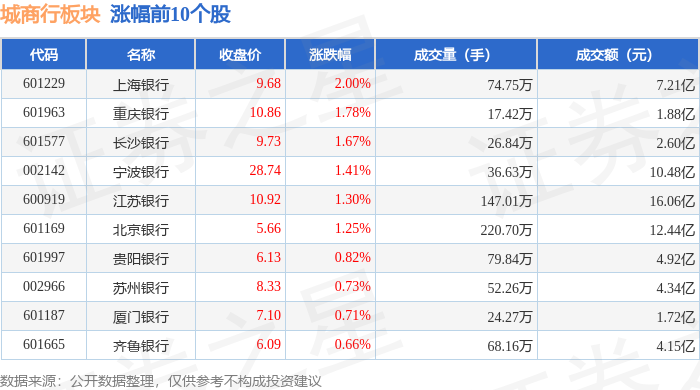
Market Performance - The city commercial bank sector increased by 1.08% on November 3, with Shanghai Bank leading the gains [1] - The Shanghai Composite Index closed at 3976.52, up 0.55%, while the Shenzhen Component Index closed at 13404.06, up 0.19% [1] Individual Stock Performance - Shanghai Bank (601229) closed at 9.68, up 2.00% with a trading volume of 747,500 shares and a transaction value of 721 million [1] - Chongqing Bank (601963) closed at 10.86, up 1.78% with a trading volume of 174,200 shares [1] - Other notable performers include: - Changsha Bank (601577) at 9.73, up 1.67% - Ningbo Bank (002142) at 28.74, up 1.41% - Jiangsu Bank (616009) at 10.92, up 1.30% [1] Capital Flow Analysis - The city commercial bank sector saw a net inflow of 280 million from institutional investors, while retail investors experienced a net outflow of 18.1 million [2] - The main capital flow for individual stocks includes: - Beijing Bank (601169) with a net inflow of 85.45 million from institutional investors [3] - Chengdu Bank (601838) with a net inflow of 78.77 million from institutional investors [3] - Jiangsu Bank (601009) with a net inflow of 28.60 million from institutional investors [3]


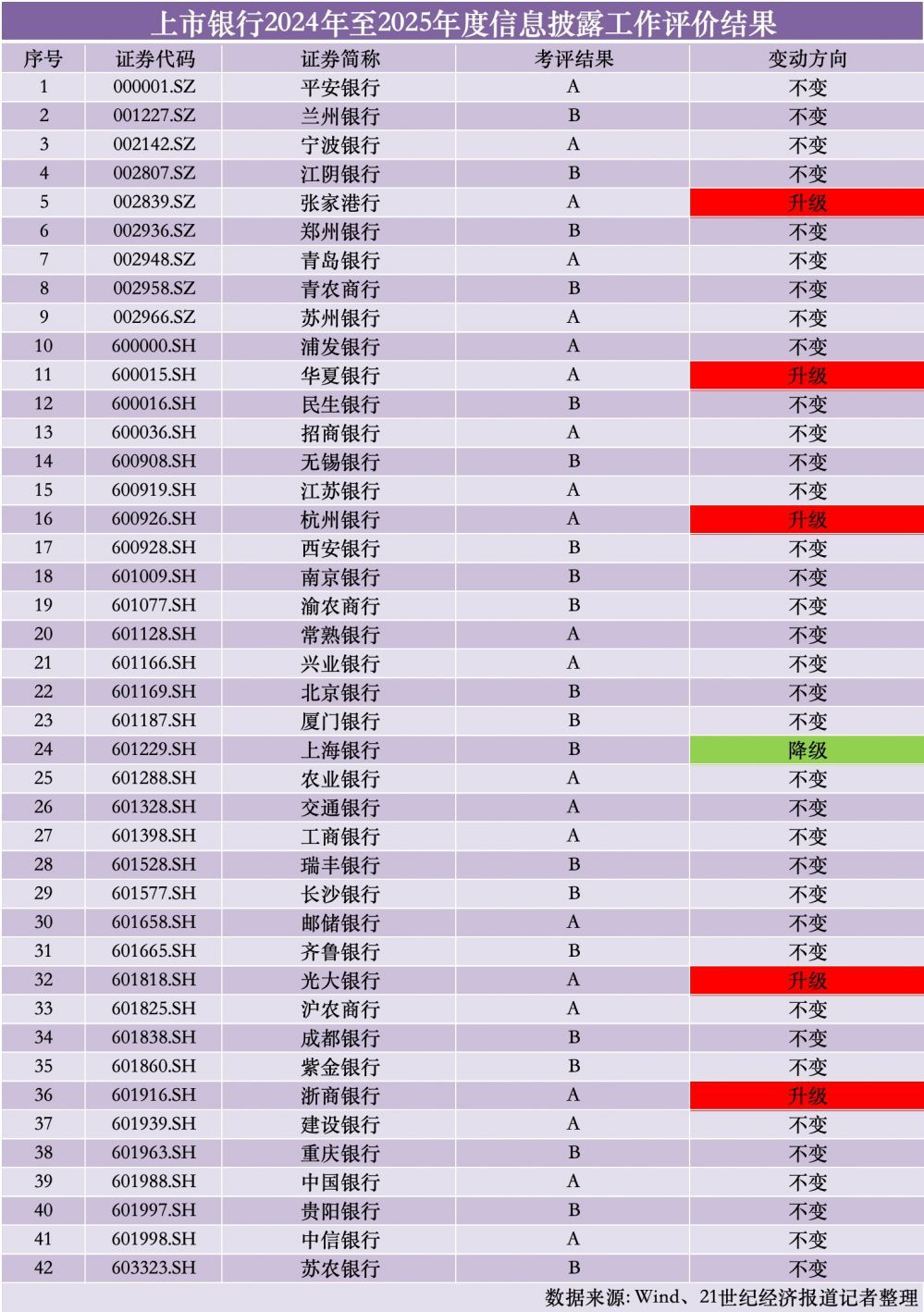
42家上市银行信披考评出炉:22家获A,光大、华夏和浙商银行提级
2 1 Shi Ji Jing Ji Bao Dao· 2025-11-03 08:21
Core Insights - The recent disclosure evaluation results for listed banks in China for the 2024-2025 period show that all listed banks received ratings of B or above, with 22 banks rated A, indicating a strong performance in information disclosure [1] Summary by Category Overall Ratings - All listed banks achieved a rating of B or higher, with 22 banks rated A, reflecting consistent performance compared to the previous year [1] - Only six banks experienced rating changes, with five banks improving their ratings and one bank, Shanghai Bank, experiencing a downgrade [1] Banks with Rating Changes - The following banks improved their ratings: - Zhangjiagang Bank - Hangzhou Bank - Huaxia Bank - Everbright Bank - Zhejiang Commercial Bank [1] - Shanghai Bank was the only bank to see a downgrade in its rating [1] Detailed Ratings - A selection of banks and their ratings includes: - Ping An Bank: A - Ningbo Bank: A - Agricultural Bank of China: A - Industrial and Commercial Bank of China: A - Shanghai Bank: B (downgraded) [2]



成都上市公司三季报出炉:91家上市公司盈利 新兴产业表现亮眼
Sou Hu Cai Jing· 2025-11-03 07:58
Core Insights - The A-share listed companies in Chengdu have reported strong performance for the third quarter of 2025, with 91 out of 122 companies profitable, representing a profitability rate of 74.6% [1][3] - Total operating revenue for these companies reached 4340.55 billion, with a net profit totaling 411.75 billion [1][3] - Chengdu Bank led in net profit with 94.93 billion, while Olin Bio achieved the highest year-on-year net profit growth rate at 1079.36% [1][3] Financial Performance - Among the 122 Chengdu A-share listed companies, 58 reported positive year-on-year net profit growth, accounting for nearly 48% [3] - Twelve companies reported net profits exceeding 10 billion, including Chengdu Bank, New Yisheng, and Sichuan Road and Bridge [3] - The net profit growth rates for several companies were remarkable, with Olin Bio at 1079.36% and Zhimingda at 995.37% [3][4] Sector Performance - The economic data from Chengdu shows a GDP of 18226.9 billion for the first three quarters, growing by 5.8% year-on-year, indicating a stable growth environment for listed companies [4] - Various sectors, including electronics, non-ferrous metals, and biomedicine, showed strong performance, particularly driven by downstream demand [4] - New Yisheng reported significant growth in the artificial intelligence sector, with a revenue increase of 221.70% and a net profit increase of 284.37% [4][5] Company Highlights - New Yisheng's revenue for the first three quarters reached 165.05 billion, with a third-quarter revenue of 60.68 billion, reflecting a year-on-year growth of 152.53% [4][5] - Olin Bio achieved a revenue of 5.07 billion, with a net profit of 4747.98 million, marking a year-on-year growth of 1079.36% [5] - Zhimingda, focusing on high-reliability embedded computing, reported a revenue of 5.12 billion, with a net profit turnaround [5]



寻找绩优股:2026年银行业年度策略
GUOTAI HAITONG SECURITIES· 2025-11-03 05:20
Investment Rating - The report indicates a cautious outlook on the credit growth rate, suggesting a shift towards quality improvement, with expectations for a recovery in corporate loan increments by 2026 [5][9]. Core Insights - Credit growth is expected to slow significantly starting in 2024, but the decline in growth rate is anticipated to moderate by 2026, with corporate loans likely to see a year-on-year increase [7][9]. - The relationship between credit growth and economic growth is weakening, emphasizing the need to optimize credit structure and reduce idle financial resources [9]. - The report highlights that the banking sector's total asset growth will outpace loan growth in 2025, driven by government bond supply and fiscal policies [9]. Summary by Sections Credit Growth Forecast - New RMB loans are projected at 21.3 trillion, 23.6 trillion, and 18.9 trillion yuan for 2022, 2023, and 2024 respectively, with a further estimate of 14.7 trillion yuan for the first three quarters of 2025 [9]. - For 2026, new loans are expected to be between 17.2 trillion and 17.7 trillion yuan, corresponding to a growth rate of 6.3% to 6.5% [9]. Loan Composition - In 2023, the total RMB loans are expected to reach 237.59 trillion yuan, with a year-on-year growth rate of 10.6% [8]. - Retail loans are projected to grow from 80.10 trillion yuan in 2023 to 82.84 trillion yuan in 2024, reflecting a growth rate decline from 5.7% to 3.4% [8]. - Corporate loans are anticipated to increase from 157.07 trillion yuan in 2023 to 171.01 trillion yuan in 2024, with a growth rate of 12.7% [8]. Regional Performance - Regions such as Jiangsu, Zhejiang, Sichuan, and Shandong are expected to continue outperforming the national average in loan growth due to strong economic performance and support from new policy financial tools [12]. Banking Sector Dynamics - The report notes that state-owned banks are expected to maintain a competitive edge due to lower funding costs and capital injections from the Ministry of Finance [12]. - The net interest margin is in a downward trend, but the rate of decline is expected to slow starting in 2025, with some smaller banks potentially stabilizing their margins by 2026 [13][17]. Asset Quality - As of Q2 2025, the non-performing loan (NPL) ratio for listed banks is reported at 1.25%, indicating a stable asset quality despite pressures on retail credit [37]. - The report emphasizes that while retail loan NPLs have increased since 2021, corporate loan clearances have improved significantly, providing a buffer against retail risks [37].


成都银行股份有限公司 关于召开2025年第三季度业绩说明会的公告
Zhong Guo Zheng Quan Bao - Zhong Zheng Wang· 2025-11-02 14:28
Core Points - The company will hold a Q3 2025 earnings presentation on November 7, 2025, from 15:00 to 16:00 [2][4] - The presentation will take place on the "Investor Relations Interactive Platform" [2][4] - Investors can submit questions via email by November 5, 2025, or ask during the meeting [2][5] Group 1 - The earnings presentation will be conducted in an interactive text format, allowing for real-time communication with investors [3] - Key company personnel, including the president, vice president, board secretary, and independent directors, will participate in the meeting [4] - The company aims to address common investor concerns during the earnings presentation [3][4] Group 2 - Contact information for investor relations is provided, including a phone number and email address for inquiries [6][7] - The announcement emphasizes the company's commitment to transparency and investor engagement [2][7]
成都银行(601838):业务规模稳健增长,关注类贷款率下降:——成都银行(601838):2025年三季报点评
Guohai Securities· 2025-11-02 08:32
Investment Rating - The investment rating for Chengdu Bank is maintained as "Buy" [1][4]. Core Views - Chengdu Bank's business scale shows steady growth, with a decrease in the rate of loans under concern. The bank's asset quality remains high, and it has maintained a low non-performing loan ratio [4][6]. - For the first three quarters of 2025, Chengdu Bank's revenue grew by 3.01% year-on-year, while net profit attributable to shareholders increased by 5.03%. However, there was a significant decline in both revenue and net profit in Q3 compared to Q2, primarily due to a decrease in fee and commission income and fair value gains [4][6]. - As of the end of Q3 2025, Chengdu Bank's total assets reached 1,385.3 billion yuan, a year-on-year increase of 13.4%. The total loan amount increased by 17.4%, with corporate loans and personal loans growing by 19.0% and 10.2%, respectively [4][6]. - The non-performing loan ratio remained stable at 0.68%, with a slight increase of 2 basis points from Q2 2025. The provision coverage ratio was 433.08%, down by 19.57 percentage points from the previous quarter. The rate of loans under concern decreased to 0.37%, down by 7 basis points [4][6]. Summary by Sections Financial Performance - Chengdu Bank's revenue for Q1-Q3 2025 was 24,908 million yuan, with a year-on-year growth rate of 8.38% projected for 2026 and 9.04% for 2027. The net profit attributable to shareholders is expected to be 133,270 million yuan in 2025, with growth rates of 3.65% and 6.08% for the following years [4][6]. - The earnings per share (EPS) is projected to be 3.14 yuan in 2025, with a price-to-earnings (P/E) ratio of 5.35 and a price-to-book (P/B) ratio of 0.80 [4][6]. Asset Quality - The bank's asset quality indicators remain robust, with a non-performing loan ratio of 0.68% and a provision coverage ratio of 433.08% as of Q3 2025. The focus on reducing the rate of loans under concern is a positive sign for future stability [4][6]. Market Performance - As of October 31, 2025, Chengdu Bank's stock price was 16.81 yuan, with a market capitalization of 71,248.10 million yuan. The stock has shown a 14.4% increase over the past 12 months [3][4].