
CTG DUTY-FREE(601888)

Search documents
港股异动 | 中国中免(01880)再涨超4% 海南封关即将落地 机构称海南市场企稳迹象显现
智通财经网· 2025-11-07 02:07
Core Viewpoint - China Duty Free Group (中国中免) shares have increased by over 4%, currently trading at 70.05 HKD, with a transaction volume of 263 million HKD, indicating positive market sentiment towards the company amid upcoming policy changes in Hainan [1] Group 1: Market Developments - The Hainan Free Trade Port is set to officially commence full island closure operations on December 18, which is expected to open a new chapter in external openness for Hainan [1] - The offshore duty-free policy remains a core pillar of Hainan's consumer market, with the inclusion of international travelers expected to boost the recovery and development of the duty-free sector [1] Group 2: Company Performance - According to Shenwan Hongyuan's research report, China Duty Free Group's profits were under pressure in the first three quarters, but there are signs of stabilization with monthly sales in core Hainan operations showing year-on-year growth and an increase in market share [1] - The revenue in the third quarter has begun to rebound from the bottom, supported by the ongoing recovery of airport channels and the opening of new large-scale city duty-free stores, which are anticipated to provide new growth momentum for the company [1] Group 3: Long-term Outlook - The long-term value of the company is viewed positively due to the expected increase in business traffic following the closure of Hainan's free trade port, as well as the company's multi-channel strategy encompassing "Hainan + airport + online + city" [1]
海外消费行业年度投资策略:2025扩品类、卡位全球,2026深度经营、品质、心智决胜
KAIYUAN SECURITIES· 2025-11-07 01:42
Group 1: Market Overview - The consumer service, retail, and media sectors in Hong Kong have shown significant performance, with the consumer service sector down by 17.34%, retail up by 94.61%, and media up by 50.98% as of October 24, 2025 [13][10][12] - The strong valuation recovery in Hong Kong stocks is attributed to a combination of global interest rate cuts, inflows of foreign and southbound capital, and the revaluation of core internet assets like Tencent and Alibaba [13][10] - The new consumption leaders in IP toys, tea drinks, and beauty sectors are showing positive fundamentals, leading to structural market trends [13][10] Group 2: IP Economy - The global licensed consumer goods market is projected to reach $307.9 billion in 2024, with a year-on-year growth of 10% [28] - Fashion apparel is identified as the category with the highest growth potential at 70%, followed by toys at 54% and food and beverages at 52% [31] - Disney, Pokémon, and Sanrio are leading in licensed retail sales, with Disney achieving $62 billion in 2024 [29][31] Group 3: Health and Wellness - The ready-to-drink beverage segment is expected to see significant penetration growth globally, with companies like Mixue Group and Guming benefiting from a positive operational cycle [4] - The return of home-cooked meals and increased health awareness are driving demand for traditional and healthy food options [4] Group 4: Beauty Sector - The cosmetics sector in China is experiencing slower growth compared to overall retail, with Douyin (TikTok) emerging as a key player in marketing and sales [4] - New ingredients and concepts are gaining traction, with a rise in oral beauty and health products [4] Group 5: Globalization Trends - The demand for spiritual entertainment in the Middle East is surging, with companies like Red Child City Technology seeing over 60% of their revenue from this region [4] - The cross-border e-commerce landscape is expanding, with companies like J&T Express capitalizing on the growth in Southeast Asia, where parcel volumes increased by 79% year-on-year [4] Group 6: Consumer Behavior Changes - The shift in consumer behavior towards more personalized and experiential consumption is evident, with a focus on self-fulfillment and value realization [4] - The education sector is adapting to changing perceptions, with new products targeting high school and college graduates to address employment challenges [4] Group 7: Entertainment and Leisure - The live music and sports sectors are expected to outperform the broader service consumption market, with companies like Ctrip and Damai Entertainment positioned to benefit [4] - The domestic concert market is maintaining high growth, with ticket sales and attendance showing significant year-on-year increases [73]



中国中免_免税政策利好驱动消费
2025-11-07 01:28
Summary of China Tourism Group Duty Free Corp. Conference Call Company Overview - **Company Name**: China Tourism Group Duty Free Corp. (CTGDF) - **Ticker**: 601888.SS (A-shares), 1880.HK (H-shares) - **Market Position**: Largest travel retail operator globally with approximately 80% market share in China's duty-free industry [26][27] Key Industry Insights - **Favorable Duty-Free Policies**: New policies effective from November 1, 2025, aim to boost consumption and recapture overseas spending onshore. Key measures include: - Tax refund/exemption for domestic products - Expansion of product categories in duty-free stores - Support for online reservations and pick-up services at duty-free stores [2][9][11] - **Hainan Free Trade Port**: Expected to enhance growth prospects starting December 18, 2025, with independent customs operations and favorable policies [2][9] Financial Performance - **3Q25 Results**: - Revenue showed a sequential improvement with a year-over-year decline narrowing to -0.4% - Earnings decreased by 29% year-over-year primarily due to lower gross margins and increased SG&A expenses [1] - Gross Profit Margin (GPM) slightly declined to 29.8% due to a higher sales mix of lower-margin mobile phones [3] - **Sales Trends**: - Hainan offshore duty-free sales increased by 3.4% in September and 13.6% during the Golden Week (October 1-8) [1] - Anticipated positive growth trajectory into the peak season due to improved execution and recovery in outbound travel [1] Strategic Initiatives - **Margin Improvement**: Management aims to enhance margins through product mix optimization, store efficiency improvements, and cost reductions [3] - **Inventory Management**: Increased inventory levels in 3Q25 to prepare for the peak season, particularly in cosmetics, while maintaining healthy inventory levels [3] Shareholder Returns - **Dividend Announcement**: The company declared its first interim dividend of RMB 517 million, representing a 17% payout ratio based on 9M25 net profit, with plans to maintain a high payout ratio [1] Valuation and Recommendations - **Target Price**: DCF-based target price set at RMB 78.00, reflecting the long-term growth potential of the duty-free business [28] - **Investment Rating**: Buy rating maintained for CTGDF, supported by structural growth in the duty-free industry and expected benefits from favorable policies and market dynamics [27] Additional Insights - **Product Diversification**: The expansion of product categories in duty-free stores is expected to cater to varying consumer preferences and enhance sales [2][11] - **Operational Efficiency**: Focus on digitalization and cost control measures to improve overall operational efficiency and profitability [3] This summary encapsulates the critical insights and financial performance of China Tourism Group Duty Free Corp. as discussed in the conference call, highlighting the company's strategic initiatives and market outlook.
免税店概念下跌2.28%,主力资金净流出26股
Zheng Quan Shi Bao Wang· 2025-11-06 10:09
Group 1 - The duty-free store concept declined by 2.28%, ranking among the top declines in the concept sector, with major declines seen in companies like Hainan Development and China Duty Free Group [2][3] - Among the duty-free store concept stocks, four stocks saw price increases, with Tibet Summit rising by 2.12%, Spring Airlines by 0.47%, and Bailian Group by 0.34% [2][3] - The duty-free store sector experienced a net outflow of 1.68 billion yuan in capital, with 26 stocks seeing net outflows, and six stocks experiencing outflows exceeding 100 million yuan [3][4] Group 2 - The top net outflow stock was Hainan Development, with a net outflow of 328.29 million yuan, followed by China Duty Free Group with 310.99 million yuan and Caesar Travel with 228.99 million yuan [3][4] - Other companies in the duty-free store concept that faced significant capital outflows include Hainan Airport, Haikou Group, and Lingnan Holdings, with respective outflows of 133.28 million yuan, 115.68 million yuan, and 62.55 million yuan [4] - Conversely, the stocks with the highest net inflows included Tibet Summit, Rizhao Port, and Bailian Group, with inflows of 30.61 million yuan, 5.83 million yuan, and 5.41 million yuan respectively [3][4]




商贸零售行业11月6日资金流向日报
Zheng Quan Shi Bao Wang· 2025-11-06 09:52
Market Overview - The Shanghai Composite Index rose by 0.97% on November 6, with 19 sectors experiencing gains, led by non-ferrous metals and electronics, which increased by 3.05% and 3.00% respectively [1] - The trading day saw a net inflow of 6.174 billion yuan in the main funds across both markets, with 12 sectors receiving net inflows [1] Sector Performance - The electronic sector had the highest net inflow of funds, totaling 12.224 billion yuan, while the non-ferrous metals sector followed with a net inflow of 3.647 billion yuan [1] - Conversely, 19 sectors experienced net outflows, with the media sector leading at a net outflow of 4.261 billion yuan, followed by the pharmaceutical and biological sector with 3.299 billion yuan [1] Retail Sector Analysis - The retail sector declined by 1.04%, with a net outflow of 1.161 billion yuan, and out of 97 stocks in this sector, 16 rose while 78 fell [2] - The top three stocks with the highest net inflow in the retail sector were CITIC Metal (601061) with 51.99 million yuan, followed by Wenkong Development (600058) and Yiyaton (002183) with 46.92 million yuan and 41.15 million yuan respectively [2] Notable Stocks in Retail Sector - The stocks with the largest net outflows included China Duty Free (601888) with 310 million yuan, followed by Supply and Marketing Group (000564) and Bubugao (002251) with 160 million yuan and 123 million yuan respectively [2] - The retail sector's performance was characterized by significant declines in several stocks, with notable drops including Zhejiang Dongri (600113) at -3.35% and Yonghui Supermarket (601933) at -1.07% [2][3]

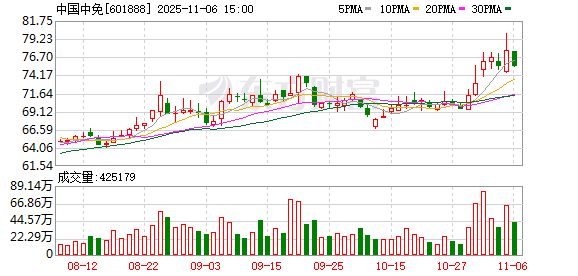
旅游零售板块11月6日跌2.91%,中国中免领跌,主力资金净流出3.69亿元
Zheng Xing Xing Ye Ri Bao· 2025-11-06 08:51
Core Viewpoint - The tourism retail sector experienced a decline of 2.91% on November 6, with China Duty Free Group leading the drop, while the overall market indices showed positive performance with the Shanghai Composite Index rising by 0.97% and the Shenzhen Component Index increasing by 1.73% [1] Group 1: Market Performance - The tourism retail sector's decline was primarily driven by China Duty Free Group, which closed at 75.34, reflecting a decrease of 2.91% [1] - The Shanghai Composite Index closed at 4007.76, marking an increase of 0.97% [1] - The Shenzhen Component Index closed at 13452.42, showing an increase of 1.73% [1] Group 2: Capital Flow - The tourism retail sector saw a net outflow of 369 million yuan from institutional investors, while retail investors contributed a net inflow of 219 million yuan [1] - The capital flow data indicates that speculative funds had a net inflow of 150 million yuan into the sector [1] - China Duty Free Group specifically experienced a net outflow of 369 million yuan from institutional investors, representing a net institutional share of -11.43% [1]

文旅上市公司2025年前三季度业绩汇总,下行压力仍持续
Sou Hu Cai Jing· 2025-11-06 06:58
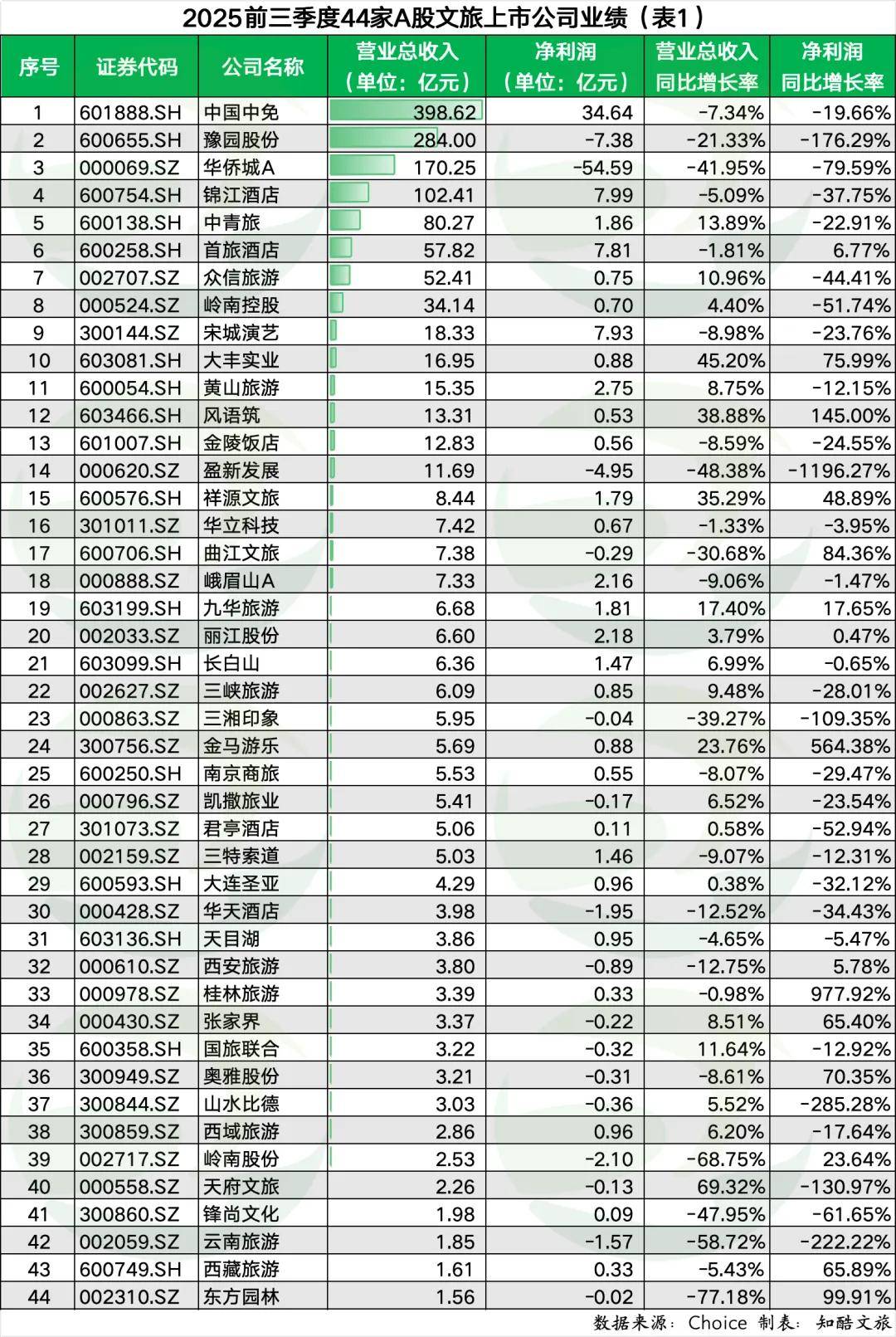
Core Insights - The financial performance of 44 A-share cultural tourism companies for the first three quarters of 2025 shows a mixed outlook, with only 20 companies reporting revenue growth while 24 experienced declines, indicating ongoing downward pressure in the cultural tourism market [1][2][3] Revenue Performance - The top three companies by revenue are China Duty Free Group (CDFG) with 39.86 billion, Yuyuan Group with 28.4 billion, and Overseas Chinese Town A with 17.03 billion [1] - Among the 44 companies, Tianfu Culture reported the highest revenue growth at 69.32%, followed by Dafeng Industrial at 45.20% and Fengyuzhu at 38.88% [2][3] - Conversely, Oriental Garden, Lingnan Holdings, and Yunnan Tourism faced the most significant revenue declines, with decreases of 77.18%, 68.75%, and 58.72% respectively [3] Profitability Analysis - China Duty Free Group, Jinjiang Hotels, and Songcheng Performance reported the highest net profits of 3.464 billion, 799 million, and 793 million respectively [3] - A total of 28 companies reported positive net profits, while 16 companies incurred losses, with the largest losses recorded by Overseas Chinese Town A at 5.459 billion, Yuyuan Group at 738 million, and Yingxin Development at 500 million [3][4] Sector Breakdown - In the tourism attraction sector, the top three companies by revenue are Songcheng Performance, Huangshan Tourism, and Xiangyuan Culture, with revenues of 1.833 billion, 1.535 billion, and 844 million respectively [5] - The performance of tourism supply chain companies is highly variable, with the overall sector facing challenges due to a downturn in tourism investment [19] Market Trends - The cultural tourism market is experiencing significant changes, with companies like Songcheng Performance struggling due to reliance on traditional tourist patterns, while others like Xiangyuan Culture are adapting to new market demands [10][12] - The shift in consumer preferences towards leisure and relaxation experiences is impacting revenue generation across various tourism sectors [12][18]


主力个股资金流出前20:吉视传媒流出6.87亿元、赛力斯流出6.20亿元





Jin Rong Jie· 2025-11-06 02:38
Core Insights - The main focus of the article is on the significant outflow of capital from specific stocks as of November 6, with notable amounts being withdrawn from various companies [1] Group 1: Major Stocks with Capital Outflow - The top stock with the highest capital outflow is Jishi Media, with a withdrawal of 687 million yuan [1] - Following Jishi Media, Sairisi experienced an outflow of 620 million yuan [1] - Xue Ren Group saw a capital outflow of 607 million yuan, ranking third in the list [1] Group 2: Additional Stocks with Significant Outflows - Tebian Electric experienced a capital outflow of 565 million yuan [1] - Haima Automobile had an outflow of 554 million yuan [1] - Pingtan Development saw a withdrawal of 367 million yuan [1] Group 3: Other Notable Stocks - Longi Green Energy experienced a capital outflow of 309 million yuan [1] - Shanzigaoke had an outflow of 295 million yuan [1] - Fulongma saw a withdrawal of 270 million yuan [1] Group 4: Remaining Stocks in the Top 20 - Xagong Co. experienced a capital outflow of 261 million yuan [1] - Leo Group had an outflow of 258 million yuan [1] - China Duty Free Group saw a withdrawal of 256 million yuan [1] - Hainan Development experienced an outflow of 253 million yuan [1] - Sanbian Technology had a capital outflow of 252 million yuan [1] - BlueFocus Communication Group saw a withdrawal of 250 million yuan [1] - Dawi Co. experienced an outflow of 229 million yuan [1] - Industrial Fulian had a capital outflow of 217 million yuan [1] - Runhe Software saw a withdrawal of 215 million yuan [1] - Wentai Technology experienced an outflow of 210 million yuan [1] - ST Huatuo had a capital outflow of 206 million yuan [1]
中期分红队伍壮大,多家行业龙头公司首次出手
Xin Lang Cai Jing· 2025-11-05 23:34
Core Viewpoint - The trend of mid-term dividends is expanding among listed companies, signaling strong operational performance and positive industry outlooks [1] Group 1: Mid-term Dividends - Industrial leaders like Xinyu Bank, Luxshare Precision, China Duty Free Group, and CRRC have announced their first mid-term dividend plans, with Xinyu Bank's dividend exceeding 10 billion yuan [1] - Mid-term dividends serve as an important signal of operational quality to the capital market, reflecting companies' confidence in future industry development [1] - The introduction of mid-term dividends alongside annual dividends creates a diversified return mechanism, which is expected to attract stable long-term capital and establish a positive cycle of "improved operations - dividend returns - valuation recovery" [1]



中期分红队伍壮大 多家行业龙头首次出手
Zheng Quan Shi Bao· 2025-11-05 18:37
Core Viewpoint - The trend of mid-term dividends is expanding among leading companies, signaling strong operational performance and positive industry outlooks [1][2][3]. Group 1: Mid-term Dividends - Industrial leaders like Industrial Bank, Luxshare Precision, China Duty Free Group, and China CRRC have announced their first mid-term dividend plans, reflecting a commitment to shareholder returns [2][3]. - Industrial Bank plans to distribute a cash dividend of 5.65 yuan per 10 shares, totaling 11.957 billion yuan, which represents 30.02% of its net profit attributable to ordinary shareholders for the first half of 2025 [2]. - Luxshare Precision reported a revenue of 220.915 billion yuan for the first three quarters, a year-on-year increase of 24.69%, and plans to distribute a cash dividend of 1.6 yuan per 10 shares, totaling 1.165 billion yuan [2]. Group 2: Overall Dividend Trends - As of October 31, 218 A-share companies have announced profit distribution plans, with a total proposed cash dividend of 46.619 billion yuan, maintaining high levels in both the number of companies and the amount [4]. - A total of 1,033 listed companies have announced cash dividend plans for the first quarter, half-year, and third quarter, an increase of 141 companies compared to the previous year [4]. - Companies like Gree Electric and Wuliangye have proposed significant cash dividends, with Gree planning to distribute 10 yuan per 10 shares, totaling 5.585 billion yuan [4][5]. Group 3: Normalization of Dividends - The trend of mid-term dividends is becoming normalized, with more companies actively returning profits to investors, reflecting a growing awareness of shareholder value [6]. - In 2024, 3,720 companies distributed cash dividends totaling approximately 2.4 trillion yuan, setting a historical record and maintaining over 2 trillion yuan for three consecutive years [6]. - Companies are increasingly committing to annual profit distributions, with some planning to distribute at least 70% of their net profits in cash dividends over the next three years [6]. Group 4: Recommendations for Dividend Policies - Experts suggest optimizing dividend policies with differentiated strategies based on industry and development stages, encouraging mature companies to increase dividend amounts and frequency while allowing innovative firms to reinvest more profits [7].