
CCB(601939)

Search documents
2025中国银行业竞争力100强出炉
21世纪经济报道· 2025-11-23 11:47
作为中国金融体系的核心支柱,银行业在经济结构调整、金融科技革新与监管政策完善的多重背景下,竞争格局持续演变,本次榜 单以科学评估体系全面呈现行业发展态势,为行业转型与创新提供重要参考。 本次竞争力100强排行以商业银行2024年年报数据(来源于企业预警通)为核心依据,构建规模、盈利、成长、稳健四大核心指标体 系,形成多维度榜单矩阵。 除综合竞争力100强主榜单外,同步发布"规模100强""盈利100强""成长性100强" 三个子榜单,分别聚 焦总资产与总负债、营业收入与 ROA、业务扩张与运营效率等关键维度,实现对银行综合实力的立体评估。 记者丨郭聪聪 编辑丨杨希 11月22日,由南方财经全媒体集团・21世纪经济报道主办的"第二十届21世纪金融年会"盛大召开,会上, 21世纪金融研究院发布了 《2025中国银行业竞争力研究报告》,备受瞩目的中国银行业竞争力100强榜单正式揭晓。 全国性股份制商业银行构成第二梯队,头部表现突出。 在12家股份行中,10家集中在榜单第5至30名区间。招商银行以亮眼的盈利 效率、发展潜力及成长稳健性位列总榜第五,成为股份制银行领军者;中信银行和兴业银行分列第八、九名,总得分相差无几 ...




养老金融新政 密集落地!多家银行发力
Zhong Guo Zheng Quan Bao· 2025-11-22 14:12
Core Viewpoint - The Guangdong Provincial Financial Regulatory Bureau has issued an implementation plan aimed at promoting high-quality development of pension finance, targeting the establishment of a distinctive pension financial system by 2028 and achieving a virtuous cycle of pension finance and the silver economy by the end of the 14th Five-Year Plan [1] Group 1: Implementation Plans and Directions - Various regions, including Beijing, Chongqing, and Guangdong, have developed specific implementation plans emphasizing the crucial role of the banking sector in enhancing pension finance [2] - The plans highlight the responsibility of the banking industry in enriching the supply of pension financial products, with Beijing proposing to promote personal pension products and specialized commercial pension insurance [3] Group 2: Empowerment of the Pension System and Silver Economy - Banks are encouraged to support the construction of pension institutions and community service stations by developing innovative credit products tailored to their operational characteristics [4] - In Guangdong, banks are urged to increase credit investment in elderly goods and services, infrastructure construction, and smart elderly assistance device development, with favorable loan terms [4] Group 3: Active Engagement of the Banking Sector - The banking sector is actively focusing on pension finance through strategic planning, brand building, product design, and business development, with China Construction Bank leading in loan support for the pension industry [5] - China Bank has launched the "Zhongyin Silver Age" pension finance brand, offering diverse products to meet individual pension needs and reporting significant figures in pension fund management [5] Group 4: Potential Opportunities in the Pension Finance Sector - Experts suggest that banks can leverage their network advantages to explore opportunities in pension finance, including deep involvement in social security fund management and customized solutions for corporate annuities [7] - The personal pension market presents significant potential, with banks capable of providing comprehensive retirement planning services to clients [7] Group 5: Digital Transformation in Pension Finance - The trend of digital transformation in the banking sector is becoming more evident, with banks expected to enhance financial services for traditional pension industries and explore new business models like smart elderly care [8]
2025中国银行业竞争力100强出炉,国有大行稳居第一梯队
2 1 Shi Ji Jing Ji Bao Dao· 2025-11-22 10:31
Core Insights - The "2025 China Banking Industry Competitiveness Research Report" was released, highlighting the evolving competitive landscape of the banking sector amid economic adjustments, fintech innovations, and regulatory improvements [1] - The report ranks the top 100 banks based on a comprehensive evaluation system focusing on scale, profitability, growth, and stability, providing a multidimensional assessment of the industry [1] Group 1: Overall Ranking and Structure - The ranking includes 6 state-owned banks, 12 joint-stock banks, 53 city commercial banks, 27 rural commercial banks, 2 private banks, and 5 foreign banks, showcasing a diverse competitive landscape [2] - State-owned banks dominate the top tier, with all 6 making it into the top ten, led by Industrial and Commercial Bank of China, which excels in asset scale and profitability [2] Group 2: Joint-Stock Banks - Among the 12 joint-stock banks, 10 are positioned between 5th and 30th place, with China Merchants Bank leading this group at 5th place due to its strong profitability and growth potential [3] - Other notable banks include CITIC Bank and Industrial Bank, ranked 8th and 9th respectively, indicating a clear differentiation in performance among these institutions [3] Group 3: City Commercial Banks - City commercial banks represent the largest group with 53 institutions, with Jiangsu Bank leading at 17th place, showcasing strong profitability and growth [4] - Other top performers include Shanghai Bank and Ningbo Bank, ranked 18th and 19th, respectively, emphasizing the importance of regional advantages in their competitive strategies [4] Group 4: Rural Commercial Banks - Rural commercial banks, with 27 institutions on the list, demonstrate robust growth and stability, with Shanghai Rural Commercial Bank ranked 22nd [4] - These banks focus on serving local farmers and small enterprises, contributing significantly to rural economic development [4] Group 5: Private and Foreign Banks - The two private banks on the list, WeBank and MyBank, rank 13th and 15th respectively, highlighting their competitive edge in the internet finance sector [5] - The 5 foreign banks, including Citibank (China) and HSBC (China), leverage their international service capabilities to establish a competitive position in cross-border financing and corporate services [6]

金融潮涌南沙 建行聚力高地
Sou Hu Cai Jing· 2025-11-22 06:22
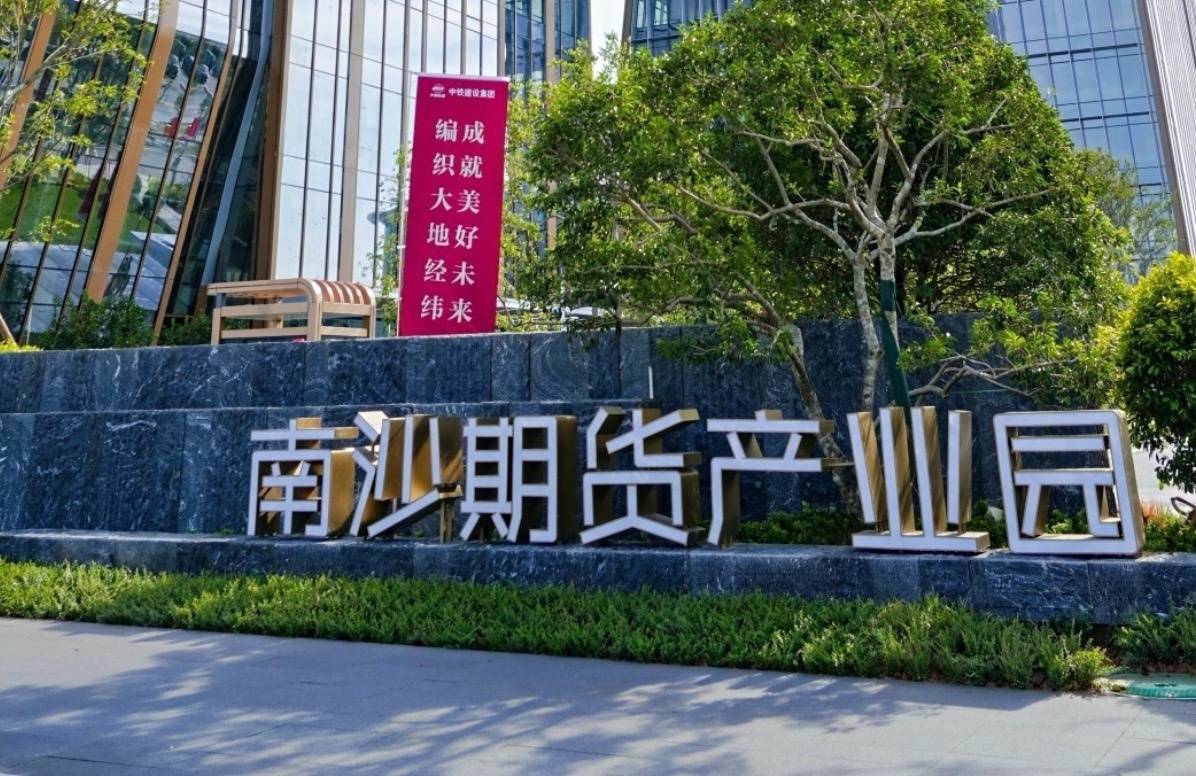
Core Insights - The Nansha Futures Industrial Park has officially opened, marking the first comprehensive futures financial industry park in China, which is a significant milestone for the financial development in Nansha and a key step towards building a modern financial system and promoting high-quality development in the Greater Bay Area [1][2] Group 1: Project Overview - The Nansha Futures Industrial Park covers a total construction area of approximately 150,000 square meters, consisting of 8 buildings, including 3 high-rise office buildings, 4 standalone sea-view headquarters, and 1 cultural exchange center [2] - The project was completed two months ahead of schedule, thanks to the flexible and efficient financing support from China Construction Bank (CCB) [1][4] Group 2: Financial Support and Investment - The total investment for the project is 1.867 billion yuan, with bank financing amounting to 1.5 billion yuan, and CCB as the lead bank approving 600 million yuan [3] - CCB played a crucial role in coordinating a syndicate of banks to meet the project's financial needs, ensuring timely funding and addressing various challenges during the construction process [3][4] Group 3: Business Ecosystem and Attraction - The park has attracted several leading financial enterprises and institutions, including the Guangzhou Futures Exchange and various representative companies, forming a diverse industrial ecosystem centered around futures [3] - The park aims to create a collaborative environment for financial innovation and development, enhancing Nansha's position as a new financial hub in the Greater Bay Area [2][3] Group 4: Digital Currency and Cross-Border Transactions - The introduction of cross-border digital RMB settlement services has improved the efficiency of traditional cross-border payment processes, allowing for real-time transactions and reducing the complexities associated with traditional methods [7][9] - CCB has actively participated in the pilot program for cross-border digital RMB, facilitating multiple transactions and enhancing the use of RMB in international trade [8][9] Group 5: Future Prospects - With the deepening of the Nansha Plan, digital RMB is expected to play a larger role in cross-border trade, further enhancing the efficiency and competitiveness of the payment system in the Greater Bay Area [9] - CCB aims to continue its support for the integration and development of the Greater Bay Area through innovative financial products and services [11]
高股息股受追捧 银行股走势最亮眼
Zheng Quan Shi Bao· 2025-11-21 16:31
证券时报记者 毛军 受外围市场大幅震荡,以及上证指数月线连续6个月上涨积累大量获利盘的影响,本周A股出现年内第二大周线级 别调整。上证指数跌破3900点,深证成指跌破13000点,创业板指、上证50双双失守3000点大关。 本周,日成交均萎缩至2万亿元以下,全周成交9.33万亿元,较上周减少近9000亿元。从分类指数来看,微盘股缩 量最为明显,环比减少约15%。 展望后市,渤海证券指出,A股短期由外部风险释放带来指数层面的调整。就现阶段而言,行情总体风险适中,监 管强调"坚决防止市场大起大落、急涨急跌"的背景下,市场不具有持续下跌的基础,市场调整为资金重新布局提 供了窗口期。若未来有增量利好政策出台,将有望推动政策主线或科技主线的展开。 太平洋证券表示,目前海外股市表现更弱,多个主要经济体如德国、英国、美国股市皆已转弱,建议投资者谨慎 为上。即使A股进入中期调整,但长期的上涨趋势预计不变,建议投资者采取高筑墙(红利),广积粮(降低仓 位),缓称王(等待时机)的策略。从近几日的行情来看,热点板块的持续性普遍不佳,仍建议投资者以避险的 高股息红利为主,留出仓位等待未来的加仓时机。 虽然银行股近年来连续上涨,但整体 ...

国有大型银行板块11月21日跌0.55%,邮储银行领跌,主力资金净流出3.94亿元
Zheng Xing Xing Ye Ri Bao· 2025-11-21 09:33
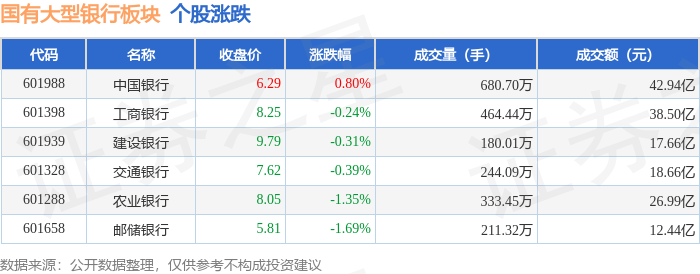
Core Insights - The state-owned large bank sector experienced a decline of 0.55% on November 21, with Postal Savings Bank leading the drop [1] - The Shanghai Composite Index closed at 3834.89, down 2.45%, while the Shenzhen Component Index closed at 12538.07, down 3.41% [1] Bank Performance Summary - China Bank (601988) closed at 6.29, up 0.80% with a trading volume of 6.807 million shares and a transaction value of 4.294 billion [1] - Industrial and Commercial Bank of China (601398) closed at 8.25, down 0.24% with a trading volume of 4.644 million shares [1] - China Construction Bank (601939) closed at 9.79, down 0.31% with a trading volume of 1.800 million shares [1] - Bank of Communications (601328) closed at 7.62, down 0.39% with a trading volume of 2.440 million shares [1] - Agricultural Bank of China (601288) closed at 8.05, down 1.35% with a trading volume of 3.334 million shares [1] - Postal Savings Bank (601658) closed at 5.81, down 1.69% with a trading volume of 2.113 million shares [1] Fund Flow Analysis - The state-owned large bank sector saw a net outflow of 394 million yuan from institutional investors, while retail investors had a net inflow of 308 million yuan [1] - The fund flow for individual banks shows that: - Bank of Communications had a net inflow of 49.743 million yuan from institutional investors [2] - Industrial and Commercial Bank had a net inflow of 2.533 million yuan from institutional investors [2] - China Bank experienced a net outflow of 14.801 million yuan from institutional investors [2] - China Construction Bank had a net outflow of 46.069 million yuan from institutional investors [2] - Postal Savings Bank saw a significant net outflow of 125 million yuan from institutional investors [2] - Agricultural Bank of China had a net outflow of 261 million yuan from institutional investors [2]


建行山东省分行供应链金融惠及2.8万户中小微企业
Zhong Guo Jin Rong Xin Xi Wang· 2025-11-21 07:35
Core Insights - China Construction Bank's Shandong branch is strategically promoting supply chain finance to support local industrial chain development, maintaining the leading position in financing volume among peers in the region [1] - The bank has cumulatively provided over 270 billion yuan in supply chain financing, benefiting 28,000 small and micro enterprises, with a financing balance exceeding 50 billion yuan as of November 20, 2025 [1] - The bank has developed a comprehensive online financing product system to meet diverse financing needs across the entire industrial chain [1] Financing Innovations - In response to the reluctance of core enterprises to provide guarantees and the slow financing process for small and micro enterprises, the bank launched the "脱核链贷e订通" series, moving financing nodes from the invoice stage to the contract and order stages [2] - This model has been successfully implemented in industries such as construction, manufacturing, and telecommunications, providing significant financing support to upstream suppliers [2] - For example, the bank facilitated nearly 500 million yuan in financing for nearly 100 suppliers of a central enterprise construction company before the Mid-Autumn Festival last year [2] Industry Integration and Support - The bank has focused on the integration of finance and industry, implementing a long-chain financial management system and forming dedicated service teams for key industrial chains in Shandong [3] - It has provided 46.6 billion yuan in funding support to 1,800 suppliers of 203 hospitals, enhancing the stability of the healthcare supply chain [3] - The bank has also connected with the Shandong government procurement financing service platform, facilitating 27.1 billion yuan in financing to support efficient government procurement operations [3]
建设银行深圳市分行 深耕“五篇大文章” 金融赋能深圳高质量发展新征程
Shen Zhen Shang Bao· 2025-11-21 07:03
Core Viewpoint - The 19th Shenzhen International Financial Expo will be held from November 19 to 21, 2025, focusing on "New Heights of Industrial Finance, Empowering Future Innovation," with nearly 300 global financial institutions participating to outline new financial services for the real economy [1] Group 1: Technology Finance - As of the end of October, the technology loan balance of the Shenzhen branch of China Construction Bank exceeded 244 billion yuan, with an increase of over 48 billion yuan since the beginning of the year, leading the industry [2] - The bank has developed a "heat map" for 34,000 technology enterprises in Shenzhen, providing differentiated services based on the characteristics of enterprises at different stages [2] - The bank has served over 11,000 technology enterprises, with nearly 6,000 credit approvals and total loans exceeding 12 billion yuan [2][3] Group 2: Green Finance - The Shenzhen branch of China Construction Bank has integrated green finance into its strategic priorities, establishing a diversified green finance service system to support the green transformation of the economy [4] - The bank has issued green loans to nearly 900 enterprises, focusing on key industries such as new energy vehicles and energy-efficient equipment manufacturing [4] - The bank has launched the first batch of "water-saving loans" in collaboration with the Shenzhen Water Conservation Technology Association, with an initial financing of 30 million yuan [5] Group 3: Inclusive Finance - As of the end of October 2025, the bank's inclusive loan balance reached 364 billion yuan, serving 106,000 clients, making it the largest financial institution serving small and micro enterprises in Shenzhen [7] - The bank has successfully provided a 3.88 million yuan working capital loan to a small jewelry company based on its good tax records and operational data [6] - The bank has developed a multi-layered, widely covered, and sustainable inclusive finance service system, leveraging digital transformation and product innovation [7] Group 4: Pension Finance - The Shenzhen branch has established the "Healthy Aging" brand, responding to the national strategy for an aging population, and has created a "1314" pension service system [8] - The bank has selected 60 "Healthy Aging" financial service outlets across 37 first-level branches, focusing on providing tailored services for elderly clients [8] - The bank aims to integrate resources to offer comprehensive services in pension planning, wealth management, and consumption for different stages of aging [8] Group 5: Digital Finance - The bank is accelerating its digital transformation to build a secure, efficient, and convenient digital financial ecosystem, supporting the "Five Major Articles" [10] - The bank has launched a "Digital Currency Prepayment Supervision Platform" to address regulatory challenges in the prepayment industry, covering 1,569 merchants and providing services for 960,000 consumers [10] - Future plans include expanding the digital currency regulatory model to 16 prepayment scenarios, enhancing consumer trust in Shenzhen [10] Group 6: Overall Impact - The achievements of the Shenzhen branch in the "Five Major Articles" reflect the bank's commitment to serving the real economy and fulfilling its social responsibilities [11] - The bank's financial services are closely aligned with the needs of various sectors, from technology enterprises to elderly care, demonstrating its responsiveness to societal changes [11]
中国银行股价续创历史新高!银行ETF天弘(515290)成交额超5000万元,机构:国有大行明年或迎来一轮估值修复
2 1 Shi Ji Jing Ji Bao Dao· 2025-11-21 02:56
Group 1 - The banking sector showed active trading on November 21, with the China Securities Bank Index down 0.20% at the time of reporting, while China Bank saw a rise of over 2%, reaching a historical high [1] - A comprehensive cooperation agreement was signed between China Agricultural Development Bank and China Construction Bank on November 19, involving 13 branches for deeper collaboration in financial markets, syndicate loans, and consulting services [1] - The banking industry in China is transitioning from a phase of scale expansion to one of transformation and value creation, as stated by the president of China Merchants Bank at the 2025 Shenzhen International Financial Conference [1] Group 2 - Shenwan Hongyuan reiterated a focus on a dual strategy of "leading banks as the platform + bottom-tier joint-stock banks and quality city commercial banks as the performers," suggesting that state-owned banks and China Merchants Bank will elevate the valuation center [2] - It is anticipated that relatively undervalued state-owned banks may experience a valuation recovery next year, while quality small and medium-sized banks with improving fundamentals and high credit growth are expected to show significant stock price elasticity amid improving economic expectations [2]

金融暖阳照亮“银发”岁月,建行山东省分行温情绘就养老金融新图景
Xin Lang Cai Jing· 2025-11-21 02:45
Core Insights - The article highlights the commitment of China Construction Bank (CCB) in Shandong Province to provide tailored financial services for the elderly, emphasizing a blend of professional service and warmth in their approach to elder care [1][9]. Group 1: Service Innovations - CCB has introduced a series of elder-friendly features in their banking services, such as a seated smart teller machine designed for seniors, which includes dual screens for guidance, enlarged fonts, and wheelchair-accessible spaces [2][3]. - The bank has established dedicated service teams, known as the Zhang Fuqing Financial Service Teams, across 130 branches to provide comprehensive support for elderly clients, including emergency rescue training for staff [3][5]. Group 2: Community Engagement - The bank's staff have developed personal relationships with elderly clients, exemplified by a case where a staff member provided ongoing support to an elderly customer over seven years, demonstrating a commitment to treating clients like family [4][5]. - CCB has set up "Chongyang Service Posts" and "Chongyang Love Financial Rooms" to assist elderly clients in understanding financial products and provide necessary health monitoring equipment [5]. Group 3: Financial Support for Elderly Care - CCB is actively involved in integrating and upgrading the elderly care industry by providing tailored financial solutions, including long-term loans with flexible repayment options to support the growth of local elderly care institutions [6][7]. - The bank has successfully facilitated two mergers in the elderly care sector, amounting to a total of 185 million yuan, which has helped local institutions scale their operations [7]. Group 4: Innovative Care Models - In response to the increasing demand for integrated rehabilitation and elderly care services, CCB has supported the "Yantai Fenglai Rehabilitation and Elderly Care Project" with a 100 million yuan loan, promoting a new model that addresses traditional service gaps [8]. - The bank's innovative financing approach considers unique cash flows from elderly care services, ensuring that financial support aligns with the specific needs of the care industry [8].