
CCB(601939)

Search documents
财经观察|金价飙到1300元/克!银行忙着调黄金积存规则,你还会入手吗
Sou Hu Cai Jing· 2025-11-12 06:11
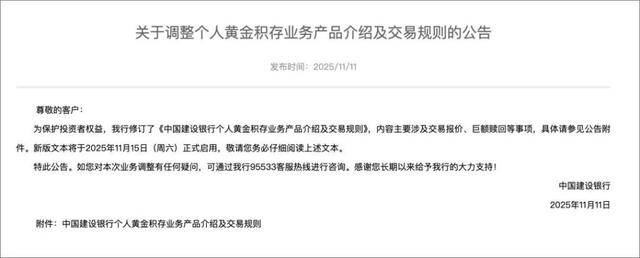
Core Viewpoint - The recent fluctuations in gold prices have prompted several banks to adjust their gold accumulation services, reflecting a response to market conditions and consumer behavior [1][2]. Group 1: Bank Adjustments - Multiple banks, including China Construction Bank and CITIC Bank, have revised their gold accumulation business rules in response to rising gold prices [2][5]. - China Construction Bank has clarified that its gold accumulation business will be based on a balance of price and volume, allowing for adjustments in transaction quotes according to market conditions [2][3]. - CITIC Bank has increased the minimum investment amount for its gold accumulation plan from 1000 yuan to 1500 yuan, while maintaining the minimum weight for regular accumulation at 1 gram [5]. Group 2: Gold Jewelry Market Trends - The price of gold jewelry has surged, with some brands exceeding 1300 yuan per gram, leading to a decline in consumer interest in gold jewelry [6][7]. - Data from the China Gold Association indicates that gold consumption in the first three quarters of 2025 was 682.730 tons, a year-on-year decrease of 7.95%, with gold jewelry consumption dropping by 32.50% [7]. - Major jewelry brands, such as Lao Feng Xiang, reported significant declines in revenue and profit due to high gold prices, which have suppressed gold jewelry consumption [7][8]. Group 3: Market Demand and Supply Dynamics - The global demand for gold reached a record high of 1313 tons in the third quarter of 2025, driven by strong investment demand, including purchases by central banks [8]. - China's gold reserves increased by 30,000 ounces to 7,409,000 ounces by the end of October, marking the twelfth consecutive month of gold accumulation [8].




已有7家银行私银客户超10万户
2 1 Shi Ji Jing Ji Bao Dao· 2025-11-12 05:45
Core Insights - The private banking sector has seen significant growth in the first three quarters of this year, with seven listed banks reporting over 100,000 private banking clients as of September 30, 2023, indicating a rising demand for wealth management services among high-net-worth individuals [2][4][5] Group 1: Growth in Private Banking Clients - Multiple banks reported a client growth rate exceeding 10%, with Minsheng Bank, Beijing Bank, and Nanjing Bank showing increases over 15% [4] - Minsheng Bank had the fastest growth, reaching 73,409 private banking clients, an increase of 18.21% from the end of last year [5] - Beijing Bank reported 20,586 private banking clients, up 17.9%, and an asset under management (AUM) of 224 billion yuan, a 14.39% increase [5][6] Group 2: Market Position of Major Banks - State-owned banks continue to dominate the private banking market, with Agricultural Bank of China leading at 279,000 clients, followed by China Construction Bank and Bank of China [6] - China Merchants Bank and Ping An Bank have also joined the "100,000 club," with Ping An Bank reaching 103,300 clients, marking its first entry into this category [6][7] Group 3: Challenges and Opportunities in Wealth Management - The growth in private banking clients is attributed to the expanding base of high-net-worth individuals and the upgrading of banking services [9] - The Hu Run Wealth Report indicates that the total wealth of China's 6 million affluent families has reached 150 trillion yuan, with ultra-high-net-worth families holding 87 trillion yuan, an increase from 56% to 58% of total wealth [9] - The private banking sector is facing challenges such as economic shifts, declining risk-free returns, and reduced investor confidence, necessitating a transformation in wealth management services [10][11]







已有7家银行私银客户超10万户
21世纪经济报道· 2025-11-12 05:38
Core Insights - The private banking business has seen significant growth in the first three quarters of this year, with seven listed banks surpassing 100,000 private banking clients as of September 30, 2023, driven by the increasing number of high-net-worth individuals and evolving wealth management needs [1][3][6] Growth of Private Banking Clients - Several banks reported a client growth rate exceeding 10%, with Minsheng Bank, Beijing Bank, and Nanjing Bank showing increases over 15%. Minsheng Bank led with an 18.21% growth, reaching 73,409 clients [3][6] - Beijing Bank's private banking clients grew by 17.9% to 20,586, with total assets under management (AUM) increasing by 14.39% to 224 billion yuan [3][6] - Nanjing Bank also reported a 15.43% increase in private banking clients [3] Dominance of State-Owned Banks - State-owned banks continue to lead in absolute numbers, with Agricultural Bank of China having 279,000 clients, followed by China Construction Bank with 265,500 clients [4] - China Merchants Bank and Ping An Bank have also joined the "100,000 club," with Ping An Bank reaching 103,300 clients, marking its first time surpassing this threshold [4][6] Market Dynamics and Competition - The private banking market is characterized by a competitive landscape where state-owned banks leverage their scale, while joint-stock banks focus on differentiated services and operational efficiency [7] - The growth of high-net-worth individuals is expected to drive competition towards service quality and asset allocation capabilities [7] Challenges in Wealth Management - The wealth management sector faces three main challenges: economic growth slowdown, declining risk-free returns, and reduced investor confidence [10][11] - Banks are urged to upgrade their wealth management services to meet clients' real needs and utilize various financial tools for comprehensive solutions [11] Changing Client Demographics - The core client base for private banking is shifting from traditional business owners to new economy groups, with a notable increase in demand for comprehensive wealth management services [9] - Banks are redefining their target clients based on their strengths, with some focusing on family wealth transfer and others on retirement financial management [9]




银行股、消费股逆势走强 农行总市值突破3万亿元 三元股份3连板
2 1 Shi Ji Jing Ji Bao Dao· 2025-11-12 04:52
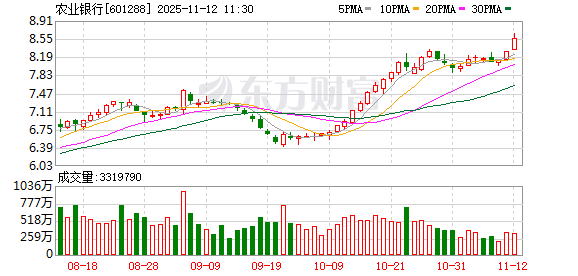
Market Overview - The A-share market experienced a decline in early trading on November 12, with the Shanghai Composite Index down by 0.23%, the Shenzhen Component Index down by 1.07%, and the ChiNext Index down by 1.58% [1][2] - The market's half-day trading volume reached 1.27 trillion, with over 4,000 stocks declining [1][2] Index Performance - Shanghai Composite Index: 3993.35, down 9.40 points (-0.23%) - Shenzhen Component Index: 13146.42, down 142.59 points (-1.07%) - ChiNext Index: 3084.70, down 49.62 points (-1.58%) - Other indices such as the CSI 300 and CSI 500 also showed declines [2] Sector Performance - The banking sector showed resilience, with Agricultural Bank of China and Industrial and Commercial Bank of China reaching historical highs. Agricultural Bank's market capitalization surpassed 3 trillion [3] - Notable stock performances included Agricultural Bank up over 3%, Bank of China up over 2%, and other banks like Industrial and Commercial Bank and Postal Savings Bank up over 1% [3][4] - The consumer sector, particularly food and beverage stocks, was active, with companies like Zhongrui and Sanyuan showing significant gains due to supportive policies aimed at boosting domestic demand [4] Economic Insights - An economist noted that the consumer sector's activity is supported by positive macroeconomic data, including favorable inflation rates in October, which has provided a basis for the rise in consumer stocks [4] - The technology sector, particularly in computing power, robotics, and AI, remains a key focus of the current bull market, despite some short-term corrections [5] - The ongoing demand for computing power from companies like OpenAI indicates that the market for AI-related technologies may continue to thrive [5]

银行股、消费股逆势走强,农行总市值突破3万亿元,三元股份3连板
21世纪经济报道· 2025-11-12 04:13
Market Overview - The A-share market experienced a decline in early trading on November 12, with the Shanghai Composite Index down 0.23%, the Shenzhen Component Index down 1.07%, and the ChiNext Index down 1.58% [1][2] - The total trading volume reached 1.27 trillion yuan, with over 4,000 stocks declining [1][2] Index Performance - Shanghai Composite Index: 3993.35, down 9.40 points (-0.23%) [2] - Shenzhen Component Index: 13146.42, down 142.59 points (-1.07%) [2] - ChiNext Index: 3084.70, down 49.62 points (-1.58%) [2] - The trading volume was predicted to be 1.98 trillion yuan, a decrease of 34 billion yuan from previous estimates [2] Sector Performance - The oil and gas, insurance, and pharmaceutical sectors showed strong gains, while the banking sector also performed well [2][3] - Notable stocks included Agricultural Bank of China, which saw its market capitalization exceed 3 trillion yuan, and both Agricultural Bank and Bank of China experienced significant price increases [3][4] Consumer Sector Activity - The consumer sector, particularly food and beverage stocks, was active, with companies like Zhongrui Co. and San Yuan Co. achieving consecutive gains [4] - Economic scholar Pan Helin noted that the consumer sector's activity is supported by positive policy signals aimed at boosting domestic demand and favorable macroeconomic data from October [4] Technology Sector Insights - Pan Helin emphasized that technology sectors such as computing power, robotics, and AI remain the main focus of the current bull market, despite recent pullbacks [5] - The valuation of computing power is considered high, but demand for computing chips remains strong, particularly from companies like OpenAI [5]


银行股强势!农行、工商均再创历史新高
Ge Long Hui A P P· 2025-11-12 04:13
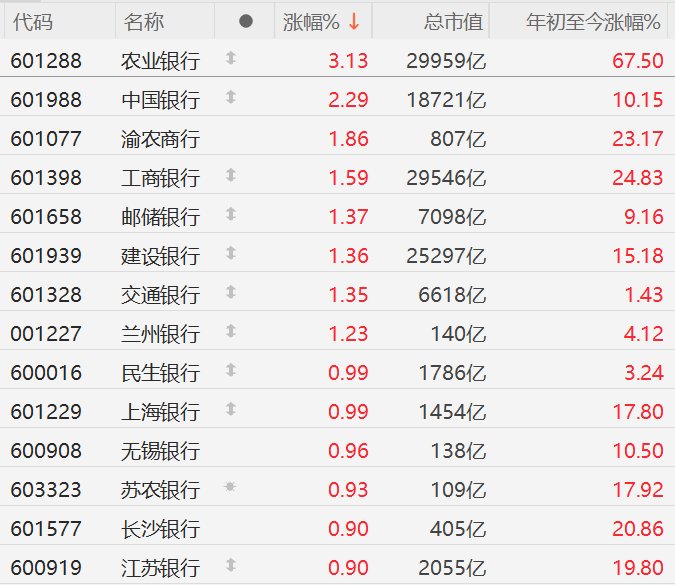
Core Insights - The A-share market has seen a strong performance in bank stocks, with Agricultural Bank leading the gains, rising over 3% [1] - Major banks such as Industrial and Commercial Bank of China also reached historical highs [1] Summary by Category Stock Performance - Agricultural Bank: Increased by 3.13%, total market value at 299.59 billion, year-to-date increase of 67.50% [2] - Bank of China: Increased by 2.29%, total market value at 187.21 billion, year-to-date increase of 10.15% [2] - Chongqing Rural Commercial Bank: Increased by 1.86%, total market value at 8.07 billion, year-to-date increase of 23.17% [2] - Industrial and Commercial Bank: Increased by 1.59%, total market value at 295.46 billion, year-to-date increase of 24.83% [2] - Postal Savings Bank: Increased by 1.37%, total market value at 70.98 billion, year-to-date increase of 9.16% [2] - Construction Bank: Increased by 1.36%, total market value at 252.97 billion, year-to-date increase of 15.18% [2] - Transportation Bank: Increased by 1.35%, total market value at 66.18 billion, year-to-date increase of 1.43% [2] - Lanzhou Bank: Increased by 1.23%, total market value at 1.40 billion, year-to-date increase of 4.12% [2] - Minsheng Bank: Increased by 0.99%, total market value at 17.86 billion, year-to-date increase of 3.24% [2] - Shanghai Bank: Increased by 0.99%, total market value at 14.54 billion, year-to-date increase of 17.80% [2] - Yuanxi Bank: Increased by 0.96%, total market value at 1.38 billion, year-to-date increase of 10.50% [2] - Sunong Bank: Increased by 0.93%, total market value at 1.09 billion, year-to-date increase of 17.92% [2] - Changsha Bank: Increased by 0.90%, total market value at 4.05 billion, year-to-date increase of 20.86% [2] - Jiangsu Bank: Increased by 0.90%, total market value at 20.55 billion, year-to-date increase of 19.80% [2]

银行收紧淘金路!建行黄金积存业务调整 多家银行门槛提至千元
Bei Ke Cai Jing· 2025-11-12 02:37
Core Viewpoint - The recent adjustments in gold accumulation business rules by major banks, including China Construction Bank and CITIC Bank, reflect the increasing volatility in gold prices and the need to protect investor interests. These changes include raising minimum investment thresholds and revising transaction rules to manage market risks effectively [1][3][4]. Group 1: Changes in Banking Rules - China Construction Bank revised its gold accumulation business rules, effective November 15, 2025, adjusting the monthly accumulation starting amount to 1200 yuan, with increments of 10 yuan [1]. - CITIC Bank announced an increase in the minimum investment amount for its gold accumulation plan from 1000 yuan to 1500 yuan, effective the same date [1][6]. - The new rules emphasize "price-volume balance," allowing banks to adjust transaction quotes based on market conditions, including international and domestic gold price trends, trading positions, and liquidity [4][6]. Group 2: Market Conditions and Price Trends - After a period of correction, gold prices have resumed an upward trend, with international gold prices reaching 4140 USD per ounce and domestic prices at 948.23 yuan per gram on November 11 [2][9]. - The fluctuations in gold prices are attributed to various factors, including geopolitical events and investor profit-taking, leading to significant daily price changes [9][10]. Group 3: Implications for Investors - The adjustments in gold accumulation business rules are seen as a response to the heightened investment risks associated with volatile gold prices, potentially limiting participation from small investors [3][8]. - The changes may also affect liquidity and increase transaction costs for short-term trading, as banks have the authority to adjust buy-sell spreads based on market conditions [6][8]. - Analysts suggest that while the long-term outlook for gold remains positive, investors should be cautious of increased market volatility and the impact of currency fluctuations on gold import costs [11].
央企银行指数盘中走强
Mei Ri Jing Ji Xin Wen· 2025-11-12 02:04
Group 1 - The central enterprise bank index increased by 1.13% during the trading session on November 12 [1] - Agricultural Bank led the gains with an increase of 1.81%, followed by CITIC Bank, Bank of China, Postal Savings Bank, and China Construction Bank with increases of 1.47%, 1.41%, 1.20%, and 1.05% respectively [1]
农业银行涨超2%,再创历史新高
Ge Long Hui A P P· 2025-11-12 01:51
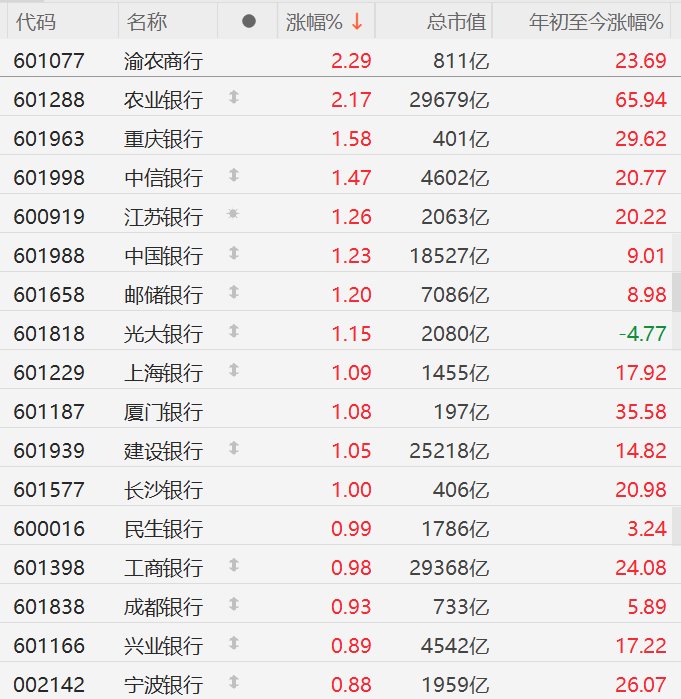
Core Insights - The A-share market has seen a rise in bank stocks, with notable increases in shares of Chongqing Rural Commercial Bank and Agricultural Bank, both rising over 2% [1] - Agricultural Bank has reached a historical high, with its total market capitalization approaching 3 trillion yuan [1] Summary by Category Stock Performance - Chongqing Rural Commercial Bank (601077) increased by 2.29%, with a total market capitalization of 81.1 billion yuan and a year-to-date increase of 23.69% [2] - Agricultural Bank (601288) rose by 2.17%, reaching a market capitalization of 2,967.9 billion yuan and a year-to-date increase of 65.94% [2] - Other banks such as Chongqing Bank (601963), CITIC Bank (601998), and Jiangsu Bank (600919) also saw increases of over 1% [2] Market Capitalization - The total market capitalization of Agricultural Bank is nearing 3 trillion yuan, marking a significant milestone [1] - Other banks like China Bank (601988) and Postal Savings Bank (601658) have market capitalizations of 1,852.7 billion yuan and 708.6 billion yuan, respectively [2] Year-to-Date Performance - The year-to-date performance of various banks shows significant growth, with Agricultural Bank leading at 65.94%, followed by Chongqing Bank at 29.62% and Jiangsu Bank at 20.22% [2]
做实做细评查工作 守好案件质量“生命线”
Zhong Yang Ji Wei Guo Jia Jian Wei Wang Zhan· 2025-11-11 23:37
Core Viewpoint - The Central Commission for Discipline Inspection emphasizes the importance of high-quality case handling in the development of discipline inspection and supervision work, highlighting the need for a robust case quality review mechanism to ensure accountability and improvement in the process [1] Group 1: Mechanism Improvement - The review mechanism will be refined by establishing clear evaluation standards and a comprehensive assessment system, breaking down the review content into 17 specific items and creating 76 quantifiable scoring criteria [2] - A daily online and offline review system will be established to strengthen the foundation of case quality assessment, ensuring a systematic approach to identifying and rectifying issues [2] Group 2: Regular Review Practices - Regular assessments of completed cases will shift from semi-annual to quarterly evaluations, allowing for continuous monitoring and comprehensive health checks of the cases handled by direct management units [3] - In 2024, a thorough review of 48 self-handled disciplinary cases will be conducted, focusing on the entire process from initial handling to case file management [3] Group 3: Expanding Review Content - The review process will incorporate both online and offline methods, with specialized training for review personnel to ensure consistency in evaluation standards [4] - The review will also include the examination of disciplinary recommendations and their effectiveness, ensuring that issues identified during case handling are addressed to improve governance [5] Group 4: Post-Review Actions - The review process is seen as a starting point for deeper rectification and mechanism optimization, with regular summaries and notifications issued to address identified issues [6] - A dual mechanism of positive reinforcement and accountability will be implemented to enhance the effectiveness of the review process and ensure compliance with corrective measures [6] Group 5: Training and Guidance - Training programs will be organized annually to enhance the professional capabilities of discipline inspection personnel, focusing on practical case handling and emerging corruption issues [7] - Practical training methods, such as simulated case testing and case discussions, will be employed to improve the skills and knowledge of the staff [7]