
CCB(601939)

Search documents
晓数点丨A股三季报风云
Di Yi Cai Jing· 2025-11-03 09:01
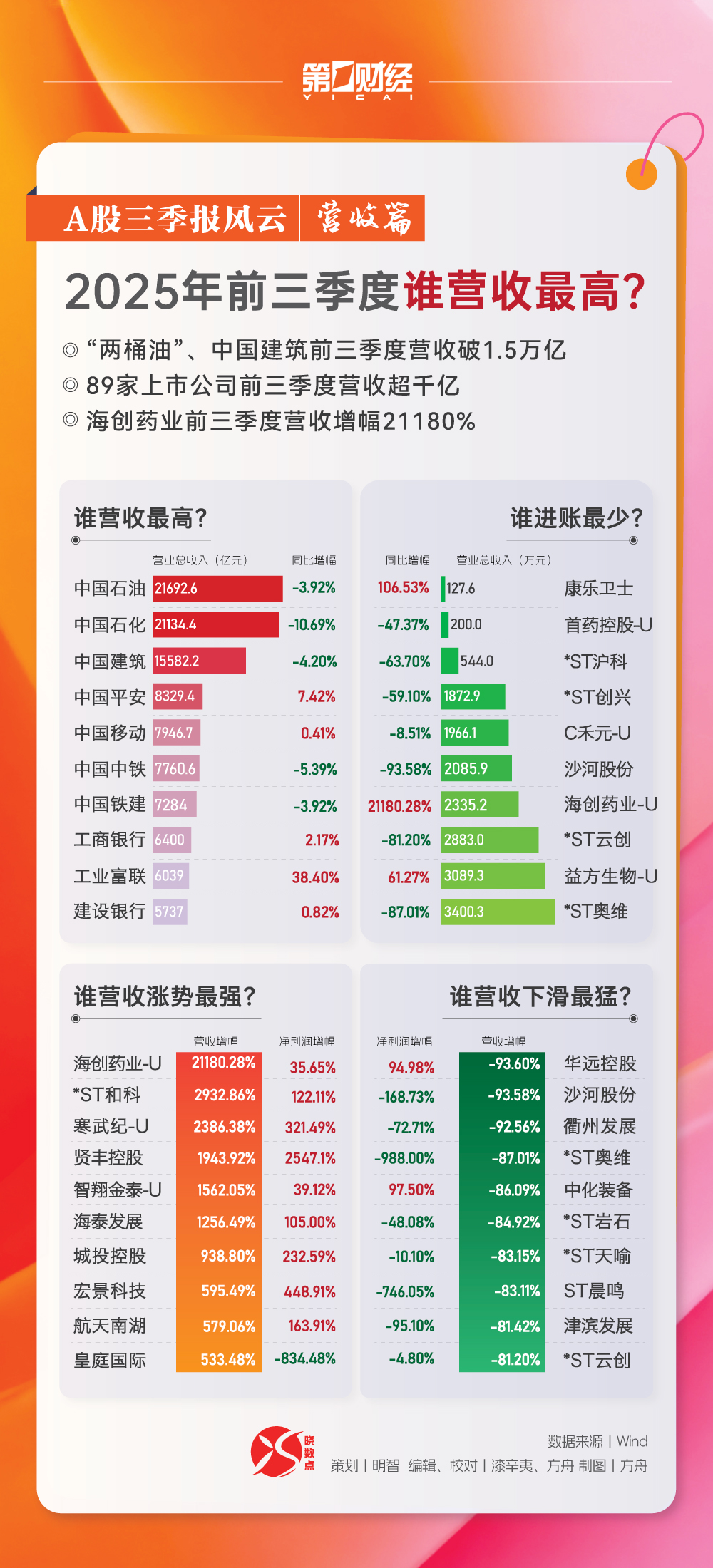
Revenue Summary - China Petroleum reported a total revenue of 216.93 billion yuan, with a year-on-year decrease of 3.92% [2] - China Sinopec's revenue was 211.34 billion yuan, reflecting a significant year-on-year decline of 10.69% [2] - China Construction's revenue stood at 155.82 billion yuan, down 4.20% year-on-year [2] - China Ping An achieved a revenue of 83.29 billion yuan, marking a year-on-year increase of 7.42% [2] - China Mobile's revenue was 79.47 billion yuan, with a slight increase of 0.41% year-on-year [2] - China Railway's revenue reached 77.61 billion yuan, down 5.39% year-on-year [2] - China Railway Construction reported a revenue of 72.84 billion yuan, with a year-on-year decrease of 3.92% [2] - Industrial Fulian's revenue was 60.39 billion yuan, showing a significant increase of 38.40% year-on-year [2] - China Construction Bank's revenue was 57.37 billion yuan, with a slight increase of 0.82% year-on-year [2] Profitability Analysis - Industrial Fulian reported a net profit increase of 61.27% [5] - China Ping An's net profit increased by 11.47% to 132.86 billion yuan [9] - China Life's net profit surged by 60.54% to 167.80 billion yuan [9] - China Petroleum's net profit decreased by 4.90% to 126.28 billion yuan [9] - China Mobile's net profit increased by 4.03% to 115.35 billion yuan [9] - Vanke A reported a significant net loss of over 28 billion yuan, a year-on-year decline of 56.14% [9] Industry Performance - The banking sector's net profit exceeded 1 trillion yuan, indicating strong performance [16] - The steel and non-ferrous metal industries showed signs of recovery [16] - The construction and decoration, as well as the oil and petrochemical industries, reported the highest revenues [16]






尾盘,突然拉升!
证券时报· 2025-11-03 09:00
Market Overview - A-shares rebounded in the afternoon on November 3, with all three major indices turning positive by the close; the Shanghai Composite Index rose by 0.55% to 3976.52 points, the Shenzhen Component increased by 0.19% to 13404.06 points, and the ChiNext Index gained 0.29% to 3196.87 points [1] - The total trading volume in the Shanghai and Shenzhen markets was 21.33 billion yuan, a decrease of 2.17 billion yuan from the previous day [1] Sector Performance Coal and Oil - The coal sector saw significant gains, with companies like Antai Group and Zhongmei Energy hitting the daily limit, and others like Shanxi Black Cat and Jin控煤业 rising over 4% [4][6] - The oil sector also performed well, with Huibo Group and Intercontinental Oil hitting the daily limit, and China National Offshore Oil Corporation and China Petroleum rising over 4% [7] AI Applications - The AI application sector was notably active, with stocks like Fushi Holdings and Xinghuan Technology rising over 10%, and several others hitting the daily limit [12][14] Nuclear Power - The nuclear power concept experienced a surge, with significant advancements in thorium-based molten salt reactor technology reported by the Chinese Academy of Sciences, marking a key development in nuclear energy [10] Key Insights - The current prices of thermal coal and coking coal remain at historical lows, providing room for a rebound due to supply-side policies and seasonal demand increases [6] - The "three barrels of oil" (China National Petroleum, Sinopec, and CNOOC) are expected to continue increasing their oil and gas equivalent production, with respective growth rates of 2.6%, 2.2%, and 6.7% projected for the first three quarters of 2025 [7] - The AI-driven content creation market is projected to grow significantly, with over 3000 new works expected in the first half of 2025, indicating a robust demand for AI applications in media [14]



建设银行11月3日起暂停易存金实时买入等业务
Bei Ke Cai Jing· 2025-11-03 08:47
Core Viewpoint - China Construction Bank has announced the suspension of certain gold-related services starting from November 3, 2025, affecting the easy deposit gold business and physical gold exchanges [1] Group 1: Business Operations - The bank will suspend real-time purchases, new investment plans, and physical gold exchanges for the easy deposit gold business [1] - Existing customers' investment plans, redemptions, and account closures will not be affected by this suspension [1] - The suspension also includes personal gold accumulation exchanges for physical precious metals, while other personal gold accumulation services remain unaffected [1] Group 2: Future Announcements - The bank will provide updates regarding the resumption of the suspended services in future announcements [1]


建行暂停易存金业务实时买入及兑换
Mei Ri Jing Ji Xin Wen· 2025-11-03 08:47
Core Viewpoint - China Construction Bank (CCB) has announced the suspension of its "Easy Storage Gold" business due to market volatility and risk management considerations, effective from November 3, 2025 [1] Group 1: Business Suspension Details - CCB will suspend the acceptance of new applications for real-time purchases, new regular investment purchases, and physical gold exchanges related to the Easy Storage Gold business [1] - Existing customers' regular investment plans, redemptions, and account closures will not be affected by this suspension [1] - The suspension also includes personal gold accumulation exchanges for physical precious metals and account gold exchanges for physical precious metals, while other personal gold accumulation services remain unaffected [1] Group 2: Future Announcements - CCB will provide updates regarding the resumption of the suspended services in future announcements [1]
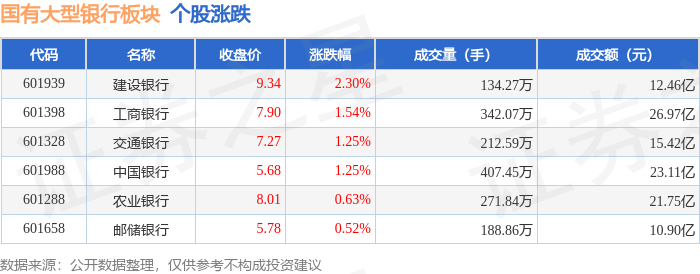
国有大型银行板块11月3日涨1.07%,建设银行领涨,主力资金净流入4.75亿元
Zheng Xing Xing Ye Ri Bao· 2025-11-03 08:47
Core Points - The state-owned large bank sector increased by 1.07% on November 3, with China Construction Bank leading the gains [1] - The Shanghai Composite Index closed at 3976.52, up 0.55%, while the Shenzhen Component Index closed at 13404.06, up 0.19% [1] Summary by Category Stock Performance - China Construction Bank (CCB) closed at 9.34, up 2.30% with a trading volume of 1.3427 million shares and a transaction value of 12.46 billion [1] - Industrial and Commercial Bank of China (ICBC) closed at 7.90, up 1.54% with a trading volume of 3.4207 million shares and a transaction value of 26.97 billion [1] - Bank of Communications closed at 7.27, up 1.25% with a trading volume of 2.1259 million shares and a transaction value of 15.42 billion [1] - Bank of China closed at 5.68, up 1.25% with a trading volume of 4.0745 million shares and a transaction value of 23.11 billion [1] - Agricultural Bank of China closed at 8.01, up 0.63% with a trading volume of 2.7184 million shares and a transaction value of 21.75 billion [1] - Postal Savings Bank of China closed at 5.78, up 0.52% with a trading volume of 1.8886 million shares and a transaction value of 10.90 billion [1] Capital Flow - The state-owned large bank sector saw a net inflow of 475 million from institutional investors, while retail investors experienced a net outflow of 95.019 million [1] - The capital flow for individual banks showed varying trends, with Bank of Communications having a net inflow of 136 million from institutional investors but a net outflow of 70.078 million from retail investors [2] - ICBC had a net inflow of 127 million from institutional investors, with a significant net outflow of 108 million from retail investors [2] - Bank of China recorded a net inflow of 95.788 million from institutional investors, while also facing a net outflow of 85.952 million from retail investors [2] - CCB had a net inflow of 81.513 million from institutional investors but a net outflow of 64.651 million from retail investors [2] - Agricultural Bank of China saw a net inflow of 63.865 million from institutional investors, with a net outflow of 116 million from retail investors [2] - Postal Savings Bank of China experienced a net outflow of 29.609 million from institutional investors, but a net inflow of 17.222 million from retail investors [2]



建行河南省分行创新乡村金融服务 助力丰产增收
Huan Qiu Wang· 2025-11-03 08:40
Group 1 - The core viewpoint of the article highlights the successful implementation of a financial support mechanism in rural areas, specifically through the "Financial Deputy Village Head" initiative by China Construction Bank in Lingbao City, which enhances agricultural productivity and financial accessibility for farmers [1][2] Group 2 - The "Financial Deputy Village Head" pilot program is characterized by a multi-level collaborative service system involving government leadership, bank support, and grassroots coordination, aimed at improving rural financial service efficiency [2] - In the pilot program, 28 individuals from Yinzhuang Town and 22 from Yuling Town have been appointed as "Financial Deputy Village Heads," who are familiar with local conditions and industry needs [2] - A specialized service team consisting of 7 outstanding customer managers from the Lingbao branch has been established to work alongside the "Financial Deputy Village Heads," creating a new model for rural financial services [2]
多家国有大行暂停黄金积存业务
Sou Hu Cai Jing· 2025-11-03 08:36
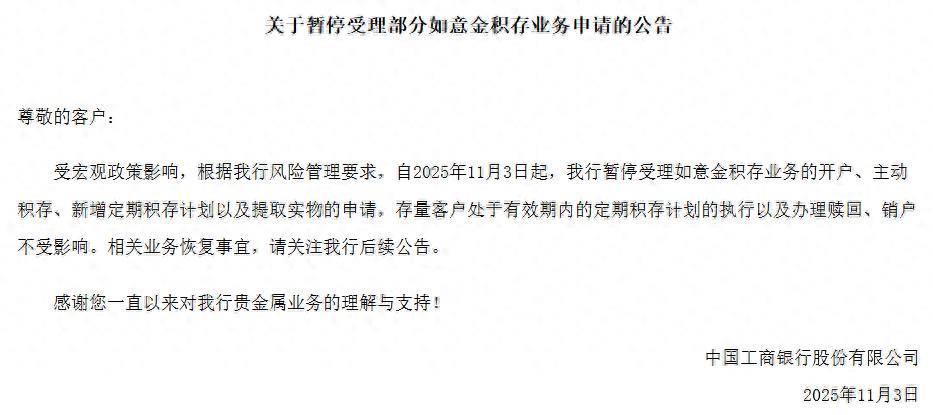
Core Viewpoint - Major Chinese banks, including Industrial and Commercial Bank of China (ICBC) and China Construction Bank (CCB), have suspended new gold accumulation business due to macroeconomic policy changes and risk management requirements, impacting various gold investment products and services [1][2]. Group 1: Bank Actions - ICBC has halted the acceptance of new accounts for its "Ruyi Gold Accumulation" program, along with new accumulation plans and physical gold withdrawals, while existing plans will continue to be executed normally [1]. - CCB has suspended real-time purchases and new investment plans for its "Easy Gold" service, as well as physical gold exchanges, but existing customers can still redeem and close accounts [1]. - Other banks, such as Industrial Bank and Ping An Bank, have already raised the minimum investment amounts for gold accumulation products in response to increased trading activity and gold price volatility [2]. Group 2: Tax Policy Changes - A significant change in gold tax policy was announced, effective from November 1, 2025, which aims to optimize the VAT arrangements for gold transactions and clarify the distinction between investment and non-investment uses [2]. - The new tax policy is expected to promote more transparent and regulated gold trading, reducing gray market activities and increasing compliance costs [2]. Group 3: Market Reactions - The international gold price has seen significant fluctuations, with a year-to-date increase exceeding 50%, while domestic gold prices also reached historical highs before experiencing corrections [3]. - Following the announcements from banks, gold retail stocks in Hong Kong and A-share markets faced declines, indicating market sensitivity to these changes [3][4]. Group 4: Risk Management Objectives - The banks' decision to pause new business is aimed at managing three key risks: reducing immediate inventory and delivery pressures during extreme volatility, allowing time for compliance with new tax regulations, and mitigating the impact of emotional trading on business operations [4]. - The new tax policy is expected to enhance the advantages of standardized gold products, leading to a potential rebalancing of channels among banks, platforms, and investors [4]. Group 5: Investor Guidance - Investors are advised to adopt a cautious approach by avoiding high-risk positions and considering gold as a hedging component in their portfolios, while prioritizing compliance and clarity in product offerings [6]. - The current restrictions on new accounts and physical withdrawals may lead to temporary adjustments in trading parameters and potential delays in transactions [6]. Group 6: Future Observations - Key points to monitor include whether more banks will follow suit in suspending new accounts, the impact of the new tax policy on different gold trading channels, and the evolution of price and trading structures in the gold market [8].
中国建设银行:暂停受理易存金业务实时买入、新增定投买入、实物金兑换等申请
Xin Hua Cai Jing· 2025-11-03 08:33
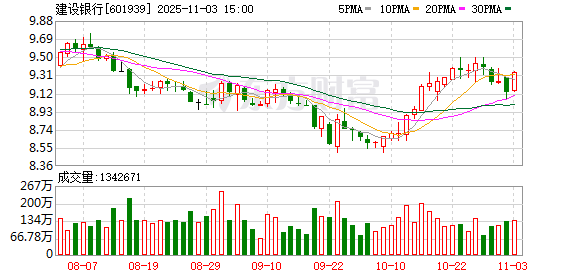
Core Points - China Construction Bank announced the suspension of certain gold investment services starting from November 3, 2025, due to market volatility and risk management considerations [2] - The suspended services include real-time purchases, new investment plans, and physical gold exchanges, while existing clients' investment plans and redemptions will remain unaffected [2] - The bank will also pause personal gold accumulation exchanges for physical precious metals, but other personal gold accumulation services will continue [2] Summary by Category - **Service Suspension** - The bank will suspend real-time buy-in, new investment plans, and physical gold exchange applications starting from November 3, 2025 [2] - Existing clients' investment plans, redemptions, and account closures will not be impacted [2] - **Impact on Personal Gold Accumulation** - Personal gold accumulation exchanges for physical precious metals will be paused [2] - Other personal gold accumulation services will remain unaffected [2] - **Future Announcements** - The bank will provide updates regarding the resumption of the suspended services in future announcements [2]
X @外汇交易员
外汇交易员· 2025-11-03 08:28
#观察 工商银行周一起暂停了如意金积存业务的开户、主动积存、新增定期积存计划以及提取实物的申请,建设银行也作出类似决定,暂停易存金业务(存量客户不受影响),理由是政策市场影响与风险管理要求。周末工行的如意金条也出现了抢购现象。 https://t.co/epcKfMOSiZ外汇交易员 (@myfxtrader):财政部、税务总局关于黄金有关税收政策的公告:会员单位购入标准黄金用于投资性用途的,交易所实行增值税即征即退,同时免征城市维护建设税、教育费附加,并按照实际成交价格向买入方会员单位开具增值税专用发票。 https://t.co/1v9W9TABq7 ...
建设银行:暂停受理易存金等业务
Xin Lang Cai Jing· 2025-11-03 08:25
Core Points - China Construction Bank announced the suspension of certain gold investment services starting from November 3, 2025 [1] - The affected services include real-time purchases, new investment plans, and physical gold exchanges, while existing clients' investment plans and redemptions will remain unaffected [1] - The bank will also pause personal gold accumulation exchanges for physical precious metals, but other personal gold accumulation services will continue [1] - Further announcements regarding the resumption of these services will be made in the future [1]