CCB(601939)

Search documents
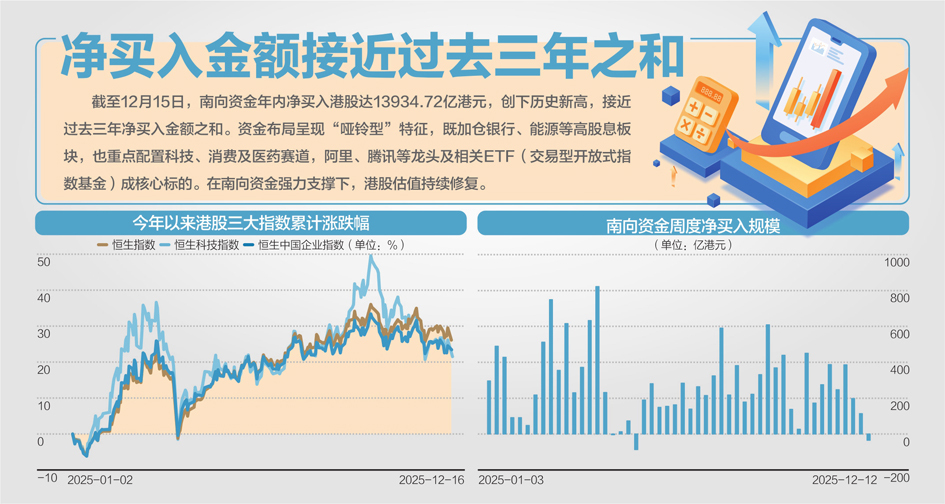
南向资金累计净买入1.39万亿港元
Mei Ri Jing Ji Xin Wen· 2025-12-16 12:16
Group 1 - The core viewpoint of the articles highlights that 2025 has seen unprecedented inflows of southbound capital into the Hong Kong stock market, with a cumulative net purchase amount reaching 50,912.63 billion HKD as of December 15, 2025, and a record annual net purchase of 13,934.72 billion HKD [1][3] - The Hang Seng Index has performed exceptionally well, with a year-to-date increase of over 27%, making it the top-performing global index [3] - Major stocks favored by southbound capital include Tencent Holdings and Alibaba, with Tencent holding a market value of 6,204 billion HKD and Alibaba at 3,422 billion HKD [4] Group 2 - Despite significant purchases by southbound capital, not all companies have seen corresponding stock price increases, as evidenced by the performance of certain stocks that have declined despite increased holdings [5][6] - Southbound long-term capital is becoming a key driver for the restructuring of liquidity and optimization of valuation in the Hong Kong stock market, with expectations of continued inflows and improvements in market conditions [7]






内银股延续跌势 机构称信贷需求待修复 债市波动对银行影响整体可控
Zhi Tong Cai Jing· 2025-12-16 10:34
Core Viewpoint - The banking sector continues to experience a downward trend, with major banks showing significant declines in stock prices due to weak credit demand and market volatility [1] Group 1: Stock Performance - Agricultural Bank of China (601288) fell by 3.11%, trading at HKD 5.3 [1] - China Construction Bank (601939) decreased by 2.12%, trading at HKD 7.39 [1] - China Merchants Bank (600036) dropped by 1.84%, trading at HKD 49.72 [1] - Industrial and Commercial Bank of China (601398) declined by 1.97%, trading at HKD 5.97 [1] Group 2: Market Analysis - According to Galaxy Securities, effective credit demand remains weak, and the trend of deposit migration has slowed [1] - Recent fluctuations in the bond market have raised concerns, with 10-year and 30-year government bond yields at 1.84% and 2.25% respectively, showing an upward trend since early November [1] - The impact on bank trading positions is short-term and relatively low, with the central bank focusing on financial market stability [1] Group 3: Dividend Insights - Changjiang Securities noted that the four major state-owned banks have recently completed their mid-term dividend ex-dividend dates, which historically leads to stock price adjustments [1] - The mid-term dividend ex-dividend date for these banks was moved up to December this year, with expectations for other large banks like China Transportation Bank and Postal Savings Bank to follow suit [1] - Long-term investors may find good entry points if stock price adjustments occur due to ex-dividend trading factors [1]


银行密集关闭代理上金所个人贵金属业务
Sou Hu Cai Jing· 2025-12-16 10:10
Core Viewpoint - Commercial banks are accelerating their exit from the personal precious metals trading business at the Shanghai Gold Exchange due to significant fluctuations in precious metal prices, with major banks like Industrial and Commercial Bank of China (ICBC) announcing changes to their operations [2][3][4]. Group 1: Actions by Major Banks - ICBC announced that starting December 19, 2025, it will transfer the balances of margin accounts with no positions, inventory, or debts to the linked settlement accounts and close related business functions [2]. - China Construction Bank and Agricultural Bank of China have also taken steps to terminate agreements with clients who have not engaged in trading for a month, with notifications sent to clients regarding the transfer of funds [3][4]. - Postal Savings Bank announced the cessation of its personal precious metals business, requiring clients to liquidate their positions by October 31 [3][4]. Group 2: Broader Industry Trends - Other banks, including Citic Bank and Ningbo Bank, have also implemented measures to clean up accounts with no trading activity, indicating a broader trend among banks to withdraw from the precious metals trading sector [4][5]. - The adjustments in precious metals business by banks are closely linked to the significant price volatility in recent years, with many banks previously halting gold and silver trading during the commodity price fluctuations in 2022 [6]. - The World Gold Council has indicated that while 2025 may see strong performance in precious metals, uncertainties will persist into 2026, suggesting a cautious outlook for the market [6].



港股异动 | 内银股延续跌势 机构称信贷需求待修复 债市波动对银行影响整体可控
智通财经网· 2025-12-16 09:43
Group 1 - The core viewpoint of the article indicates that the banking sector, particularly the major state-owned banks in China, is experiencing a decline in stock prices, with specific banks like Agricultural Bank down by 3.11% and Construction Bank down by 2.12% as of the report date [1] - Recent financial data for November shows a continued weakness in effective credit demand and a slowdown in deposit migration, which may impact the banking sector's performance [1] - The bond market has shown volatility, with 10-year and 30-year government bond yields rising to 1.84% and 2.25% respectively since early November, although the impact on bank trading positions is considered manageable [1] Group 2 - Long-term trends suggest that the recent mid-term dividend announcements by the four major state-owned banks typically lead to short-term stock price adjustments, as seen historically [1] - The mid-term dividend ex-dividend date for these banks has been moved up to December this year, with expectations that other large banks will follow suit with similar announcements around the end of the year and early next year [1] - If stock price adjustments occur due to ex-dividend trading factors, it may present a favorable opportunity for long-term investors to allocate funds [1]
上市银行发中期“红包”了!工行、农行共发近千亿现金红利,多家银行“红包”正在路上
Mei Ri Jing Ji Xin Wen· 2025-12-16 09:39
Core Viewpoint - Major Chinese banks are actively distributing mid-term cash dividends, reflecting strong profitability and capital adequacy, which is expected to enhance shareholder value and market confidence [6][8]. Group 1: Dividend Distribution by Major Banks - On December 15, Industrial and Agricultural Banks announced a total cash dividend of approximately 92.2 billion yuan for the first half of 2025, with A-share dividends amounting to about 76.2 billion yuan [1]. - Industrial Bank distributed a cash dividend of 0.1414 yuan per share, totaling approximately 503.96 billion yuan, with A-share dividends around 381.23 billion yuan [3]. - Agricultural Bank issued a cash dividend of 0.1195 yuan per share, totaling about 418.23 billion yuan, with A-share dividends approximately 381.5 billion yuan [3]. - Other major banks, including China Bank and Construction Bank, have also announced significant cash dividends, contributing to a total of over 200 billion yuan in cash dividends from the six major banks [4]. Group 2: Participation of Other Banks - Several joint-stock banks, such as CITIC Bank and Ping An Bank, have also joined the mid-term dividend distribution, with CITIC Bank distributing 104.61 billion yuan and Ping An Bank distributing 45.80 billion yuan [7]. - New entrants to the mid-term dividend distribution include Industrial Bank, which plans to distribute 119.57 billion yuan, and Ningbo Bank, which will distribute 19.81 billion yuan [7]. - Chongqing Bank plans to distribute 5.85 billion yuan, representing 11.99% of its net profit attributable to ordinary shareholders [7]. Group 3: Market Implications and Analyst Insights - Analysts indicate that the increase in mid-term dividends is a response to regulatory guidance and market demand for high-yield assets, particularly in a low-interest-rate environment [8]. - The trend of early and substantial mid-term dividends reflects the stable profitability of quality banks and their enhanced capacity for dividend distribution [8]. - Mid-term dividends are seen as a strategy to optimize capital structure and improve return on equity (ROE), while also attracting long-term investors [8].



2025年金融机构不良处置提速:多渠道协同筑牢资产质量防线
Jin Rong Jie· 2025-12-16 09:27
Core Insights - The transfer of non-performing loans (NPLs) is gaining momentum, becoming a crucial strategy for financial institutions to mitigate asset risks by 2025 [1][2] - The pace of asset disposal has accelerated significantly in 2025, with both the scale and frequency of disposals showing marked increases [2][4] - Consumer finance institutions are actively participating in the NPL market, contributing to the overall asset disposal efforts [3][4] Group 1: NPL Transfer Activities - The Silver Transfer Center reported nearly 60 NPL transfer announcements within three days, with major banks like China Construction Bank and Postal Savings Bank participating [1] - In the first quarter of 2025, the batch transfer of personal NPLs reached 37.04 billion yuan, a staggering increase of 761.4% year-on-year, with personal consumption loans making up over 70% of this figure [2] - Several banks, including Ping An Bank and Zhongyuan Bank, have initiated significant NPL transfer projects, with outstanding principal and interest amounts reaching 762 million yuan and 522 million yuan respectively [2] Group 2: Market Dynamics and Challenges - The pressure on asset quality is evident, with rising non-performing loan ratios among various banks, such as Chongqing Bank's ratio climbing to 6.23% [4] - The financial environment, characterized by macroeconomic fluctuations, is impacting the repayment capabilities of individuals and businesses, leading to increased NPLs [4] - The Silver Transfer Center's report indicates that the pressure for NPL disposal will persist throughout 2025 [4] Group 3: Regulatory and Technological Support - Regulatory policies are providing robust support for NPL disposal efforts, with calls for increased asset disposal and capital replenishment [5] - Financial institutions are leveraging technology to enhance risk management and improve the efficiency of NPL disposals, with initiatives like "smart disposal" platforms being developed [5][6] - Institutions like Agricultural Bank of China and China Bank are emphasizing digital transformation to strengthen risk control and reduce new NPLs [5]


银校同心筑梦 建行河南省分行推进青少年金融教育
Huan Qiu Wang· 2025-12-16 07:03
该行积极参与青少年金融教育读本编制和视频课程录制,创新研发金融知识拼图、反诈飞行棋等10类互 动教具,推动金融教育从"教材"走向"学材"。校外金融辅导员队伍通过系统培训,走进课堂讲授理性消 费、个人信息保护等知识,把专业资源转化为校园教育的"活教材"。 在线下,建行河南省分行探索"银校结对"机制,推动郑州地区部分支行与中小学共建"校内+校外"双轨 教育平台。分行营业部打造青少年金融教育实践基地,设置五大功能区域,形成"请进来+走出去"的教 育闭环。在线上,该行承办"金融小先锋 答题大闯关"等网络竞赛,推动金融知识普及向"最后一公 里"延伸。 此外,建行河南省分行注重发挥品牌和IP的传播作用,将河南省青少年金融教育卡通形象融入读本、宣 讲和线上活动中,形成立体传播矩阵。今年以来,"金融伴成长 共筑强国梦"系列活动陆续走进多所中 小学,通过动画呈现、情景体验等形式,让金融知识可亲可感。 从一所学校的主题活动到全行体系的持续推动,从课堂讲授到社会拓展,建行河南省分行以专业力量和 平台资源,不断夯实青少年金融教育基础。下一步,该行表示将持续完善"四个课堂"建设,为行业提供 可复制、可推广的实践经验,切实履行国有大行在 ...
26家银行密集分红!总额超2600亿,工商银行居首,多家首次推出中期方案
Sou Hu Cai Jing· 2025-12-16 05:23
Core Viewpoint - As of December 15, 2025, 26 A-share listed banks have announced mid-term or quarterly dividend plans, with a total expected payout exceeding 260 billion yuan [1]. Group 1: Major Contributors - The six major state-owned banks are the main contributors to this dividend distribution, with Industrial and Commercial Bank of China leading at 50.396 billion yuan, followed by China Construction Bank at 48.605 billion yuan, Agricultural Bank of China at 41.823 billion yuan, Bank of China at 35.250 billion yuan, Postal Savings Bank of China at 14.771 billion yuan, and Bank of Communications at 13.811 billion yuan [3]. - The total cash dividend from these six major banks exceeds 200 billion yuan [3]. Group 2: Other Banks - Among joint-stock banks, both Industrial Bank and CITIC Bank are expected to distribute over 10 billion yuan in dividends, specifically 11.957 billion yuan and 10.461 billion yuan respectively [3]. - Everbright Bank and Minsheng Bank are also projected to exceed 5 billion yuan in dividends [3]. - Several regional small and medium-sized banks are actively participating in mid-term dividends, with Shanghai Bank, Nanjing Bank, Hangzhou Bank, Shanghai Rural Commercial Bank, and Ningbo Bank leading in dividend amounts [3]. - Notably, banks like Industrial Bank and Ningbo Bank are introducing mid-term dividend plans for the first time [3]. Group 3: Dividend Implementation - Several banks have specified the dates for dividend distribution, with Industrial and Agricultural Banks set to distribute cash dividends on December 15, 2025 [3]. - Bank of Communications has announced that it expects to distribute mid-term cash dividends to A-share shareholders on December 25, 2025 [3].

从川超赛场到文旅生态
Jin Rong Shi Bao· 2025-12-16 03:32
Core Viewpoint - The article highlights the integration of sports events, particularly the Sichuan Super League, with local economic activities, emphasizing the role of financial services in enhancing consumer engagement and supporting local businesses [1][4]. Group 1: Event and Consumer Engagement - The Sichuan Super League has gained significant popularity since its launch in September 2025, with ticket sales booming and a vibrant atmosphere at matches, engaging fans across 21 cities in Sichuan [1][5]. - The event has evolved into a celebration that combines sports, food, and tourism, creating a festive environment for local consumers [1]. Group 2: Financial Services Integration - The Bank of China Sichuan Branch has embedded financial services into the event, promoting its brand through various activities and providing fans with financial products such as digital currency and consumer loans [2][3]. - The bank has created a "Sichuan Super Carnival" to engage with the public, offering promotional packages and facilitating transactions at the event [2]. Group 3: Local Business Support - The bank is actively supporting local merchants by providing convenient payment solutions and financial services, helping them capitalize on the increased foot traffic during the event [4]. - Over 240 merchants have participated in the initiative, with 220,000 fans receiving fan packages, indicating a strong community engagement [5]. Group 4: Cultural and Tourism Development - The Sichuan Branch has been focusing on building a cultural and tourism ecosystem, with over 6,000 tourism enterprise loan clients as of September 2025 [6][7]. - The bank is facilitating financing solutions tailored to the needs of local tourism projects, enhancing the overall efficiency of financial services in the tourism sector [7].
交通银行一高管因工作调动辞任!3个月前刚升任业务总监
Nan Fang Du Shi Bao· 2025-12-16 03:11
对于唐朔"下一站"去哪儿,有消息称,其已任建设银行党委委员,在走完必要的程序后,唐朔或将出任 建行副行长一职。如建行副行长任职资格落定,他或将成为六家国有大行中最为年轻的一位副行长。 建行官网信息显示,目前该行高级管理层包括行长张毅,副行长纪志宏、李建江、韩静和雷鸣,以及首 席财务官生柳荣。 采写:南都湾财社记者 刘兰兰 公告显示,唐朔1978年出生,今年47岁。于2001年加入交通银行,在该行连续服务24年,曾任交通银行 北京市分行行长,广东省分行行长,江西省分行行长、副行长(代为履行行长职责),北京市分行副行 长、行长助理,总行公司机构业务部(投资银行部)副总经理,北京市分行个人金融业务部总经理、望 京支行行长、林萃路支行副行长等职务。 "任职期间勤勉敬业、恪尽职守,为本行改革发展事业作出了重要贡献。董事会谨此向唐先生表示衷心 感谢!"交通银行董事会在公告中表示。 值得一提的是,今年8月份,唐朔刚刚被提拔为业务总监。据交通银行8月29日发布的公告,公司董事会 会议同意聘任唐朔为业务总监(公司与机构业务)。这意味着,唐朔在业务总监(公司与机构业务)位 置上仅任职3个多月。 近日,交通银行发布公告称,唐朔因工 ...