CCB(601939)

Search documents
交行业务总监唐朔公告离任,下一站料是国有大行副行长
Hua Er Jie Jian Wen· 2025-12-15 12:34
12月15日晚间,交通银行公告,唐朔因工作调动原因,已向交通银行董事会提交书面报告,辞去该行业 务总监(公司与机构业务)职务,辞任自2025年12月15日起生效。 唐朔已确认与交通银行董事会和高管层没有任何意见分歧,同时也没有任何与辞任有关而需要通知该行 股东和债权人的事项。 来自相关媒体的报道,唐朔已出任建设银行党委委员,在走完必要的程序后,唐朔大概率将出任建行副 行长一职。 当年10月31日,交通银行公告收到《国家金融监督管理总局关于唐朔交通银行业务总监(公司与机构业 务)任职资格的批复》,唐朔先生任本行业务总监(公司与机构业务)的任职资格获国家金融监督管理 总局核准生效。 未料,短短3个多月过去后,唐朔再次出现了工作调动。 交通银行称,唐朔任职期间勤勉敬业、恪尽职守,为该行改革发展事业做出了重要贡献。董事会向唐朔 表示衷心感谢。风险提示及免责条款市场有风险,投资需谨慎。本文不构成个人投资建议,也未考虑到 个别用户特殊的投资目标、财务状况或需要。用户应考虑本文中的任何意见、观点或结论是否符合其特 定状况。据此投资,责任自负。 资料显示,唐朔,1978年生,2001年于西安交通大学获法学学士学位,2018年 ...


建行山东省分行赋能枣庄石榴产业焕新机
Zhong Guo Jin Rong Xin Xi Wang· 2025-12-15 12:10
Core Insights - The city of Zaozhuang in Shandong has elevated the pomegranate industry to a municipal development strategy, promoting the integration of the entire industry chain [1] - China Construction Bank (CCB) has actively contributed financial support to the local pomegranate industry through diversified financial products and services [1] Group 1: Industry Development - Zaozhuang has developed a comprehensive pomegranate industry that includes cultivation, processing, and cultural tourism, transforming from a single planting model to a full-chain industry ecosystem [3] - Approximately 300 households in Liuyuan Town are engaged in cultivating pomegranate bonsai, producing around 200,000 pots annually, which significantly boosts local agritourism [2] Group 2: Financial Support - CCB's Zaozhuang branch has issued loans totaling 329 million yuan to support 442 entities in the pomegranate industry chain, including farmers and processing enterprises [3] - The bank has provided 5.5 million yuan in "e-government" loans and 14.17 million yuan in various loans for pomegranate-related businesses [2] Group 3: Cultural Initiatives - The local animation project "Silk Road," which is based on Zaozhuang's pomegranate culture, received a 4 million yuan technology compensation loan from CCB, helping to alleviate cash flow issues [3] - The animation has gained significant traction, being broadcasted on 275 platforms nationwide and included in key cultural promotion projects by the government [3] Group 4: Future Outlook - CCB plans to deepen cooperation with enterprises and extend its services to ensure the steady development of Zaozhuang's pomegranate industry, aiming to enhance the economic impact of the "pomegranate economy" in rural revitalization [4]
工行、农行、中行、建行、交行、邮储等银行宣布分红方案
Bei Jing Ri Bao Ke Hu Duan· 2025-12-15 10:17
Core Viewpoint - The major state-owned banks in China are leading in cash dividend distributions, with a total planned payout exceeding 260 billion yuan for the 2025 mid-year dividends, reflecting a strong commitment to shareholder returns [1][2]. Group 1: Dividend Distribution - As of December 15, over 20 A-share listed banks, including six major state-owned banks, have announced or implemented dividend distributions, totaling over 260 billion yuan [1]. - The state-owned banks have collectively announced cash dividends exceeding 200 billion yuan, with Industrial and Commercial Bank of China (ICBC) leading at approximately 503.96 billion yuan, followed by China Construction Bank (486.05 billion yuan), Agricultural Bank of China (418.23 billion yuan), and Bank of China (352.50 billion yuan) [2]. - Postal Savings Bank plans to distribute 1.230 yuan per 10 shares, totaling 147.72 billion yuan, which represents 30% of its net profit for the first half of 2025 [3]. Group 2: Market Response and Valuation - The high dividend yields of bank stocks are attracting dividend-sensitive investments, contributing to the recovery of the banking sector's valuations [5]. - As of December 12, the banking sector's price-to-book ratio was 0.69, indicating a 38.55% discount compared to the overall A-share market, while the sector's dividend yield stood at 4.64%, higher than the average for all A-shares [6]. - The central economic work conference's policy measures are expected to improve bank operations and optimize structures, with long-term funds continuing to increase their holdings in bank stocks, enhancing pricing efficiency and valuation reconstruction [6]. Group 3: Regulatory Environment - Regulatory bodies have been encouraging listed banks to increase the frequency and amount of dividend distributions, aiming for more stable and predictable returns for investors [4]. - The emphasis on consistent profit distribution aligns with the long-term interests of banks and their shareholders, ensuring sustainable development [4].




助力走好秦巴山水振兴路
2 1 Shi Ji Jing Ji Bao Dao· 2025-12-15 10:12
Core Viewpoint - The article highlights the efforts of the Guangdong Branch of China Construction Bank (CCB) in supporting agricultural modernization and rural development in Han Yin County, showcasing various projects aimed at improving local living conditions and economic opportunities. Group 1: Agricultural Modernization Initiatives - CCB has actively engaged in projects that enhance agricultural capabilities, such as the construction of irrigation systems to address seasonal water shortages, benefiting over 3,000 acres of farmland and 2,000 acres of orchards [2] - The bank has supported the development of local specialty products, including the introduction of health food products like mulberry leaf buns, by facilitating funding for automated production equipment [4] - The "One Village, One Live Streaming Room" initiative aims to promote local agricultural products through digital marketing, contributing to a 19% year-on-year increase in online retail sales of agricultural products [5][6] Group 2: Infrastructure Development - The construction of a 1.1-kilometer cement road in Shui Tian Village aims to improve transportation for local farmers, enhancing access to markets and facilitating the growth of the local economy [3] - CCB has coordinated donations for water supply projects, ensuring that local communities have reliable access to water for both domestic and agricultural use [2] Group 3: Community Support and Education - CCB plans to provide financial support for educational initiatives, including assistance for 100 left-behind children in Han Yin County, addressing their needs for learning materials and personal care [6] - The bank has also committed to improving the living conditions in rural schools by funding the installation of air conditioning units to create a better learning environment [6] Group 4: Financial Contributions and Partnerships - In 2024, CCB coordinated donations totaling 2.7 million yuan from 33 charitable enterprises to support various projects in Han Yin County [7] - The bank has purchased over 5 million yuan worth of local specialty agricultural products as part of its efforts to bolster rural revitalization and economic development [7]
图解丨南下资金净买入小米、中国平安
Ge Long Hui A P P· 2025-12-15 09:52
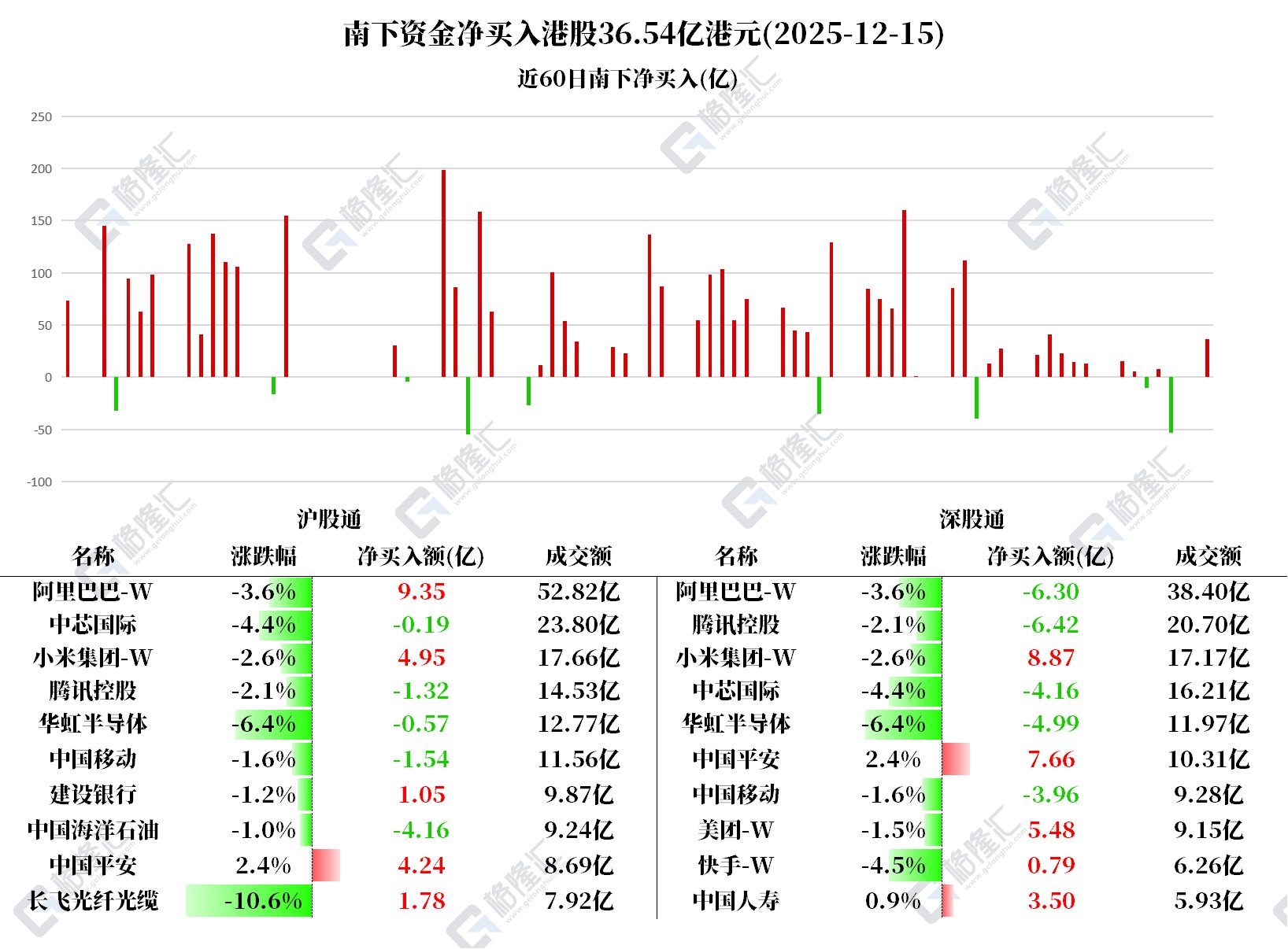
Group 1 - Southbound funds net bought Hong Kong stocks worth 36.54 billion HKD today [1] - Notable net purchases include Xiaomi Group-W (13.82 billion HKD), China Ping An (11.9 billion HKD), and Meituan-W (5.47 billion HKD) [1] - Continuous net buying trends observed for Xiaomi (12 days, total 121.5043 billion HKD) and Meituan (4 days, total 46.2952 billion HKD) [1] Group 2 - Significant net selling includes Tencent Holdings (7.74 billion HKD), Hua Hong Semiconductor (5.55 billion HKD), and China Mobile (5.5 billion HKD) [1] - Continuous net selling trends noted for SMIC (5 days, total 19.8564 billion HKD) and Tencent (4 days, total 24.9089 billion HKD) [1] - Other companies with net selling include China National Offshore Oil (4.16 billion HKD) and Hua Hong Semiconductor (15.4751 billion HKD) [1] Group 3 - Alibaba-W experienced a decline of 3.6% with a net buy of 9.35 million HKD [1] - SMIC saw a drop of 4.4% with a net sell of 0.19 million HKD [1] - China Ping An increased by 2.4% with a net buy of 4.24 million HKD [1]




部分内银股午后走低 年底银行股资金面波动率放大 分红除净亦可能造成股价调整
Zhi Tong Cai Jing· 2025-12-15 06:29
Group 1 - The core viewpoint of the article indicates that the recent decline in Chinese bank stocks is attributed to fluctuations in year-end trading fund allocations, reflecting changes in market risk appetite as the quarter and year-end approaches [1] - Major state-owned banks have recently completed their interim dividend ex-dividend dates, which historically leads to short-term stock price adjustments. The ex-dividend date for this year was moved up to December [1] - Long-term investment opportunities may arise from stock price adjustments caused by trading factors such as ex-dividend dates, as these periods are often seen as good entry points for long-term capital [1] Group 2 - Specific declines in bank stocks include Bank of Communications down 3.93% to HKD 6.84, Agricultural Bank down 2.52% to HKD 5.41, China Construction Bank down 0.79% to HKD 7.58, and Industrial and Commercial Bank down 0.33% to HKD 6.12 [1] - The report from Changjiang Securities suggests that the fluctuations in bank stocks are expected to stabilize and potentially increase after the year-end, as institutional investors may need to realize profits [1] - It is anticipated that large banks such as Bank of Communications, Postal Savings Bank, China Merchants Bank, and Industrial Bank will also implement interim dividend ex-dividend dates towards the end of the year and early next year [1]
总数突破2600亿,26家上市银行官宣分红方案,多家银行首次分红
Guan Cha Zhe Wang· 2025-12-15 03:47
Group 1 - A total of 26 A-share listed banks have announced interim or quarterly dividend plans, exceeding the 24 banks that did so in 2024 [1] - The total expected dividend amount from these banks is over 260 billion yuan, with state-owned banks accounting for approximately 70% of this total [1] - Industrial and Commercial Bank of China leads with a proposed dividend of 50.396 billion yuan, followed by China Construction Bank, Agricultural Bank of China, Bank of China, Postal Savings Bank, and Bank of Communications with dividends of 48.605 billion yuan, 41.823 billion yuan, 35.250 billion yuan, 14.771 billion yuan, and 13.811 billion yuan respectively [1] Group 2 - Several banks, including Industrial Bank and Ningbo Bank, are announcing dividend plans for the first time [2] - Industrial Bank plans to distribute a cash dividend of 5.65 yuan per 10 shares, totaling 11.957 billion yuan, which represents 30.02% of its net profit attributable to ordinary shareholders for the first half of 2025 [2]



多领域协同发力 科创生态建设再添新动能
Zhong Zheng Wang· 2025-12-15 02:22
中证报中证网讯(记者 高改芳)12月14日,科技-产业-金融融合创新研究与传播基地、全球南方财经研 究与传播基地在沪正式揭牌,为科技创新与产业、金融深度融合搭建新平台。 其中,科技-产业-金融基地由《国际金融报》、上海财经大学、中国建设银行上海市分行联合发起,屠 光绍担任学术指导;全球南方财经基地由《国际金融报》与上海财经大学发起,原联合国秘书长南南合 作事务特使、联合国南南合作办公室主任周一平出任首席顾问。 活动现场,多位嘉宾围绕科创发展分享实践经验与思考。 全国政协常委、上海市政协原副主席周汉民指出,科技创新具有长期不确定性、高资本投入与高风险并 存等特征,传统金融抵押和现金流风控机制难以适配,需通过知识产权质押融资、中长期创投基金等创 新方式,打通创新链与资金链,破解科技企业"融资难、融资贵、融资慢"问题,推动科技成果从"实验 室"走向"生产线"。 中国建设银行上海市分行行长刘军介绍,该行构建"价值流科创评价体系",通过创新链、产业链等七个 维度,为7万余家上海科技企业精准画像,还打造"科创E建行"平台服务科技人才。目前,该行科技企业 贷款余额超1300亿元,服务客户逾8600户,同时联动总行股权投资公 ...
未来三年分红规划,这些公司已提前布局(名单)
Zheng Quan Shi Bao Wang· 2025-12-15 01:39
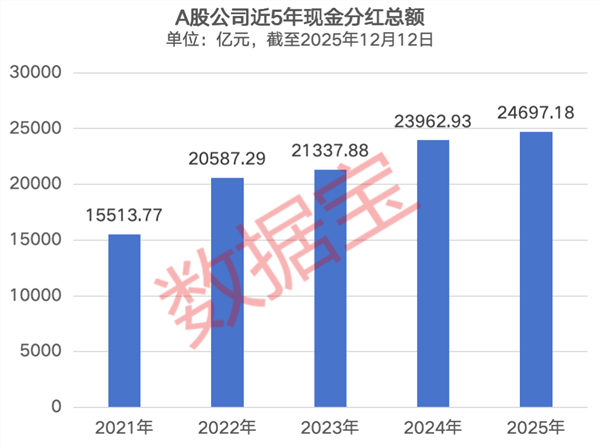
Core Viewpoint - The article highlights the increasing trend of cash dividends among listed companies in China, with a focus on their commitment to return profits to shareholders through substantial cash distributions over the next three years. Group 1: Cash Dividend Trends - Listed companies in China have shown a significant increase in cash dividend intentions, with the total cash dividends exceeding 2.47 trillion yuan this year, surpassing the total for the entire previous year [2][4] - Major companies like BYD, Hikvision, and Zijin Mining have reported cash dividends exceeding 10 billion yuan for the first time this year, with many traditional "dividend giants" increasing their payouts [4][5] Group 2: Future Dividend Plans - Nearly 40 companies have established shareholder return plans for the next three years (2026-2028), with most committing to distribute at least 10% of their annual distributable profits in cash [7] - Specific companies have set higher targets, such as Qibin Group, which plans to distribute over 50% of its annual distributable profits in cash, and China Merchants Shekou, which aims for a minimum of 40% [7][9] Group 3: Market Performance and Institutional Interest - Companies that announced shareholder return plans have seen an average stock price increase of over 4.5%, outperforming the average increase of the CSI 300 index [10] - Notably, companies like Wangzi New Materials and Aibison have experienced stock price increases exceeding 50% since their announcements [10][12] Group 4: Institutional Research Activity - Among the 37 companies with announced return plans, 17 have received significant institutional interest, with some receiving over 350 institutional research inquiries [11][12] - Companies like Baiwei Storage and Shiji Information have also reported substantial stock price increases alongside their active engagement with institutional investors [12][13]





最低持有期榜单出炉!固收增强产品成“最靓的仔”
2 1 Shi Ji Jing Ji Bao Dao· 2025-12-15 01:17
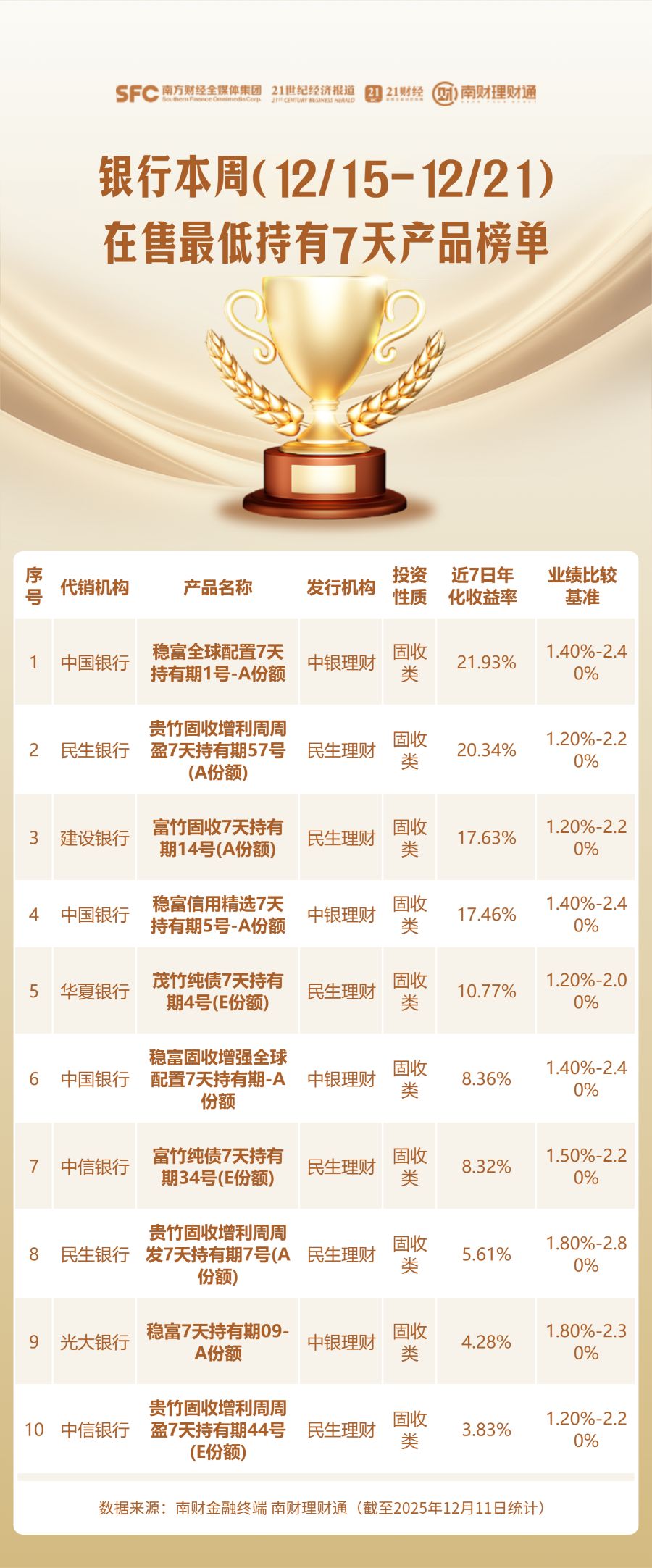
本期,南财理财通重点关注最低持有期人民币公募产品的业绩表现,按照7天、14天、30天、60天持有期限分类对产品业绩进行 排名,业绩指标计算指标为年化收益率,计算区间与持有期限相同,如90天持有期产品的业绩计算区间为近三月年化收益率, 同机构同系列同投资周期产品保留一只参与排名。 统计代销机构(28家):工商银行、中国银行、农业银行、邮储银行、建设银行、交通银行、招商银行、中信银行、光大银 行、民生银行、兴业银行、浦发银行、广发银行、浙商银行、华夏银行、平安银行、恒丰银行、渤海银行、北京银行、宁波银 行、江苏银行、上海银行、南京银行、杭州银行、徽商银行、微众银行、网商银行、百信银行。 需要特别提醒的是:本榜单对理财产品"在售"状态的判断基于其投资周期推算。但实际情况中,部分产品可能因额度售罄,或 银行针对不同客户展示的产品清单存在差异而无法购买。因此,建议投资者以代销银行APP的实际展示为准。 此外,南财理财通虽力求客观公正,但不对本评价榜信息的真实性、完整性和准确性作任何保证,排名信息仅供参考。 | | | (A(分割) | | K | | | | --- | --- | --- | --- | --- | ...