Red Avenue New Materials(603650)

Search documents
彤程新材2月2日获融资买入5515.64万元,融资余额7.93亿元
Xin Lang Cai Jing· 2026-02-03 01:30
Group 1 - On February 2, Tongcheng New Materials experienced a decline of 4.81% with a trading volume of 843 million yuan. The margin trading data indicated a financing buy amount of 55.16 million yuan and a financing repayment of 79.24 million yuan, resulting in a net financing buy of -24.09 million yuan. As of February 2, the total margin trading balance was 799 million yuan [1] - The financing balance of Tongcheng New Materials was 793 million yuan, accounting for 2.38% of the circulating market value, which is above the 80th percentile level over the past year, indicating a high level [1] - In terms of securities lending, on February 2, the company repaid 47,900 shares and sold 13,900 shares, with a selling amount of 753,500 yuan. The remaining securities lending volume was 113,900 shares, with a balance of 6.18 million yuan, exceeding the 70th percentile level over the past year, also indicating a high level [1] Group 2 - As of September 30, the number of shareholders of Tongcheng New Materials reached 60,200, an increase of 27.61% compared to the previous period. The average circulating shares per person decreased by 21.42% to 9,914 shares [2] - For the period from January to September 2025, Tongcheng New Materials achieved an operating income of 2.523 billion yuan, representing a year-on-year growth of 4.06%. The net profit attributable to the parent company was 494 million yuan, with a year-on-year increase of 12.65% [2] - Since its A-share listing, Tongcheng New Materials has distributed a total of 1.493 billion yuan in dividends, with 847 million yuan distributed over the past three years [3]

彤程新材料集团股份有限公司2026年第一次临时股东会决议公告
Shang Hai Zheng Quan Bao· 2026-01-30 23:24
证券代码:603650 证券简称:彤程新材 公告编号:2026-009 彤程新材料集团股份有限公司2026年第一次临时股东会决议公告 本公司董事会及全体董事保证本公告内容不存在任何虚假记载、误导性陈述或者重大遗漏,并对其内容 的真实性、准确性和完整性承担法律责任。 重要内容提示: ● 本次会议是否有否决议案:无 一、会议召开和出席情况 (一)股东会召开的时间:2026年1月30日 (二)股东会召开的地点:中国上海市浦东新区银城中路501号上海中心大厦25层2501室 (三)出席会议的普通股股东和恢复表决权的优先股股东及其持有股份情况: ■ (四)表决方式是否符合《公司法》及《公司章程》的规定,会议主持情况等。 会议采取现场投票与网络投票相结合的方式进行表决,由董事长Zhang Ning女士主持本次股东会。会议 召开及表决方式符合《公司法》和《公司章程》的规定。 (五)公司董事和董事会秘书的列席情况 1、公司在任董事9人,列席9人; 2、董事会秘书徐重璞女士列席会议。 二、议案审议情况 (一)非累积投票议案 1、议案名称:关于公司发行H股股票并在香港联合交易所有限公司主板上市的议案 审议结果:通过 2.02、议 ...
彤程新材(603650) - 彤程新材2026年第一次临时股东会决议公告
2026-01-30 10:30
证券代码:603650 证券简称:彤程新材 公告编号:2026-009 彤程新材料集团股份有限公司 2026年第一次临时股东会决议公告 本公司董事会及全体董事保证本公告内容不存在任何虚假记载、误导性陈述 或者重大遗漏,并对其内容的真实性、准确性和完整性承担法律责任。 重要内容提示: 本次会议是否有否决议案:无 一、 会议召开和出席情况 | 1、出席会议的股东和代理人人数 | 736 | | --- | --- | | 2、出席会议的股东所持有表决权的股份总数(股) | 389,233,613 | | 3、出席会议的股东所持有表决权股份数占公司有表决权股 | | | 份总数的比例(%) | 63.4855 | (四) 表决方式是否符合《公司法》及《公司章程》的规定,会议主持情况等。 会议采取现场投票与网络投票相结合的方式进行表决,由董事长 Zhang Ning 女士主持本次股东会。会议召开及表决方式符合《公司法》和《公司章程》的规 (一) 股东会召开的时间:2026 年 1 月 30 日 (二) 股东会召开的地点:中国上海市浦东新区银城中路 501 号上海中心大厦 25 层 2501 室 (三) 出席会议的普通 ...
彤程新材(603650) - 上海市锦天城律师事务所关于彤程新材料集团股份有限公司2026年第一次临时股东会的法律意见书
2026-01-30 10:30
上海市锦天城律师事务所 关于彤程新材料集团股份有限公司 2026 年第一次临时股东会的 法律意见书 锦 天 城 律 师事 务 所 ALLBRIGHT LAW OFFICES 地址:上海市浦东新区银城中路 501 号上海中心 11、12 层 电话: 021-20511000 传真: 021-20511999 邮编: 200120 上海市锦天城律师事务所 法律意见书 上海市锦天城律师事务所 关于彤程新材料集团股份有限公司 2026年第一次临时股东会的法律意见书 致:彤程新材料集团股份有限公司 上海市锦天城律师事务所(以下简称"本所")接受彤程新材料集团股份有 限公司(以下简称"公司")委托,就公司召开 2026年第一次临时股东会〈以 下简称"本次股东会")的有关事宜,根据《中华人民共和国公司法》(以下简 称"《公司法》")《上市公司股东会规则》等法律、法规和其他规范性文件以 及《彤程新材料集团股份有限公司章程》(以下简称"《公司章程》")的有关 规定,出具本法律意见书。 为出具本法律意见书,本所及本所律师依据《律师事务所从事证券法律业务 管理办法》和《律师事务所证券法律业务执业规则(试行)》等规定,严格履行 了法 ...
深度报告:2025光刻胶与未来趋势报告(附26页PPT)
材料汇· 2026-01-28 16:00
Market Overview - The global photoresist market exceeded $10 billion in 2022, with China's market nearing 10 billion RMB. It is projected to reach $12.6 billion globally and 15.2 billion RMB in China by 2026 [6][8]. - China's photoresist production capacity is primarily focused on lower-end products, particularly PCB photoresists [6]. Market Growth and Trends - The global photoresist market is expected to grow at a CAGR of approximately 12% from 2017 to 2026, while China's market is projected to grow at a CAGR of around 22% during the same period [7][8]. - The demand for photoresists is driven by the expansion of wafer fabs and the rise of AI technologies, which require advanced processing and higher precision in photoresist applications [11][12]. Industry Drivers - The push for domestic substitution in China is urgent due to geopolitical tensions and supply chain security concerns, particularly in high-end photoresist products [11][13]. - The rapid growth of AI and the expansion of wafer fabrication plants are significantly increasing the demand for photoresists, as they are critical materials in semiconductor manufacturing [11][12]. Industry Barriers - The photoresist industry faces high barriers to entry, including stringent customer validation processes, reliance on proprietary formulations, and dependence on imported raw materials and equipment [16][18]. - The production of high-end photoresists is limited by the monopolistic supply of advanced lithography machines, particularly EUV machines, which are primarily supplied by ASML [18][19]. Application Segmentation - The photoresist market is segmented into various applications, including PCB, LCD, and semiconductor photoresists, with each category having its specific subtypes [26][27]. - The demand for different types of photoresists varies based on their application, with semiconductor photoresists requiring the highest technical specifications and barriers [27][54]. Domestic Production and Substitution - The domestic production of photoresists in China is gradually increasing, with local companies capturing around 50% of the wet film photoresist and solder mask markets [36][34]. - Despite the high domestic production rate for PCB photoresists, the market for dry film photoresists remains heavily reliant on imports, dominated by Japanese companies [36][34]. Company Insights - Companies like Rongda Photoresist are leading in the PCB photoresist market, with a complete product range and strong customer relationships [41][42]. - Tongcheng New Materials has become the largest domestic supplier of display panel photoresists, achieving significant market share through strategic acquisitions and product innovations [59].




从PCB到半导体:2025 光刻胶国产化路线图,三大赛道谁能抢占先机?
材料汇· 2026-01-26 15:08
Core Viewpoint - The global photoresist market is steadily growing, with the market size expected to reach $12.6 billion by 2026, while China's market is projected to reach 15.2 billion RMB [6][7][8]. Market Size and Growth - In 2022, the global photoresist market surpassed $10 billion, and China's market size was nearly 10 billion RMB [6]. - The global photoresist market is forecasted to grow at a CAGR of approximately 12% from 2022 to 2026 [7]. - China's photoresist market is expected to grow at a CAGR of around 22% during the same period [8]. Product Structure and Applications - China's photoresist production capacity is concentrated in lower-end products, particularly PCB photoresists [6]. - The downstream applications of photoresists in China include display panels (43.1%), semiconductor (16.1%), and others [10]. Industry Drivers - The demand for photoresists is driven by the expansion of wafer fabs, the rise of AI technologies, and the need for domestic substitution due to supply chain security concerns amid US-China trade tensions [11][12]. - The rapid growth of AI and the expansion of wafer fabs are expected to significantly increase the demand for advanced photoresists [11]. Policy Support - Policies are focused on promoting domestic production of photoresists and reducing reliance on imports, especially in high-end segments [13][14]. - Various government initiatives have been introduced to support the development of key materials, including tax incentives for companies involved in photoresist production [15]. Industry Barriers - The photoresist industry faces significant barriers, including long product validation cycles, reliance on proprietary technologies, and dependence on imported raw materials and equipment [16][17]. - The production of high-end photoresists is particularly challenging due to stringent customer certification requirements and the complexity of manufacturing processes [18]. Domestic Production and Market Share - Domestic companies are gradually increasing their market share in the photoresist sector, with some achieving significant penetration in the PCB and solder mask markets [34][36]. - Major domestic players include Rongda Photoresist, which has established a strong presence in the PCB photoresist market [41][42]. Future Trends - The photoresist market is expected to continue evolving with advancements in technology and increasing domestic production capabilities [24][33]. - The shift towards higher-end applications and the need for more sophisticated photoresist materials will drive innovation and competition in the industry [12][56].

半导体光刻胶行业更新
2026-01-26 02:50
Summary of Conference Call on the Electronic Industry and Photoresist Market Industry Overview - The conference focused on the electronic industry dynamics and updates on the photoresist sector, highlighting the current market's vibrancy and key areas of investor interest, including commercial aviation and domestic computing power [1][2]. Key Points and Arguments Domestic Computing Power and Replacement - The domestic computing power sector is gaining attention, particularly regarding major cloud service providers like ByteDance and Alibaba, and their bidding activities [1]. - The domestic replacement trend is significant, especially with upcoming IPOs of major storage manufacturers, raising questions about potential investment opportunities [1][2]. Photoresist Market Dynamics - The photoresist market is categorized into semiconductor-grade and display-grade, with the domestic market size estimated at around 10 billion RMB, with semiconductor-grade photoresists accounting for 70-80% of this market [6][7]. - The market is dominated by Japanese and Korean manufacturers, holding approximately 88% of the global market share, while domestic production is gradually increasing, with a current localization rate of 30-40% [8][9]. Supply Chain and Challenges - The supply chain for photoresists faces challenges, particularly in raw materials and production equipment, which are heavily reliant on imports [15][16]. - Key raw materials include solvents (50-90% of the composition) and resins (10-40%), with domestic production still lagging behind in quality compared to imports [15][16]. Impact of Japan's Export Controls - The recent escalation in technology competition between China and Japan has created investment opportunities in materials, components, and equipment [5]. - Concerns about potential supply disruptions due to Japan's export controls are noted, but it is believed that the impact will not be as severe as anticipated, given existing inventories and the willingness of some suppliers to maintain business relationships [14]. Company-Specific Insights Major Domestic Players - **HuaMao Technology**: Achieved 80-90% production capacity for I-line and G-line photoresists, with revenues exceeding 100 million RMB [17][18]. - **Tongcheng**: Expected to generate 300 million RMB in revenue in 2024, with a 30% growth forecast for 2025, focusing on mid-to-low-end photoresists [19]. - **Nanda**: One of the earliest companies in China to engage in photoresist R&D, currently developing its own resin capabilities [19]. - **Shanghai Xinyang**: Produces I-line, KRF, and ARF photoresists, with a focus on resin synthesis [20]. Additional Important Content - The conference highlighted the potential for accelerated domestic validation and replacement of photoresists due to the current geopolitical climate, with a shift in focus towards local production capabilities [12][13]. - The verification cycle for new photoresist products is expected to shorten from 3-5 years to approximately one year due to increased demand for supply chain security [13]. This summary encapsulates the key discussions and insights from the conference call, providing a comprehensive overview of the electronic industry and the photoresist market dynamics.


彤程新材(603650) - 彤程新材2026年第一次临时股东会会议资料
2026-01-23 08:00
股票代码:603650 股票简称:彤程新材 彤程新材料集团股份有限公司 2026 年第一次临时股东会 会议资料 二零二六年一月 彤程新材料集团股份有限公司 2026 年第一次临时股东会会议资料 目录 | 一、2026 年第一次临时股东会会议须知 3 | | --- | | 二、2026 年第一次临时股东会会议议程 5 | | 三、议案一:关于公司发行 H 股股票并在香港联合交易所有限公司主板上市的议案 7 | | 四、议案二:关于公司发行 H 股股票并在香港联合交易所有限公司主板上市方案的议案 8 | | 五、议案三:关于公司申请转为境外募集股份有限公司的议案 12 | | 六、议案四:关于公司发行 H 股股票并在香港联合交易所有限公司主板上市决议有效期的 | | 议案 13 | | 七、议案五:关于公司发行 H 股股票募集资金使用计划的议案 14 | | 八、议案六:关于提请股东会授权董事会及其授权人士全权处理与本次发行 H 股并上市有 | | 关事项的议案 15 | | 九、议案七:关于公司发行 H 股股票前滚存利润分配方案的议案 22 | | 十、议案八:关于修订公司于 H 股发行上市后适用的《公司章程 ...
ETF复盘资讯|化工、贵金属逆市爆发!化工ETF(516020)劲涨1.27%续创阶段新高!电力ETF(159146)上市首日开门红!
Sou Hu Cai Jing· 2026-01-20 13:47
Market Overview - Major Asia-Pacific indices showed a collective decline, with the A-share market also experiencing consolidation, as the Shanghai Composite Index fluctuated while the Shenzhen Component and ChiNext indices performed weakly. The total trading volume in Shanghai, Shenzhen, and Beijing reached 2.8 trillion yuan, an increase of 72 billion yuan compared to the previous day [1] Real Estate Sector - The real estate sector rebounded strongly, with a notable increase in the price of a real estate ETF (159707) by 3.22%, marking multiple consecutive gains. According to the National Bureau of Statistics, the sales price of newly built commercial residential properties in first-tier cities decreased by 0.3% month-on-month in December 2025, with Shanghai seeing a slight increase of 0.2% [1] Chemical Sector - The chemical sector experienced a significant rally, with the chemical ETF (516020) reaching a new high since August 2022, closing up 1.27%. Major companies in the sector, such as BASF and Dow, have been raising prices across Europe, Asia, and the Middle East. The ETF attracted 1.148 billion yuan in the last ten days [1][4] - The chemical ETF has seen substantial net inflows, with over 5.8 billion yuan in net subscriptions in the last five trading days and 11 billion yuan in the last ten days. The Ministry of Industry and Information Technology has set guidelines for zero-carbon factory construction, which may limit new capacity in the chemical sector [6][7] Banking Sector - The banking sector showed resilience amid market volatility, with a significant number of bank stocks rising. The top bank ETF (512800) closed up 0.77%, ending a four-day losing streak. Historical data indicates that the banking sector has a high probability of generating absolute and excess returns before the Spring Festival, with an average return of 4.4% from 2017 to 2025 [8][11][14] - The banking sector is expected to benefit from continued growth in credit, supported by stable growth policies and a favorable low-interest-rate environment. The latest dividend yield for the banking index stands at 4.78%, significantly higher than the 10-year government bond yield of 1.84% [14][15] AI and Technology Sector - The AI and technology sectors faced a downturn, with the entrepreneurial AI ETF (159363) experiencing a four-day decline. Despite this, the sector remains attractive for future investments, particularly in light of ongoing developments in AI applications and infrastructure [16][18] - The communication and semiconductor industries are expected to see increased attention due to their potential for earnings upgrades, with significant growth anticipated in the coming years [18][20]





政策催化持续,化工板块迎“戴维斯双击”?化工ETF(516020)午后拉升摸高1.7%再创近3年新高!
Xin Lang Cai Jing· 2026-01-20 11:32
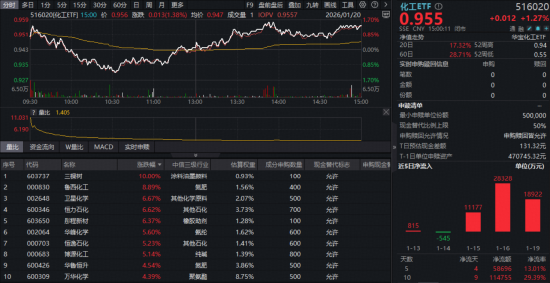
Group 1 - The chemical sector continues to show strong performance, with the chemical ETF (516020) reaching a closing price that marks a new high since August 2022, closing up 1.27% on January 20, 2026 [1][9] - Notable individual stocks within the sector include Sanhe Tree, which hit the daily limit, and Luxi Chemical, which surged by 8.89%, while Satellite Chemical, Hengli Petrochemical, and Tongcheng New Materials all rose over 6% [1][10] - Since the beginning of 2025, the chemical ETF has seen a cumulative increase of 54.34%, significantly outperforming major indices such as the Shanghai Composite Index (22.73%) and the CSI 300 Index (19.92%) [1][13] Group 2 - The chemical ETF has attracted significant capital inflow, with over 5.8 billion yuan in net subscriptions over the last five trading days and more than 11 billion yuan over the last ten trading days [4][12] - A recent policy from the Ministry of Industry and Information Technology aims to promote zero-carbon factory construction by 2030, which may lead to stricter regulations on new chemical projects and limit new capacity in the petrochemical sector [4][12] - Analysts suggest that the chemical industry is currently in a weak performance phase, but certain sub-sectors, such as lubricants, have exceeded expectations, indicating potential investment opportunities in glyphosate, fertilizers, and high-dividend assets [5][14] Group 3 - The chemical ETF (516020) tracks the CSI Sub-Industry Chemical Theme Index, with nearly 50% of its holdings concentrated in large-cap leading stocks like Wanhua Chemical and Salt Lake Industry, while the other half includes leading stocks in various sub-sectors [5][14] - The ETF provides a more efficient way to invest in the chemical sector, especially for those looking to capitalize on the sector's rebound [5][14]