JUNEYAOAIR(603885)

Search documents
平均38.7%座位被锁定 江苏消保委约谈10家航司要求限期整改
Yang Shi Xin Wen· 2025-11-26 11:02
Core Viewpoint - The recent practice of airlines locking seats and charging for seat selection has raised consumer concerns, as it is seen as a way for airlines to increase revenue at the expense of consumer rights [1][2]. Group 1: Investigation Findings - A special investigation by Jiangsu Consumer Council targeted 10 domestic airlines, revealing that seat locking is prevalent, with the proportion of locked seats in economy class ranging from 19.9% to 62.1%, averaging 38.7% [1][2]. - The locked seats are primarily desirable ones, such as those in the front row, window, and aisle, limiting consumer choice to less favorable options [1][2]. Group 2: Consumer Rights Violations - The unlocking mechanism for preferred seats often requires payment through membership points or miles, disadvantaging non-members or occasional travelers who lack accumulation channels [2]. - Airlines have introduced additional paid options for unlocking seats, effectively splitting the basic seat selection rights into paid services, increasing travel costs for consumers [2]. - Information regarding seat locking rules and fees is often unclear, violating consumers' right to know, with customer service responses being inadequate and contradictory [2]. Group 3: Recommendations for Airlines - Airlines are urged to ensure transparency by clearly informing consumers about seat distribution and pricing policies [3]. - Fairness in rules must be maintained, ensuring equal seat selection opportunities for all passengers at the same fare [3]. - Airlines should respect consumer autonomy by safeguarding their right to choose and preventing disguised compulsory consumption [3]. Group 4: Required Actions - Airlines must conduct self-assessments to address excessive seat locking and eliminate disguised paid seat selection models, ensuring a reasonable and balanced distribution of free seat options [3][4]. - Unfair clauses in agreements related to seat locking should be reviewed and amended to avoid limiting consumer rights or increasing consumer responsibilities unfairly [4].



江苏省消保委就飞机“锁座”问题约谈10家航司 要求限期整改
Di Yi Cai Jing· 2025-11-26 05:44
据江苏省消保委消息,近期,飞机"锁座"及有偿选座服务引发热议。为厘清行业经营边界,推动消费者 合法权益得到切实保障,江苏省消保委于11月21日线上约谈东方航空、南方航空、中国国航、海南航 空、厦门航空、深圳航空、山东航空、四川航空、春秋航空、吉祥航空等十家航空公司。会上,江苏省 消保委结合调查结果,通报了机票锁座服务市场存在的四个问题:一是锁座行为普遍存在,优质座位过 度锁定;二是解锁机制变相付费,挤压普通消费者权益;三是信息不透明且解释不合理,侵犯知情权; 四是协议文本存在不公平格式条款,权利义务设置不对等。江苏省消保委就飞机票锁座问题的整改工 作,向各航司提出两点明确要求,并于15个工作日内将整改情况以书面形式进行提交。 (文章来源:第一财经) ...
浙商早知道-20251126
ZHESHANG SECURITIES· 2025-11-25 23:30
Market Overview - On November 25, the Shanghai Composite Index rose by 0.87%, the CSI 300 increased by 0.95%, the STAR 50 went up by 0.43%, the CSI 1000 climbed by 1.31%, the ChiNext Index gained 1.77%, and the Hang Seng Index rose by 0.69% [5] - The best-performing sectors on November 25 were telecommunications (+3.54%), media (+2.85%), non-ferrous metals (+2.42%), comprehensive (+2.21%), and electronics (+2.14%). The worst-performing sectors were defense and military (-0.32%) and transportation (-0.11%) [5][4] - The total trading volume of the A-share market on November 25 was 1,826.2 billion yuan, with a net inflow of 11.166 billion Hong Kong dollars from southbound funds [5][4] Important Recommendations - The report highlights 吉祥航空 (China's private airline leader) as a key investment opportunity, noting that the airline industry is approaching a supply-demand inflection point. The company's aircraft utilization is expected to recover, and ticket prices are anticipated to rise, leading to potential earnings exceeding expectations [6] - The report suggests that the worst performance period for 吉祥航空 has passed, with a forecast for significant earnings recovery over the next three years. The expected aircraft utilization recovery is projected for 2026-2027, with the introduction of 5-6 new aircraft annually under the 九元 plan [6] - The target price for 吉祥航空 is set at a 20x PE for 2027, corresponding to a target market value of 45.9 billion yuan [6] Earnings Forecast and Valuation - The projected operating revenue for 吉祥航空 from 2025 to 2027 is 22,044 million yuan, 23,196 million yuan, and 24,940 million yuan, with growth rates of 0%, 5%, and 8% respectively. The net profit attributable to shareholders is forecasted to be 1,007 million yuan, 1,571 million yuan, and 2,294 million yuan, with growth rates of 10%, 56%, and 46% respectively [7] - The earnings per share are expected to be 0.46 yuan, 0.72 yuan, and 1.05 yuan for the years 2025, 2026, and 2027, with corresponding PE ratios of 27.09, 17.36, and 11.89 [7] Important Insights - The macroeconomic report indicates that the GDP weekly high-frequency prosperity index was at 4.7% as of November 22, remaining stable compared to the previous week [8] - The report emphasizes that traditional economic indicators may not accurately reflect the current economic structure transformation, suggesting a need for updated measurement methods [8]

吉祥航空(603885):利用率触底 业绩修复斜率有望超预期
Xin Lang Cai Jing· 2025-11-25 12:29
Core Viewpoint - The company, as a leading private airline, is expected to exceed performance expectations due to the recovery of aircraft utilization and anticipated price increases in the aviation industry [1] Industry Summary - The aviation supply side is facing hard constraints, crossing a supply-demand inflection point, with ticket price elasticity expected to materialize. The industry is currently in a "tight balance" phase, with passenger load factors reaching new highs and off-season ticket prices turning positive year-on-year. The three major airlines are expected to return to profitability in 2025, with sustained tightness on the supply side anticipated to continue into 2026, driven by calls to avoid internal competition, extended holiday periods, and optimized entry-exit policies. This is expected to lead to steady growth in demand, alongside favorable oil prices and exchange rates, accelerating profit recovery for airlines [2] Company Summary 1. Engine maintenance has negatively impacted aircraft utilization, leading to a significant increase in unit non-fuel costs, which has short-term performance implications. The company's aircraft utilization is expected to recover, driven by improvements in supply-demand dynamics, leading to a steeper upward trajectory in performance over the next three years. In the first half of 2025, the company's aircraft utilization (including grounded aircraft) was 9.8 hours per day, down 0.6 hours year-on-year, with the A320 series utilization at 9.1 hours per day, down 2.2 hours year-on-year. In contrast, the industry-wide aircraft utilization increased by 0.2 hours year-on-year during the same period. The insufficient aircraft utilization led to a year-on-year increase of 11% in unit non-fuel costs for the company in the first three quarters of 2025, temporarily dragging down profitability. The company expects significant improvements in engine issues by the end of 2026, and as aircraft utilization recovers, it will benefit from industry supply-demand improvements, with substantial profit elasticity potential over the next three years [3] 2. The scale operation of wide-body aircraft by the company is expected to elevate profitability. As of the first half of 2025, the company operated 10 B787 wide-body aircraft across 28 international routes (including 7 intercontinental routes), with a daily utilization rate of 14.0 hours, an increase of 2.5 hours compared to the same period in 2019. The profitability of wide-body operations is expected to continue improving. Additionally, the company’s low-cost airline, operating in the Greater Bay Area, has seen continuous optimization of scheduling resources, leading to improved operational efficiency and profitability. In the first half of 2025, this low-cost airline achieved a net profit of approximately 230 million yuan, an increase of 8% year-on-year compared to the first half of 2024, and a staggering 1087% increase compared to the first half of 2019 [4] 3. The company is increasing its dividend and share repurchase efforts, demonstrating confidence in its development. In 2024, the company plans to distribute a dividend of 0.19 yuan per share (including interim dividends), corresponding to a cash dividend ratio of 45%. In 2025, the company announced its third round of share repurchase plans since its listing, intending to repurchase between 250 million to 500 million yuan worth of shares at a price not exceeding 15.80 yuan per share from January 27, 2025, to January 26, 2026. As of September 2025, approximately 400 million yuan had been repurchased at an average price of 12.71 yuan per share. Furthermore, the company has cumulatively canceled 30 million repurchased shares from 2024 to 2025, accounting for 1.4% of the total share capital before cancellation [4] Major Expectations - The company's performance recovery pace is slightly different from the industry, with the worst period already behind. The performance recovery slope and profit elasticity over the next three years are expected to exceed expectations. Market expectations indicate that the maintenance schedule for the engine is slower than anticipated, leading to a slower-than-expected recovery in aircraft utilization, which has impacted profitability. However, it is believed that aircraft utilization will be largely restored by 2026-2027, with plans to introduce 5-6 new aircraft annually from 2027-2028. With favorable fundamentals in supply-demand, oil prices, and exchange rates, the company's effective capacity is expected to grow significantly, and performance is likely to exceed expectations over the next three years [5] Potential Catalysts - Price and volume increases; improved aircraft utilization; declining oil prices; appreciation of the renminbi [6]
吉祥航空(603885):更新报告:利用率触底,业绩修复斜率有望超预期
ZHESHANG SECURITIES· 2025-11-25 11:48
Investment Rating - The investment rating for the company is "Buy" (maintained) [7] Core Views - The company is a leading private airline, and the aviation industry is approaching a supply-demand inflection point, with expectations for aircraft utilization recovery and rising ticket prices, leading to potential earnings exceeding expectations [1] - The aviation industry is currently in a "tight balance" phase, with high passenger load factors and seasonal ticket prices turning positive year-on-year, indicating resilience in the industry [1] - The company is expected to benefit significantly from the recovery in aircraft utilization and industry supply-demand improvements over the next three years, with substantial profit elasticity potential [1][3] Summary by Sections Company Performance - The company's aircraft utilization rate has been negatively impacted by engine maintenance issues, leading to a significant increase in unit non-fuel costs, which has temporarily affected earnings [1] - As of the first half of 2025, the company's aircraft utilization rate was 9.8 hours per day, down 0.6 hours year-on-year, with the A320 series utilization at 9.1 hours per day, a decline of 2.2 hours compared to the first half of 2024 [1] - The company expects substantial improvement in engine issues by the end of 2026, which will allow it to fully benefit from the industry's supply-demand recovery [1] Financial Projections - The company forecasts net profits of approximately 1.007 billion, 1.571 billion, and 2.294 billion yuan for 2025, 2026, and 2027 respectively, with a target market value of 45.9 billion yuan based on a 20x PE ratio for 2027 [5] - The company plans to increase dividends and share buybacks, reflecting confidence in its development, with a proposed dividend of 0.19 yuan per share for 2024 and a share buyback plan of 250 million to 500 million yuan [2] Market Expectations - The market anticipates that the recovery pace of the company's earnings may differ slightly from the industry, with the worst period already passed, and future earnings recovery rates and profit elasticity expected to exceed forecasts [3] - The company plans to introduce 5-6 new aircraft annually from 2027 to 2028, which will contribute to significant growth in effective capacity and earnings [3] Catalysts - Potential catalysts for the company include increases in volume and price, improved aircraft utilization, declining oil prices, and appreciation of the renminbi [4]
吉祥航空大股东高质押后再抛8亿减持计划:有息负债升至345亿 航餐成本下滑服务投诉高发
Xin Lang Cai Jing· 2025-11-25 10:18
知名民营航空公司吉祥航空的大股东又抛出了一份减持计划。 11月21日晚,吉祥航空公告,控股股东均瑶集团拟在未来3个月内减持不超过公司6552.02万股股份,即 不超过公司总股本的3%。 以吉祥航空当日收盘价13.24元/股计算,顶格减持,均瑶集团将套现约8.68亿元。 这已不是均瑶集团首次减持吉祥航空。2018年,均瑶集团就通过引进战略投资者协议转让股权方式,一 次性套现约17.13亿元。 均瑶集团此次减持计划的背后,是其高企的股权质押率。 截至11月20日,解除部分质押后,均瑶集团所持吉祥航空的股权仍有67.44%被质押,其一致行动人均 瑶投资的质押率也高达76.25%。 公告显示,均瑶集团未来一年内到期的质押股份数量约6.19亿股,对应融资余额高达49.88亿元。 不仅是在吉祥航空,均瑶系旗下另外两家A股公司——爱建集团和均瑶健康,也同样面临高比例质押。 截至最新公告,均瑶集团所持爱建集团的股权质押率为79.03%,所持均瑶健康的股权质押率为 76.69%。 这种高比例质押情况,反映出均瑶集团自身可能面临一定的财务压力。 在大股东筹划减持的同时,吉祥航空的经营业绩也正面临挑战。 2025年前三季度,吉祥航 ...


航空机场板块11月25日跌1.84%,华夏航空领跌,主力资金净流入1.05亿元
Zheng Xing Xing Ye Ri Bao· 2025-11-25 09:09
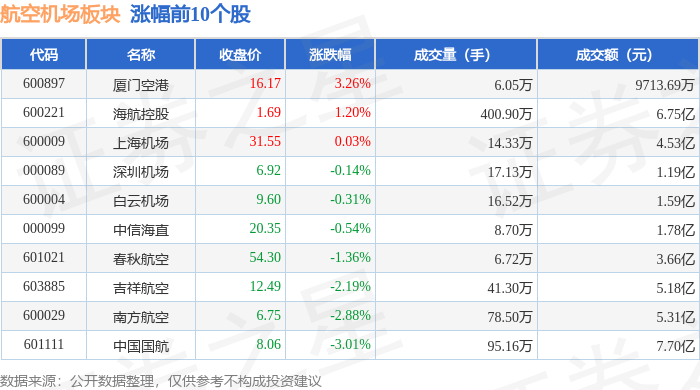
Core Viewpoint - The aviation and airport sector experienced a decline of 1.84% on November 25, with Huaxia Airlines leading the drop. In contrast, the Shanghai Composite Index rose by 0.87% and the Shenzhen Component Index increased by 1.53% [1]. Group 1: Market Performance - The aviation and airport sector saw a net inflow of 105 million yuan from institutional investors, while retail investors contributed a net inflow of 141 million yuan. However, speculative funds experienced a net outflow of 246 million yuan [2][3]. - Key stocks in the aviation sector showed varied performance, with Xiamen Airport rising by 3.26% to close at 16.17 yuan, while Huaxia Airlines fell by 3.93% to 10.50 yuan [1][2]. Group 2: Individual Stock Analysis - Major stocks such as China Eastern Airlines and China National Aviation Corporation saw declines of 3.89% and 3.01%, respectively, indicating a broader trend of negative performance within the sector [2][3]. - The trading volume for China Eastern Airlines reached 2.06 million shares, with a transaction value of 1.028 billion yuan, highlighting significant trading activity despite the stock's decline [2].



199股获杠杆资金大手笔加仓
Zheng Quan Shi Bao Wang· 2025-11-25 04:34
Market Overview - On November 24, the Shanghai Composite Index rose by 0.05%, while the total margin balance in the market decreased by 2.78 billion yuan to 24,586.69 billion yuan compared to the previous trading day [1] - The margin balance in the Shanghai Stock Exchange was 12,499.83 billion yuan, down by 0.62 billion yuan; in the Shenzhen Stock Exchange, it was 12,011.43 billion yuan, down by 2.08 billion yuan; and in the Beijing Stock Exchange, it was 75.43 billion yuan, down by 0.08 billion yuan [1] Industry Analysis - Among the industries classified by Shenwan, 14 industries saw an increase in margin balance, with the media industry leading with an increase of 0.847 billion yuan, followed by the defense and military industry and transportation industry with increases of 0.543 billion yuan and 0.283 billion yuan, respectively [1] Individual Stock Performance - A total of 1,745 stocks experienced an increase in margin balance, accounting for 46.56% of the total, with 199 stocks seeing an increase of over 5% [1] - The stock with the largest increase in margin balance was 吉祥航空 (Jixiang Airlines), which had a margin balance of 126.28 million yuan, reflecting a 59.63% increase, despite a 3.55% decline in its stock price on the same day [1] - Other notable stocks with significant increases in margin balance included 泰鹏智能 (Taipeng Intelligent) and 中诚咨询 (Zhongcheng Consulting), with increases of 48.25% and 44.02%, respectively [1] Top Gainers and Losers - Among the top 20 stocks with the largest increase in margin balance, the average stock price rose by 1.83%, with 光云科技 (Guangyun Technology), 晨曦航空 (Chenxi Airlines), and 君亭酒店 (Junting Hotel) leading with increases of 20.00%, 14.13%, and 13.27%, respectively [2] - Conversely, the stocks with the largest declines included 平潭发展 (Pingtan Development), 九牧王 (Jiumuwang), and 国城矿业 (Guocheng Mining), with declines of 10.03%, 10.02%, and 10.00%, respectively [2] Margin Balance Declines - A total of 2,003 stocks saw a decrease in margin balance, with 164 stocks experiencing a decline of over 5% [3] - The stock with the largest decrease in margin balance was 保丽洁 (Baolijie), which saw a decline of 42.65% to 2.6643 million yuan [5] - Other stocks with significant declines included 四川路桥 (Sichuan Road and Bridge) and 铁拓机械 (Tietuo Machinery), with decreases of 38.47% and 26.62%, respectively [5]



中国航司大面积调整日本航线,每周减少156航班
2 1 Shi Ji Jing Ji Bao Dao· 2025-11-24 13:40
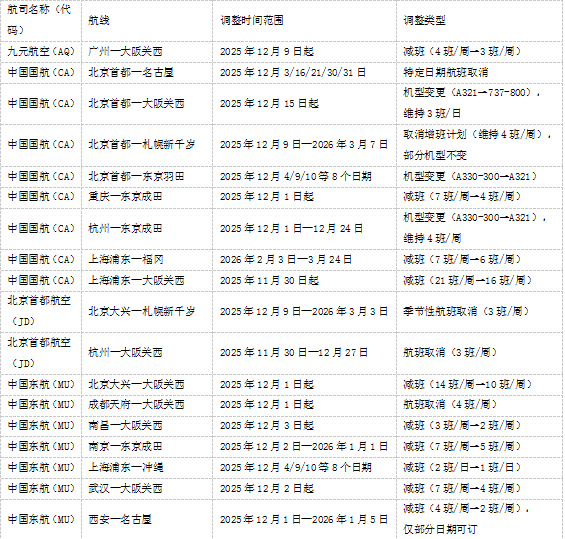
Core Insights - The impact of recent statements from the Japanese Prime Minister has led to significant reductions and cancellations of flights between China and Japan, affecting travel plans during peak seasons such as New Year and Spring Festival [1][2] Flight Reductions and Cancellations - Starting December 1, 16 Chinese airlines will reduce weekly flights to Japan by 156, with the most significant cuts from Juneyao Airlines, which will decrease its flights from 114 to 79 per week, a reduction of 31% [1] - China Southern Airlines, Shenzhen Airlines, and Eastern Airlines will also see reductions of 23, 22, and 18 flights per week, respectively [1] - The cancellation rate for planned flights to Japan is projected to reach 21.6% by November 27, with 12 routes canceling all flights [1][2] Specific Route Adjustments - High cancellation rates are noted on routes such as Tianjin Binhai to Kansai International (65.0%) and Nanjing Lukou to Kansai International (59.4%) [2] - Smaller airlines like Beijing Capital Airlines are canceling entire routes, such as the Beijing Daxing to Sapporo New Chitose, while Changlong Airlines is canceling all flights in December [2][3] Aircraft Type Adjustments - Airlines are also adjusting aircraft types, with Air China switching from larger Airbus A330-300 to smaller A321 on several routes, reducing passenger capacity [3] - Some airlines, like Shandong Airlines and Xiamen Airlines, have not made any adjustments to their Japan flight schedules [3] Pricing Implications - The reduction in flights is expected to increase travel costs for consumers planning trips to Japan during the winter season, with Spring Airlines raising minimum ticket prices significantly [3] Summary of Flight Adjustments - A detailed table outlines various airlines and their specific flight adjustments, including reductions and cancellations across multiple routes, effective from late November through March 2026 [4][5]

中国航司大面积调整日本航线,每周减少156航班
21世纪经济报道· 2025-11-24 13:34
Core Viewpoint - The article discusses the significant reduction and cancellation of flights between China and Japan due to recent political tensions, affecting travel plans for the upcoming winter and spring seasons [1][2]. Flight Reductions and Cancellations - Starting December 1, 16 Chinese airlines will reduce weekly flights to Japan by 156, with the most significant cuts from Juneyao Airlines, which will decrease its flights from 114 to 79 per week, a reduction of 31% [1]. - China Southern Airlines, Shenzhen Airlines, and Eastern Airlines will also see reductions of 23, 22, and 18 flights per week, respectively [1]. - The cancellation rate for planned flights to Japan is projected to reach 21.6% by November 27, with 12 routes already canceling all flights [1][2]. Impact on Travelers - The reduction in flights coincides with the peak travel season for skiing and hot springs in Japan, leading to potential disruptions for travelers planning winter trips [2]. - Specific routes with high cancellation rates include Tianjin Binhai to Kansai International (65.0%) and Nanjing Lukou to Kansai International (59.4%) [2]. Aircraft Type Adjustments - Airlines are not only reducing flight frequencies but also changing aircraft types to smaller models, such as switching from the Airbus A330-300 to the A321, which has a lower passenger capacity [3]. - Some airlines, like Shandong Airlines and Xiamen Airlines, have not made any adjustments to their Japan routes [3]. Price Increases - Spring Airlines has raised the minimum ticket prices for several routes, with the lowest fare for Shanghai to Okinawa reaching 42,900 JPY (approximately 2,000 CNY) [4]. Summary of Adjustments by Airlines - A detailed table lists various airlines and their specific route adjustments, including reductions in frequency and cancellations, with some airlines maintaining their original schedules [5][6][7].