JUNEYAOAIR(603885)

Search documents
交通运输行业周报:原油运价波动上行,前10月邮政行业收入历史首超电信行业-20251201
Bank of China Securities· 2025-12-01 02:42
Investment Rating - The transportation industry is rated as "Outperform" [2] Core Insights - The report highlights an upward trend in crude oil freight rates, with the China Import Crude Oil Index (CTFI) reaching 2520.07 points, an increase of 8.4% from November 20 [3][13] - The postal industry revenue surpassed the telecommunications industry for the first time in history, reaching 1.47 trillion yuan, compared to 1.467 trillion yuan for telecommunications [3][24] - The civil aviation sector showed growth in both passenger and cargo transport volumes in October, with international routes performing particularly well [3][17] Summary by Sections Industry Hot Events - Crude oil freight rates are rising, with the Middle East route seeing a 10.76% increase in rates [13] - Qifly Aviation signed a procurement agreement for 105 eVTOL aircraft with three companies in the Guangdong-Hong Kong-Macao Greater Bay Area, focusing on low-altitude logistics [15][16] - The postal industry revenue for January to October 2025 reached 1.47 trillion yuan, marking a significant milestone [24][25] High-Frequency Data Tracking - The Baltic Air Freight Price Index decreased month-on-month but increased year-on-year [26] - Domestic freight flights in October 2025 increased by 0.32% year-on-year, while international flights rose by 11.12% [32] - The express delivery business volume in October 2025 increased by 7.90% year-on-year, with total revenue reaching 131.67 billion yuan [50] Investment Recommendations - Focus on the equipment and manufacturing export chain, recommending companies like COSCO Shipping and China Merchants Energy [5] - Attention to low-altitude economy investment opportunities, particularly in companies like CITIC Offshore Helicopter [5] - Consider investment opportunities in the express delivery sector, recommending SF Express and Jitu Express [5]





十家航司被约谈后,消费者仍受“锁座”困扰
Nan Fang Du Shi Bao· 2025-11-30 10:34
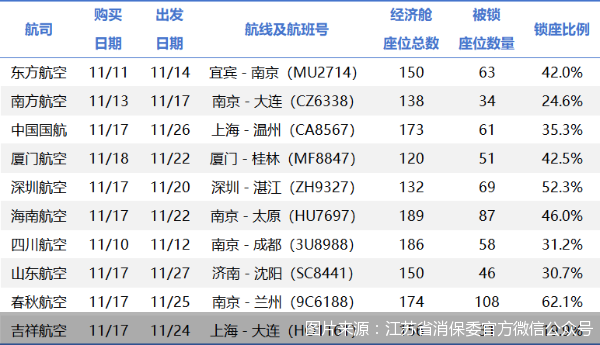
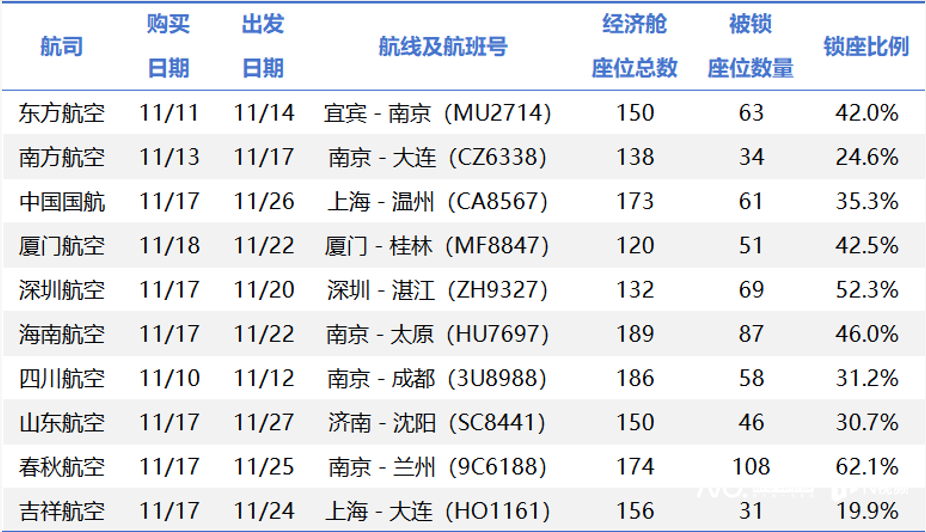
Core Viewpoint - The long-standing and controversial airline "seat locking" phenomenon is expected to undergo rectification following a special investigation by the Jiangsu Provincial Consumer Protection Committee, which has interviewed ten domestic airlines and requested written responses regarding corrective actions [1][5]. Group 1: Investigation Findings - The Jiangsu Provincial Consumer Protection Committee conducted an investigation into the "seat locking" practices of ten major airlines, revealing that the proportion of locked seats during the purchasing phase ranged from 19.9% to 62.1%, with an average of 38.7% [2][3]. - Notably, Spring Airlines' Nanjing-Lanzhou route had a seat locking rate exceeding 60%, while Shenzhen Airlines' Shenzhen-Zhanjiang route exceeded 50% [2][3]. - Other airlines like Hainan Airlines, Eastern Airlines, and Xiamen Airlines had locking rates between 40% and 46%, while Lucky Air had a relatively low rate of less than 20% [2][3]. Group 2: Reasons for Seat Locking - Airlines provided various justifications for seat locking, including reserving seats for special passengers, ensuring emergency seat availability, and maintaining flight load balance [4]. - The investigation identified common issues with the "seat locking" phenomenon, including a lack of clear communication regarding seat locking rules, vague explanations, differential resource allocation based on membership levels, and unilateral rights granted to airlines [4]. Group 3: Consumer Feedback and Reactions - Consumers expressed dissatisfaction with the differentiation of paid and free seating areas in economy class, indicating that such practices increase travel costs and lead to a frustrating experience [6][10]. - Feedback highlighted that many passengers were unaware of the specific rules regarding seat locking, leading to limited seat choices, especially for families traveling together [10][11]. Group 4: Regulatory Actions and Implications - The Jiangsu Provincial Consumer Protection Committee has mandated that the airlines submit written corrective actions within 15 working days, including self-inspections and revisions of unfair terms related to "seat locking" [5][15]. - Legal experts have commented that the "seat locking" practice infringes on consumer rights and may violate consumer protection laws, suggesting that the committee's actions could serve as a model for regulatory oversight in other regions [15][16].





航空机场板块11月28日涨0.26%,厦门空港领涨,主力资金净流出7280.69万元
Zheng Xing Xing Ye Ri Bao· 2025-11-28 09:08
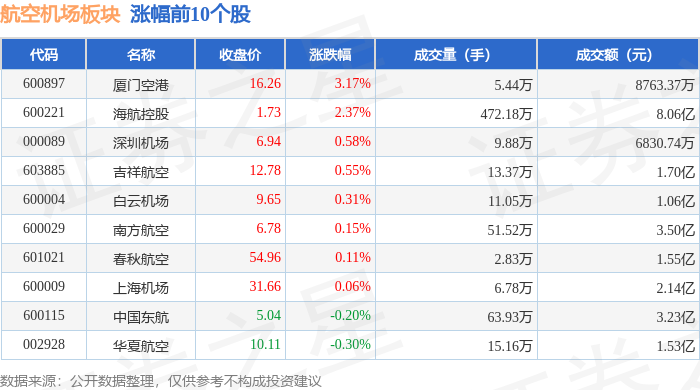
Core Insights - The aviation and airport sector experienced a slight increase of 0.26% on November 28, with Xiamen Airport leading the gains [1] - The Shanghai Composite Index closed at 3888.6, up 0.34%, while the Shenzhen Component Index closed at 12984.08, up 0.85% [1] Stock Performance - Xiamen Airport (600897) closed at 16.26, up 3.17% with a trading volume of 54,400 shares and a transaction value of 87.63 million yuan [1] - Hainan Airlines (600221) closed at 1.73, up 2.37% with a trading volume of 4.72 million shares and a transaction value of 806 million yuan [1] - Shenzhen Airport (000089) closed at 6.94, up 0.58% with a trading volume of 99,880 shares and a transaction value of 68.31 million yuan [1] - China Eastern Airlines (600115) closed at 5.04, down 0.20% with a trading volume of 639,300 shares and a transaction value of 323 million yuan [1][2] Capital Flow - The aviation and airport sector saw a net outflow of 72.81 million yuan from institutional investors, while retail investors contributed a net inflow of 103 million yuan [2] - The detailed capital flow indicates that Hainan Airlines had a net inflow of 96.67 million yuan from institutional investors, while retail investors had a net outflow of 51.95 million yuan [3] - Xiamen Airport experienced a net outflow of 1.69 million yuan from institutional investors, but a net inflow of 4.48 million yuan from retail investors [3]


十家航司被约谈 直指“锁座”乱象
Jing Ji Guan Cha Wang· 2025-11-27 05:00
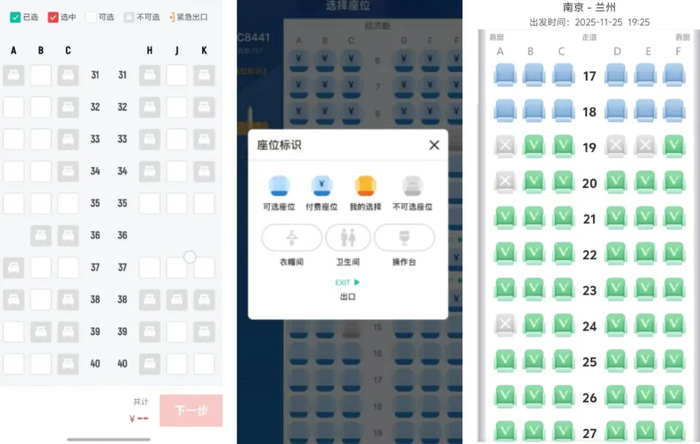
飞机"锁座"及有偿选座服务问题近日引发社会广泛关注。江苏省消费者权益保护委员会(以下简称"江 苏省消保委")一纸调查,直指航司"锁座"乱象,将国内10家主流航空公司推到了风口浪尖。 11月21日,江苏省消保委线上约谈了东方航空、南方航空(600029)、中国国航(601111)等10家主流 航空公司。11月26日,通过公众号发布有关调查结果,详细列举了机票锁座服务市场中存在的诸多问 题,亮明对"锁座"现象长期存在的"零容忍"态度,并要求各公司在15个工作日内将整改情况以书面形式 提交。 专家认为,航司"锁座"行为锁的不仅是座位,还有旅客的知情权和公平交易权。"付费选座"等霸王条款 还可能涉嫌违反《消费者权益保护法》,侵害旅客的自主选择权,属于典型变相收费行为,让旅客暗吃 了不少"哑巴亏"。长此以往,"锁座"行为最终损害的是旅客对航司服务的信任,不利于航空服务业的高 质量发展。 近四成座位被锁 所谓飞机"锁座",是指航司将经济舱前排、靠窗、靠过道等较为便利舒适的座位单独锁定,要么无法选 择,要么需额外付费或用积分兑换。从范围来看,锁定范围高度集中于经济舱前排、靠窗及靠过道等消 费者偏好的优质座位,仅开放中间区域 ...

东航、南航、国航、海航、春秋等10家航司被约谈
Mei Ri Jing Ji Xin Wen· 2025-11-26 16:27
Core Viewpoint - The recent practice of airlines locking seats and charging for seat selection has raised consumer concerns, as it is perceived as a means for airlines to increase revenue at the expense of consumer rights [1][2]. Group 1: Investigation Findings - A special investigation by Jiangsu Consumer Council focused on 10 domestic airlines, revealing that seat locking is prevalent, with the proportion of locked seats in economy class ranging from 19.9% to 62.1%, averaging 38.7% [1][2]. - The locked seats are primarily desirable ones, such as those in the front row, window, and aisle, limiting consumer choice to less favorable options [1][2]. - The investigation identified four main issues: widespread seat locking, disguised payment mechanisms, lack of transparency, and unfair contractual terms [2]. Group 2: Consumer Rights and Responsibilities - Airlines are legally responsible for protecting consumer rights and must ensure transparency in seat distribution and pricing policies [3]. - Airlines should provide equal seat selection opportunities for all passengers at the same fare and respect consumer autonomy in choosing seats [3]. Group 3: Required Actions from Airlines - Jiangsu Consumer Council has mandated airlines to conduct self-assessments and rectify their seat selection rules, particularly addressing excessive locking and disguised payment models [4]. - Airlines must revise unfair contractual terms that limit consumer rights and ensure that their policies are clear and transparent [4]. Group 4: Industry Response - Representatives from Southern Airlines and Lucky Air acknowledged the situation and stated they are evaluating the requirements set by Jiangsu Consumer Council [5]. - Experts have pointed out that while some seat locking for safety or special needs is acceptable, excessive locking for profit could violate consumer rights [5][6].

机票“锁座”变相收费 10家航司被约谈
Bei Jing Shang Bao· 2025-11-26 15:54
Core Viewpoint - The Jiangsu Consumer Rights Protection Committee has released a report highlighting issues related to seat locking practices by airlines, including widespread locking behavior, excessive locking of premium seats, disguised fees for unlocking, and infringement on consumer rights [1][4]. Group 1: Investigation Findings - The average seat locking rate among the 10 surveyed airlines is 38.7%, with rates ranging from 19.9% to 62.1% [3][4]. - Spring Airlines and Shenzhen Airlines have particularly high locking rates, exceeding 60% and 50% respectively, while Juneyao Airlines has a relatively low rate of under 20% [3][4]. - The investigation focused on the locking ratio, locking range, redemption methods, and customer service explanations [3]. Group 2: Identified Issues - Widespread seat locking practices are prevalent, with premium seats being excessively locked, limiting consumer choices to less desirable seats [4][5]. - The unlocking mechanism often requires payment or points redemption, which disadvantages non-members or infrequent travelers, effectively increasing travel costs [4][5]. - There is a lack of transparency in information provided to consumers, with unclear seat selection rules and inadequate customer service responses [4][5]. Group 3: Recommendations and Actions - The Jiangsu Consumer Rights Protection Committee has urged airlines to conduct self-examinations and rectify unfair terms in their agreements regarding seat locking [1][6]. - Airlines are recommended to ensure a reasonable and balanced distribution of free seat options, limiting paid options to only those necessary for special circumstances [7]. - Continuous monitoring of airlines' compliance with these recommendations will be conducted, with potential follow-up measures if necessary [8].

买机票还要再花钱选座?10家航司被约谈!锁座比例平均超38%
Bei Jing Shang Bao· 2025-11-26 14:33
Core Viewpoint - The Jiangsu Provincial Consumer Protection Committee has raised concerns regarding the long-standing issues of seat locking and paid seat selection services among major Chinese airlines, highlighting the need for reform in these practices to protect consumer rights [1][2][3]. Group 1: Issues Identified - The practice of seat locking is widespread among the ten airlines, with the proportion of locked seats in the economy class ranging from 19.9% to 62.1%, averaging 38.7%, primarily affecting preferred seating areas [1][2]. - Airlines are increasingly using a mechanism that effectively charges consumers for seat selection, particularly disadvantaging non-members or infrequent travelers who lack the means to accumulate points for free seat selection [2]. - There is a lack of transparency in the information provided to consumers regarding seat locking rules and associated fees, with airlines often providing vague explanations that do not align with the high rates of seat locking [2]. Group 2: Required Reforms - The Jiangsu Provincial Consumer Protection Committee has mandated airlines to conduct self-assessments and rectify their seat selection rules within 15 working days, specifically addressing the excessive locking of seats and eliminating disguised paid seat selection models [3][4]. - Airlines are required to ensure a reasonable and balanced distribution of free seat options, retaining only necessary seat locks for special passengers or emergency purposes, while prohibiting the inclusion of standard economy seats in the paid category [3]. - The committee has called for a review and modification of unfair contractual terms related to seat locking, ensuring that consumer rights are not limited and that airlines' responsibilities are clearly defined within a transparent framework [4].

吉祥航空20251126
2025-11-26 14:15
Summary of the Conference Call for 吉祥航空 Company Overview - **Company**: 吉祥航空 (Juneyao Airlines) - **Industry**: Aviation Key Points and Arguments Industry Demand and Supply Dynamics - Aviation demand is closely linked to GDP growth, typically at a ratio of 1.2 to 1.8 times GDP growth. As of 2025, overall demand has recovered to 115% of 2019 levels, while supply growth has significantly slowed, leading to a tight balance between supply and demand in the market [2][5][10] - The increase in aircraft utilization is notable, with each additional hour of aircraft utilization contributing approximately 1 billion yuan to profits [2][5] Operational Challenges - 吉祥航空 is facing capacity constraints due to engine maintenance issues, specifically related to the PW1,100G engine recall by Pratt & Whitney. This has resulted in extended waiting times for repairs, but the company expects to gradually resolve these issues and improve aircraft utilization over the next two to three years [2][6][7] - The average daily utilization of the 787 wide-body aircraft has increased, enhancing profitability. The company currently operates 10 units of the 787 and has opened multiple international routes [3][12] Financial Environment - Oil prices have been declining since 2024, currently fluctuating around 60 USD, with expectations to drop further to the 30-40 USD range. This decline is expected to significantly reduce operational costs for airlines [2][8] - The appreciation of the yuan is alleviating financial pressure from dollar-denominated debts for airlines, creating a more favorable external environment for profitability [2][8] Market Position and Future Outlook - 民营航空公司 (private airlines) like 吉祥航空 may experience a quicker recovery once operational bottlenecks are resolved, compared to state-owned airlines that rely more on overall market improvements [9] - The company has implemented a new dividend policy starting in 2024, with a cash dividend ratio of 45%, and has initiated a share buyback plan, completing 400 million yuan in buybacks [3][17][18] Profitability Projections - Projected net profits for 吉祥航空 from 2025 to 2027 are 1.007 billion yuan, 1.571 billion yuan, and 2.294 billion yuan, respectively. The company is expected to benefit from improved aircraft utilization and industry supply-demand dynamics [21] - The company is currently valued at approximately 28 to 29 billion yuan, indicating significant growth potential, and maintains a "buy" rating [21] Additional Considerations - The impact of geopolitical tensions on specific routes, such as those between China and Japan, has been minimal, as the company can reallocate resources to other popular destinations [14] - The subsidiary 九元航空 has shown significant improvement, achieving a net profit of 230 million yuan in the first half of 2025, marking an 8% increase year-on-year [15] Conclusion 吉祥航空 is positioned to benefit from favorable market conditions, operational improvements, and strategic financial policies, suggesting a positive outlook for the coming years despite current challenges related to engine maintenance and capacity constraints.
吉祥航空回应被约谈飞机锁座问题
Xin Lang Cai Jing· 2025-11-26 14:08
针对飞机"锁座"及有偿选座服务等问题,江苏省消保委于近日约谈东方航空、南方航空、中国国航、海 南航空、厦门航空、深圳航空、山东航空、四川航空、春秋航空、吉祥航空等10家航空公司。11月26 日,吉祥航空相关负责人表示,"公司将根据江苏省消保委的要求开展自查自纠和相关条款的梳理工 作,目前公司正进行内部评估。" ...
机票“锁座”近四成,江苏消保委约谈10家航司直指变相付费
Bei Jing Shang Bao· 2025-11-26 13:02
Core Viewpoint - The Jiangsu Consumer Rights Protection Committee has released a report highlighting issues related to seat locking practices by airlines, including widespread seat locking, excessive locking of premium seats, disguised fees for unlocking, and infringement on consumer rights [1][4]. Group 1: Survey Findings - The average seat locking rate among the 10 surveyed airlines is 38.7%, with rates ranging from 19.9% to 62.1% across different routes [2][4]. - Spring Airlines has the highest locking rate at over 60% for the Nanjing-Lanzhou route, while Juneyao Airlines has the lowest at under 20% [2][4]. - The survey included major airlines such as China Southern Airlines, China Eastern Airlines, and Hainan Airlines, focusing on their booking apps to assess seat locking practices [2][4]. Group 2: Identified Issues - The report identifies four main issues: the prevalence of seat locking, excessive locking of desirable seats, disguised fees for unlocking, and lack of transparency in information provided to consumers [4][5]. - Premium seats are predominantly locked, limiting consumer choice to less desirable options, which infringes on consumer rights [4][5]. - Airlines are increasingly charging for seat selection, which can significantly increase travel costs, especially for families seeking adjacent seating [6][8]. Group 3: Recommendations and Actions - The Jiangsu Consumer Rights Protection Committee has urged airlines to conduct self-inspections and rectify unfair terms in their agreements regarding seat locking [6][7]. - Airlines are recommended to ensure a reasonable distribution of free seat options and to eliminate disguised fees associated with seat selection [6][7]. - Continuous monitoring of airlines' compliance with these recommendations will be conducted by the Jiangsu Consumer Rights Protection Committee [8].