
UIH(688271)

Search documents
Q3态势良好,持续关注创新药械产业链
Haitong Securities International· 2025-11-06 04:34
Investment Rating - The report maintains a focus on innovative pharmaceuticals and medical devices, highlighting key A-share and H-share targets for investment [6][32]. Core Insights - The pharmaceutical sector showed a good recovery in Q3 2025, with overall revenue increasing by 0.6% year-on-year and net profit attributable to shareholders rising by 0.3% year-on-year [11][32]. - Medical equipment benefited from procurement recovery, with Q3 revenue and net profit growth of 10.6% and 0.6% year-on-year, respectively [11][32]. - Medical R&D outsourcing continued to achieve high growth, with Q3 revenue and net profit growth of 10.9% and 47.9% year-on-year [11][32]. - The offline pharmacy sector improved, with Q3 revenue and net profit growth of 2.1% and 37.8% year-on-year [11][32]. Summary by Sections 1. Focus on Innovative Pharmaceuticals and Medical Devices - Key A-share targets include Jiangsu Heng Rui Medicine, Sichuan Kelun Pharmaceutical, Huadong Medicine, Changchun High-tech Industry, Jiangsu Nhwa Pharmaceutical, WuXi AppTec, Hangzhou Tigermed Consulting, Lepu Medical, APT Medical, and related target Guangdong Zhongsheng Pharmaceutical [6][32]. - Key H-share targets include Hansoh Pharmaceutical Group, 3SBio, Akeso, and related target Innovent Biologics, WuXi AppTec [6][32]. 2. Q3 2025 Pharmaceutical Sector Recovery - The pharmaceutical sector's overall revenue increased by 0.6% year-on-year, with net profit attributable to shareholders up by 0.3% year-on-year [11][32]. - Specific segments such as medical devices and medical R&D outsourcing showed significant growth [11][32]. 3. October 2025 Market Performance - In October 2025, the pharmaceutical sector underperformed the market, with the SW Pharmaceutical and Biological index falling by 1.8% while the SHCOMP rose by 1.9% [14][32]. - The relative premium of the pharmaceutical sector compared to all A-shares was at a normal level, with a current relative premium rate of 76.7% [23][32]. 4. Hong Kong and U.S. Market Performance - The Hong Kong pharmaceutical sector underperformed, with the Hang Seng Healthcare index falling by 11.1% [24][32]. - In contrast, the U.S. S&P 500 healthcare sector rose by 3.5% [24][32].



科创ETF(588050)开盘涨0.63%,重仓股中芯国际涨1.77%,海光信息涨2.25%
Xin Lang Cai Jing· 2025-11-06 04:01
Core Viewpoint - The Sci-Tech ETF (588050) opened with a slight increase of 0.63%, indicating a positive market sentiment towards technology stocks [1] Group 1: ETF Performance - The Sci-Tech ETF (588050) opened at 1.435 yuan, reflecting a modest gain [1] - The ETF's performance benchmark is the Shanghai Stock Exchange Sci-Tech 50 Index [1] - Since its inception on September 28, 2020, the ETF has returned -0.57%, while its return over the past month is -6.98% [1] Group 2: Major Holdings - Key stocks within the ETF include: - SMIC (中芯国际) up by 1.77% - Haiguang Information (海光信息) up by 2.25% - Cambrian (寒武纪) up by 2.82% - Lanke Technology (澜起科技) up by 1.30% - Zhongwei Company (中微公司) up by 1.42% - United Imaging Healthcare (联影医疗) up by 0.11% - Kingsoft Office (金山办公) down by 0.52% - Chipone (芯原股份) up by 2.41% - Roborock (石头科技) up by 0.33% - Transsion Holdings (传音控股) unchanged [1]





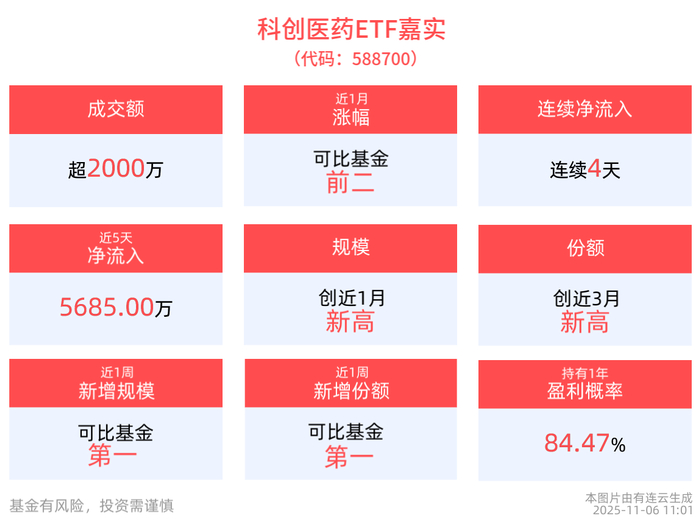
机构称医药板块近期已呈现结构性修复趋势,科创医药ETF嘉实(588700)盘中蓄势,近4日合计“吸金”5685.00万元
Xin Lang Cai Jing· 2025-11-06 03:23
Core Viewpoint - The biopharmaceutical sector on the STAR Market has shown mixed performance, with the STAR Biopharmaceutical Index declining by 0.60% as of November 6, 2025, while individual stocks exhibited varied movements, indicating a potential for structural recovery in the sector [1][4]. Group 1: Market Performance - The STAR Biopharmaceutical Index decreased by 0.60% as of November 6, 2025, with stocks like Huaheng Biological leading gains at 2.86%, while Yifang Biological experienced the largest decline [1]. - The Jiashi STAR Biopharmaceutical ETF recorded a turnover of 6.67% and a transaction volume of 21.39 million yuan, reaching a new high of 322 million yuan in scale, ranking first among comparable funds [3]. - The Jiashi STAR Biopharmaceutical ETF has seen a net inflow of 56.85 million yuan over the past four days, with a peak single-day net inflow of 16.85 million yuan [3]. Group 2: Fund Performance - As of November 5, 2025, the Jiashi STAR Biopharmaceutical ETF has achieved a one-year net value increase of 26.53%, with the highest monthly return since inception being 23.29% and the longest consecutive monthly gain lasting seven months [3]. - The average monthly return during the rising months of the Jiashi STAR Biopharmaceutical ETF is 7.85% [3]. Group 3: Industry Outlook - Recent adjustments in the pharmaceutical sector are attributed to a recovery in capital market financing and an increase in the scale of innovative drug exports, leading to a rebound in domestic innovative drug research and development [3]. - The outlook for the innovative drug sector remains focused on business development (BD) expectations, with BD activities typically accounting for about 40% of annual transactions in the fourth quarter [3]. - According to data, the top ten weighted stocks in the STAR Biopharmaceutical Index account for 49.74% of the index, indicating a concentration of investment in key players [4][6].



科创50ETF增强(588450)开盘涨0.97%,重仓股中芯国际涨1.77%,寒武纪涨2.82%
Xin Lang Cai Jing· 2025-11-06 03:19
Core Viewpoint - The article discusses the performance of the Kexin 50 ETF Enhanced (588450), highlighting its opening price and the performance of its major holdings [1] Group 1: ETF Performance - Kexin 50 ETF Enhanced (588450) opened with a gain of 0.97%, priced at 1.763 yuan [1] - Since its inception on May 6, 2024, the fund has achieved a return of 75.05%, while its return over the past month has been -7.16% [1] Group 2: Major Holdings Performance - Major holdings include: - SMIC (中芯国际) up by 1.77% - Cambrian (寒武纪) up by 2.82% - Lattice Semiconductor (澜起科技) up by 1.30% - Haiguang Information (海光信息) up by 2.25% - Zhongwei Company (中微公司) up by 1.42% - United Imaging Healthcare (联影医疗) up by 0.11% - Kingsoft Office (金山办公) down by 0.52% - Roborock (石头科技) up by 0.33% - Amlogic (晶晨股份) up by 0.51% - Western Superconducting (西部超导) down by 0.48% [1]

471家公司获机构调研(附名单)
Zheng Quan Shi Bao Wang· 2025-11-06 01:34
Core Insights - In the past five trading days, a total of 471 companies were investigated by institutions, with notable interest in companies like United Imaging Healthcare and Aibo Medical [1] - Among the companies surveyed, 223 received attention from more than 20 institutions, with United Imaging Healthcare being the most popular, attracting 318 institutions [1] - The data indicates a significant net inflow of funds into 68 of the companies that were heavily researched, with Tianji Co., Ltd. seeing the highest net inflow of 707 million yuan [1][2] Group 1: Institutional Research Activity - A total of 434 companies were surveyed by securities firms, accounting for 92.14% of the research activities [1] - Fund companies conducted research on 373 companies, while private equity firms surveyed 275 companies [1] - The most frequently researched company was Ice Wheel Environment, which was surveyed 7 times [1] Group 2: Market Performance of Surveyed Companies - Out of the companies that were heavily researched, 85 saw an increase in their stock prices, with notable gains from Aibo Medical (43.40%), Tianji Co., Ltd. (30.76%), and Boying Special Welding (20.27%) [2] - Conversely, 138 companies experienced declines, with the largest drops seen in Dekoli (-22.54%), Juguang Technology (-17.67%), and Stone Technology (-16.91%) [2] Group 3: Earnings Forecasts - Among the companies that disclosed annual earnings forecasts, only one company predicted an increase in profits, with Luxshare Precision expecting a net profit of 16.852 billion yuan, representing a year-on-year increase of 26.09% [2]


“十五五”规划建议锚定未来产业 海外机构按图索骥加快调研
Zheng Quan Ri Bao Zhi Sheng· 2025-11-05 12:44
Group 1 - The "Suggestions" document emphasizes the importance of technology and innovation in driving economic growth, mentioning "technology" 46 times and "innovation" 61 times [1] - Overseas institutions have accelerated their research on A-share listed companies, with 233 companies being investigated since the release of the "Suggestions" [1] - Notable companies such as United Imaging Healthcare and Luxshare Precision have attracted significant attention, with over 20 overseas institutions conducting research on them [1] Group 2 - United Imaging Healthcare reported a research and development investment of 1.855 billion yuan in the first three quarters of the year, reflecting a year-on-year increase of 13.48% [2] - The company is focused on an innovation-driven strategy, enhancing its core resources in forward-looking research and continuously launching differentiated high-end medical equipment [2] - Goldman Sachs has raised its GDP growth forecast for China to 5.0% for 2025, indicating a positive outlook for the advanced manufacturing sector and exports [2] Group 3 - The dual catalysts of policy dividends and market vitality are expected to accelerate the technological iteration and maturity of future industries in China, enhancing its position in the global innovation landscape [3]
联影医疗(688271):25Q3收入增速亮眼,海外占比持续提升
Guoxin Securities· 2025-11-05 11:14
Investment Rating - The investment rating for the company is "Outperform the Market" [5] Core Insights - The company reported significant revenue growth in Q3 2025, with a year-on-year increase of 75.41%, leading to a turnaround in profitability [1] - The domestic market is steadily recovering, while the overseas market shows impressive growth, with a 42.0% increase in revenue [2] - The gross margin slightly decreased to 47.02%, primarily due to price competition from centralized procurement [2] - The company maintains its profit forecast, expecting revenue growth of 20.4% in 2025, with net profit projected to increase by 54.5% [2] Summary by Sections Financial Performance - In the first three quarters of 2025, the company achieved revenue of 88.59 billion yuan, up 27.39%, and a net profit of 11.20 billion yuan, up 66.91% [1] - Q3 2025 alone saw revenue of 28.43 billion yuan and a net profit of 1.22 billion yuan, marking increases of 75.41% and 143.80%, respectively [1] - Revenue from equipment sales reached 70.71 billion yuan, with various product lines showing growth rates between 8% and 40% [1] Market Dynamics - Domestic revenue for the first three quarters of 2025 was 68.66 billion yuan, reflecting a 23.7% increase, driven by accelerated equipment updates and a recovering bidding market [2] - The overseas market contributed 19.93 billion yuan, with a revenue share of 22.5%, indicating a strong growth trajectory [2] Cost Management - The company reported a slight decline in gross margin to 47.02%, attributed to price competition [2] - Significant reductions in expense ratios were noted, with sales, management, and R&D expense ratios all decreasing [2] Future Projections - Revenue forecasts for 2025-2027 are set at 124.1 billion yuan, 145.1 billion yuan, and 169.4 billion yuan, with corresponding net profits of 19.5 billion yuan, 23.7 billion yuan, and 27.7 billion yuan [2] - The current stock price corresponds to a PE ratio of 58, 48, and 41 for the years 2025, 2026, and 2027, respectively [2]
联影医疗(688271):单季度收入表现亮眼,海外潜力市场持续向好
Hua Yuan Zheng Quan· 2025-11-05 10:16
Investment Rating - The investment rating for the company is "Buy" (maintained) [5] Core Views - The company has shown strong quarterly revenue performance, with significant growth potential in overseas markets [5] - The domestic market is stabilizing, while overseas growth is accelerating, particularly in North America and Europe [7] - The company is expected to maintain high revenue growth and profitability in the coming years, supported by a diverse range of imaging equipment and increasing global competitiveness [7] Financial Performance Summary - For the first three quarters of 2025, the company achieved revenue of 88.59 billion yuan (yoy +27.39%) and a net profit of 11.20 billion yuan (yoy +66.91%) [7] - The revenue for Q3 2025 was 28.43 billion yuan (yoy +75.41%), with a net profit of 1.22 billion yuan (yoy +143.80%) [7] - The company’s gross margin for the first three quarters of 2025 was 47.02%, with a continuous optimization of expense ratios [7] Revenue and Profit Forecast - Revenue projections for 2025-2027 are 126.04 billion yuan, 151.57 billion yuan, and 182.24 billion yuan, with year-on-year growth rates of 22.37%, 20.25%, and 20.24% respectively [6][7] - Net profit forecasts for the same period are 18.71 billion yuan, 22.87 billion yuan, and 27.86 billion yuan, with growth rates of 48.26%, 22.23%, and 21.85% respectively [6][7] - The current price-to-earnings (P/E) ratios are projected to be 60x, 49x, and 41x for 2025, 2026, and 2027 respectively [6][7]
联影医疗(688271):25Q3 收入增速亮眼,海外占比持续提升
Guoxin Securities· 2025-11-05 10:11
Investment Rating - The investment rating for the company is "Outperform the Market" [5] Core Views - The company reported significant revenue growth in Q3 2025, with a total revenue of 8.859 billion yuan, representing a year-on-year increase of 27.39%. The net profit attributable to shareholders reached 1.122 billion yuan, up 66.91% [1][2] - The domestic market is steadily recovering, with revenue of 6.866 billion yuan in the first three quarters of 2025, an increase of 23.7%. The overseas market showed remarkable growth, with revenue of 1.993 billion yuan, up 42.0%, increasing its revenue share to 22.5% [2] - The gross margin slightly decreased to 47.02%, down 2.40 percentage points, primarily due to price competition from centralized procurement. However, the company effectively controlled expenses, with significant reductions in sales, management, and R&D expense ratios [2] Summary by Sections Financial Performance - In Q3 2025, the company achieved a quarterly revenue of 2.843 billion yuan, a 75.41% increase year-on-year, and a net profit of 122 million yuan, up 143.80% [1] - For the first three quarters of 2025, equipment sales revenue was 7.071 billion yuan, a 23.7% increase, with specific product lines showing varied growth rates: CT (+8%), MR (+40%), MI (+22%), XR (+25%), and RT (+28%) [1] - The maintenance service business also grew rapidly, generating 1.243 billion yuan in revenue, a 28.4% increase, accounting for 14% of total revenue [1] Market Dynamics - The recovery in the domestic market is attributed to accelerated implementation of equipment update policies and a significant rebound in the bidding market [2] - The overseas market's revenue growth is notable, with a 42.0% increase, reflecting the company's successful expansion efforts [2] Profitability and Expense Management - The company's gross margin decreased slightly to 47.02%, influenced by price competition from centralized procurement [2] - The expense ratios showed improvement, with sales expense ratio at 17.19% (-2.73pp), management expense ratio at 5.05% (-0.87pp), and R&D expense ratio at 14.11% (-4.83pp) [2] Future Projections - The company maintains its profit forecast, expecting revenues of 12.41 billion yuan, 14.51 billion yuan, and 16.94 billion yuan for 2025, 2026, and 2027, respectively, with year-on-year growth rates of 20.4%, 16.9%, and 16.8% [2] - The projected net profits for the same years are 1.95 billion yuan, 2.37 billion yuan, and 2.77 billion yuan, with growth rates of 54.5%, 21.7%, and 16.7% [2]
309家公司获海外机构调研
Zheng Quan Shi Bao Wang· 2025-11-05 08:59
Core Insights - Overseas institutions have shown significant interest in the Chinese stock market, with 309 listed companies being investigated in the past 10 days, highlighting a trend of increasing foreign investment interest [1][2] - Huaming Equipment has emerged as the most scrutinized company, receiving attention from 71 overseas institutions, followed by United Imaging Healthcare with 62 institutions [1][2] - The average stock price of companies investigated by overseas institutions increased by 3.03% over the past 10 days, indicating a positive market sentiment towards these stocks [1] Company Performance - Huaming Equipment (stock code: 002270) was the most investigated company, with a closing price of 26.90 yuan and a price increase of 15.60% during the investigation period [2] - Other notable performers include: - Aters (688472) with a price increase of 78.97% and a closing price of 21.28 yuan [1] - Shenzhou Information (000555) with a price increase of 64.17% and a closing price of 21.26 yuan [1] - Duofuduo (002407) with a price increase of 50.59% and a closing price of 29.59 yuan [1] - Conversely, 142 companies experienced a decline in stock prices, with Yiyi Co. (001206) showing the largest drop of 17.42% [1][2] Sector Analysis - The electric equipment sector has shown strong performance, with multiple companies like Aters, Jinpan Technology, and Tianhe Energy experiencing significant price increases [1][2] - The computer and electronic sectors also demonstrated resilience, with companies like Shenzhou Information and Jiangbolong achieving notable gains [1][2] - The overall trend indicates a growing interest from overseas institutions in sectors such as electric equipment, healthcare, and technology, reflecting a shift in investment strategies [1][2]


