
HYATECH(688510)

Search documents
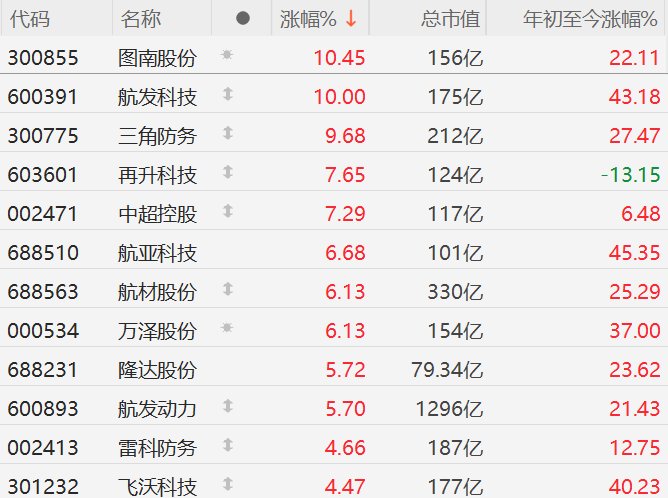
A股大飞机概念拉升:航材股份、万泽股份涨超6%创历史新高
Ge Long Hui A P P· 2026-01-27 05:36
Group 1 - The A-share market saw a significant rise in the large aircraft concept stocks, with Tuanan Co. increasing over 10%, and Hangfa Technology hitting the daily limit for the seventh consecutive day [1] - China Commercial Aircraft Corporation plans to moderately increase the production and delivery of its C919 narrow-body aircraft, targeting the delivery of 28 or more units this year [1] Group 2 - Notable stock performances include Tuanan Co. with a 10.45% increase and a market capitalization of 15.6 billion, and Hangfa Technology with a 10% increase and a market capitalization of 17.5 billion [2] - Other companies such as Triangle Defense and Zaiseng Technology also experienced significant gains, with increases of 9.68% and 7.65% respectively [2] - The year-to-date performance shows Hangfa Technology leading with a 43.18% increase, while Zaiseng Technology has decreased by 13.15% [2]






未知机构:广发机械北美缺电新增三大线索再梳理20260126北美AI-20260127
未知机构· 2026-01-27 02:15
Summary of Key Points from Conference Call Industry Overview - The focus is on the North American AIDC (Artificial Intelligence Data Center) sector, which is experiencing rapid growth in power generation demand, creating a significant contradiction with the limited capacity of gas turbines [1][2]. Core Insights and Arguments 1. **Internal Combustion Engines (ICE)** - Reciprocating internal combustion engines can utilize diesel, natural gas, and gasoline for power generation, serving as a primary power source for AIDC. - Wärtsilä currently has approximately 1,500 orders on hand, with 15% allocated for AIDC, and an annual delivery rate of 500 units [1][2]. - Major manufacturers like Yanmar, Wärtsilä, and Caterpillar have scheduled production until 2028, while most domestic manufacturers are still in the testing and certification phase, indicating a potential for rapid adoption by North American clients [2]. 2. **Aviation-Modified Fuels** - Aircraft engines and gas turbines share similar structures and principles, allowing retired engines to be modified for continued operation for an additional 20,000 to 50,000 hours, covering a power range of 30-60 MW, making them suitable as a primary power source for AIDC with strong stability [2]. - A total of 12,000 retired aircraft engines are available, and with a 20% modification ratio, there is significant potential for flexibility in power generation [2]. - Recommended companies include Hangya Technology (which has bulk orders for GEA aviation-modified engines) and Wanze Co., a new supplier of Siemens aviation-modified turbine blades [2]. 3. **Solid Oxide Fuel Cells (SOFC)** - SOFCs have an efficiency of approximately 60%, with near-zero emissions and only 9% redundancy required, compared to the 30% typically needed for gas turbines. Their modular delivery allows for rapid deployment within 2-3 quarters, significantly faster than gas turbines or nuclear power [3]. - Overseas AEP has made additional purchases of SOFCs, accumulating orders at a GW level, marking a milestone in the industry [3]. - New recommendations include Chunhui Quality Control (a core supplier for BE) and Weichai Power (a main manufacturer of SOFCs) [3]. Additional Important Insights - The current electricity shortage in North America is transitioning from reliance on gas turbines to internal combustion engines, aviation-modified fuels, and SOFCs, moving from logical reasoning to actual order fulfillment [3]. - The upcoming week marks the beginning of a busy period for foreign leading companies in financial report disclosures, with expectations for order, capacity, and performance guidance to be further upgraded, indicating strong catalysts for the market [3].



航亚科技
2026-01-26 02:50
Summary of the Conference Call on Hangya Technology Company Overview - **Company**: Hangya Technology - **Industry**: Aerospace components, specifically focusing on aviation engines and gas turbines - **Core Business**: Two main segments - aviation engine components and orthopedic implants, with a strong emphasis on aviation engine parts [9][10] Key Points and Arguments Market Demand - **Aviation Engine Demand**: Global demand for aviation engines is surging due to increased passenger turnover and the need for aircraft maintenance. The global passenger turnover is projected to reach 93 trillion in 2024, an 11% year-on-year increase, with a seat occupancy rate at a historical high of 85% [2][3] - **Aircraft Replacement**: It is estimated that 80% of the current commercial aircraft will need replacement within the next 20 years due to aging fleets, with the average age of commercial aircraft currently at 14.8 years [2][17] - **Maintenance Market Growth**: The demand for aircraft maintenance is rising, driven by older aircraft and increased maintenance costs due to engine-related groundings [3][4] Company Positioning - **Technological Edge**: Hangya Technology has a high technical barrier in precision forging of blades, gaining recognition from international clients. The company is accelerating its entry into overseas supply chains, capitalizing on the tight supply chain situation [2][6] - **Client Base**: The company has established long-term agreements with major clients like Safran and Rolls-Royce, securing a significant share of the market for compressor blades [10][34] Financial Performance - **Revenue Growth**: The company has shown consistent revenue growth from 2018 to 2024, with a recovery in overseas revenue share post-pandemic. The projected net profit for 2026 and 2027 is estimated at 202 million and 290 million, respectively, with a valuation of 33 times earnings [11][38] - **Order Backlog**: As of mid-2025, GE's aviation business had an order backlog of $12.38 billion, reflecting a 157% increase from the previous year, indicating strong demand in the aviation sector [4][5] Supply Chain Challenges - **Supply Chain Bottlenecks**: The global supply chain for aviation components is under strain, particularly for parts produced in Europe, affecting delivery capabilities [6][20] - **Material Costs**: Fluctuations in raw material prices, particularly for titanium and high-temperature alloys, pose risks to profitability [38] Competitive Landscape - **Market Position**: Hangya Technology is positioned in the midstream of the aerospace supply chain, focusing on precision forging and machining of components, which are critical for engine performance [14][15] - **Industry Competitors**: The company competes with other firms in the precision forging sector, such as AVIC Heavy Machinery and Parker Hannifin, but distinguishes itself through its unique technology and client relationships [15][38] Risks - **Client Concentration**: A high concentration of revenue from a few key clients (e.g., Safran and Rolls-Royce) presents risks related to geopolitical factors and market dynamics [38] - **Talent Retention**: The potential loss of technical talent and increasing market competition are additional risks that could impact future growth [38] Additional Important Information - **Technological Development**: The company is advancing its capabilities in precision machining and has received various international certifications for its processes [36][37] - **Future Outlook**: The company is optimistic about its growth trajectory, particularly in the maintenance and repair market, as well as its ability to capture more market share in the gas turbine sector [16][38] This summary encapsulates the key insights from the conference call regarding Hangya Technology's market position, financial outlook, and the challenges it faces in the aerospace industry.


商业航天和商发两机景气持续,重视海外共振赛道机遇
GF SECURITIES· 2026-01-25 12:48
Core Insights - The report emphasizes the ongoing prosperity in the commercial aerospace and military sectors, highlighting opportunities in overseas markets and the importance of technological advancements in the industry [2][3] Group 1: Industry Overview - The commercial aerospace sector is experiencing upward momentum, driven by SpaceX's advancements in reusable rocket technology, which could reduce space access costs by 100 times [13] - The military aviation sector is expected to benefit from increased demand for large aircraft and military trade, with significant growth anticipated in 2026 [14] - The report identifies a focus on supply chain reforms and the integration of AI technologies as key trends shaping the future of the defense and aerospace industries [15] Group 2: Investment Recommendations - The report recommends companies that align with the "S-curve" evolution, focusing on supply chain reforms and automation, including firms like航发动力 (Aero Engine Corporation) and 中航沈飞 (AVIC Shenyang Aircraft Corporation) [15] - Companies positioned for expansion in military trade and civil aviation, such as 国睿科技 (Guorui Technology) and 中国动力 (China Power), are highlighted for their growth potential [15] - Emerging industries like commercial aerospace, AI, and quantum computing are also recommended, with firms like 睿创微纳 (Ruichuang Micro-Nano) and 菲利华 (Feilihua) noted for their innovative capabilities [15] Group 3: Company Valuations and Financial Analysis - 航发动力 (Aero Engine Corporation) is projected to have a 2025E EPS of 0.22 CNY, with a PE ratio of 216.82 for 2025 [6] - 中航高科 (AVIC High-tech) is expected to achieve a 2025E EPS of 0.90 CNY, with a PE ratio of 29.16 for 2025 [6] - The report provides detailed financial metrics for various companies, indicating growth in EPS and improvements in PE ratios across the sector, reflecting a positive outlook for the defense and aerospace industries [6]


最新披露,社保新晋7只大飞机龙头股,全是全球唯一性龙头
Sou Hu Cai Jing· 2026-01-24 03:40
Core Viewpoint - The A-share market experienced a significant sector rotation, particularly in the large aircraft sector, with major stocks like Changhe Aircraft Industries and others hitting the daily limit up, indicating a collective surge in the industry chain [1] Group 1: Market Movement - The large aircraft sector saw a collective rally with 13 leading stocks reaching their daily limit up, indicating strong investor interest and confidence in the sector [1] - The surge in the large aircraft sector is attributed to recent disclosures from the National Social Security Fund, which revealed new investments in seven leading companies within the large aircraft industry chain [3][4] Group 2: Key Companies and Investments - Chaojie Co., a core supplier of fasteners for the C919 aircraft, was highlighted as a new investment by the social security fund, becoming its sixth-largest shareholder with 670,000 shares [3] - Xice Testing, the only private entity with full-chain aerospace testing qualifications, saw the social security fund increase its holdings to 3.5 million shares, making it the fourth-largest shareholder [3] - Aero Engine Corporation of China (AECC) Technology, a key player in the C919 engine supply chain, attracted new investments from major international banks like Goldman Sachs and UBS [3] - Hangya Technology, a leader in the domestic aviation precision forging blade sector, received new investments from the social security fund, becoming the eighth and ninth largest shareholders [4] - Hongdu Aviation, a core enterprise under AVIC, is the sole supplier of the C919's front and rear fuselage, with the social security fund acquiring 5 million shares [4] Group 3: Industry Developments - The European Union Aviation Safety Agency (EASA) completed the compliance flight test for the C919, providing a positive evaluation that exceeded market expectations and facilitating its entry into the EU market [6] - The CJ-1000A domestic engine has completed extensive testing, resolving previous capacity constraints and is expected to receive certification by the second quarter of 2026 [6] - Predictions indicate that C919's annual production capacity could rapidly increase to 50-70 aircraft by 2027, with plans to raise production from 30 to 60 aircraft in 2026 [7] Group 4: Market Potential - The existing orders for C919 exceed 1,000 aircraft, representing a market scale of 650 billion yuan, with the potential to drive over 2 trillion yuan in value across the supply chain [7] - The Yangtze River Delta region has become a hub for the large aircraft industry, housing over one-third of the national aircraft supply chain suppliers [7] - By 2043, China's civil aviation fleet is projected to reach 10,061 aircraft, making it the largest single aviation market globally, with an expected reception of 9,323 new passenger aircraft over the next 20 years [8]



通用航空板块领跌,下跌1.07%




Di Yi Cai Jing· 2026-01-23 13:00
Group 1 - The general aviation sector experienced a decline of 1.07% [1] - Among the companies, Hangya Technology saw a drop of 5.25% [1] - Beimo High-tech decreased by 3.12% [1] - Hangfa Control fell by 2.7% [1] - Other companies such as Boyun New Materials, China Eastern Airlines, and Hongdu Aviation also experienced declines of over 2% [1]
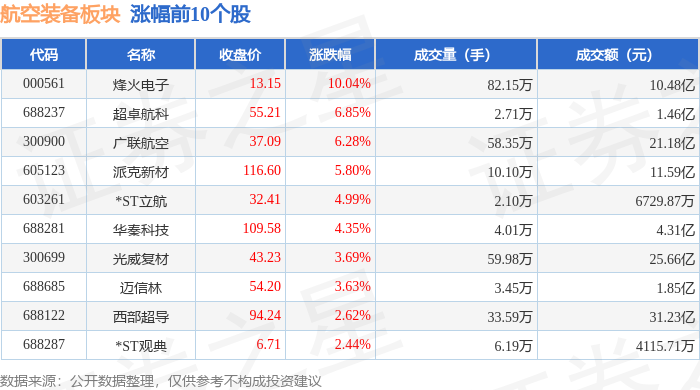
航空装备板块1月23日跌0.4%,航亚科技领跌,主力资金净流出8.73亿元
Zheng Xing Xing Ye Ri Bao· 2026-01-23 09:07
证券之星消息,1月23日航空装备板块较上一交易日下跌0.4%,航亚科技领跌。当日上证指数报收于 4136.16,上涨0.33%。深证成指报收于14439.66,上涨0.79%。航空装备板块个股涨跌见下表: | 代码 | 名称 | 收盘价 | 涨跌幅 | 成交量(手) | 成交额(元) | | --- | --- | --- | --- | --- | --- | | 000561 | 煌火电子 | 13.15 | 10.04% | 82.15万 | 10.48亿 | | 688237 | 超卓航科 | 55.21 | 6.85% | 2.71万 | 1.46亿 | | 300900 | 广联航空 | 37.09 | 6.28% | 58.35万 | 21.18亿 | | 605123 | 派克新材 | 116.60 | 5.80% | 10.10万 | 11.59亿 | | 603261 | *ST立航 | 32.41 | 4.99% | 2.10万 | 6729.87万 | | 688281 | 华秦科技 | 109.58 | 4.35% | 4.01万 | 4.31亿 | | 300699 | 光威复材 ...
SpaceX上市,有新消息!航空航天ETF天弘(159241)标的指数昨日大涨3.6%,机构:今年航空航天行业将迎来供需拐点
2 1 Shi Ji Jing Ji Bao Dao· 2026-01-23 01:23
消息面上,据证券时报,马斯克据悉希望在7月前让SpaceX上市。当地时间1月21日,据媒体报道,马 斯克正积极推进麾下太空探索技术公司SpaceX的首次公开募股(IPO)计划,其目标是在今年7月之前 完成IPO。报道称,知情人士称,马斯克一心想着让SpaceX成为首家在太空建数据中心的公司。如果没 有IPO一次性带来的数十亿美元资金,就很难尝试这样的壮举。马斯克还认为,SpaceX IPO将有助于他 的AI公司xAI追赶上竞争对手。 国金证券认为,2026年航空航天行业将迎来供需拐点。供给端受飞机制造商产能制约显著。需求端则持 续增长,中国民航客运量预计同比增速4.7%-5.5%,供需缺口或达1.4%,推动客座率超2019年水平。 (文章来源:21世纪经济报道) 相关ETF方面,航空航天ETF天弘(159241)昨日成交额为1.59亿元,溢价率为0.14%。资金流向方面,该 ETF1月19日至21日三日累计获资金净流入额超4000万元。截至1月21日收盘,该ETF最新流通份额为 5.44亿份,最新流通规模为8.12亿元。 航空航天ETF天弘(159241)紧密跟踪国证航天航空行业指数,该指数覆盖航空装备、航天 ...


华创证券:我国商用航空发动机市场潜力巨大,关注产业链三条线索
3 6 Ke· 2026-01-23 00:59
Core Viewpoint - The commercial aviation engine market in China has significant potential, with projections indicating a total market size exceeding 2.6 trillion yuan over the next 20 years, translating to an annualized scale of over 130 billion yuan [1] Group 1: Market Potential - The after-sales market is expected to reach approximately 100 billion yuan annually, contributing to a combined total of 240 billion yuan per year from both the engine market and after-sales services [1] Group 2: Investment Recommendations - The report suggests focusing on three key areas within the domestic aviation engine supply chain: - Core supporting companies, including Hangzhou Engine, Aero Engine Technology, and Aero Engine Control [1] - Suppliers of high-temperature alloys and other basic components, with continued recommendations for Yingliu Co., and attention to Wanze Co., Hangya Technology, and Hangyu Technology [1] - Raw material suppliers, highlighting AVIC High-tech [1]


华创交运航空强国系列研究(二):技术壁垒到估值高地,全球视角看商用航空发动机产业链
Huachuang Securities· 2026-01-22 13:25
Investment Rating - The report maintains a recommendation for the commercial aviation engine industry, indicating a positive investment outlook [1]. Core Insights - The commercial aviation engine is referred to as the "crown jewel" of modern industry, with engines accounting for approximately 25% of the total value of commercial aircraft [4][20]. - The report emphasizes the significant growth potential of China's commercial aviation engine market, projecting a total market size exceeding 2.6 trillion yuan over the next 20 years, with an annualized scale of over 130 billion yuan [5][11]. - The commercial aviation engine supply chain is characterized by high barriers to entry, with a global oligopoly dominated by a few major manufacturers [5][6]. Summary by Sections Industry Overview - The report introduces the commercial aviation engine as a critical component of modern industrial capabilities, highlighting China's reliance on imported engines and the low marketization rate of domestic engines, which is less than 1% [4][21]. Commercial Aviation Engine Analysis - The structure of commercial aviation engines includes key components such as fans, compressors, combustion chambers, and turbines, with the hot section being the most critical and challenging to manufacture [26][33]. - The aftermarket services for engines can generate revenues up to four times the initial sale price, indicating a lucrative long-term profit potential [4][18]. Business Model Exploration - The primary manufacturers operate under a "super blade + long-term blade" profit model, leveraging significant discounts on initial sales to capture market share while securing long-term service contracts for profitability [5][6]. - Suppliers in the engine manufacturing chain are positioned as "hidden champions," benefiting from high entry barriers and the need for extensive certification processes [5][6]. Global Valuation Perspective - The average price-to-earnings (PE) ratio for major engine manufacturers is reported at 30.2 times, with leading companies like GE Aerospace at 42 times, indicating robust valuation metrics driven by order backlog and aftermarket growth [5][6]. - Core suppliers exhibit an even higher average PE of 68.5 times, reflecting their scarcity and stable demand characteristics [5][6]. China's Commercial Aviation Engine Market - The report highlights the Longjiang series of engines as a key initiative to reduce reliance on foreign technology and enhance domestic capabilities [5][11]. - The projected growth of the Chinese aviation market is supported by forecasts indicating a compound annual growth rate (CAGR) of 4.4% from 2024 to 2044, with expectations of 10,175 aircraft by 2044 [5][11]. Investment Recommendations - The report suggests focusing on three key areas within the domestic aviation engine supply chain: core component suppliers, high-temperature alloy manufacturers, and raw material suppliers [5][11].
