SMIC(688981)

Search documents
上证180ETF指数基金(530280)冲击3连涨,机构建议配置上哑铃型策略
Xin Lang Cai Jing· 2025-11-26 02:38
Core Viewpoint - The overall market sentiment remains cautiously optimistic, with no significant negative trends observed in the fundamental performance of key sectors, particularly in technology and growth stocks [1] Group 1: Market Performance - As of November 26, 2025, the Shanghai 180 Index rose by 0.30%, with notable increases in stocks such as Haiguang Information (3.95%) and Zhongke Shuguang (3.53%) [1] - The Shanghai 180 ETF Index Fund also saw a slight increase of 0.17%, marking its third consecutive rise [1] Group 2: Sector Analysis - The technology growth sector, including communications and semiconductors, continues to show strong performance, suggesting that recent market adjustments may be positioning for future gains [1] - Despite a slowdown in policy support compared to the first half of the year, the overall market remains in a loose monetary environment, which is expected to support recovery in the technology sector [1] Group 3: Investment Strategy - A "barbell strategy" is recommended for investment, suggesting to maintain positions in growth sectors like communications, semiconductors, and innovative pharmaceuticals while being cautious with short-term operations [1] - Defensive investments in dividend-paying sectors are advised to mitigate risks during market fluctuations [1] Group 4: Index Composition - The Shanghai 180 Index comprises 180 large-cap stocks selected for their market capitalization and liquidity, reflecting the overall performance of core listed companies in the Shanghai securities market [2] - As of October 31, 2025, the top ten weighted stocks in the index account for 26.29% of the total index, with notable companies including Kweichow Moutai and China Ping An [2]




半导体ETF(159813)开盘跌0.29%,重仓股寒武纪跌1.19%,中芯国际跌0.88%
Xin Lang Cai Jing· 2025-11-26 01:39
Group 1 - The semiconductor ETF (159813) opened down 0.29% at 1.027 yuan [1] - Major holdings in the semiconductor ETF include companies like Cambricon, SMIC, and Huagong Information, with varying performance on the opening day [1] - The ETF's performance benchmark is the National Securities Semiconductor Chip Index, managed by Penghua Fund Management Co., with a return of 54.60% since its inception on April 17, 2020, and a recent one-month return of -12.71% [1]


中芯国际根据2014以认股权计划而发行1万股
Zhi Tong Cai Jing· 2025-11-25 16:36
Core Points - Semiconductor Manufacturing International Corporation (SMIC) announced the issuance of 10,000 shares on November 21, 2025, under the 2014 Share Option Plan adopted on June 13, 2013 [1] - On November 25, 2025, 56,800 ordinary shares were issued as a result of the exercise of restricted stock units granted under the 2014 Share Incentive Plan adopted on June 13, 2013 by non-director employees of the company [1]
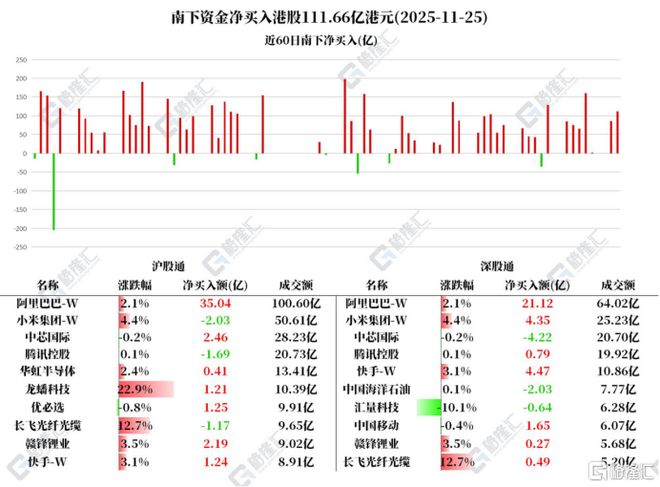
资金动向 | 北水净买入港股111亿港元,连续9日加仓阿里
Ge Long Hui· 2025-11-25 11:25
Group 1: Southbound Capital Inflows - Southbound capital net bought Hong Kong stocks worth 11.166 billion HKD on November 25, with notable purchases including Alibaba-W (5.616 billion HKD), Kuaishou-W (571 million HKD), and Ganfeng Lithium (246 million HKD) [1] - Southbound capital has continuously net bought Alibaba for 9 days, totaling 23.003 billion HKD, and Kuaishou for 3 days, totaling 1.98355 billion HKD [1] Group 2: Company Insights - Citic Securities believes that the profitability of electric vehicle companies is still limited, and the Chinese EV industry is entering a critical phase of consolidation, where profitability will be the core competitive indicator [3] - Kuaishou repurchased 2 million shares at a price range of 45.100 to 46.650 HKD, with a total repurchase amount of 91.8768 million HKD, and the stock closed at 46.350 HKD, up 4.51% [3] - Ganfeng Lithium expressed optimism about long-term lithium demand despite recent price volatility, expecting lithium carbonate prices to gradually return to reasonable levels, with potential improvements in supply-demand dynamics next year [3]





中芯国际(688981) - 港股公告:翌日披露报表
2025-11-25 10:45
FF305 翌日披露報表 (股份發行人 ── 已發行股份或庫存股份變動、股份購回及/或在場内出售庫存股份) 表格類別: 股票 狀態: 新提交 公司名稱: 中芯國際集成電路製造有限公司 呈交日期: 2025年11月25日 如上市發行人的已發行股份或庫存股份出現變動而須根據《香港聯合交易所有限公司(「香港聯交所」)證券上市規則》(「《主板上市規則》」)第13.25A條 / 《香港聯合交易所有限公司GEM證券 上市規則》(「《GEM上市規則》」)第17.27A條作出披露,必須填妥第一章節 。 | 第一章節 | | | | | | | | --- | --- | --- | --- | --- | --- | --- | | 1. 股份分類 | 普通股 | 股份類別 不適用 | | 於香港聯交所上市 | 是 | | | 證券代號 (如上市) | 00981 | 說明 港股 | | | | | | A. 已發行股份或庫存股份變動 | | | | | | | | | | 已發行股份(不包括庫存股份)變動 | | 庫存股份變動 | | 已發行股份總數 | | 事件 | | 已發行股份(不包括庫存股份)數 目 | 佔有關事件 ...
中芯国际(00981)根据2014以认股权计划而发行1万股
智通财经网· 2025-11-25 10:24
2025年11月25日,非本公司董事因行使根据2014以股支薪奖励计划(于2013年6月13日获采纳)所授予的 受限制股份单位而发行的5.68万股普通股股份。 智通财经APP讯,中芯国际(00981)发布公告,于2025年11月21日,根据2014以认股权计划(于2013年6月 13日获采纳)而发行1万股。 ...
中芯国际(00981) - 翌日披露报表
2025-11-25 10:14
FF305 翌日披露報表 (股份發行人 ── 已發行股份或庫存股份變動、股份購回及/或在場内出售庫存股份) 表格類別: 股票 狀態: 新提交 | 2). 就根據股份計劃授予參與人(發行人的董事除外)的股份獎勵或期權 | 56,813 | 0.00071 % | HKD | 0.031 | | | --- | --- | --- | --- | --- | --- | | 而發行新股或轉讓庫存股份 - 涉及新股 | | | | | | | 非本公司董事因行使根據2014以股支薪獎勵計劃(於2013年6月13日 | | | | | | | 獲採納)所授予的受限制股份单位而發行的普通股股份 | | | | | | | 變動日期 2025年11月25日 | | | | | | | 於下列日期結束時的結存 (註5及6) 2025年11月25日 | 6,000,597,200 | | 0 | | 6,000,597,200 | | B. 贖回/購回股份 (擬註銷但截至期終結存日期尚未註銷) (註5及6) | | | | | | | 2. 股份分類 | 普通股 | 股份類別 不適用 | | | 於香港聯交所上市 | 否 | ...
图解丨南下资金净买入港股111亿港元,大幅加仓阿里
Ge Long Hui A P P· 2025-11-25 09:58
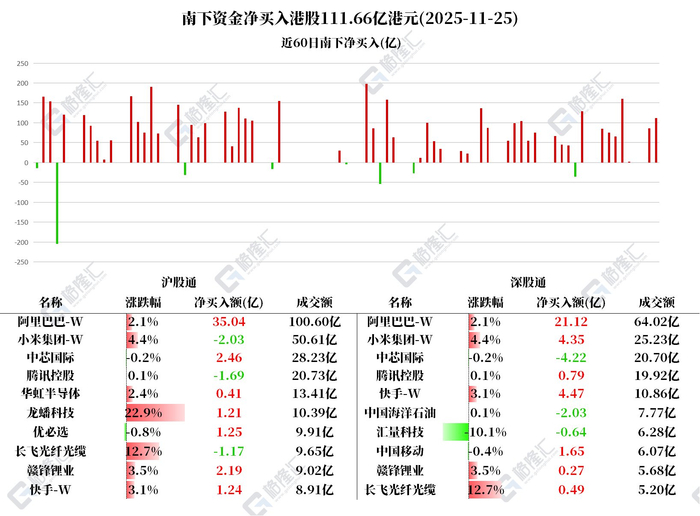
Group 1 - Southbound funds net purchased Hong Kong stocks worth 11.166 billion HKD today, with notable purchases including Alibaba-W (5.616 billion HKD) and Kuaishou-W (0.571 billion HKD) [1] - Southbound funds have continuously net purchased Alibaba for 9 days, totaling 23.003 billion HKD, and have also net purchased Xiaomi for 3 days, totaling 1.98355 billion HKD [1] - The net selling of SMIC has occurred for 4 consecutive days, amounting to 1.409 billion HKD [1] Group 2 - Alibaba-W experienced a decline of 2.1% with a net purchase of 3.504 billion HKD in the Shanghai Stock Connect, while the Shenzhen Stock Connect recorded a net purchase of 2.112 billion HKD [3] - Kuaishou-W saw a 3.1% increase with a net purchase of 1.24 billion HKD in the Shanghai Stock Connect [3] - China National Offshore Oil Corporation had a slight decline of 0.1% with a net selling of 0.203 billion HKD [3]
中芯国际涨0.15%,成交额45.84亿元,人气排名21位!后市是否有机会?附走势预测
Xin Lang Cai Jing· 2025-11-25 09:50
Core Viewpoint - SMIC's stock performance shows slight increase with a trading volume of 4.584 billion yuan and a market capitalization of 893.45 billion yuan, indicating its popularity in the A-share market [1] Group 1: Company Overview - SMIC is the largest integrated circuit manufacturing enterprise group in mainland China, recognized for its advanced technology and comprehensive support [2] - The company specializes in integrated circuit wafer foundry services, design services, IP support, and photomask manufacturing, with wafer foundry services accounting for 93.83% of its revenue [6] - As of September 30, 2025, SMIC reported a revenue of 49.51 billion yuan, representing a year-on-year growth of 18.22%, and a net profit of 3.818 billion yuan, up 41.09% year-on-year [6] Group 2: Investment and Shareholding - The National Integrated Circuit Industry Investment Fund holds a 1.61% stake in SMIC, reflecting government support for the company [2] - As of September 30, 2025, the number of shareholders in SMIC increased to 336,200, with an average of 6,134 shares held per shareholder [6] - Major shareholders have reduced their holdings, with significant decreases noted in several ETFs, indicating a shift in institutional investment [7] Group 3: Market Position and Trends - SMIC ranks second globally among pure wafer foundry companies and first among mainland Chinese enterprises based on the latest sales figures for 2024 [2] - The company is part of the China AI 50 index, which focuses on AI-related capabilities and performance metrics [2] - The average trading cost of SMIC shares is 123.25 yuan, with current price fluctuations between resistance at 119.22 yuan and support at 99.98 yuan, suggesting potential trading strategies [5]
资讯日报:中美元首进行上月会晤以来的首次通话-20251125
Guoxin Securities Hongkong· 2025-11-25 09:13
Market Overview - The Hong Kong stock market showed a significant recovery on November 24, with all three major indices ending a streak of declines[9] - Large tech stocks performed strongly, with Kuaishou rising over 7%, and NetEase and Bilibili increasing over 5%[9] - The Hang Seng Tech Index closed at 5,546, up 2.78% for the day and 24.11% year-to-date[3] Sector Performance - Innovative pharmaceuticals and outsourcing concepts saw notable gains, with companies like Innovent Biologics rising over 6%[9] - Military stocks also performed well, with China Shipbuilding Defense up over 13%[9] - Oil stocks were weak, with China National Offshore Oil Corporation and China Oilfield Services both declining over 1%[9] U.S. Market Insights - On the same day, U.S. markets saw all three major indices close higher, driven by increased bets on a Federal Reserve rate cut[9] - The "Magnificent Seven" tech stocks, including Google and Nvidia, all rose, with Google gaining over 6%[9] - The S&P 500 index is projected to achieve double-digit annual growth according to HSBC strategists[14] Economic Indicators - The Federal Reserve is expected to cut rates in December, with market predictions showing a 70% probability[14] - The U.S. economy's third-quarter GDP report has been delayed due to a government shutdown, affecting economic analysis[14] Investment Trends - The Nasdaq Golden Dragon China Index rose by 2.82%, indicating a positive trend for Chinese concept stocks[13] - Significant inflows into semiconductor stocks were noted, with companies like Broadcom surging 11%[13]