
PAB(000001)

Search documents
最新!又有多家银行宣布:下调!
Zhong Guo Ji Jin Bao· 2025-05-21 12:55
Core Viewpoint - Nine joint-stock banks in China have followed state-owned banks in rapidly lowering deposit interest rates, focusing on medium to long-term deposits, particularly three-year and five-year terms [2][4][5] Group 1: Deposit Rate Adjustments - As of May 21, seven banks including Ping An Bank and CITIC Bank have announced reductions in deposit rates, with three-year and five-year fixed deposit rates lowered by 25 basis points (BP) [2][4] - The adjusted rates for Ping An Bank are now 0.70% for three months, 0.95% for six months, 1.15% for one year, 1.20% for two years, and 1.30% for three years, reflecting a decrease of 15 BP for shorter terms and 25 BP for longer terms [3][4] - Minsheng Bank has also reduced its deposit rates, with similar decreases across various terms, including a 25 BP drop for three-year and five-year deposits [3][4] Group 2: Market Expectations and Reactions - Investors had anticipated the recent reductions in deposit rates, with no significant rush to lock in rates observed at bank branches [4][5] - The speed of the banks' responses to the need for lower deposit rates aligns with market expectations, indicating a proactive approach to stabilize net interest margins and support the real economy [5][6] Group 3: Implications for Banking Sector - The adjustments in deposit rates are seen as necessary to reduce financing costs for the real economy, with banks needing to lower their liability costs to maintain profitability [5][8] - The current trend shows that the reductions in deposit rates are larger than the Loan Prime Rate (LPR) decreases, which may help banks manage interest expenses and improve their financial performance [8]







大量个人不良贷款转让流拍背后:价格走低,专家称供需失衡
Nan Fang Du Shi Bao· 2025-05-21 11:31
Core Insights - The personal non-performing loan (NPL) transfer market has seen significant activity recently, with over 50 announcements from banks and consumer finance companies regarding batch transfers of personal NPLs, indicating a supply-demand imbalance and declining asset prices [2][3][4] Group 1: Market Activity - The recent surge in personal NPL transfer announcements includes 8 from Ping An Bank, totaling over 1.8 billion yuan in outstanding principal and interest, with the largest single loan amounting to 715 million yuan [3] - Other banks, such as SPDB and Zhongyuan Bank, have also reported substantial NPL transfer announcements, with SPDB's two announcements involving 2.744 billion yuan and Zhongyuan Bank's four announcements totaling 394 million yuan [3] - Consumer finance companies, including Zhongyin Consumer Finance and Zhaolian Consumer Finance, have contributed to the market activity with 29 announcements, with Zhongyin alone reporting 20 announcements totaling 1.905 billion yuan [3] Group 2: Year-on-Year Growth - In Q1, the batch transfer scale of personal NPLs reached 37.04 billion yuan, an increase of 860% compared to the same period last year, with personal consumer loan NPLs growing by 785.15% and credit card overdraft NPLs by 879.25% [4][5] Group 3: Asset Package Dynamics - A significant portion of the recently announced asset packages are re-listed due to previous failures to sell, indicating a market imbalance where asset prices are decreasing [6] - For example, SPDB's two projects were re-listed with reduced starting prices, and Zhongyin's recent announcements also involved re-listed packages with lowered starting prices [6] - The average discount rate for personal NPL transfers in Q1 was 4.1%, down from previous quarters, while the average principal recovery rate was 6.9%, indicating a downward trend in asset recovery [7] Group 4: Expert Analysis - Analysts suggest that the increase in NPLs is due to heightened pressure on banks to manage their non-performing assets, coupled with a more mature regulatory framework supporting NPL transfers [5] - To address the supply-demand imbalance, banks should improve the selection and pricing of NPLs, while buyers need to enhance their valuation and recovery capabilities [7]

多家银行保险机构取消监事会 业内:由审计委员会行使职权将为公司治理提供更多灵活选择
Mei Ri Jing Ji Xin Wen· 2025-05-21 10:41
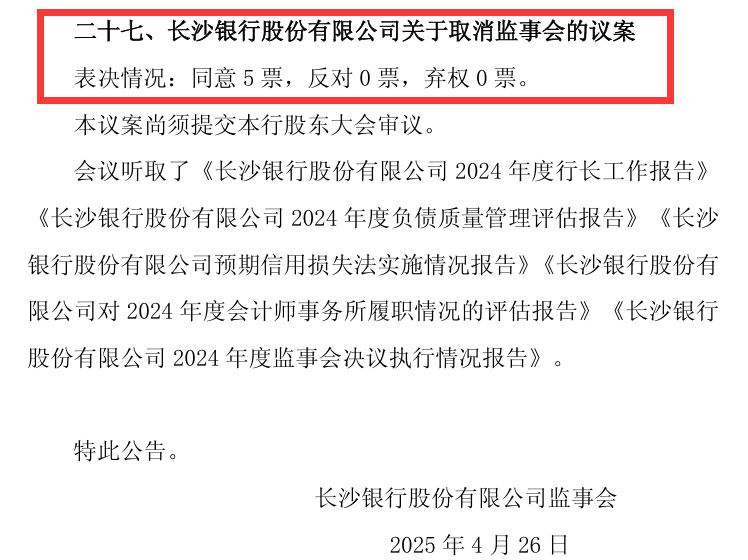
Core Viewpoint - The recent trend of financial institutions, including banks and insurance companies, to abolish supervisory boards reflects a significant reform in corporate governance, driven by changes in the Company Law of the People's Republic of China [1][6][12]. Group 1: Abolishment of Supervisory Boards - Changsha Bank has decided to abolish its supervisory board, transferring its functions to the audit committee of the board of directors [1]. - Many financial institutions, including major state-owned banks and insurance companies, are following suit, indicating a broader shift in governance practices [1][6]. - The new Company Law allows limited liability companies to establish an audit committee within the board of directors to perform the functions of a supervisory board, thus eliminating the need for a separate supervisory board [6][9]. Group 2: Regulatory Changes and Implications - The National Financial Regulatory Administration has issued new regulations that allow trust companies to set up audit committees within their boards, further promoting the idea of eliminating supervisory boards [2][6]. - The changes aim to enhance operational efficiency by reducing redundancy in oversight functions, as the roles of supervisory boards and audit committees often overlap [2][8]. - The flexibility provided by the new governance structure is expected to lead to more tailored governance models that suit the specific needs of different financial institutions [9][10]. Group 3: Impact on Corporate Governance - The shift to a single-tier governance model allows boards to exercise oversight more directly, potentially improving decision-making efficiency in a rapidly changing financial environment [9][10]. - Smaller financial institutions may benefit from reduced operational costs by not having a supervisory board, while larger institutions may require more complex oversight mechanisms [9][10]. - The transition to audit committees taking on supervisory roles is seen as a way to innovate governance structures and improve compliance management [10][12]. Group 4: Concerns and Future Considerations - There are concerns regarding the effectiveness of audit committees in fulfilling the oversight roles traditionally held by supervisory boards, particularly regarding potential conflicts of interest [11][12]. - Experts suggest that while the new structure may reduce costs, it is crucial to ensure that adequate checks and balances remain in place to maintain effective governance [11][12]. - Future modifications to the Company Law may be necessary to address the evolving needs of corporate governance in the financial sector [12].



平安银行(000001) - 关于2025年第一期小型微型企业贷款专项金融债券(债券通)发行完毕的公告
2025-05-21 10:32
证券代码:000001 证券简称:平安银行 公告编号:2025-026 优先股代码:140002 优先股简称:平银优 01 平安银行股份有限公司关于 2025 年 第一期小型微型企业贷款专项金融债券(债券通)发行完毕的公告 本公司及董事会全体成员保证信息披露的内容真实、准确、完整,没有虚假记载、误导 性陈述或重大遗漏。 经相关监管机构批准,平安银行股份有限公司于近日在全国银行间债券市 场发行了"平安银行股份有限公司 2025 年第一期小型微型企业贷款专项金融债 券(债券通)"(以下简称本期债券)。 本期债券于 2025 年 5 月 19 日簿记建档,于 2025 年 5 月 21 日发行完毕。 本期债券发行规模为人民币 300 亿元,为 3 年期固定利率债券,票面利率为 1.74%,募集资金将依据适用法律和监管部门的批准,专项用于发放小型微型企 业贷款。 特此公告。 平安银行股份有限公司董事会 2025 年 5 月 22 日 ...
9家股份行跟进下调存款利率,活期存款接近零利率,定存最大降幅25bp
Hua Xia Shi Bao· 2025-05-21 10:19
Core Viewpoint - The recent adjustment of deposit rates by major banks marks the seventh round of rate cuts, significantly lowering the cost of bank liabilities and stabilizing profit margins, which is expected to enhance the banks' internal growth capabilities and maintain sound operations [4][7]. Group 1: Deposit Rate Adjustments - As of May 21, nine joint-stock banks have announced adjustments to their deposit rates, following the lead of the six major state-owned banks [5]. - The new rates include a 5 basis point reduction in demand deposit rates and a 15-25 basis point reduction in time deposit rates, with the one-year fixed deposit rate falling below 1% [3][5]. - The current demand deposit rate is now close to zero, and the one-year fixed deposit rate has been set at 1.15% for most banks [5][6]. Group 2: Impact on Banking Sector - The reduction in deposit rates is expected to lower banks' funding costs, thereby stabilizing net interest margins and enhancing their ability to support the real economy [8][12]. - Analysts suggest that the ongoing low interest rate environment may lead to a shift in deposits from large banks to smaller banks, which could affect the competitive landscape [8][12]. - The overall banking sector is entering a low interest rate and low spread cycle, with net interest margins for various types of banks showing a downward trend [10][12]. Group 3: Future Outlook - The adjustments in deposit rates are anticipated to lead to a decrease in overall deposit rates by approximately 0.11-0.13 percentage points, which may help stabilize banks' net interest margins [13]. - Despite the downward pressure on net interest margins, it is expected that the decline will not continue indefinitely, as measures to control funding costs are taking effect [12][13]. - The shift in deposit rates may also influence the allocation of bank assets towards bonds, potentially increasing demand in the bond market [8][13].

多家银行为何调整存款利率?怎么调整?一文了解
Yang Shi Wang· 2025-05-21 08:49
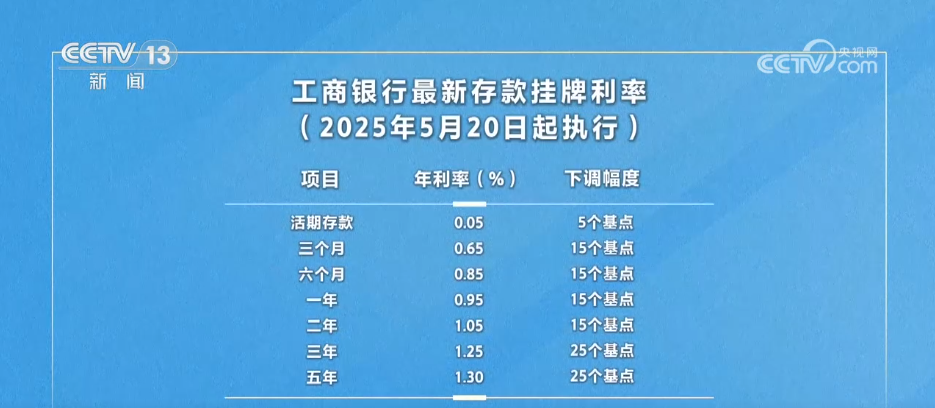
Core Points - The one-year and five-year Loan Prime Rates (LPR) have both decreased by 10 basis points, now standing at 3.0% and 3.5% respectively [1] - Major banks, including the six largest banks and several joint-stock banks, have announced reductions in deposit rates following the LPR adjustments [1] Group 1: Deposit Rate Adjustments - The Industrial and Commercial Bank of China (ICBC) has updated its deposit rates effective from May 20, 2025, with all types of deposit rates being lowered [2] - The new rates include a 5 basis point reduction for demand deposits, and a 15 basis point reduction for three-month, six-month, and one-year fixed deposits [2] - Three-year and five-year fixed deposit rates have been reduced by 25 basis points [2] Group 2: Comparison of Deposit Rates - The adjusted deposit rates among major banks such as ICBC, Agricultural Bank of China, Bank of China, China Construction Bank, Bank of Communications, and China Merchants Bank are largely consistent, with slight variations from Postal Savings Bank and China Everbright Bank [4] - For instance, the one-year fixed deposit rate at ICBC is 0.95%, while Postal Savings Bank offers 0.98% and China Everbright Bank offers 1.15% [4] - Actual deposit rates may differ from the listed rates, with ICBC's one-year fixed deposit rate being 1.1% for amounts starting at 50 yuan on mobile banking [4] Group 3: Reasons for Rate Adjustments - The adjustments in deposit rates are closely linked to the recent decrease in LPR, as banks aim to maintain stable interest margins amid declining loan rates [6] - Typically, large banks initiate the rate adjustments, followed by joint-stock banks, and finally smaller banks [6] - Joint-stock and smaller banks often offer higher deposit rates compared to large banks after adjustments [6]





最新!跌破1%
Zhong Guo Ji Jin Bao· 2025-05-21 08:35
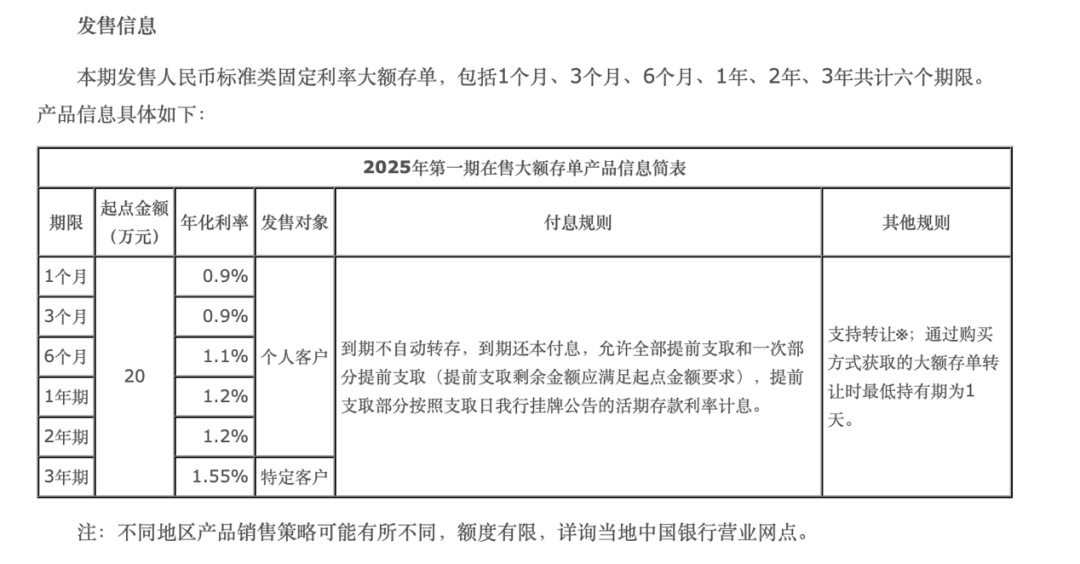
Core Viewpoint - A new round of interest rate cuts for large-denomination certificates of deposit (CDs) has begun, with some products' rates falling below 1% for the first time in recent years, indicating a significant shift in the banking sector's approach to deposit rates [1][9]. Summary by Category Interest Rate Changes - Major banks, including state-owned banks, have reduced the annualized interest rates for 1-month and 3-month large-denomination CDs to 0.9%, marking a historic low [1][3]. - The latest issuance by Bank of China shows a reduction of 25 basis points for 1-month, 3-month, 6-month, and 1-year products, while the 3-year product saw a reduction of 35 basis points [3][10]. - Other banks, such as Industrial and Agricultural Banks, have also lowered their rates to 0.9% for similar products [3][6]. Implications for the Banking Sector - The reduction in deposit rates is seen as a strategy to alleviate pressure on net interest margins, which have been declining [10][11]. - Analysts suggest that lowering deposit rates will help banks stabilize their net interest margins and reduce financing costs for the real economy [10][11]. Investor Guidance - Investors are advised to adjust their expectations regarding investment returns and consider a diversified asset allocation strategy in light of the declining interest rates [1][8][11]. - The trend of decreasing deposit rates is expected to continue, prompting investors to seek alternative investment options such as cash management products, money market funds, and government bonds [11].
从风险出清到价值重估,平安银行(000001.SZ)的筑底突围之路
Ge Long Hui· 2025-05-21 07:53
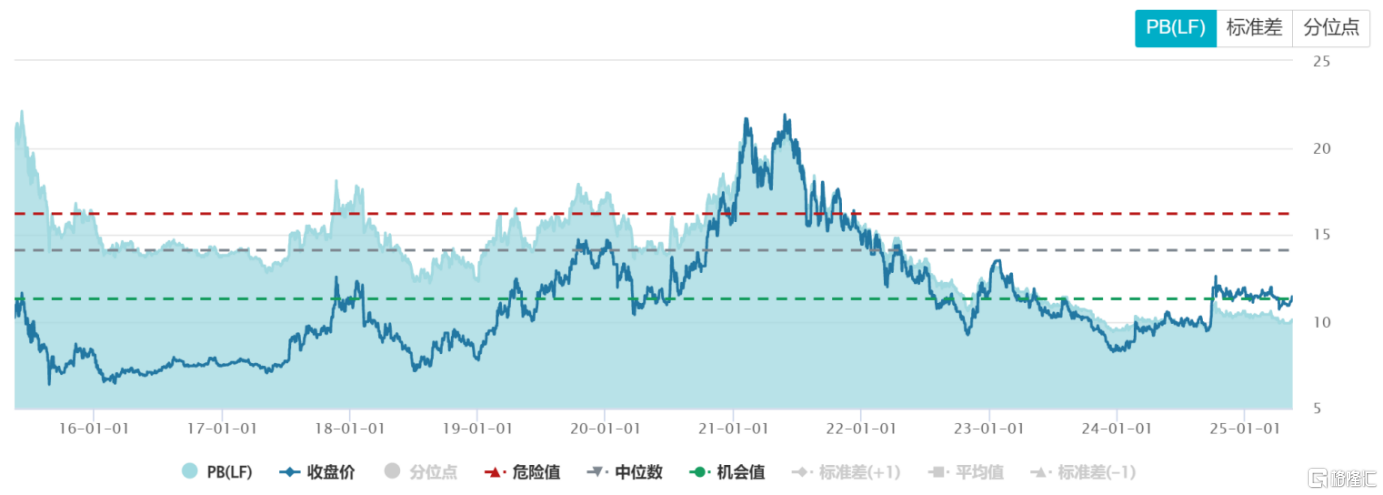
Core Viewpoint - The China Securities Regulatory Commission has issued a plan to promote the high-quality development of public funds, which aims to increase the weight of fund performance assessments and guide public funds to align with benchmark index holdings, potentially reversing the long-term underweighting of bank stocks in public funds [1] Group 1: Valuation and Market Position - Ping An Bank's stock price has retraced 52% from its peak of 23.68 yuan in 2021, indicating a significant valuation bottoming process [2] - The bank's price-to-book ratio is currently at 0.51, marking a historical low at the 7.72% percentile over the past decade [3] - The bank's dividend yield has increased to 5.34%, positioning it among the leaders in its peer group [4] Group 2: Dividend Policy and Shareholder Returns - In 2024, Ping An Bank increased its total dividend by 13.2 billion yuan compared to 2023, with cash dividends accounting for 28.32% of net profit attributable to ordinary shareholders [10] - The bank's management has expressed a commitment to maintaining a high and stable dividend payout ratio to reward shareholders [10] Group 3: Risk Management and Strategic Adjustments - Ping An Bank has shifted from a scale-driven to a quality-driven approach, proactively reducing high-risk assets and improving asset quality [12][13] - As of March 2025, the bank's personal loan non-performing ratio was 1.32%, down 7 basis points from the end of 2024, with credit card non-performing ratios also declining [13] - The bank has actively written off 17.065 billion yuan in loans and recovered 9.425 billion yuan in non-performing assets in Q1 2025 [13] Group 4: Business Development and Growth Strategies - The bank is focusing on high-quality customer acquisition through refined management of deposits and wealth management, achieving a 12.5% year-on-year increase in wealth management fee income [14] - Ping An Bank has increased its corporate loan balance by 4.7% year-on-year, with significant new loan issuance in key industries [15] - The bank is also expanding its support for emerging industries, with a 32.7% year-on-year increase in new loans to these sectors [15] Group 5: Long-term Strategic Vision - The bank's dual focus on retail and corporate banking is seen as a strategic necessity for sustainable development, reflecting a balance between short-term challenges and long-term goals [16] - The ongoing reforms at Ping An Bank are viewed as a proactive response to industry cycles, aiming to establish a solid foundation for future growth [17]
平安、浦发、中信、兴业、民生、广发、华夏7家银行公告:下调存款利率!
Mei Ri Jing Ji Xin Wen· 2025-05-21 07:51
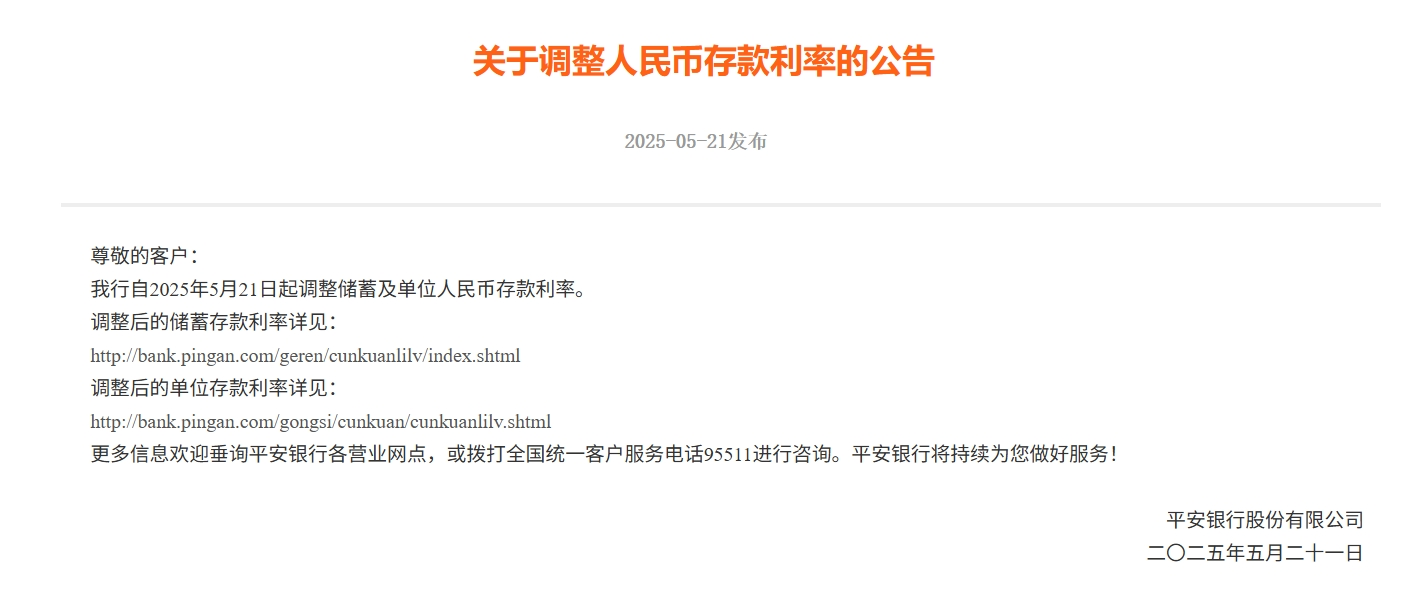
每经编辑|张锦河 5月21日,平安银行在官网发布公告称,我行自2025年5月21日起调整储蓄及单位人民币存款利率。 存款利率迎来新一轮下调。 在5月20日中国银行、中国工商银行、中国建设银行及招商银行等多家银行宣布下调人民币存款利率后,5月21日,平安银行、中信银行、兴业银行、浦发银 行、民生银行、广发银行、华夏银行7家银行也跟进下调存款利率。 上述7家股份制银行将1年、2年定期利率均调降了15个基点。其中,1年定期存款利率均下调至1.15%;2年定期存款利率普遍下调至1.20%,民生银行下调至 1.15%。3年、5年定期存款利率普遍下调了25个基点,分别下调至1.30%、1.35%。 | 适用日期: 2025-5-21 | | 单位:年利率% | | --- | --- | --- | | 期限 | 基准利率 | 挂牌利率 | | (一)活期存款 | 0.35 | 0.05 | | (二) 定期存款 | | | | 三个月 | 1.10 | 0.70 | | 未 年 | 1.30 | 0.95 | | 一 年 | 1.50 | 1.15 | | 二年 | 2.10 | 1.20 | | 三 年 | 2.75 ...
7家股份制银行跟进下调人民币存款利率
news flash· 2025-05-21 07:50
7家股份制银行跟进下调人民币存款利率 智通财经5月21日电,中国银行、工商银行、建设银行、招商银行等多家银行5月20日宣布下调人民币存 款利率后,5月21日,平安银行、中信银行、兴业银行、浦发银行、民生银行、广发银行、华夏银行7家 银行跟进下调存款利率,将1年、2年定期利率均下调15个基点。 ...