
OCT(000069)

Search documents
多家上市文旅企业发布半年报预告,几家欢喜几家忧?
Sou Hu Cai Jing· 2025-08-07 10:45
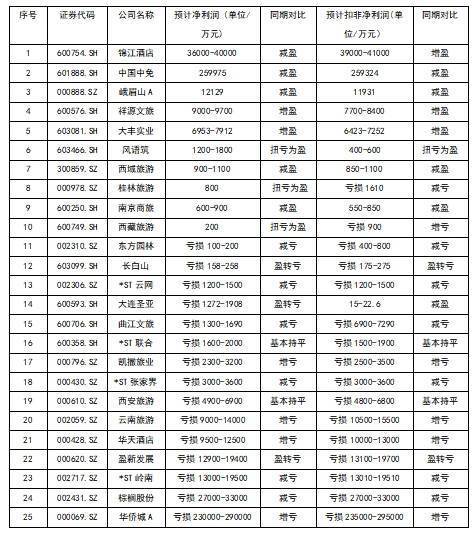
Core Viewpoint - The overall performance of listed tourism companies in A-shares is under pressure, with 15 companies expected to collectively lose approximately 4 billion yuan in the first half of 2025, indicating significant operational challenges in the tourism sector [1][2]. Group 1: Financial Performance - As of August 7, 2025, 25 listed tourism companies have released their half-year performance forecasts, with 15 companies anticipating a total loss of around 4 billion yuan, reflecting widespread operational difficulties [1]. - Among the companies, Huazhou City A (华侨城A) is projected to incur the highest losses, with expected net losses ranging from 2.3 billion to 2.9 billion yuan, marking an increase in losses of 117.77% to 174.58% year-on-year [2][4]. - Huazhou City A's main business segments, tourism and real estate, are both facing profit margin compression, with tourism revenue declining by 13.03% and real estate revenue increasing by 11.18% [4][5]. Group 2: Company-Specific Insights - Huazhou City A's gross profit margin for tourism was 14.34%, down 4.76 percentage points, while the real estate segment's margin was 11.54%, down 7.33 percentage points [5]. - Huazhou City A has faced continuous losses for 14 quarters, attributed to multiple factors, including declining project income and gross margins [5]. - Huazhou City A's major shareholder is actively supporting the company through loans and share purchases to ensure its high-quality development [5]. Group 3: Market Trends and Opportunities - The domestic tourism market showed a significant increase in travel activity, with 3.15 trillion yuan spent on travel in the first half of 2025, a 15.2% increase year-on-year [11]. - The tourism market is characterized by high-frequency, stratified, and down-market trends, with digitalization and sustainability influencing business model innovations [11][12]. - The summer tourism market remains robust, with a 38% increase in bookings, indicating a strong recovery despite the financial struggles of many companies [12]. Group 4: Future Outlook - The application of new tools and technologies, particularly artificial intelligence (AI), is expected to reshape tourism demand and experiences, prompting companies to adapt their strategies for a digitalized environment [13][14]. - Companies are encouraged to focus on personalized and sustainable travel experiences, leveraging AI for enhanced customer engagement and operational efficiency [14].


退出困难、本金被套,房地产跟投机制在行业变革中淡出
Di Yi Cai Jing· 2025-08-06 08:21
日前,央企华侨城有员工因为跟投资金无法拿回而与公司产生纠纷。部分员工对外透露,当初跟投的资 金如今只能拿回一两成本金,而公司方面则解释称,跟投本质上属于投资行为,有盈利也会有亏损。 房地产已连续调整近4年时间,在高位跟投项目的从业人员多数都陷入亏损境地。如今回溯跟投这项曾 经让业内人士激情燃烧的机制,许多人已有恍若隔世之感。张琳表示,自己在集团总部,投的项目是精 挑细选过的,原本以为会有巨大的收益,没想到最后只是黄粱一梦。 房地产项目跟投机制,最早出现于大约2012年前后,在设立之初,公司旨在将企业与员工利益绑定,调 动员工的能动性、提高管理效率的利器。在市场上行期,房企员工即便"盲目跟投"也收获颇丰,这一制 度也曾为房企留下核心人才,推动企业规模快速扩张。但随着行业竞争加剧,这一制度逐渐变质,有部 分中小型房企将跟投作为解决项目融资的渠道。此后行业进入下行期,销售陷入低迷,跟投项目收益降 低、风险增大等各类问题逐步暴露,"跟不动"的现象越发普遍,而企业与员工之间的矛盾也最终在这个 领域内爆发。 跟投作为市场上行期适用的制度,在下行期遇到了挑战。 "很幸运,我在公司时跟投的几个项目,资金都退回来了。"曾经就职 ...


湖南省第三工程有限公司被华侨城集团“拉黑”
Qi Lu Wan Bao· 2025-08-05 00:35
Group 1 - The core point of the news is that Hunan Third Engineering Co., Ltd. has been blacklisted by China Overseas Chinese Town Group Co., Ltd. due to violations of procurement and supplier management regulations, resulting in the suspension of its bidding qualifications within the group [1] Group 2 - Hunan Third Engineering Co., Ltd. was established in 1951 and evolved from the Xiangtan City Mud and Wood Cooperative, which later merged with several other engineering teams and agencies before being renamed in 1983 [2] - The company underwent several mergers and was transformed from a wholly state-owned enterprise to a wholly state-owned company in 2008, now operating as a subsidiary of Hunan Construction Investment Group Co., Ltd. [2]
房地产行业周度观点更新:如何看待产业政策的节奏和空间?-20250803
Changjiang Securities· 2025-08-03 14:15
Investment Rating - The report maintains a "Positive" investment rating for the real estate industry [11] Core Insights - The policy goal of stabilizing the market has somewhat boosted market expectations, but since April, marginal downward pressure has increased, leading to a higher probability of policy easing. Future easing is merely a matter of timing [4][8] - The rapid decline in industry volume and price may have already passed, with structural highlights in core areas and quality properties. Current stock positions are not far from the bottom, providing room for a rebound in cyclical sectors [4] - Emphasis is placed on leading real estate companies with low inventory, good locations, and strong product capabilities, as well as leading brokerage firms, commercial real estate, and state-owned property management companies with stable cash flows [4] Market Performance - The Yangtze River Real Estate Index decreased by 2.76% this week, with an excess return of -1.01% relative to the CSI 300, ranking 24th out of 32 industries. Year-to-date, the index is down 0.45%, with an excess return of -3.50%, ranking 29th [5][14] - The real estate sector performed poorly this week, with declines primarily in development and property management stocks, while rental stocks showed mixed results [5] Policy Developments - The Central Political Bureau meeting emphasized the need to prevent and resolve risks in key areas and to conduct urban renewal with high quality. Local governments are encouraged to manage debt risks and enhance the attractiveness of domestic capital markets [6][18] - Shanghai is accelerating the renovation of "two old and one village," aiming to complete the renovation of approximately 380,000 square meters of old housing this year [6][18] Sales Data - New home and second-hand home registrations in sample cities remain at low levels. The new home transaction area in 37 cities decreased by 19.1% year-on-year, while second-hand home transactions decreased by 2.3% [7][20] - Year-to-date, the cumulative transaction area for new homes in 37 cities is down 4.9%, while second-hand homes are up 15.3% [7][20]


7月“武汉好房”卖得好 准四代住宅开盘3小时销售额破亿元
Chang Jiang Ri Bao· 2025-08-03 00:45
Core Insights - The Wuhan real estate market is showing signs of recovery, with significant increases in new housing transactions in July compared to the previous year [1][4] - High-quality residential projects are attracting buyers, leading to a positive feedback loop between good properties and land market activity [4][5] Group 1: Market Performance - In July, Wuhan recorded 10,405 new commercial housing contracts, a 13% increase year-on-year, while new residential housing contracts reached 8,212, up 5% from the previous year [1] - The sales performance of high-quality projects, such as the Huashang City Tianhui, indicates a strong demand, with significant foot traffic and sales activity even during the traditionally slower month of July [2][3] Group 2: Buyer Behavior - Buyers are motivated by favorable policies, including tax exemptions and low down payment requirements, making it an opportune time to purchase homes [3] - The appeal of new projects is driven by their quality, location, and amenities, with buyers prioritizing factors like school districts and community features [3] Group 3: Land Market Dynamics - The land market in Wuhan is experiencing intense competition for high-quality plots, with a notable premium on core areas, such as a 54.36% increase in land prices for key locations [4] - Recent changes in land supply strategies have led to a focus on lower-density, high-quality land offerings, which are crucial for the market's positive shift [5] Group 4: Industry Trends - The average building area for residential land plots in Wuhan has nearly halved compared to 2021, indicating a shift in developer focus from profit-driven models to user-centric approaches [5] - The market is transitioning from a competition based on quantity to one focused on quality, with an emphasis on comprehensive living experiences, including good housing, amenities, and services [5]
ESG解读|华侨城跟投制度风险收益严重失衡,员工权益受损,信息获取无门
Sou Hu Cai Jing· 2025-08-01 07:13
Core Viewpoint - The forced co-investment system at China Overseas Land and Investment Limited (华侨城) has raised significant concerns regarding employee rights, governance compliance, and decision-making transparency, particularly in light of recent employee complaints about the inability to recover invested funds due to project delays and financial losses [2][5][8] Group 1: Co-Investment System - The co-investment system was initiated in November 2019, with employees facing pressure to participate, as non-participation could lead to marginalization within the company [4] - Employees are reportedly subjected to a "persuasion loop" involving direct leadership discussions and human resources intervention, creating an environment where opting out is not a viable choice [4][7] - The management guidelines stipulate that employees can only recover up to 80% of their investment after the project's cash flow turns positive, with full recovery contingent on project completion, which has not been met in many cases [4][6] Group 2: Employee Rights and Governance Issues - The recent co-investment incident has sparked public scrutiny over the company's commitment to employee rights, governance compliance, and transparency in decision-making processes [5][8] - The company's 2024 ESG report claims to uphold equal rights for employees in recruitment, promotion, and compensation, yet the co-investment system contradicts these claims by imposing financial risks on employees [5][6] - The co-investment system's linkage to performance evaluations creates a conflict where employees feel compelled to invest to avoid negative impacts on their career progression, undermining the principle of voluntary participation [7][8] Group 3: Risk Management and Transparency - The co-investment system may violate labor laws that prohibit coercing employees into unrelated economic activities, raising legal compliance concerns for the company [8] - Reports indicate a lack of transparency regarding the financial status of co-investment projects, with employees unable to access crucial information about their investments [9] - The risk-sharing model presented by the company appears to disproportionately burden employees with financial losses while limiting their potential gains, particularly in a declining real estate market [9]
7 月政治局会议点评:焕新发展模式,锚定城市更新
GUOTAI HAITONG SECURITIES· 2025-07-31 05:56
Investment Rating - The report maintains an "Overweight" rating for the real estate industry [4][6]. Core Insights - The focus of urban renewal should be on the transformation of urban villages and the renovation of dilapidated housing. It is anticipated that urban village renovation projects will continue to increase in volume by 2025, with attention on the pace of PSL (Policy-based Financial Instruments) issuance in the second half of the year [2][3]. - The report suggests that the fourth quarter of this year will face a high base period, but there is an expectation of policy strengthening in the third quarter to alleviate fundamental pressures and aim for stabilization. If sales do not stabilize in the fourth quarter, there may be sales pressure on blue-chip developers in the first half of 2025 [5][6]. - The report highlights the importance of high-quality urban renewal as a key theme in this year's important meetings, emphasizing the need for effective implementation of urban renewal policies [5][10]. Summary by Sections Investment Recommendations - The report recommends maintaining an "Overweight" rating, with specific stock picks including: 1. Development: Vanke A, Poly Developments, China Merchants Shekou, and JinDi Group in A-shares; China Overseas Development in H-shares 2. Commercial and Residential: China Resources Land, Longfor Group, and New Town Holdings 3. Property Management: Wanwu Cloud, China Resources Vientiane Life, China Overseas Property, Poly Property, and New Dazheng 4. Cultural Tourism: Overseas Chinese Town A [5][6]. Key Company Earnings Forecasts - The report provides earnings per share (EPS) forecasts for key companies, with all listed companies receiving an "Overweight" rating. For example: - Vanke A: EPS forecast for 2024A is -4.17 CNY - Poly Developments: EPS forecast for 2024A is 0.42 CNY - China Overseas Development: EPS forecast for 2024A is 1.43 CNY [6].



深化务实合作 共谱发展华章
Zheng Zhou Ri Bao· 2025-07-31 00:51
Group 1 - The meeting between Zhengzhou's municipal leadership and the chairman of Overseas Chinese Town Group emphasizes the importance of cultural tourism development in Zhengzhou, aligning with national strategies for cultural prosperity and tourism integration [1] - Zhengzhou aims to become a national hub for the inheritance and innovation of Chinese historical civilization, focusing on enhancing its cultural tourism industry [1] - The Overseas Chinese Town Group, as a leading state-owned enterprise in the cultural tourism sector, is expected to deepen cooperation with Zhengzhou in cultural resource protection and tourism integration [1] Group 2 - The chairman of Overseas Chinese Town Group expressed gratitude for Zhengzhou's support and highlighted the city's rich history, cultural depth, and favorable investment environment [2] - The group plans to actively participate in the construction of Zhengzhou as a strong cultural tourism city and accelerate the implementation of cooperative projects [2]
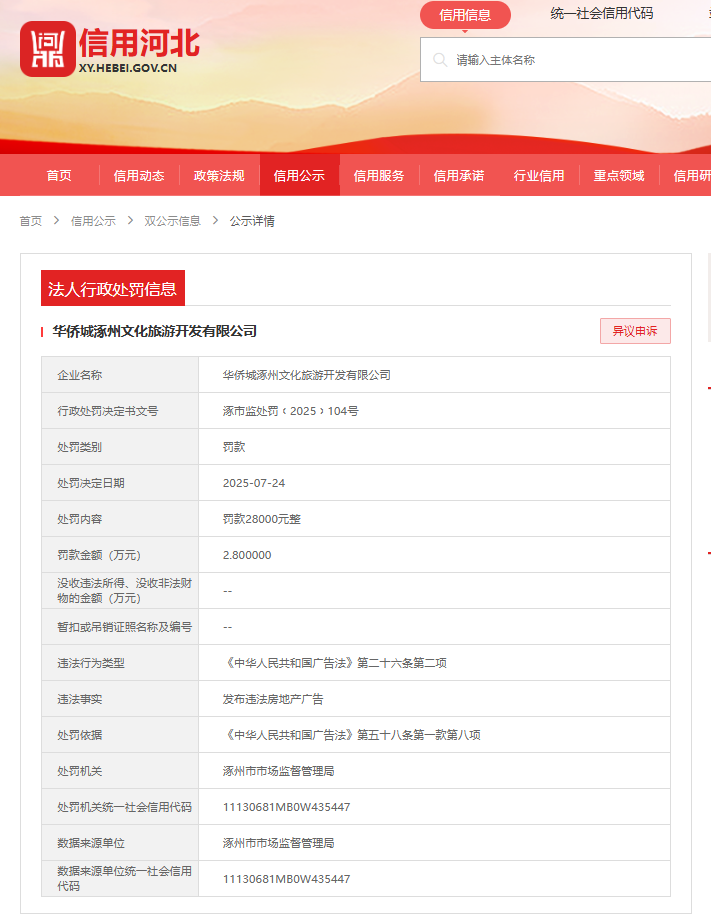
发布违法房地产广告!华侨城涿州文化旅游开发有限公司被罚
Qi Lu Wan Bao· 2025-07-30 03:49
| 法人行政处罚信息 | | | | --- | --- | --- | | 华侨城涿州文化旅游开发有限公司 | | 异议申诉 | | 企业名称 | 华侨城涿州文化旅游开发有限公司 | | | 行政处罚决定书文号 | 涿市监处罚(2025)104号 | | | 处罚类别 罚款 | | | | 处罚决定日期 | 2025-07-24 | | | 处罚内容 | 罚款28000元整 | | | 罚款金额(万元) | 2.800000 | | | 没收违法所得、没收非法财 -- 物的金额(万元) | | | | 暂扣或吊销证照名称及编号 -- | | | | 违法行为类型 | 《中华人民共和国广告法》第二十六条第二项 | | | 违法事实 | 发布违法房地产广告 | | | 处罚依据 | 《中华人民共和国广告法》第五十八条第一款第八项 | | | 处罚机关 | 涿州市市场监督管理局 | | | 处罚机关统一社会信用代码 | 11130681MB0W435447 | | | 数据来源单位 | 涿州市市场监督管理局 | | | 数据来源单位统一社会信用 代码 | 11130681MB0W435447 | | 华侨城涿州文 ...
华侨城A:公司在海南已落地华侨城曦海岸综合项目
Zheng Quan Ri Bao Wang· 2025-07-29 12:17
证券日报网讯华侨城A7月29日在互动平台回答投资者提问时表示,公司在海南已落地华侨城曦海岸综 合项目,该项目位于海口市,涵盖了住宅、商业、办公等业态。 ...