OCT(000069)

Search documents
华侨城集团被曝大量员工资金被套,有人称投8万拿回9000
Qi Lu Wan Bao· 2025-07-29 10:09
房企跟投事件再次引发了舆论关注。日前,华侨城集团前员工向南都·湾财社记者反映,在企业推行的"强制"跟投制度下,大量员工资金被卷入地产项 目,如今因项目停工、资金未回正等原因难以返还,尤其部分被裁员工数额不菲的跟投本金被套牢。 "即便已与企业解除劳动关系,仍要按原规则等待漫长的返还流程。"在他看来,这种"人走钱留"的状况让本就因失业而陷入生活困境的自己更添焦虑。 而针对前员工反映的跟投本金无法追回等问题,华侨城方面在接受记者采访时表示—— 跟投实质属于投资行为,有盈利也有亏损的情况,无论跟投人员在职或离职,项目盈利时均会按照相关跟投协议及跟投制度予以分红,项目亏损时也需共 担风险。 另外对于员工关切,公司一直高度重视,与相关员工保持紧密、充分、友善的沟通,后续也将持续积极稳妥推进相关工作。 "强制"跟投? 南都·湾财社记者了解到,华侨城的跟投制度始于2019年。当年,企业发布《深圳华侨城股份有限公司项目跟投管理办法》的公告,对跟投相关事项作出 明确规定。 其中第一条明确提到,原则上所有投资项目必须实施跟投,确因项目类型、性质不适合开展跟投的,应经公司党委会审批同意。 而在跟投人员上,必须跟投人包括项目公司负责人 ...


一深圳央企被曝:大量员工资金被套,有人投8万拿回9000
Nan Fang Du Shi Bao· 2025-07-28 14:51
Core Viewpoint - The forced investment scheme at China Overseas Chinese Town Group has raised public concern, as many employees are unable to recover their invested funds due to project suspensions and financial difficulties, exacerbating their already precarious financial situations [1][10][12]. Group 1: Forced Investment Scheme - The investment scheme was initiated in 2019, mandating that all investment projects implement a follow-up investment mechanism, with exceptions requiring approval from the company's party committee [3][5]. - Employees, particularly key personnel, are compelled to participate in the investment scheme, with penalties for non-compliance, including performance score deductions [5][10]. - Employees who have been laid off still face lengthy processes to recover their investments, leading to increased anxiety and financial strain [1][6]. Group 2: Employee Experiences - Employees like Wang Tian have reported significant losses, with one individual investing 80,000 yuan but only recovering 9,000 yuan after being laid off [5][10]. - Legal attempts to reclaim funds have been unsuccessful, as courts do not recognize the investment as coercive enough to warrant legal protection [6][14]. - The lack of a reasonable exit mechanism in the investment scheme has led to feelings of betrayal among employees, especially during the downturn in the real estate market [12][14]. Group 3: Company Response and Industry Context - The company maintains that the investment scheme is a legal and common practice in the real estate industry, emphasizing the principle of shared risks and rewards [13][14]. - The company has stated that it is committed to maintaining communication with affected employees and will continue to work within the framework of national policies to stabilize the real estate market [13][14]. - Broader industry issues include forced participation in investment schemes, liquidity constraints, and a lack of balanced risk-sharing clauses in investment agreements, which have become more apparent during the current market downturn [14][15].
人走钱留?华侨城“房企跟投”后遗症:被裁员工本金拿不回
Nan Fang Du Shi Bao· 2025-07-28 08:49
Core Viewpoint - The forced co-investment system implemented by China Overseas Chinese Town Group has raised significant public concern, particularly regarding the inability of employees to recover their invested funds due to project suspensions and financial difficulties [1][11]. Group 1: Co-Investment System Overview - The co-investment system was initiated in 2019, mandating that all investment projects implement co-investment, with exceptions requiring approval from the company's party committee [3][5]. - Employees required to participate in co-investment include project company leaders and key personnel, while other employees may participate voluntarily [3][5]. Group 2: Employee Experiences and Concerns - Employees, such as Wang Tian, reported significant financial losses, with some investing substantial amounts and only recovering a fraction of their investments after being laid off [5][6]. - Legal attempts to reclaim funds have been unsuccessful, as courts do not recognize the co-investment as coercive enough to constitute legal "forced" participation [5][6]. Group 3: Company Response and Policy Changes - The company maintains that co-investment is a legal and common practice in the real estate industry, emphasizing the principle of shared risks and rewards [11][12]. - A revised co-investment management policy was introduced in 2023, allowing for potential withdrawal from co-investment for employees who leave the company, although implementation remains inconsistent [9][12]. Group 4: Industry-Wide Issues - The co-investment model has revealed broader industry issues, including forced participation linked to job security and the lack of effective exit mechanisms for employees [12][13]. - The current economic downturn in the real estate sector has exacerbated these issues, leading to project suspensions and delayed fund recovery for employees [12][13].
【行业深度】洞察2025:中国文旅融合行业竞争格局及市场份额(附市场集中度、企业竞争力等)
Qian Zhan Wang· 2025-07-26 03:10
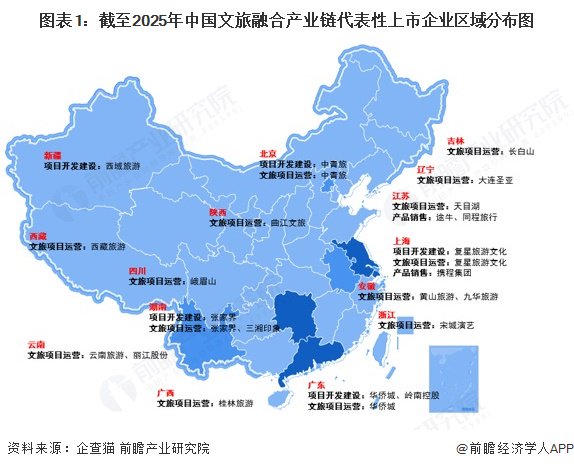
Group 1: Regional Competitive Landscape - The cultural tourism integration industry in China is predominantly concentrated in Guangdong, Anhui, Jiangsu, and Shanghai, with Guangdong having notable listed companies such as Overseas Chinese Town and Lingnan Holdings [1] Group 2: Brand Rankings - The "2024 China Cultural Tourism Group Brand Communication Power Top 100" list includes Ctrip Group, China Youth Travel Service, Haichang Ocean Park, China Duty Free Group, Qujiang Cultural Tourism, and Overseas Chinese Town Group in the top ten [4][6] Group 3: Market Share and Revenue - In 2024, the total revenue of listed companies in China's cultural tourism integration industry reached 351.306 billion yuan, with the top three companies being China Duty Free Group, Overseas Chinese Town, and Tongcheng Travel, collectively accounting for over 45% of the market [7] Group 4: Market Concentration - The market concentration in the cultural tourism integration industry is high, with the top ten companies accounting for 82.93% of the market share, CR3 at 46.73%, and CR5 at 66.89% [9] Group 5: Competitive Dynamics - The cultural tourism market is becoming increasingly competitive, with many companies entering the sector. Government policies are supporting the development of cultural tourism integration, indicating significant growth potential. The threat of new entrants is high, while the threat of substitutes is low. The bargaining power of suppliers is weak, and consumer bargaining power is also limited due to fixed pricing of products like tickets and accommodations [12]


中国城市运行周期跟踪(2025.Q2):量价回落,波动加剧
GUOTAI HAITONG SECURITIES· 2025-07-25 08:28
Investment Rating - The report assigns an "Accumulate" rating for the real estate industry [5]. Core Insights - The overall market in Q2 2025 shows weak transaction volumes, stable prices lacking trends, and increasing inventory with heightened de-stocking pressure [3]. - Only 19% of the 27 cities analyzed exhibit signs of market bottoming, indicating a general trend of "volume contraction, price stagnation, and inventory pressure" [12]. - The new housing market is experiencing a downturn, with first-tier cities showing a significant slowdown in sales growth, while the second-hand housing market demonstrates relative resilience but with increasing regional disparities [12][13]. Summary by Sections 1. Transaction Decline and Lengthening De-stocking - The report highlights that the real estate cycle varies significantly across cities due to localized policies and differing reliance on land finance [8]. - A comprehensive scoring model based on seven core indicators is used to assess the real estate cycle of each city, categorizing them into four stages: bottoming, rising, topping, and declining [8][9]. 2. Price Trends: Q2 New and Second-hand Housing Prices Decline - In Q2 2025, new housing prices experienced a slight decline after a period of stabilization, with 85% of cities unable to sustain price increases for more than two months [17]. - Second-hand housing prices also fell, with 78% of cities still in a downward trend by June [17][19]. 3. Transaction Volume: Weak Recovery and Increased Volatility - First-tier cities maintained an upward trend in new housing transactions until June, where a decline of 12% was noted [22]. - Second-tier cities saw a 15% year-on-year drop in new housing transactions in Q2, reflecting greater inventory pressure and declining buyer confidence [22][27]. 4. Demand Entering a Tug-of-War Phase Leading to Rising Inventory Cycles - The de-stocking cycle for first-tier cities increased to 20 months by June 2025, indicating intensified market supply-demand conflicts [29]. - Second-tier cities faced even longer de-stocking cycles, reaching 23 months, highlighting structural issues such as declining population attraction and excess land supply [29]. 5. Company Profit Forecasts - The report includes profit forecasts for key companies, with several companies rated as "Accumulate" based on their projected earnings per share (EPS) and price-to-earnings (PE) ratios [32].





华侨城集团,彻底退出!昔日“彩电大王”易主
Nan Fang Du Shi Bao· 2025-07-24 14:47
Core Viewpoint - The transfer of control of Konka Group to China Resources has been completed, marking a significant shift in ownership and strategic direction for the company, which faces ongoing challenges in its core business despite a reduction in losses compared to the previous year [1][5][8]. Group 1: Ownership Transition - The transfer of shares from the former controlling shareholder, Overseas Chinese Town Group, to China Resources was finalized after a lengthy process involving antitrust reviews and approvals [2]. - Following the transfer, China Resources, through its subsidiaries, holds a total of 30% of Konka's shares, making it the new controlling shareholder [3][4]. - The actual controller of Konka has shifted from Overseas Chinese Town Group to China Resources, with the ultimate control still resting with the State-owned Assets Supervision and Administration Commission [5]. Group 2: Financial Performance - Konka Group's half-year performance forecast indicates a net loss of between 360 million to 500 million yuan, a significant improvement from a loss of 1.088 billion yuan in the same period last year [5]. - However, the reduction in losses is primarily attributed to non-recurring gains of 450 million to 700 million yuan, suggesting that the core business remains under pressure [6]. - The forecasted net loss, excluding non-recurring items, is expected to be between 950 million to 1.1 billion yuan, nearly unchanged from the previous year's loss of 1.103 billion yuan [6]. Group 3: Business Challenges - The consumer electronics segment continues to face challenges due to intensified competition, delays in new product launches, and a mismatch with national subsidy policies, leading to ongoing losses [7]. - The semiconductor business, seen as a potential growth area, is still in its early stages and has not yet achieved scale or profitability [7]. - High financial costs due to significant interest-bearing liabilities are placing additional strain on the company's operations [7]. Group 4: Future Prospects - The entry of China Resources presents both opportunities and challenges for Konka, with potential for industrial synergy, particularly in the semiconductor sector [8]. - Analysts highlight the importance of effective integration between China Resources' existing semiconductor operations and Konka's capabilities to enhance technological and resource synergies [9]. - The success of the transition will depend on addressing internal governance and strategic focus issues, with expectations for a clearer reform roadmap emerging in the following year [9].

机构调研、股东增持与公司回购策略周报(20250714-20250718)-20250721
Yuan Da Xin Xi· 2025-07-21 12:01
Group 1: Institutional Research on Popular Companies - The top twenty companies with the highest number of institutional research visits in the past 30 days include Ice Wheel Environment, Boshi Jie, Dazhu CNC, Fuguang Co., and Jun Ding Da [2][11] - In the last five days, the most popular companies for institutional research were Ice Wheel Environment, Yanjing Beer, Xingrong Environment, Ningbo Bank, and Chaojie Co. [2][11] - Among the top twenty companies in the past 30 days, six companies had ten or more rating agencies, including Yanjing Beer, Huadian Co., China National Heavy Duty Truck Group, Huichuan Technology, Hualing Steel, and Northern Rare Earth [2][11] - Yanjing Beer, Huadian Co., and China National Heavy Duty Truck Group are expected to see significant growth in net profit attributable to shareholders in 2024 compared to 2023 [2][11] Group 2: Shareholder Increase and Buyback Strategies - From July 14 to July 18, 2025, three companies announced significant shareholder increases: Diou Home, Liard, and Huachao City A [3][15] - A total of 81 companies announced buyback progress during the same period, with 18 companies having ten or more rating agencies [3][20] - Among the buybacks, five companies had an expected buyback amount that exceeded 1% of their market value on the announcement date: Xiamen Xiangyu, Changhong Meiling, Mengbaihe, Longsheng Technology, and Hainan Huatie [3][20] - From January 1 to July 18, 2025, 241 companies announced shareholder increases, with 63 having ten or more rating agencies [3][17] - Of these, 19 companies had an expected increase amount that exceeded 1% of their market value, including New Energy, Tunnel Co., Sailun Tire, and Wanrun Co. [3][17] Group 3: Buyback Situation - From January 1 to July 18, 2025, 1587 companies announced buyback progress, with 346 having ten or more rating agencies [3][21] - Among these, 97 companies had a buyback amount that exceeded 1% of their market value on the announcement date [3][21] - Companies in the board proposal stage include Jiayi Co., Haixing Electric, Huaming Equipment, Jinfa Technology, Shantui Co., Sanofi Biological, Liugong, Mosi Co., Muyuan Co., New Continent, and Jiajia Yue [3][21]


2025年中国文旅融合行业细分市场分析之研学旅游 2024年自然生态、红色文化项目热度较高【组图】
Qian Zhan Wang· 2025-07-21 08:45
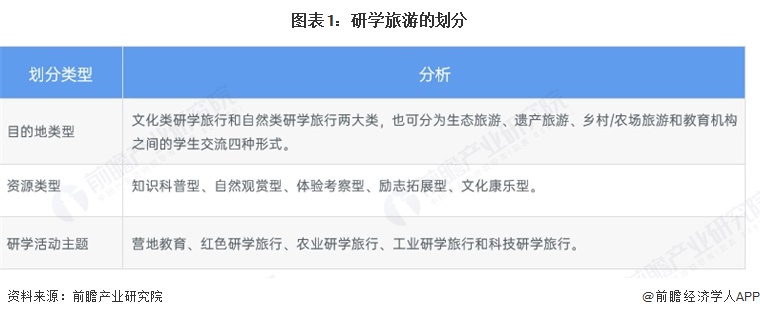
Core Insights - The article discusses the growth and potential of the "research-based travel" sector in China, highlighting its emergence as a new educational and tourism model since its mention in the 2013 National Tourism and Leisure Outline [1] Group 1: Definition and Development - "Research-based travel" was first mentioned in the 2013 National Tourism and Leisure Outline, marking its entry into the educational and tourism sectors as a new approach to educational reform and tourism transformation [1] - As of the end of 2024, most research-based travel companies are in a growth stage, indicating significant development potential [2] Group 2: Main Business Activities - The primary business of research-based travel companies is organizing or receiving school research teams, accounting for 52.72% of their operations, followed by the operation of research bases (camps) at 20.08% [4] Group 3: Market Trends - The most popular themes in the research-based travel market include natural ecology, red culture, labor practice, traditional culture, and technological innovation, with popularity percentages of 53.14%, 53.14%, 50.63%, 45.61%, and 30.96% respectively [6] Group 4: Consumer Demographics - In 2024, the main consumer groups for research-based travel products are from Beijing, Guangdong Province, and Shanghai, with consumption shares of 28.45%, 18.83%, and 13.39% respectively [10]
房地产行业周度观点更新:产品迭代与增量机遇-20250720
Changjiang Securities· 2025-07-20 10:13
Investment Rating - The report maintains a "Positive" investment rating for the real estate industry [13]. Core Insights - The policy goal of stabilizing the market has somewhat boosted market expectations, but marginal downward pressure has increased since April. The rapid decline in volume and price may have passed, with structural highlights in core areas and quality properties [6][10]. - The report identifies a significant gap in quality housing due to a high proportion of old residential buildings in key cities and the impact of price controls on the quality of new homes. This creates a foundation for product iteration and potential volume growth [3][10]. - The loosening of price controls is expected to lead to a revaluation of property prices, particularly for mid-to-high-end products, which could enhance product pricing power and profitability for developers with regional advantages and manageable inventory levels [3][10]. Market Performance - The Yangtze River Real Estate Index decreased by 1.94% this week, underperforming the CSI 300 by 3.03%, ranking 32 out of 32 industries. Year-to-date, the index is down 0.81%, with a cumulative underperformance of 3.95% compared to the CSI 300 [7][17]. - The report notes that the real estate sector has shown poor performance this week, primarily driven by declines in development stocks, while property management and rental stocks exhibited mixed results [7]. Policy Developments - The Central Urban Work Conference outlined seven key tasks, emphasizing the transition from rapid urbanization to stable development, focusing on optimizing urban systems and enhancing living conditions [8][21]. - Local policies in cities like Qingdao and Changsha are being optimized to support housing exchanges and stimulate market activity through various measures, including subsidies for home purchases and revitalizing existing land [8][21]. Sales Trends - New home and second-hand home transaction volumes in sample cities are experiencing low-level fluctuations. For instance, the transaction area for new homes in 37 cities decreased by 18.1% year-on-year, while second-hand homes in 19 cities saw a decline of 7.2% [9][22]. - Year-to-date, new home transaction areas in 37 cities are down 3.9%, while second-hand homes in 19 cities have increased by 16.3% [9][22]. Investment Opportunities - The report highlights that the real estate downcycle requires three conditions for a trend reversal: the cycle must reach a bottom, economic feedback must be positive, and policies must be sufficiently strong. Currently, these conditions are challenging to meet in the short term, with investment opportunities primarily in policy expectations and structural segments [10]. - The potential for product iteration and stable cash flow in the real estate sector is emphasized, particularly for developers with regional advantages and low inventory pressure, which may yield long-term alpha and stable profit returns [3][10].
61家房企合计预亏超400亿,上半年哪些房企在盈利?
Nan Fang Du Shi Bao· 2025-07-17 13:26
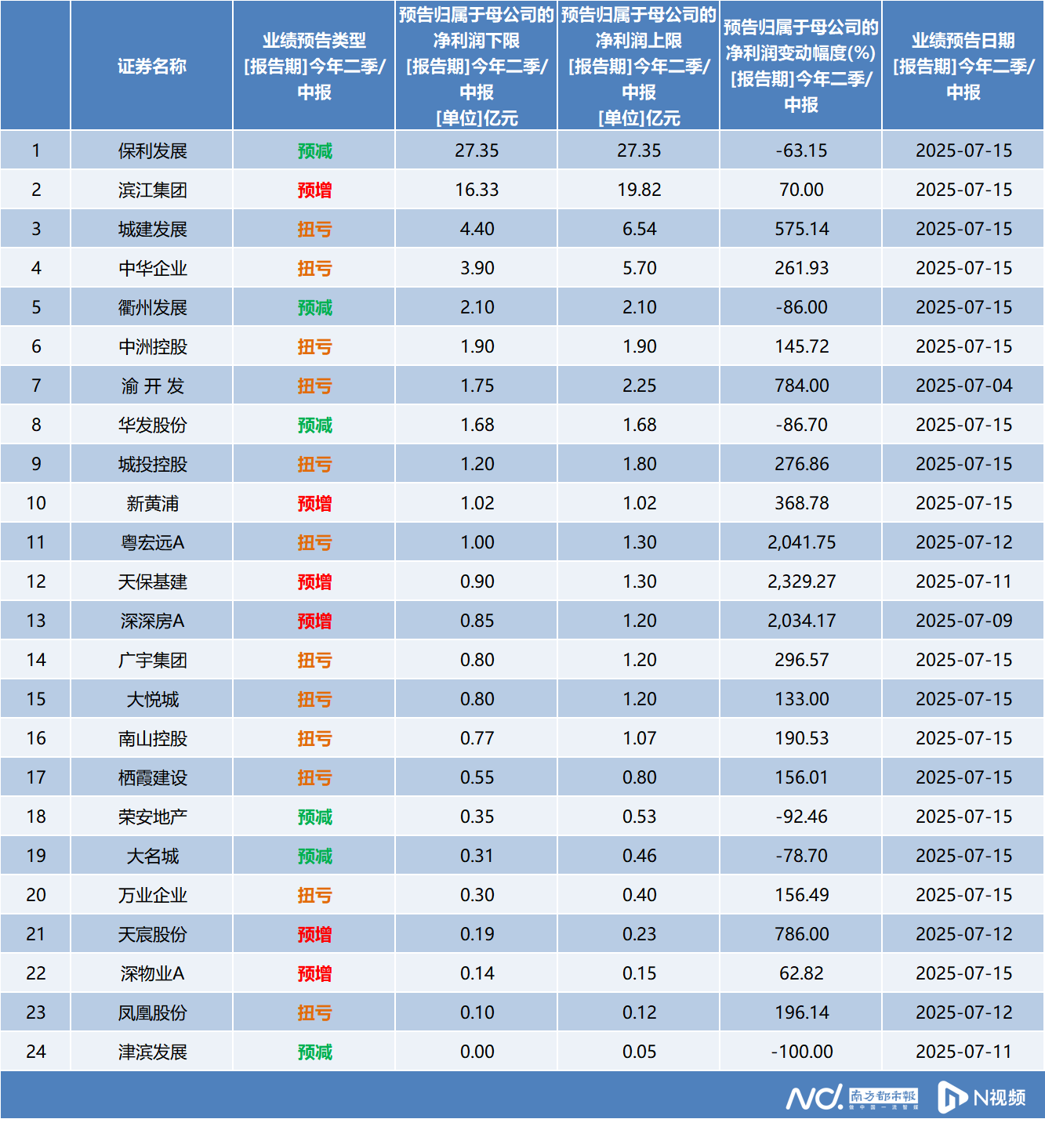
Core Viewpoint - The real estate industry is facing significant challenges in the first half of 2025, with a notable performance divergence among listed companies, as many report substantial losses while a few manage to turn profits [1][2]. Group 1: Overall Performance - As of July 17, 2025, 61 listed real estate companies have disclosed their mid-year performance forecasts, with a total expected loss ranging from 342.56 billion to 464.97 billion [1]. - Out of these, 24 companies anticipate profits while 37 expect losses, indicating that 60% of the companies are projected to report losses [1][2]. - The overall trend shows a decline in performance, with companies like China Vanke and Greenland Holdings shifting from profit to loss, while others like Joy City and Urban Construction Development have managed to turn losses into profits [1][2]. Group 2: Companies Turning Profits - In the first half of 2025, 24 companies are expected to achieve profits totaling between 68.68 billion and 80.16 billion, with 12 companies successfully reversing previous losses [2][3]. - Urban Construction Development is projected to report a net profit of 4.4 billion to 6.54 billion, marking a year-on-year increase of up to 575.14% [3][7]. - Other companies that have turned profitable include Zhongzhou Holdings, City Investment Holdings, and Joy City, showcasing resilience in a challenging market [2][3]. Group 3: Companies Reporting Losses - Among the 37 companies forecasting losses, 13 are expected to report their first-ever losses, including Shahe Co., Xiangjiang Holdings, and Greenland Holdings [8][11]. - The total expected loss for these companies ranges from 422.72 billion to 533.64 billion, with Vanke leading with a projected loss of 100 billion to 120 billion [8][11]. - Other notable companies with significant losses include Jindi Group, which anticipates a loss of 34 billion to 42 billion, and Xinda Real Estate, expecting a loss of 35 billion to 39 billion [11][12]. Group 4: Market Outlook - The overall real estate market is still in an adjustment phase, but signs of stabilization are emerging, particularly in first-tier and some strong second-tier cities [14]. - Analysts suggest that the second half of 2025 may present a turning point for the industry, with potential recovery driven by policy adjustments and improved buyer confidence [13][14]. - The top 100 real estate companies reported a total sales amount of 18,364.1 billion, a year-on-year decline of 11.8%, but the rate of decline is narrowing [13].