
SACL(000089)

Search documents
深圳机场:11月旅客吞吐量568.93万人次
Bei Ke Cai Jing· 2025-12-09 10:09
新京报贝壳财经讯12月9日,深圳机场(000089)公告,2025年11月旅客吞吐量为568.93万人次,同比 增长8.77%;本年累计旅客吞吐量为6062.65万人次,同比增长8.02%。其中,国内航线旅客吞吐量为 513.98万人次,同比增长7.50%;地区航线旅客吞吐量为4.77万人次,同比增长23.73%;国际航线旅客 吞吐量为50.18万人次,同比增长22.14%。 ...

深圳机场(000089) - 关于2025年11月生产经营快报的自愿性信息披露公告
2025-12-09 09:46
| 项目 | 本月实际 | 同比增长 | 本年累计 | 同比增长 | | --- | --- | --- | --- | --- | | 旅客吞吐量(万人次) | 568.93 | 8.77% | 6,062.65 | 8.02% | | 其中:国内航线 | 513.98 | 7.50% | 5,485.78 | 6.59% | | 地区航线 | 4.77 | 23.73% | 47.08 | 10.91% | | 国际航线 | 50.18 | 22.14% | 529.80 | 25.08% | | 货邮吞吐量(万吨) | 18.67 | 0.20% | 186.66 | 9.90% | | 其中:国内航线 | 8.76 | -0.12% | 90.11 | 8.63% | | 地区航线 | 0.58 | 4.24% | 6.19 | 4.73% | | 国际航线 | 9.33 | 0.27% | 90.35 | 11.59% | | 航班起降架次(架次) | 37,868 | 3.42% | 408,659 | 4.59% | | 其中:国内航线 | 32,330 | 2.43% | 350,683 | ...
深圳机场:11月旅客吞吐量568.93万人次,同比增长8.77%
Xin Lang Cai Jing· 2025-12-09 09:39
Core Viewpoint - Shenzhen Airport announced a projected passenger throughput of 5.6893 million for November 2025, representing a year-on-year increase of 8.77% [1] Passenger Traffic Summary - Cumulative passenger throughput for the current year reached 60.6265 million, with a year-on-year growth of 8.02% [1] - Domestic passenger throughput was 5.1398 million, showing a year-on-year increase of 7.50% [1] - Regional passenger throughput was 47.7 thousand, reflecting a significant year-on-year growth of 23.73% [1] - International passenger throughput stood at 501.8 thousand, marking a year-on-year increase of 22.14% [1] Cargo and Mail Traffic Summary - Cargo and mail throughput was 186.7 thousand tons, with a year-on-year growth of 0.20% [1] - Cumulative cargo and mail throughput for the current year reached 1,866.6 thousand tons, showing a year-on-year increase of 9.90% [1] Flight Operations Summary - The number of flight takeoffs and landings was 37,868, which represents a year-on-year increase of 3.42% [1]
深圳机场:11月份旅客吞吐量同比增长8.77%
Zheng Quan Shi Bao Wang· 2025-12-09 09:39
人民财讯12月9日电,深圳机场(000089)12月9日公告,11月份旅客吞吐量568.93万人次,同比增长 8.77%。本年累计旅客吞吐量为6062.65万人次,同比增长8.02%。 ...
大湾区机场群迈入“三跑道” 顶级货运枢纽撑起“买全球卖全球”
Nan Fang Du Shi Bao· 2025-12-09 03:17
Core Viewpoint - The expansion and upgrade of the three major international aviation hubs in the Greater Bay Area (GBA) - Guangzhou, Shenzhen, and Hong Kong - signify a shift towards a collaborative network that enhances the overall regional aviation capacity and efficiency, moving into a "3.0 era" characterized by high quality, high efficiency, and high collaboration [1][2][3]. Group 1: Infrastructure Expansion - The three major hubs have completed their runway expansions, with Shenzhen Airport's third runway operational since December 6, 2023, handling over 200 flights in its first week [1][3]. - Guangzhou Baiyun Airport has become the first in China to operate five commercial runways, with its new T3 terminal capable of accommodating an annual passenger throughput of 120 million, and a terminal capacity of 140 million [2][3]. - Hong Kong Airport's three-runway system, fully operational by 2024, is expected to handle 120 million passengers and 10 million tons of cargo annually [3]. Group 2: New Routes and Connectivity - Guangzhou Baiyun Airport has launched new intercontinental routes to Madrid and Darwin, enhancing its position as a key aviation hub connecting China to Europe and Oceania [2][3]. - The "seamless transfer" service between Shenzhen and Hong Kong airports allows passengers to transit without re-entering immigration, significantly improving travel efficiency [5][6]. Group 3: Economic Drivers - The upgrades in the GBA airports are driven by the region's vibrant economy and the specific demands of high-value industries such as electronics, biomedicine, and cross-border e-commerce [7][8]. - The total air cargo volume of the three major airports reached 9.2 million tons in 2024, accounting for 7.2% of the global total, positioning them among the top 20 global cargo airports [7][8]. Group 4: Emerging Economic Zones - The GBA is developing multiple high-end industrial clusters around its airports, including logistics, aircraft maintenance, and high-end manufacturing [8][9]. - The focus on enhancing airport functionalities aims to attract more high-value industries and services, contributing to regional economic growth [9]. Group 5: Competitive Dynamics - The GBA airports face challenges in collaborative development due to overlapping service areas and competition for international routes and cargo resources [10]. - Differentiated positioning is essential, with Guangzhou focusing on Southeast Asia and Oceania, Shenzhen on technology and high-end manufacturing, and Hong Kong on maintaining its global network advantage [10]. Group 6: Future Outlook - By 2035, the GBA is projected to meet an aviation passenger demand of 420 million, necessitating the current infrastructure developments to support global connectivity [11]. - The enhanced airport network is expected to attract multinational companies and elevate the GBA's status in the global economic landscape [11].

“高品质创新型国际航空枢纽”啥模样?深圳给出答案
Di Yi Cai Jing· 2025-12-09 01:41
深圳市打造"高品质创新型国际航空枢纽",突出体现在"智慧"二字 国际及地区客运航点达到55个,每周计划航班量超900架次;国际及地区货运航点超40个,每周全货机 航班量近820架次;加密国内前十大机场航线,增强与京津冀、长三角、成渝三大城市群的通达性…… 深圳市"打造高品质创新型国际航空枢纽"的试点任务已取得成效。 第一财经记者从交通运输部了解到,该部日前会同中国民航局组织开展了深圳市"打造高品质创新型国 际航空枢纽"试点任务验收。验收意见称,深圳市"打造高品质创新型国际航空枢纽"试点任务内容基本 完成,达到试点预期目标。 航拍深圳机场。摄影/章轲 据深圳市试点单位介绍,深圳市"打造高品质创新型国际航空枢纽"试点,突出体现在"智慧"二字:聚焦 智慧运行,全面提升机场保障效率;聚焦智慧服务,打造优质旅客出行体验;聚焦智慧物流,持续提高 航空货运品质。 深圳机场形成统一的信息交换、服务调用、数据共享能力,为机场70余项智慧化应用提供支撑。全天超 1200架次航班可在2分钟内完成分配,航班靠桥率提升至85%以上。 在深圳机场,航站楼内新建了淋浴间、睡眠舱,打造外籍人员一站式综合服务中心,构建集支付、文 旅、通信、交 ...

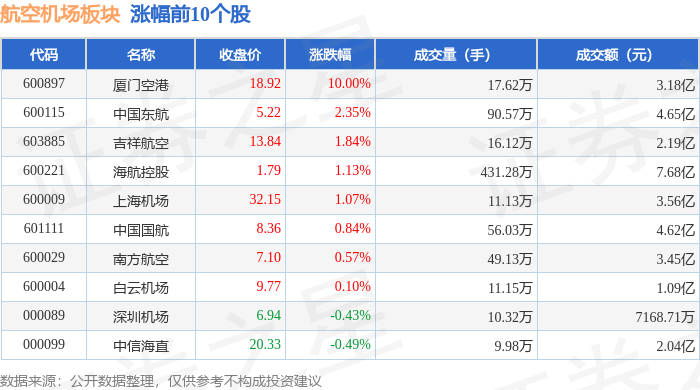
航空机场板块12月8日涨0.91%,厦门空港领涨,主力资金净流出118.47万元
Zheng Xing Xing Ye Ri Bao· 2025-12-08 09:09
Market Performance - The aviation and airport sector increased by 0.91% on December 8, with Xiamen Airport leading the gains [1] - The Shanghai Composite Index closed at 3924.08, up 0.54%, while the Shenzhen Component Index closed at 13329.99, up 1.39% [1] Stock Performance - Xiamen Airport (600897) saw a significant rise of 10.00%, closing at 18.92 with a trading volume of 176,200 shares and a transaction value of 318 million yuan [1] - China Eastern Airlines (600115) increased by 2.35%, closing at 5.22 with a transaction value of 465 million yuan [1] - Other notable performers include: - 吉祥航空 (603885) up 1.84% to 13.84 [1] - 海航控股 (600221) up 1.13% to 1.79 [1] - 上海机场 (600009) up 1.07% to 32.15 [1] Capital Flow - The aviation and airport sector experienced a net outflow of 1.1847 million yuan from institutional investors, while retail investors saw a net outflow of 113 million yuan [2] - Conversely, speculative funds recorded a net inflow of 11.4 million yuan [2] Individual Stock Capital Flow - Xiamen Airport (600897) had a net inflow of 75.8533 million yuan from institutional investors, but a net outflow of 41.6046 million yuan from retail investors [3] - Shanghai Airport (600009) saw a net inflow of 12.4068 million yuan from institutional investors, with a net outflow of 19.0737 million yuan from retail investors [3] - China Eastern Airlines (600115) experienced a net outflow of 5.7540 million yuan from institutional investors, while speculative funds had a net inflow of 37.2950 million yuan [3]





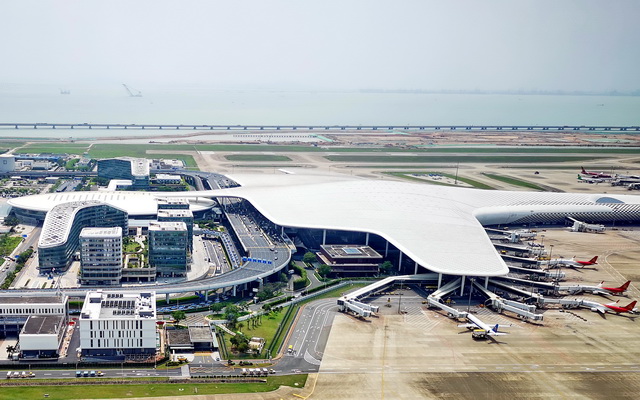
深圳机场国际及地区客运航线突破60条 恢复至2019年历史峰值水平
Zhong Guo Min Hang Wang· 2025-12-08 03:32
Core Viewpoint - Shenzhen Airport has officially launched its 60th international passenger route, marking a return to its historical peak level of international routes as of December 6, 2023, following the operation of its third runway in late November [1][2]. Group 1: International Route Expansion - The newly launched Shenzhen-Douhu route is operated by Zhejiang Long Airlines using an Airbus A320, with a high passenger load factor of 90.6% on its inaugural flight [2]. - In 2023, Shenzhen Airport has opened and enhanced 27 international and regional routes, expanding its network to 60 cities across five continents [2]. - The recent visa exemption agreement between China and Malaysia, effective July, has facilitated the opening of multiple routes to Malaysian cities, enhancing business and tourism connections [2]. Group 2: Passenger Volume and Infrastructure Development - From January to November 2023, Shenzhen Airport recorded over 5.7 million international and regional passengers, reflecting a year-on-year increase of 23% [3]. - The airport has upgraded its international service areas with new facilities, including charging stations, lounges, and a comprehensive service center for foreign travelers, enhancing the overall passenger experience [3]. - The third runway has alleviated peak hour operational pressure, with over 200 flights taking off and landing within the first week of its operation, indicating improved flight capacity and efficiency [3]. Group 3: Future Development Goals - Shenzhen Airport aims to focus on becoming a world-class airport by continuously upgrading its infrastructure, enhancing operational capabilities, and expanding its passenger and cargo route network [4]. - The airport's development is seen as a reflection of Shenzhen's urban vitality and ongoing commitment to opening up to the world, contributing to the high-quality development of the local economy and the construction of a world-class airport cluster in the Greater Bay Area [4].
继“三跑”后,深圳机场国际客运恢复至历史峰值
2 1 Shi Ji Jing Ji Bao Dao· 2025-12-07 14:32
Core Insights - Shenzhen Airport has officially launched its 60th international passenger route, restoring operations to pre-2019 peak levels [1] - The new route from Shenzhen to Tawau is operated by Zhejiang Long Airlines using an Airbus A320, with a high passenger load factor of 90.6% on its inaugural flight [1] - The launch of this route is closely linked to the implementation of the mutual visa exemption policy between China and Malaysia, which took effect in July [1] - The new route aims to enhance business trade, cross-border family visits, tourism, and educational exchanges between the Guangdong-Hong Kong-Macau Greater Bay Area and Malaysia [1] Route Expansion - Shenzhen Airport has been actively expanding its international route network, collaborating with various airlines to add and enhance 27 international routes, including destinations like Mexico City, Male, Tokyo, and Dubai [3] - As of now, the airport's international routes cover 60 cities across five continents, with new routes to Melbourne, Australia, set to launch soon [3] Infrastructure Development - Shenzhen Airport has recently put its third runway into operation, becoming the 13th airport in China to have three or more runways [3] - The new runway has already facilitated over 200 flight takeoffs and landings within its first week, helping to alleviate peak operational pressure [3] - From January to November this year, the airport has seen over 5.7 million international and regional passengers, marking a 23% year-on-year increase [3] - Future capacity and operational efficiency improvements are expected as the third runway's capacity is further utilized, supporting the growth of regional air passenger and cargo transport [3]

广深港机场扩容升级,粤港澳大湾区联通全球再提速
Nan Fang Du Shi Bao· 2025-12-07 00:02
Core Insights - The third runway at Shenzhen Bao'an International Airport has officially commenced operations, increasing the total number of runways in the Guangdong-Hong Kong-Macao Greater Bay Area airport cluster to 15, making it one of the regions with the highest runway density globally [1] - The Greater Bay Area airport cluster, centered around Guangzhou, Shenzhen, and Hong Kong, has been continuously expanding and upgrading, with significant investments in infrastructure to enhance capacity and connectivity [2] Group 1 - The new runway and terminal resources are expected to upgrade the Greater Bay Area's air route network from "broad coverage" to "high density and high quality," reflecting the region's increased vitality and economic stability [1] - In 2024, the economic output of the Greater Bay Area is projected to reach 14.79 trillion yuan, with its foreign trade accounting for nearly one-fifth of the national total, driving substantial demand for air travel and logistics [1][2] - The airport cluster's expansion will attract international airlines to open and enhance routes, supporting China's high-level opening-up strategy [2][3] Group 2 - The expanded airport cluster will significantly improve cargo capacity, which is crucial for the responsiveness of supply chains and the resilience of the manufacturing sector in the Greater Bay Area [2] - The upgraded Shenzhen Bao'an Airport is expected to accommodate an annual passenger throughput of 80 million and a cargo throughput of 4.5 million tons, while Guangzhou Baiyun Airport will have a terminal capacity of 140 million passengers and 600,000 tons of cargo [2] - A more efficient global aviation network will accelerate personnel exchanges, technology transfers, and capital flows, enhancing the Greater Bay Area's status as a hub in the global city network [3]