GUJING(000596)

Search documents
白酒行业周期专题 2:以史为镜,当前时点为什么我们认为白酒进入布局阶段?
Guoxin Securities· 2025-10-28 12:10
Investment Rating - The report maintains an "Outperform" rating for the liquor industry [5][6]. Core Viewpoints - The current market for the liquor sector shows divergence, with significant year-on-year performance declines expected for liquor companies in Q3 2025. However, both valuation and holdings are at low levels, and positive factors on both supply and demand sides are increasing [1][4]. - Historical analysis from 2013-2015 indicates strong similarities between the current cycle and previous ones, suggesting that buying opportunities may accelerate [1][4]. Summary by Sections Price and Performance Trends - Most companies confirmed their stock price bottoms between Q4 2013 and Q1 2014, with performance declines starting in Q3 2013. Despite the declining performance, stock prices showed moderate reactions, following the overall market uptrend [2][7]. - The stock price performance of individual companies remains closely tied to their fundamentals, with regional leaders like Gujing and Laobaigan showing smaller declines compared to the overall market [2][13]. Company Strategies - Companies are leveraging channels to amplify brand and product advantages during the adjustment phase. High-end liquor brands focus on maintaining brand strength, with Moutai shifting its focus to customer expansion [3][32]. - Regional leaders are retreating to core markets while enhancing their presence in lower-tier markets, with companies like Yanghe and Gujing focusing on channel cultivation [3][39]. Investment Recommendations - The report suggests a two-phase recovery path for industry valuations. The first phase is driven by demand recovery, with expectations for Moutai's PE ratio to recover from 20x to 25x, corresponding to a dividend yield of about 3% [4][17]. - The second phase anticipates a return to long-term confidence in liquor assets, with industry PE potentially reaching 30x by Q4 2026. Recommended stocks include Luzhou Laojiao, Moutai, and Shanxi Fenjiu, with a watch on Wuliangye and Yanghe for potential recovery [4][5].






白酒行业周期专题2:以史为镜,当前时点为什么我们认为白酒进入布局阶段?
Guoxin Securities· 2025-10-28 10:59
Investment Rating - The report maintains an "Outperform" rating for the liquor industry [5][6] Core Viewpoints - The current market for the liquor sector shows divergence, with significant year-on-year performance declines expected for Q3 2025, yet both valuation and holdings are at low levels, indicating potential positive changes in supply and demand dynamics [1][4] - Historical analysis from 2013-2015 suggests that the current cycle has strong similarities, indicating that buying opportunities may accelerate [1][4] - The report anticipates a two-phase recovery in industry valuations, with the first phase driven by demand recovery and the second phase contingent on improved supply-demand relationships and market confidence in long-term liquor assets [4][17] Summary by Sections Price and Performance Analysis - Most companies confirmed their stock price bottoms between Q4 2013 and Q1 2014, with performance declines starting in Q3 2013, while stock prices remained relatively stable [2][7] - The report highlights that stock price performance is closely linked to fundamental performance, with regional leaders showing less decline compared to the overall market [2][13] Company Strategies - Companies are leveraging channels to enhance brand and product advantages during the adjustment phase, with a focus on maintaining brand strength for high-end products [3][30] - Regional leaders are concentrating on core markets and enhancing distribution channels, while expansion-oriented companies are increasing their presence in mid-to-low-end products [3][30] Investment Recommendations - The report suggests that the industry is entering a layout phase, recommending investments in stable-performing companies with long-term growth potential, such as Luzhou Laojiao, Guizhou Moutai, and Shanxi Fenjiu, while also monitoring Wuliangye and Yanghe for potential recovery [4][5]
押宝年轻化赛道,20多度白酒能否“破圈”?
Bei Ke Cai Jing· 2025-10-28 08:55
Core Viewpoint - The recent trend in the Chinese liquor industry is a shift towards low-alcohol white spirits, with major brands launching products with alcohol content below 30 degrees, aiming to attract younger consumers and adapt to changing consumption preferences [1][3][5]. Group 1: Market Trends - Numerous brands showcased low-alcohol white spirits at recent trade fairs, reigniting discussions on the trend of lower alcohol content in white liquor [1][3]. - The market for low-alcohol white spirits is significant, with approximately 450 billion yuan in market size, accounting for nearly half of the total white liquor consumption [7]. - The penetration rate of low-alcohol spirits is increasing, with regions like Hebei and Shandong showing over 80% and 70% penetration rates, respectively [7]. Group 2: Consumer Preferences - Younger consumers prefer low-alcohol options for their comfort and drinking experience, moving away from traditional drinking cultures [5][11]. - The perception that higher alcohol content equates to better quality is fading, with consumers now prioritizing flavor and overall drinking experience [11][12]. - The trend towards low-alcohol spirits is seen as a response to the lifestyle changes of younger generations, who favor casual drinking and home cocktail preparation [5][11]. Group 3: Industry Response - Major liquor companies are actively developing low-alcohol products, with brands like Wuliangye and Gujinggong launching new offerings specifically targeting younger demographics [4][10]. - The industry is undergoing a transformation, with a focus on creating products that emphasize flavor and experience rather than just alcohol content [10][12]. - The introduction of new standards for low-alcohol spirits aims to address quality concerns and align with consumer demand for diverse and personalized products [9][10]. Group 4: Challenges and Future Outlook - The transition to low-alcohol products requires time and successful market examples to educate consumers [12][13]. - Companies must not only adjust alcohol content but also enhance brand positioning and marketing strategies to resonate with younger consumers [13]. - The future of the industry may see a complete redefinition of quality metrics, moving away from alcohol content as the primary indicator of product value [10][12].


官泽帆2025年三季度表现,易方达中证500增强策略ETF基金季度涨幅26.11%
Sou Hu Cai Jing· 2025-10-27 23:31
Core Viewpoint - The best-performing fund managed by manager Guan Zefan is the E Fund CSI 500 Enhanced Strategy ETF, which achieved a quarterly net value increase of 26.11% by the end of Q3 2025 [1] Fund Performance Summary - Guan Zefan manages a total of 3 funds, with the following performance metrics: - E Fund CSI 500 Enhanced Strategy ETF: 1.17 billion yuan, annualized return of 11.08%, quarterly increase of 26.11%, top holding in Gan Hong Technology with a weight of 2.21% [2] - E Fund CSI 500 Index Quantitative Enhanced C: 4.59 billion yuan, annualized return of 3.59%, quarterly increase of 24.17%, top holding in Gan Hong Technology with a weight of 1.57% [2] - E Fund CSI 500 Index Quantitative Enhanced A: 3.34 billion yuan, annualized return of 3.90%, quarterly increase of 24.27%, top holding in Sheng Hong Technology with a weight of 1.57% [2] Historical Performance and Stock Adjustments - During Guan Zefan's tenure as manager of E Fund Yi Bai Intelligent Quantitative Strategy A, the cumulative return was 23.67% with an average annualized return of 6.97%. The fund made 96 adjustments to its holdings, achieving a win rate of 60.42% with 58 profitable adjustments [2] - Notable stock adjustments include: - Longi Green Energy: Bought in Q2 2020, sold in Q2 2021, with an estimated return of 226.03% and a company performance growth of 47.68% [3][5] - Wuliangye: Bought in Q2 2020, sold in Q2 2021, with an estimated return of 96.30% and a company performance growth of 17.15% [6] - Bohai Leasing: Bought in Q1 2018, sold in Q3 2018, with an estimated return of -35.68% despite a company performance growth of 14.91% [7]




酒香也怕巷子深?酿新篇:中国酒业的三味“新曲”
Sou Hu Cai Jing· 2025-10-26 03:03
Core Insights - The 23rd China International Wine Expo showcased a comprehensive display of the entire industry chain, moving beyond just finished products to include raw materials, smart equipment, and digital marketing [4][10] - The industry is undergoing significant transformations characterized by three main themes: youthfulness, digitalization, and internationalization, which are essential for the industry's evolution [2][12] Youthfulness - Wine companies are actively adapting to attract younger consumers, with products like "no high-low" yellow wine targeting health-conscious youth, and innovative offerings such as wine-infused chocolates and face masks [6][7] - The shift towards youthfulness is driven by the emergence of Generation Z as a new consumer force, emphasizing personalized experiences and health-conscious choices [7][9] Digitalization - The digital transformation in the wine industry is evident through automation in production processes and the integration of technologies like blockchain for transparency and AR/VR for immersive experiences [9][10] - However, the digitalization efforts are primarily benefiting larger enterprises, raising concerns about the potential widening gap between large and small companies in the industry [9][12] Internationalization - Chinese wine companies are increasingly engaging with global markets, supported by China's growing international influence and proactive industry reforms [10][12] - The internationalization of Chinese wine faces challenges, including the need to meet international quality standards and cultural recognition in foreign markets [12][13] Conclusion - The wine expo reflects a broader trend of transformation in traditional industries, where youthfulness, digitalization, and internationalization are interconnected and mutually reinforcing [13][15] - The industry must embrace change with an open mindset and innovative spirit to navigate the complexities of modern market dynamics [15]


白酒双十一迎来“冷静期”?线上大促线下观望
Nan Fang Du Shi Bao· 2025-10-24 13:18
Core Insights - The annual Double Eleven shopping festival has begun, but the liquor industry is experiencing a "cooling period" with mixed price movements across online and offline channels [2][12] - High-end liquor prices have remained stable despite promotional activities, while some mid-to-high-end products are seeing slight price declines [2][12] Price Trends - In the Greater Bay Area, online platforms are using subsidies to lower high-end liquor prices, while offline channels are mostly observing the market [2][12] - In Guangzhou, over half of the sampled products saw price increases, with high-end products like Wuliangye and Guojiao 1573 experiencing minor price hikes [3][4] - Conversely, some products, including Moutai, saw price reductions due to adjustments by instant retail platforms [4][6] Regional Variations - In Shenzhen, liquor prices showed stability, with some products like Moutai and Guojiao 1573 experiencing slight declines, while others like Wuliangye saw price increases [5][6] - In Foshan, liquor prices remained stable, with Moutai showing a slight increase, while other products experienced minor fluctuations [8][9] - Dongguan reported significant price drops for Moutai, with online channels driving the decline, while mid-range products displayed mixed price movements [10][11] Market Dynamics - The Double Eleven promotions have intensified price competition among high-end liquors, with leading brands like Moutai facing downward pressure on prices [12] - The cautious attitude of distributors towards seasonal sales is reflected in the limited follow-up promotions in offline channels [12] - Despite overall pressure, some brands like Fenjiu and Xijiu have shown resilience with slight price increases, indicating consumer demand for specific products [12]

机构:白酒三季报亮红灯,5个龙头利润下降30%,动销数据大幅走弱
Sou Hu Cai Jing· 2025-10-23 20:42
Core Viewpoint - The Chinese liquor industry is facing a bleak outlook, with multiple securities firms predicting significant profit declines for major companies, including Moutai and Wuliangye, by Q3 2025, indicating a severe downturn compared to previous optimistic expectations [1][4]. Group 1: Industry Predictions - Analysts from various securities firms, including Zhongyou Securities and Guangfa Securities, predict that major liquor companies may experience profit declines of up to 30% or more, with Wuliangye's profits potentially halving [1][3]. - Moutai is expected to see near-zero profit growth, while Wuliangye, Luzhou Laojiao, and Gujinggongjiu are projected to face around a 20% profit decline [1][4]. - The overall liquor industry is anticipated to face a more than 20% decline in sales volume due to external demand shocks [4]. Group 2: Market Conditions - The retail sales growth of consumer goods has significantly slowed, particularly in the catering sector, which has nearly stagnated, directly impacting liquor consumption [1][8]. - The average turnover days for inventory in the industry are high, indicating a pressing need for companies to manage inventory effectively amid changing consumer demand [10]. Group 3: Company Responses - Companies are adopting pragmatic strategies to alleviate channel pressure, including adjusting inventory and reducing expenses to enhance operational efficiency [6][9]. - Wuliangye acknowledged the challenges in the market during the recent holiday season but emphasized that official data should be awaited for a clearer picture [3]. Group 4: Consumer Trends - There is a noticeable shift in consumer behavior towards more rational consumption, with increased sensitivity to prices and a decline in the enthusiasm for high-priced products [9]. - The demand is shifting from traditional business banquets to more casual settings, such as gatherings with friends and family, prompting companies to adjust their product offerings [9][10]. Group 5: Future Outlook - Despite the short-term profit declines, the fundamentals of the liquor industry, especially for leading companies, remain intact, with a potential shift towards quality-focused growth rather than mere scale expansion [11]. - The upcoming Q3 reports are expected to provide critical insights into how companies are navigating the current challenges and adapting to market changes [11].

2025年1-4月中国白酒(折65度,商品量)产量为130.8万千升 累计下降7.8%
Chan Ye Xin Xi Wang· 2025-10-23 01:24
Core Viewpoint - The Chinese liquor industry is experiencing a decline in production, with a significant drop in output expected in 2025, indicating potential challenges for major companies in the sector [1] Industry Summary - According to the National Bureau of Statistics, the production of Chinese liquor (converted to 65 degrees, in commodity volume) is projected to be 281,000 kiloliters in April 2025, representing a year-on-year decrease of 13.8% [1] - From January to April 2025, the cumulative production of Chinese liquor (converted to 65 degrees, in commodity volume) is expected to reach 1,308,000 kiloliters, reflecting a cumulative decline of 7.8% [1] - The report by Zhiyan Consulting provides an analysis of the market status and investment prospects for the Chinese liquor industry from 2025 to 2031, highlighting the ongoing challenges and potential shifts in the market landscape [1] Company Summary - Major listed companies in the Chinese liquor industry include Kweichow Moutai (600519), Wuliangye (000858), Yanghe Brewery (002304), Luzhou Laojiao (000568), Shanxi Fenjiu (600809), Gujing Gongjiu (000596), Shui Jing Fang (600779), Shede Liquor (600702), Jiu Gui Jiu (000799), and Lao Bai Gan Jiu (600559) [1]

食品饮料行业2025年三季报前瞻:白酒加速出清,大众逐渐改善
Huachuang Securities· 2025-10-22 00:46
Investment Rating - The report maintains a recommendation for the liquor sector, indicating a bottoming out phase with potential for recovery in the future [2]. Core Insights - The liquor industry is experiencing a significant decline in sales, with an expected drop of over 20% in overall sales volume. However, there are signs of month-on-month improvement, and the decline is narrowing [5][9]. - Major liquor companies like Moutai and Wuliangye are showing strong recovery in payment collection, with over 80% collection rates, while regional brands are performing adequately [5][9]. - The report emphasizes the importance of focusing on high-quality liquor brands that are likely to recover faster, such as Moutai and Fenjiu, while also highlighting the need to monitor companies undergoing significant changes [6][9]. Summary by Sections 1. Liquor Sector: Q3 Accelerated Decline and Bottoming Out - The liquor sector is facing a 20%+ decline in sales due to external demand shocks, with a gradual improvement expected in the coming months [5][9]. - High-end liquor brands are expected to show resilience, with Moutai projected to achieve a 3% revenue growth in Q3, while Wuliangye is expected to see a 20% revenue decline [10][11]. - The report indicates that companies are adjusting their strategies to reduce channel pressure and improve operational efficiency [9][10]. 2. Consumer Goods Sector: Overall Demand Weakness, Structural Resilience - The consumer goods sector is experiencing overall weak demand, but segments like snacks and beverages are showing higher resilience [17][24]. - The report notes that while the demand for dairy and beer remains stable, the restaurant supply chain is still under pressure [17][24]. - Raw material prices are generally declining, which may provide some cost relief to companies in the sector [24][25]. 3. Investment Recommendations: Focus on Liquor Bottoming Catalysts and Selective Consumer Goods Trends - The report suggests focusing on liquor companies that are at the bottom of their cycles, with Moutai and Fenjiu being primary recommendations [6][9]. - For consumer goods, the report highlights the potential of snack and beverage companies, recommending brands that are well-positioned to benefit from current trends [6][17].




白酒板块10月21日涨0.14%,*ST岩石领涨,主力资金净流入1218.93万元
Zheng Xing Xing Ye Ri Bao· 2025-10-21 08:21
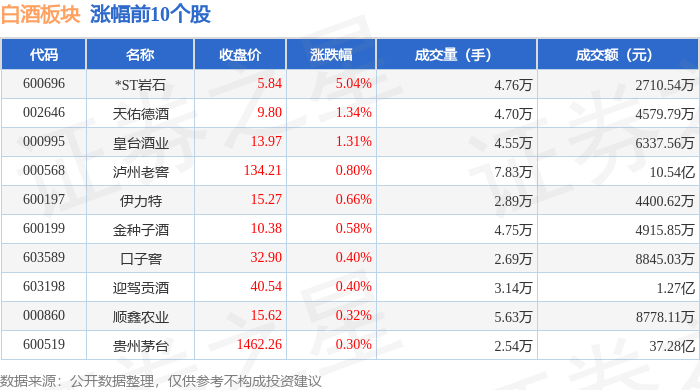
Core Insights - The liquor sector experienced a slight increase of 0.14% on October 21, with *ST Rock leading the gains [1] - The Shanghai Composite Index closed at 3916.33, up 1.36%, while the Shenzhen Component Index closed at 13077.32, up 2.06% [1] Stock Performance Summary - *ST Rock (600696) closed at 5.84, with a rise of 5.04% and a trading volume of 47,600 shares, totaling 27.11 million yuan [1] - Other notable performers include Tianyoude Liquor (002646) at 9.80, up 1.34%, and Qingdao Wenzhou (000995) at 13.97, up 1.31% [1] - Major stocks like Luzhou Laojiao (000568) and Kweichow Moutai (600519) saw minor increases of 0.80% and 0.30%, respectively, with Moutai's closing price at 1462.26 and a trading volume of 25,400 shares, totaling 3.73 billion yuan [1] Capital Flow Analysis - The liquor sector saw a net inflow of 12.19 million yuan from major funds, while retail investors contributed a net inflow of 15.9 million yuan [2] - Conversely, speculative funds experienced a net outflow of 172 million yuan [2] Individual Stock Capital Flow - Kweichow Moutai (600519) had a significant net inflow of 1.26 billion yuan from major funds, while it faced a net outflow of 1.26 billion yuan from speculative funds [3] - Wuliangye (000858) reported a net inflow of 29.16 million yuan from major funds, but a net outflow of 39.27 million yuan from retail investors [3] - *ST Rock (600696) showed a net inflow of 6.38 million yuan from major funds, while retail investors withdrew 5.52 million yuan [3]