
GUJING(000596)

Search documents
古井贡酒前三季度营收164.25亿元同比降13.87%,归母净利润39.60亿元同比降16.57%,净利率下降0.82个百分点
Xin Lang Cai Jing· 2025-10-30 10:24
Core Viewpoint - Gujing Gongjiu reported a decline in revenue and net profit for the first three quarters of 2025, indicating potential challenges in the company's financial performance [1][2]. Financial Performance - The company's revenue for the first three quarters was 16.425 billion yuan, a year-on-year decrease of 13.87% [1]. - The net profit attributable to shareholders was 3.960 billion yuan, down 16.57% year-on-year [1]. - The basic earnings per share were 7.49 yuan [2]. - The gross profit margin for the first three quarters was 79.87%, an increase of 0.16 percentage points year-on-year [2]. - The net profit margin was 24.86%, a decrease of 0.82 percentage points compared to the same period last year [2]. Quarterly Analysis - In Q3 2025, the gross profit margin was 79.83%, up 1.96 percentage points year-on-year but down 0.41 percentage points quarter-on-quarter [2]. - The net profit margin for Q3 was 12.02%, down 11.12% year-on-year and down 17.31 percentage points from the previous quarter [2]. Expense Management - Total expenses for the period were 5.109 billion yuan, a decrease of 450 million yuan year-on-year [2]. - The expense ratio was 31.10%, an increase of 1.95 percentage points year-on-year [2]. - Sales expenses decreased by 6.53%, while management expenses decreased by 1.89% [2]. - R&D expenses increased by 20.58%, and financial expenses decreased by 41.43% [2]. Shareholder Information - As of the end of Q3 2025, the total number of shareholders was 49,400, a decrease of 10,200 or 17.12% from the end of the previous half [2]. - The average market value per shareholder increased from 1.1798 million yuan to 1.7168 million yuan, a growth of 45.51% [2]. Company Overview - Gujing Gongjiu is located in Bozhou, Anhui Province, and was established on March 5, 1999, with its listing date on September 27, 1996 [3]. - The main business involves the production and sales of various alcoholic beverages, with the white liquor business accounting for 98.27% of total revenue [3]. - The company belongs to the food and beverage industry, specifically in the liquor sector [3].

古井贡酒:第三季度净利润2.99亿元,同比下降74.56%
Di Yi Cai Jing· 2025-10-30 09:12
Core Viewpoint - The company reported a significant decline in both revenue and net profit for the third quarter and the first three quarters of the year, indicating potential challenges in its financial performance [1] Financial Performance Summary - Third quarter revenue was 2.545 billion, a year-on-year decrease of 51.65% [1] - Third quarter net profit was 299 million, a year-on-year decrease of 74.56% [1] - Revenue for the first three quarters was 16.425 billion, a year-on-year decrease of 13.87% [1] - Net profit for the first three quarters was 3.96 billion, a year-on-year decrease of 16.57% [1]
古井贡酒1—9月实现营收164.25亿元
Bei Jing Shang Bao· 2025-10-30 09:05
Core Viewpoint - Anhui Gujing Gongjiu Co., Ltd. reported strong financial performance for the first nine months of 2023, indicating robust growth in revenue and net profit [1] Financial Performance - For the period of January to September 2023, the company achieved operating revenue of 16.425 billion yuan [1] - The net profit attributable to shareholders of the listed company was 3.96 billion yuan [1] - In the third quarter alone, the company recorded operating revenue of 2.545 billion yuan [1] - The net profit for the third quarter was 300 million yuan [1]
古井贡酒:第三季度净利润2.99亿元 同比下降74.56%
Di Yi Cai Jing· 2025-10-30 08:55
Core Insights - The company reported a significant decline in both revenue and net profit for the third quarter, with revenue at 2.545 billion and a year-on-year decrease of 51.65% [2] - For the first three quarters, the company’s revenue totaled 16.425 billion, reflecting a year-on-year decline of 13.87%, while net profit was 3.96 billion, down 16.57% year-on-year [2] Financial Performance - Third quarter revenue: 2.545 billion, down 51.65% year-on-year [2] - Third quarter net profit: 299 million, down 74.56% year-on-year [2] - Year-to-date revenue: 16.425 billion, down 13.87% year-on-year [2] - Year-to-date net profit: 3.96 billion, down 16.57% year-on-year [2]

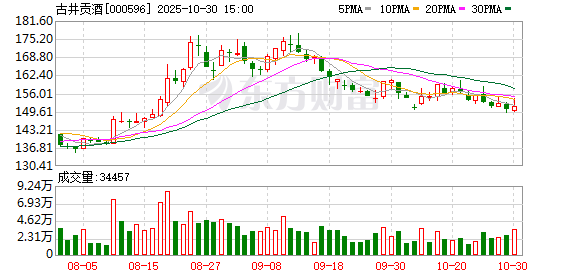
古井贡酒前三季度营收164.2亿,同比下降13.87%
Xin Lang Cai Jing· 2025-10-30 08:55
Core Viewpoint - Gujinggong Liquor reported a decline in revenue and net profit for the first three quarters of the year, indicating potential challenges in the company's financial performance [1] Financial Performance - Revenue for the first three quarters was 16.425 billion, a year-on-year decrease of 13.87% [1] - Net profit attributable to shareholders was 3.960 billion, down 16.57% year-on-year [1] - In the third quarter of 2025, revenue was 2.545 billion, reflecting a significant year-on-year decline of 51.65% [1] - Net profit for the third quarter was 299 million, a sharp decrease of 74.56% year-on-year [1]
古井贡酒(000596) - 2025 Q3 - 季度财报
2025-10-30 08:45
安徽古井贡酒股份有限公司 2025 年第三季度报告 2025 年 10 月 2025 年第三季度报告 证券代码:000596、200596 证券简称:古井贡酒、古井贡 B 公告编号:2025-024 安徽古井贡酒股份有限公司 2025年第三季度报告 本公司及董事会全体成员保证本公告内容真实、准确和完整,没有虚假记载、误导性陈 述或重大遗漏。 重要内容提示: 1.董事会及董事、高级管理人员保证季度报告的真实、准确、完整,不存在虚假记载、误导性陈述或重大遗 漏,并承担个 别和连带的法律责任。 2.公司负责人、主管会计工作负责人及会计机构负责人(会计主管人员)声明:保证季度报告中财务信息的真实、准确、完整。 3.第三季度报告是否经过审计 □是 否 一、主要财务数据 (一)主要会计数据和财务指标 公司是否需追溯调整或重述以前年度会计数据 □适用 不适用 | | 本报告期 | 本报告期比上年同期 | 年初至报告期末 | 年初至报告期末比上 | | --- | --- | --- | --- | --- | | | | 增减 | | 年同期增减 | | 营业收入(元) | 2,544,788,530.16 | -51.6 ...
白酒板块10月30日跌0.09%,皇台酒业领跌,主力资金净流出5.86亿元
Zheng Xing Xing Ye Ri Bao· 2025-10-30 08:40
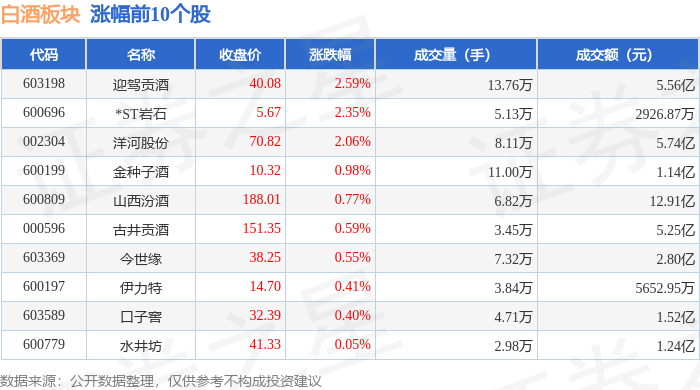
Core Insights - The liquor sector experienced a slight decline of 0.09% on October 30, with Huangtai Liquor leading the drop [1] - The Shanghai Composite Index closed at 3986.9, down 0.73%, while the Shenzhen Component Index closed at 13532.13, down 1.16% [1] Liquor Sector Performance - Notable gainers in the liquor sector included: - Macau Sina: Closed at 40.08, up 2.59% with a trading volume of 137,600 shares and a transaction value of 556 million [1] - ST Yanshi: Closed at 5.67, up 2.35% with a trading volume of 51,300 shares and a transaction value of 29.27 million [1] - Yanghe Distillery: Closed at 70.82, up 2.06% with a trading volume of 81,100 shares and a transaction value of 574 million [1] - Other companies like Kweichow Moutai and Wuliangye saw minor declines of 0.36% and 0.30% respectively [2] Capital Flow Analysis - The liquor sector saw a net outflow of 586 million from institutional investors, while retail investors contributed a net inflow of 65.5 million [2] - Major stocks with significant capital inflows included: - Yingjia Gongjiu: Net inflow of 52.03 million from institutional investors [3] - Luzhou Laojiao: Net inflow of 37.36 million from institutional investors [3] - Conversely, stocks like Yanghe Distillery and Kweichow Moutai experienced net outflows from both institutional and retail investors [3]




茅台三季报出炉!吃喝板块绝地反击,食品ETF(515710)盘中翻红!机构看好低估值配置时机
Xin Lang Ji Jin· 2025-10-30 02:57
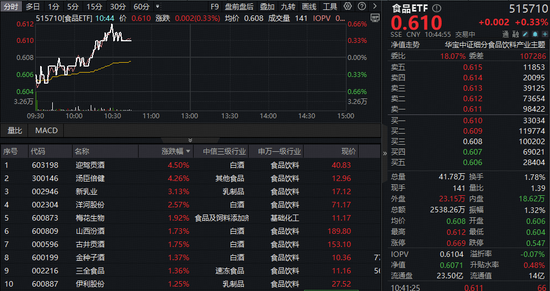
Group 1 - The food and beverage sector experienced a significant reversal on October 30, with the Food ETF (515710) opening lower but then rising to a gain of 0.33% as of the report [1] - Notable stocks in the sector included strong performances from liquor brands, with companies like Yingjia Gongjiu and Tangchen Beijian both rising over 4%, and New Dairy rising over 3% [1] - Guizhou Moutai reported a total revenue of 130.904 billion yuan for the first nine months of the year, a year-on-year increase of 6.32%, with a net profit of 64.626 billion yuan, also reflecting a growth of 6.25% [2][3] Group 2 - Huatai Securities highlighted that the food and beverage sector is currently at a low valuation, making it a potentially good time for investment, with the Food ETF's price-to-earnings ratio at 19.99, which is in the 4.7% percentile of the last decade [3] - Guizhou Moutai's third-quarter revenue reached 39.81 billion yuan, showing a slight year-on-year increase of 0.35%, indicating stable performance amidst market fluctuations [2][3] - The food and beverage sector is expected to enter a recovery phase as consumer policies from the second quarter begin to wane, with signs of improved supply chain dynamics and industry consolidation [4]




古井贡酒跌2.00%,成交额1.81亿元,主力资金净流出2476.90万元
Xin Lang Cai Jing· 2025-10-29 02:58
Core Viewpoint - Gujing Gongjiu's stock price has experienced a decline of 10.72% year-to-date, with a recent drop of 2.00% on October 29, 2023, indicating potential challenges in the market [1] Financial Performance - For the first half of 2025, Gujing Gongjiu reported revenue of 13.88 billion yuan, a year-on-year increase of 0.54%, and a net profit attributable to shareholders of 3.66 billion yuan, up 2.49% year-on-year [2] - Cumulatively, the company has distributed 12.61 billion yuan in dividends since its A-share listing, with 7.14 billion yuan distributed over the past three years [3] Shareholder Information - As of October 10, 2023, the number of shareholders increased to 50,400, reflecting a growth of 1.99% [2] - The top circulating shareholders include major funds, with notable changes in holdings, such as an increase of 1.80 million shares by the second-largest shareholder, while others like the eighth-largest shareholder reduced their holdings by 1.85 million shares [3] Market Activity - On October 29, 2023, Gujing Gongjiu's stock traded at 149.37 yuan per share, with a total market capitalization of 78.96 billion yuan [1] - The stock has seen a trading volume of 181 million yuan, with a turnover rate of 0.29% [1]
国信证券:白酒行业筑底信号增多 板块进入布局阶段
智通财经网· 2025-10-29 02:08
Core Viewpoint - The investment opportunities in the liquor sector are currently characterized by market divergence, with expectations of a significant decline in performance for liquor companies in Q3 2025, while both valuation and holdings are at low levels, and positive factors on both supply and demand sides are gradually increasing [1] Group 1: Market Dynamics - The industry demand is expected to recover on a month-on-month basis, particularly during the dual festivals, leading to a more optimistic market outlook regarding performance and price expectations, which will likely result in valuation recovery as demand improves [1] - The first phase of recovery is driven by dividend yield pricing, while the second phase will see a return to long-term confidence in liquor assets as supply-demand relationships improve and performance indicators are realized [1] Group 2: Historical Performance Analysis - Historical data indicates that the majority of liquor companies confirmed their stock price bottoms between Q4 2013 and Q1 2014, despite a continued decline in performance and market conditions [2] - The stock price performance remained relatively stable after the third quarter of 2013, with most companies generating absolute returns within one month post earnings report, attributed to the market's sufficient digestion of performance decline expectations [2] Group 3: Business Strategies of Liquor Companies - Liquor companies are leveraging channels to amplify brand and product advantages, signaling changes in supply-side dynamics during the adjustment phase [3] - High-end liquor brands are focusing on maintaining brand strength, with companies like Moutai and Wuliangye adapting their strategies to enhance channel management and product offerings [3] - Regional leaders are concentrating on their base markets while expanding into lower-tier markets, with companies like Yanghe and Gujing enhancing their presence in these areas [3]

