
CHANGAN AUTOMOBILE-B(000625)

Search documents
【读财报】上市车企12月销量:整车销量超222万辆 江淮汽车、赛力斯、江铃汽车等销量增速加快
Xin Lang Cai Jing· 2026-01-20 23:35
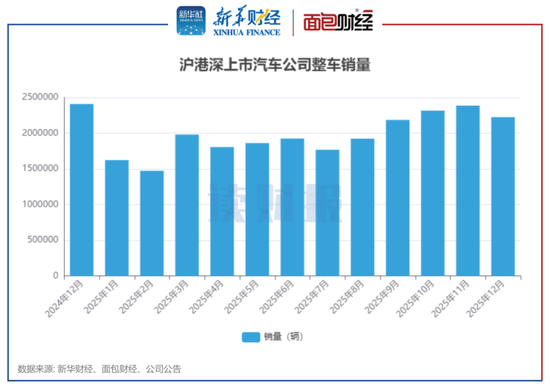
Core Insights - The overall vehicle sales for 20 A and H-share listed automotive manufacturers in December 2025 totaled 2.2255 million units, representing a year-on-year decline of 7.64% and a month-on-month decrease of 6.77% [10][11] - In December 2025, 16 companies reported sales of approximately 1.2532 million new energy vehicles (NEVs), marking a year-on-year increase of 1.99% and a penetration rate of about 58% [10][11] Group 1: Overall Vehicle Sales - The total vehicle sales for the 20 listed companies in December 2025 were 2.2255 million units, down 7.64% year-on-year and down 6.77% month-on-month [10][11] - For the entire year of 2025, these companies sold over 23.5 million vehicles, reflecting a year-on-year growth of 8.86% [11] - Companies such as Jianghuai Automobile, Seres, and Jiangling Automobile saw an acceleration in sales growth in December compared to November, while companies like Shuguang and Zhongtong Bus experienced a slowdown [10][11] Group 2: New Energy Vehicle Sales - In December 2025, the total sales of NEVs reached approximately 1.2532 million units, with a year-on-year increase of 1.99% and a month-on-month decrease of 8.93% [5][15] - The NEV penetration rate for December was about 57.96%, a decrease of 0.85 percentage points from November [15] - BYD, SAIC Group, and Geely were the top three companies in NEV sales for December, with significant growth observed in companies like BAIC Blue Valley and Jianghuai Automobile, which reported growth rates exceeding 70% [7][17] Group 3: Company-Specific Performance - BYD led the sales in December with 420,398 units sold, although this represented an 18.34% decline year-on-year [4][14] - SAIC Group and Changan Automobile followed with sales of 399,449 units and 254,843 units, respectively, with Changan showing a slight year-on-year increase of 1.66% [4][14] - Geely's December sales increased by 12.74% year-on-year, totaling 236,817 units, while GAC Group experienced a significant decline of 33.82% in sales [4][15]






【整车主线周报】12月零售符合预期,看好26年景气度向上
东吴汽车黄细里团队· 2026-01-20 14:07
Investment Highlights - The passenger car sector is expected to see a recovery in Q1 2026 due to the implementation of subsidy policies, with a focus on high-end electric vehicles that are less sensitive to policy changes, such as Jianghuai Automobile, Geely, Great Wall Motors, BAIC Blue Valley, Seres, and Li Auto [2][7] - For exports, priority should be given to leading companies with established overseas systems and proven execution capabilities, including BYD, Great Wall Motors, Chery, Leap Motor, Xpeng, SAIC Motor, and Changan Automobile [2][7] Heavy Truck Sector - In 2025, wholesale heavy truck sales reached 1.144 million units, up 26.8% year-on-year, with domestic sales of 799,000 units, up 32.8%, and exports of 341,000 units, up 17.2% [3][37] - The expected domestic sales for heavy trucks in 2026 is optimistic, projected at 800,000 to 850,000 units, a 3% increase year-on-year [3][37] - Recommended leading heavy truck companies include China National Heavy Duty Truck Group, Weichai Power, Foton Motor, FAW Jiefang, and CIMC Vehicles [3][37] Bus Sector - The implementation of the vehicle replacement policy in 2026 is slightly better than expected, with bus sales in 2025 projected at 38,000 units, a 25% increase year-on-year [3][37] - For 2026, bus sales are expected to grow to 40,000 units, a 5% increase year-on-year, supported by the number of buses over eight years old that need replacement [3][37] - Recommended leading bus companies include Yutong Bus, King Long Motor, and Zhongtong Bus [3][37] Motorcycle Sector - The motorcycle industry is projected to achieve total sales of 19.38 million units in 2026, a 14% increase year-on-year, with large-displacement motorcycles expected to reach 1.26 million units, a 31% increase [4][34] - Domestic sales of large-displacement motorcycles are expected to grow slightly to 430,000 units in 2026, a 5% increase year-on-year, while exports are projected to reach 830,000 units, a 50% increase [4][34] - Recommended leading motorcycle companies include Chunfeng Power and Longxin General [4][34]

博俊科技:公司为零跑供货的量产车型有零跑B01等
Zheng Quan Ri Bao Zhi Sheng· 2026-01-20 14:02
Group 1 - The company, Bojun Technology, is currently supplying mass production models to various clients, including Leap Motor and Changan [1] - The mass production models supplied to Leap Motor include B01, LAFA5, B10, and C11 [1] - The mass production models supplied to Changan include Deep Blue S7, SL03, S05, L05, G318, Avita 12, Changan Qiyuan A06, Qiyuan New Q05, and Changan CS75PLUS [1]

埃泰克上交所IPO通过上市委会议 客户包括奇瑞汽车、长安汽车等
智通财经网· 2026-01-20 11:37
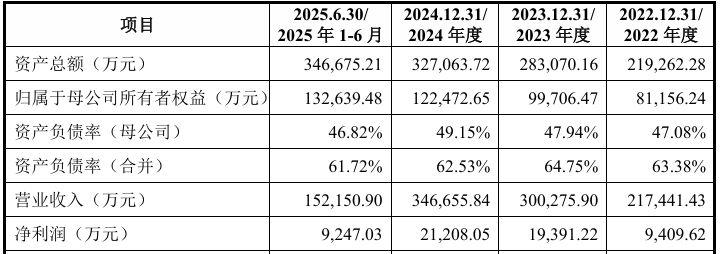
Core Viewpoint - Aitek, a leading automotive electronics solution provider, is set to raise 1.5 billion RMB through its IPO on the Shanghai Stock Exchange, with a focus on various automotive electronic domains including body control, intelligent cockpit, power, and intelligent driving [1]. Group 1: Company Overview - Aitek specializes in the research, production, and sales of automotive electronic products, providing EMS and technical development services [1]. - The company has developed a complete business system from product design to mass production, accumulating extensive experience in automotive electronics [1]. - Aitek has established a diverse customer base, including major domestic automakers like Chery, Changan, Great Wall, SAIC, Geely, BAIC, and Dongfeng, as well as new energy vehicle manufacturers such as Li Auto, Xpeng, and Leap Motor [1]. Group 2: Market Position - Aitek has successfully broken the monopoly of international automotive electronics giants like Bosch, Denso, and Continental in key technologies and markets [2]. - In 2024, Aitek holds a 25.50% market share in the pre-installed body control units for domestic passenger cars, ranking first for three consecutive years [2]. - The company also ranks first with a 13.83% market share in pre-installed remote physical keys and third with a 6.41% market share in cockpit domain and display assembly for domestic passenger cars [2]. Group 3: Financial Performance - Aitek's revenue for the years 2022, 2023, and 2024 is projected to be approximately 2.174 billion RMB, 3.003 billion RMB, and 3.467 billion RMB respectively, with a net profit of around 94.10 million RMB, 194 million RMB, and 212 million RMB for the same years [3]. - As of June 30, 2025, the total assets are estimated at 3.467 billion RMB, with equity attributable to shareholders at 1.326 billion RMB [3]. - The company's asset-liability ratio is projected to be 46.82% for the first half of 2025, showing a slight decrease from previous years [3].
长安汽车金融取得群体识别方法专利
Jin Rong Jie· 2026-01-20 01:12
Group 1 - The core point of the article is that Changan Automobile Finance Co., Ltd. has obtained a patent for a group identification method, device, equipment, and computer-readable storage medium, with the patent number CN120951062B and an application date of October 2025 [1] - Changan Automobile Finance Co., Ltd. was established in 2012 and is located in Chongqing, primarily engaged in monetary financial services [1] - The registered capital of Changan Automobile Finance Co., Ltd. is approximately 476.84 million RMB [1] Group 2 - The company has participated in 1,664 bidding projects and has 76 trademark information entries and 62 patent information entries [1] - Additionally, the company holds 29 administrative licenses [1]
合兴股份:公司与长安汽车已建立良好合作关系
Zheng Quan Ri Bao Wang· 2026-01-19 13:40
Group 1 - The company, Hexing Co., Ltd. (605005), has established a good cooperative relationship with Changan Automobile as an automotive electronic component supplier [1] - The company does not have specific information regarding the application of its products in particular vehicle models [1] - The company will fulfill its disclosure obligations in accordance with the law if future cooperation meets the information disclosure standards [1]

重夺“汽车第一城”,西部重镇杀回来了
Mei Ri Jing Ji Xin Wen· 2026-01-19 13:10
Core Insights - The competition for the title of "Automobile Capital" in China is intensifying, with Chongqing projected to produce 2.788 million vehicles in 2025, marking a 9.7% increase and solidifying its position as the top city in vehicle production [1] - Chongqing's automotive industry is experiencing a resurgence after a decade, with significant growth in new energy vehicles (NEVs), expected to reach 1.296 million units, a 36% increase [1] - The issuance of China's first L3-level autonomous driving license to Changan Automobile signifies a historic milestone in the large-scale application of intelligent driving technology, positioning Chongqing as a leader in this field [1] Industry Overview - The automotive industry in Chongqing aims to reclaim its status as a leader, having previously reached a peak production of 3.156 million vehicles in 2016 before experiencing a decline to 1.383 million in 2019 [2] - The shift in consumer preferences towards mid-to-high-end vehicles and the rise of NEVs have been pivotal in reshaping the automotive landscape [2] - Changan Automobile's strategic pivot towards electric vehicles, including the "Shangri-La" plan to cease traditional fuel vehicle production by 2025, reflects the industry's adaptation to market demands [3] Company Developments - Changan Automobile's collaboration with Huawei and CATL has led to the launch of new high-end NEV brands, contributing to a projected total vehicle sales of 2.913 million by 2025, with NEV sales expected to reach 1.11 million, a 51.1% increase [3] - Seres, another key player, has transitioned from traditional manufacturing to NEVs, achieving significant growth and profitability, with projected NEV sales of 472,300 units in 2025, a 10.63% increase [5] - The partnerships with Huawei have been crucial for both Changan and Seres, enabling them to leverage advanced technology and market positioning in the competitive NEV sector [6][9] Competitive Landscape - The automotive industry is entering a new competitive phase, with a consensus that the NEV market will see accelerated consolidation, leading to a "淘汰赛" (elimination round) among brands [10] - Chongqing's strategic initiatives, including the development of smart connected vehicles and the establishment of a comprehensive industrial ecosystem, are aimed at enhancing its competitive edge [12] - Other cities, such as Guangzhou, are also intensifying their efforts to reclaim leadership in the automotive sector, highlighting the competitive dynamics at play [13] Challenges and Opportunities - Despite its advancements, Chongqing faces challenges in AI and core technology competitiveness, ranking 14th nationally in AI industry strength, which may hinder its long-term leadership in intelligent driving [15] - The city is focusing on addressing its weaknesses in talent acquisition and technological infrastructure to maintain its position in the evolving automotive landscape [15]

「汽车第一城」易主
36氪· 2026-01-19 10:21
Group 1 - Chongqing has regained its title as "China's Automobile Capital" after nine years, with a projected total vehicle production of 2.788 million units in 2025, representing a growth of 9.7% [2][3] - The production of new energy vehicles (NEVs) in Chongqing is expected to reach 1.296 million units, marking a significant increase of 36%, with the industrial cluster scale surpassing 800 billion yuan [2] - Historical data indicates that Chongqing held the title of "China's Automobile Capital" for three consecutive years from 2014 to 2016, but faced competition from Shenzhen, which produced 2.9353 million vehicles in 2024 [4] Group 2 - The automotive industry in Chongqing is supported by traditional brands like Changan and emerging players like Seres, which is aiming to achieve a second million-unit production target within two years [4][6] - In January 2026, the "Wenjie" model reached a milestone of 1 million units produced at the Chongqing Liangjiang New Area super factory, highlighting the growth of local manufacturing capabilities [5] - Excluding direct-controlled municipalities, Hefei is emerging as a strong competitor for the title of "Automobile Capital," with Anhui province surpassing Guangdong in total vehicle production [8]
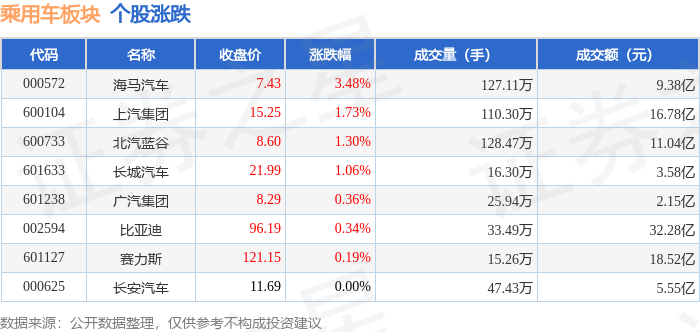
乘用车板块1月19日涨0.68%,海马汽车领涨,主力资金净流入6355.93万元
Zheng Xing Xing Ye Ri Bao· 2026-01-19 08:52
Group 1 - The passenger car sector increased by 0.68% on January 19, with Haima Automobile leading the gains [1] - The Shanghai Composite Index closed at 4114.0, up 0.29%, while the Shenzhen Component Index closed at 14294.05, up 0.09% [1] - Key stocks in the passenger car sector showed varied performance, with notable increases in stocks like Haima Automobile (3.48%) and SAIC Motor (1.73%) [1] Group 2 - The net inflow of main funds in the passenger car sector was 63.56 million yuan, while retail investors experienced a net outflow of 45.99 million yuan [1] - Haima Automobile had a significant main fund net inflow of 73.46 million yuan, while retail investors saw a net outflow of 86.47 million yuan [2] - BYD experienced a net outflow of 88.17 million yuan from main funds, indicating a negative trend in investor sentiment [2]




长安汽车发布关于广西南宁15辆车连撞交通事故的声明
Xin Lang Cai Jing· 2026-01-19 06:41
Core Viewpoint - Changan Automobile's misinformation reporting center has issued a statement addressing the spread of false information regarding a traffic accident involving 15 vehicles in Nanning, Guangxi, which has been inaccurately linked to the "Aviator driving assistance system malfunction" [1] Group 1 - The company emphasizes that the dissemination of unverified information has severely distorted facts and misled the public, causing significant harm to the Aviator brand's reputation [1] - Aviator Technology released a statement on January 17 to clarify the situation surrounding the incident [1] - The company asserts that the online space is not beyond the law and will take legal action against any defamatory behavior that harms its legitimate rights and interests [1] Group 2 - The company encourages the public to report any entities spreading false information through its misinformation reporting center's official account [1] - The statement highlights the importance of maintaining a clear online environment and fair market competition order [1]