GREE(000651)

Search documents
暴增54%,小米正式打到格力家门口,董明珠怎么办?
Sou Hu Cai Jing· 2025-08-18 03:04
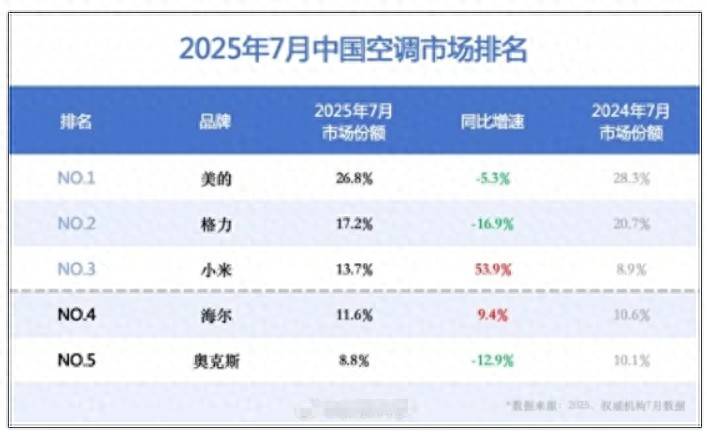
Core Insights - The air conditioning market in China for July 2025 shows significant shifts in brand rankings and market shares, with Midea leading at 26.8% despite a decline of 5.3% year-over-year [2] - Xiaomi has made notable gains, achieving a 53.9% increase in market share, positioning itself third with 13.7%, while Gree experienced the largest decline at 16.9% [1][2] - This marks Xiaomi's first entry into the top five brands, with a market share gap of only 2.5% from Gree, indicating a competitive landscape [2][3] Brand Performance - Midea holds the top position with a market share of 26.8%, down from 28.3% in the previous year [2] - Gree's market share has dropped to 17.2%, down from 20.7%, reflecting a significant decline [2] - Xiaomi's market share increased to 13.7%, up from 8.9% year-over-year, showcasing its rapid growth [2] - Haier and Aux follow with market shares of 11.6% and 8.8%, respectively, with Aux also experiencing a decline of 12.9% [2] Pricing Trends - The average price for Midea's air conditioners is 3103 yuan, which has increased by 12.06% [3] - Xiaomi's average price is 2513 yuan, reflecting an increase of 11.37% [3] - Gree's average price stands at 3488 yuan, with a slight increase of 10.16% [3] Competitive Dynamics - The competitive tension between Xiaomi and Gree is highlighted, with Gree's CEO, Dong Mingzhu, historically critical of Xiaomi, indicating the pressure Xiaomi's growth places on Gree [3][5] - Despite past challenges, Xiaomi's rapid expansion into the air conditioning market demonstrates its strategic advantage and adaptability compared to Gree's more focused approach [5][8] - The evolving market dynamics suggest that Xiaomi's value proposition, including cost-effectiveness and ecosystem integration, may soon allow it to surpass Gree in the air conditioning segment [8]



家用电器行业研究框架培训
2025-08-18 01:00
Summary of Home Appliance Industry Research Conference Call Industry Overview - The home appliance industry is characterized by a dual nature of manufacturing and consumer goods, with a long supply chain that includes upstream raw materials and intermediate component manufacturing, as well as downstream channel sales and brand operations [2][3][9] Key Insights and Arguments - The white goods market is nearing saturation, with growth relying on overseas markets; the black goods market is experiencing a global volume decrease but price increase, with domestic brands showing significant technological advantages [1][3] - Kitchen appliances are influenced by real estate fluctuations, but emerging categories like dishwashers are seeing increased penetration rates [1][3] - Small appliances are diversifying as household income rises, with increased penetration rates and brand diversity [1][4] - Investment styles can be matched with different segments of the home appliance industry: white goods for stable investors, black goods for those seeking inflection point opportunities, kitchen appliances for post-real estate cycle investors, and small appliances for growth-oriented investors [1][5] Market Size Analysis - Market size can be estimated through household numbers, average ownership rates, and product prices. For instance, with approximately 500 million households in China, if each household owns three air conditioners, the total stock would be around 1.5 billion units, leading to an annual sales estimate of 150 million units [6][10] Technological Changes and Market Dynamics - Technological innovations significantly impact market dynamics, such as the iteration of robotic vacuum cleaners and changes in black goods technology paths, enhancing the global competitiveness of Chinese companies [1][7] - High functional recognition categories (e.g., air conditioners) require significant R&D investment, while low recognition categories (e.g., refrigerators) rely more on marketing and distribution [8][11] Production Cost Characteristics - The production cost chain in the home appliance industry is extensive, with raw material costs (steel, copper, aluminum) constituting 60-70% of production costs, which can significantly affect profitability [9][14] - Price fluctuations in raw materials, such as steel and panel prices, directly impact the gross margins of companies like Gree and Hisense [9][14] Competitive Landscape - Brand loyalty, reputation, and awareness are crucial in determining the competitive landscape of home appliance categories. High recognition products like air conditioners benefit from brand loyalty, while low recognition products depend more on marketing [11][12] - Price wars, particularly in the air conditioning sector, have significantly influenced competitive dynamics, with historical price reductions leading to shifts in market share among key players [12][13] Future Trends - The home appliance industry is expected to face a decline in domestic sales due to subsidy adjustments, while overseas demand will drive growth in white goods. Companies are exploring diversification into robotics, B2B businesses, and new energy sectors [15][16] Data Tracking and Analysis - The home appliance industry has a robust data tracking system that includes online and offline sources, allowing for comprehensive monitoring of sales and market trends [17][18][19] - Ensuring data consistency with actual company performance involves using various data sources and regular communication with companies to validate information [20] Support for Investors - Longjiang Home Appliances offers detailed databases and continuous updates on market segments, providing support for investors seeking in-depth analysis and discussions [21]

小米强势杀入“前三”,7月线上销量超格力,空调格局变了吗?
华尔街见闻· 2025-08-17 12:49
Core Viewpoint - The Chinese air conditioning market is experiencing a significant shift, with Xiaomi surpassing Gree in online sales market share for the first time, indicating a potential disruption in the long-standing duopoly of Midea and Gree [2][6][20]. Market Dynamics - In July 2025, Xiaomi's online sales market share reached 16.71%, overtaking Gree's 15.22%, while Midea remains the market leader [2]. - Xiaomi's year-on-year growth rate of 53.9% has positioned it as the third-largest player in the industry, highlighting its status as the only "high-growth" variable among the top three brands [2]. Competitive Strategies - Xiaomi's strategy focuses on leveraging software to redefine hardware value, transforming air conditioners into integral components of smart home ecosystems [7]. - The company has established a significant partnership with Changhong, contributing approximately 60% of its revenue, which has led to a compression of Changhong's profit margins [7][10]. Cost Constraints - A financial model indicates that the lowest possible retail price for a quality 1.5 HP air conditioner, under ideal conditions, cannot fall below 1900 yuan, suggesting that Xiaomi's pricing strategy is nearing its limits [8][10]. Traditional Giants' Advantages - Midea and Gree possess historical experience, absolute scale, and control over the supply chain, forming a robust defense against new entrants like Xiaomi [11][14]. - The market size is approximately 300 billion yuan, with Midea and Gree generating over 100 billion yuan in domestic sales, providing them with significant purchasing power and cost advantages [12][14]. Future Competition Landscape - The competition is expected to evolve from direct brand confrontations to a more nuanced "agent war" involving sub-brands, allowing traditional giants to maintain their premium positioning while competing with Xiaomi [17][18]. - Sub-brands like Midea's "Hualing" and Haier's "Tongshuai" have gained market share without undermining their parent brands, indicating a strategic shift in competitive tactics [17][18]. Conclusion on Market Structure - While Xiaomi's entry has altered the competitive landscape, the foundational structures of the industry, characterized by historical patterns, scale advantages, and technological control, remain intact [21][22]. - The current market dynamics suggest a more diverse and competitive environment for consumers, driven by the need for traditional players to adapt to new challenges [22].
中国车谷品牌运营中心开业,已有45家企业签约入驻
Chang Jiang Ri Bao· 2025-08-17 08:45
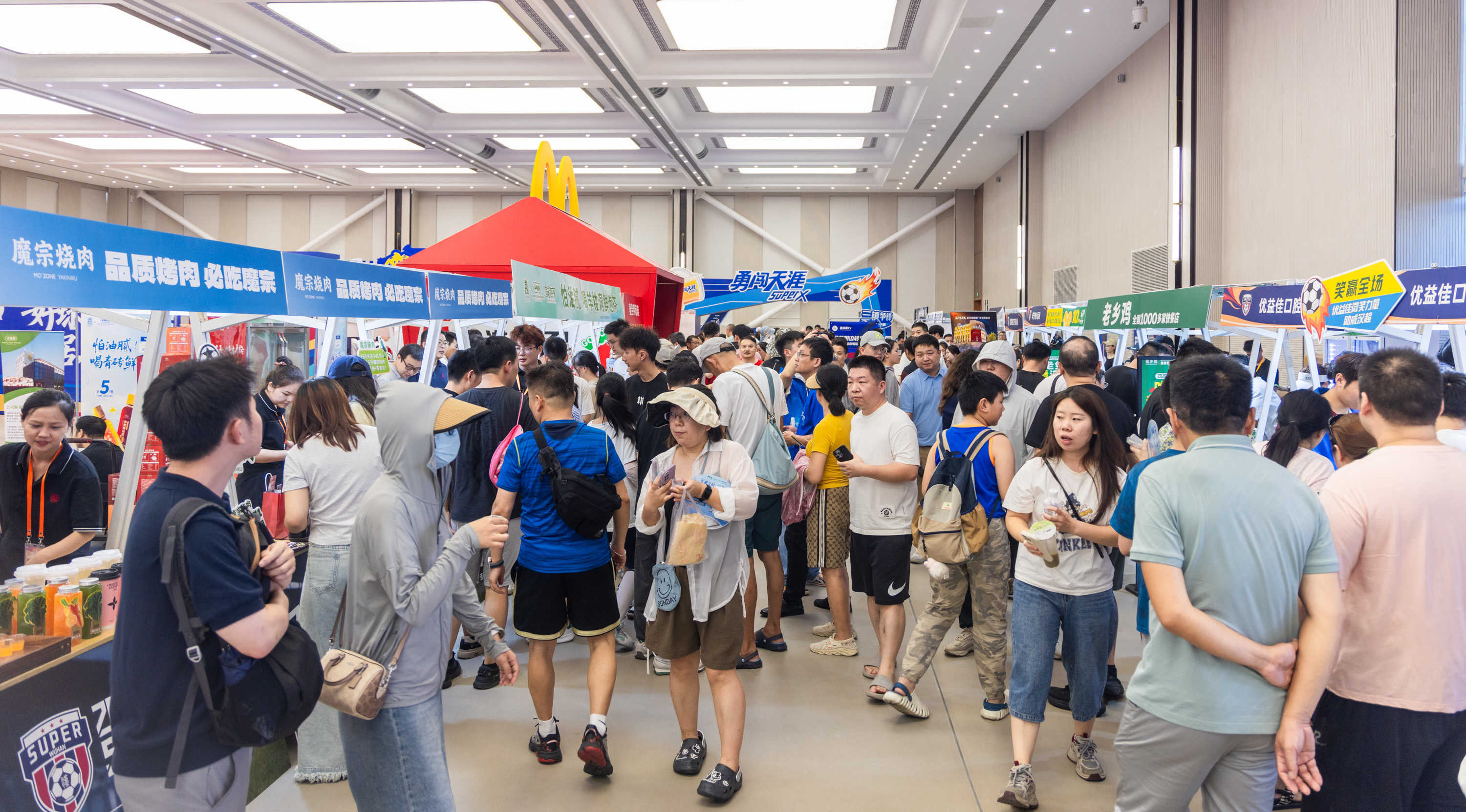
Group 1 - The "Han Super" football league is set to kick off in Wuhan, attracting nearly 50,000 fans and visitors to the food and lifestyle event [1][4] - Wuhan Sports Center hosts over 100 cultural and sports events annually, receiving more than 5 million visitors [3] - The China Car Valley Brand Operation Center, covering approximately 23,000 square meters, will serve as a platform for product display, brand promotion, and e-commerce [3] Group 2 - Ten companies, including Jinhuixuan, New Agricultural Beef, and Xiaomi, have signed agreements to enter the China Car Valley Brand Operation Center [6][7] - The center aims to enhance the brand ecosystem and create a commercial vitality zone around the Wuhan Sports Center [7] - Future plans include developing a night economy and hosting various promotional activities to boost consumption [7]



87岁范曾被新婚娇妻卷走20亿?女儿发声;OpenAI融资83亿美元,年收入将破200亿;小米空调7月线上销量超越格力丨邦早报
创业邦· 2025-08-17 01:09
Group 1 - The article discusses the disappearance of renowned Chinese artist Fan Zeng, who was reportedly taken away by his wife, Xu Meng, leading to concerns about his well-being and the status of his art collection valued at over 2 billion yuan [1] - Fan Zeng's daughter, Fan Xiaohui, claims that her father was forcibly moved from his residence, which has been sealed, and that valuable artworks have been removed under suspicious circumstances [1] - The situation has garnered significant attention on social media, with many users expressing concern for Fan Zeng's safety and questioning the legitimacy of the claims made by his family [1][3] Group 2 - OpenAI has successfully raised 8.3 billion USD in a new funding round, part of a larger 40 billion USD financing plan, amid rapid growth in its business [3] - The annual recurring revenue for OpenAI has increased from 10 billion USD in June to 13 billion USD, with projections to exceed 20 billion USD by the end of the year [3] - The number of paid enterprise users for ChatGPT has surged from 3 million to 5 million in a matter of months, indicating strong demand for its services [3] Group 3 - Xiaomi's air conditioner sales surpassed those of Gree in July, achieving a market share of 16.71% compared to Gree's 15.22% [15][16] - The article highlights the competitive landscape in the air conditioning market, with Xiaomi's rapid growth signaling a shift in consumer preferences [15][16] Group 4 - Shanghai's first batch of autonomous smart connected taxis has officially begun operations, covering 58 locations in the Lingang area [18] - The fare structure for these taxis includes a starting price of 16 yuan for trips under 5 kilometers, with additional charges of 4 yuan per kilometer for longer distances [18] Group 5 - The article mentions the launch of the new generation of the NIO ES8, which is the first high-end electric vehicle in China to complete its third iteration [11] - The vehicle is designed to meet the needs of MPV users and showcases advancements in electric vehicle technology, including a comprehensive battery swap network [11]



小米强势杀入“前三”,7月线上销量超格力,空调格局变了吗?
Hua Er Jie Jian Wen· 2025-08-16 12:07
Core Insights - The Chinese air conditioning market is experiencing a significant shift, with Xiaomi surpassing Gree in online sales market share for the first time in July 2025, achieving 16.71% compared to Gree's 15.22% [2] - Xiaomi's annual growth rate reached 53.9%, positioning it as the third-largest player in the market, making it the only high-growth variable among the top three brands [2][6] - The competitive landscape is evolving, with Xiaomi's entry challenging the long-standing dominance of Midea and Gree, which have ruled the market for nearly two decades [6][19] Group 1: Xiaomi's Strategy - Xiaomi's approach leverages software to redefine hardware value, focusing on the smart home ecosystem, with over 70% of its air conditioning users connected online [7] - The company has established a significant partnership with Changhong, contributing approximately 60% of its revenue from air conditioning sales, but this has pressured Changhong's profit margins [10][11] - Despite its aggressive pricing strategy, Xiaomi faces limitations due to physical cost constraints, with a quality air conditioner priced no lower than 1900 yuan under ideal conditions [10][12] Group 2: Traditional Giants' Resilience - Midea and Gree maintain a strong defensive position through historical experience, scale, and control over the supply chain, which have proven effective against price wars in the past [12][13] - The market size of approximately 300 billion yuan allows these giants to leverage their scale, with Midea and Gree generating over 100 billion yuan in domestic sales, significantly outpacing their competitors [12][13] - The vertical integration in the compressor market, where Midea and Gree hold a combined 65% market share, further solidifies their control over the industry [13][16] Group 3: Future Competitive Landscape - The future competition is expected to shift from direct brand confrontations to a more nuanced "agent war" involving sub-brands, allowing giants to maintain their premium positioning while competing with Xiaomi [17][21] - Sub-brands like Midea's "Hualing" and Haier's "Tongshuai" have gained market share, indicating a strategic pivot to capture value in the price-sensitive segment without undermining the main brand [17][21] - The overall market dynamics are changing, with Xiaomi's entry prompting traditional players to adapt their strategies rather than engage in destructive price wars [19][20]
小米空调线上销量超越格力
Bei Jing Shang Bao· 2025-08-16 09:00
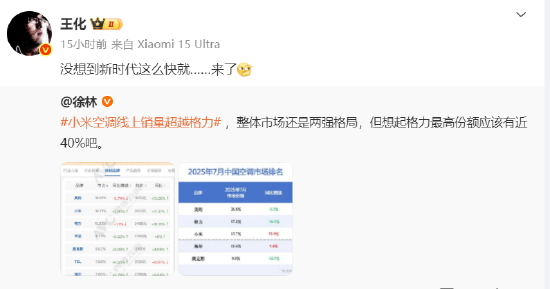
具体来看,美的、小米、格力依次位列中国空调线上市场市占率前三。小米市占率16.71%,同比增长 2.83%;格力市占率15.22%,同比下降1.1%。 小米集团公关部总经理王化转发相关微博并评论称"没想到新时代这么快就来了"。 北京商报讯(记者 陶凤 实习记者 王天逸)8月16日,奥维云网发布2025年7月家电市场总结(线上 篇),数据显示,7月小米空调线上销量超越格力。 ...
小米空调7月线上销量超越格力,王化回应:没想到新时代这么快就来了
Xin Lang Ke Ji· 2025-08-16 07:20
Group 1 - In July 2023, Xiaomi's online air conditioner sales surpassed Gree, with Xiaomi holding a market share of 16.71% compared to Gree's 15.22% [1] - The public relations manager of Xiaomi Group, Wang Hua, expressed surprise at the rapid change in market dynamics by sharing a related Weibo post [1]
奥维云网、中怡康7月数据:空调市场TOP3格局稳固,美的格力海尔领跑
Huan Qiu Wang· 2025-08-16 06:47
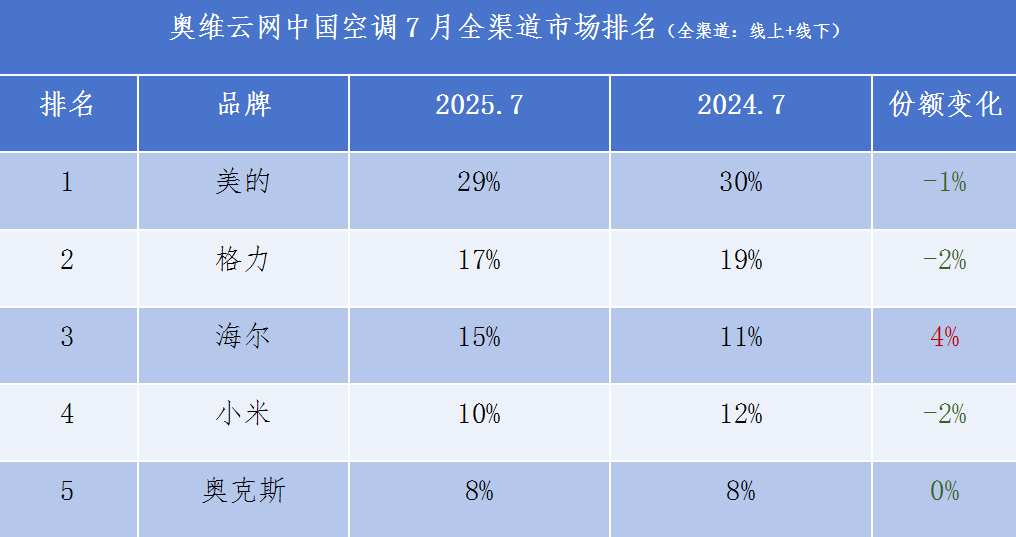
Core Insights - The air conditioning market in China remains dominated by three major brands: Midea, Gree, and Haier, according to the latest retail monitoring reports from AVC and CMM [1][2] - Midea holds the largest market share at 29%, followed by Gree at 17% and Haier at 15%, with Haier being the only brand among the top three to show a year-on-year net growth in market share [1][2] Group 1 - Midea's market share decreased from 30% in July 2024 to 29% in July 2025, reflecting a 1% decline [2] - Gree's market share also declined from 19% in July 2024 to 17% in July 2025, marking a 2% decrease [2] - Haier's market share increased from 11% in July 2024 to 15% in July 2025, indicating a 4% growth [2] Group 2 - Xiaomi's market share fell from 12% in July 2024 to 10% in July 2025, representing a 2% decline [2] - Aux maintained its market share at 8% from July 2024 to July 2025, showing no change [2] - The overall competitive landscape in the air conditioning market remains stable, with the top three brands consistently leading [1][2]
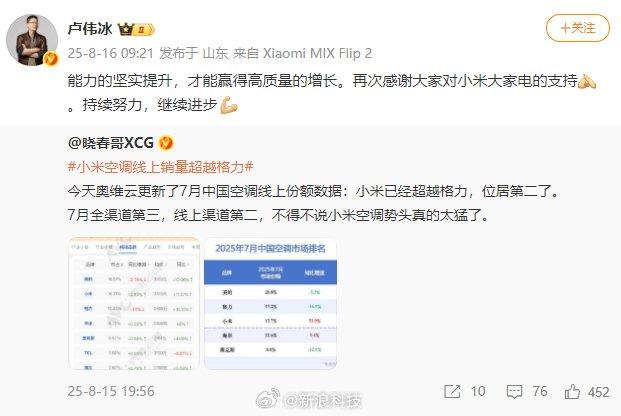
7月中国空调线上销量小米超格力,卢伟冰回应感谢支持
Xin Lang Ke Ji· 2025-08-16 03:47
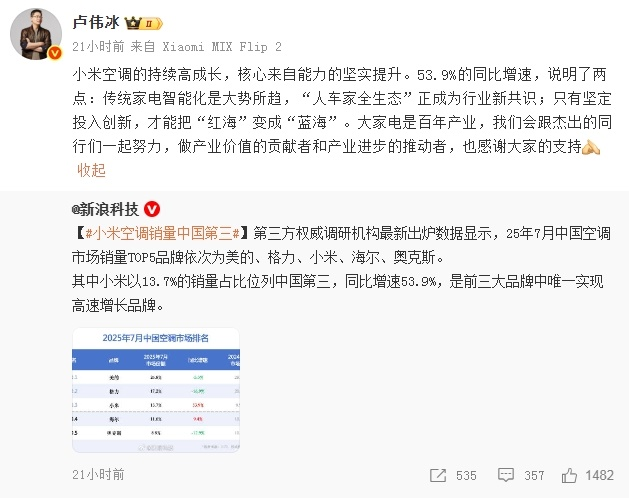
Group 1 - The core viewpoint of the article highlights that Xiaomi has surpassed Gree in online air conditioner sales, ranking second in the market, only behind Midea [1] - In July 2025, the top five air conditioner brands in China by sales volume were Midea, Gree, Xiaomi, Haier, and Aux [1] - Xiaomi achieved a market share of 13.7% in July, representing a year-on-year growth rate of 53.9%, making it the only brand among the top three to experience significant growth [1] Group 2 - According to data from Aowei Cloud Network, Xiaomi's online market share for air conditioners has exceeded that of Gree, positioning it as the second-largest online seller [1] - Xiaomi's president, Lu Weibing, emphasized the importance of solid capabilities for achieving high-quality growth and expressed gratitude for the support of Xiaomi's home appliance segment [1]