
ZGXT(000831)

Search documents
拿不到中国稀土,欧盟决定跟美并肩作战,王毅在杭州会见两位贵客
Sou Hu Cai Jing· 2025-10-18 10:32
Core Viewpoint - The article discusses the implications of China's rare earth export controls and the EU's response, highlighting the tension between the EU's desire for strategic autonomy and its reliance on the US for support against China [1][2][5]. Group 1: EU's Response to China's Export Controls - The EU, under pressure from the US, has decided to respond strongly to China's rare earth export controls, with plans to coordinate with the G7 for a united front [1][2]. - Despite the strong rhetoric, EU officials express underlying concerns about their dependence on Chinese rare earths, particularly in high-tech industries like semiconductors and electric vehicles [1][5]. - The EU's initial silence and subsequent response indicate a lack of confidence in its ability to act independently from the US [2][5]. Group 2: Strategic Autonomy and Internal Divisions - The statements from Danish Foreign Minister Lars Løkke Rasmussen reveal the EU's struggle for strategic autonomy, as he emphasizes the need to consult with the US before taking action against China [2][5]. - France and Spain's positions reflect a desire for strategic independence, suggesting that not all EU member states are willing to follow the US's lead on China [5][7]. - The meetings between Chinese Foreign Minister Wang Yi and European officials signal a potential for cooperation, contrasting with the EU's confrontational stance [3][7]. Group 3: Economic Dependencies and Risks - The article highlights the critical role of rare earths in Europe's high-tech manufacturing, with companies like ASML heavily reliant on Chinese supplies [1][5]. - The EU's attempts to pressure China may backfire, as the region's economic interests are closely tied to Chinese resources, raising concerns about the consequences of following the US's approach [5][7]. - The ongoing geopolitical tensions underscore the need for the EU to reassess its strategy and consider the risks of economic isolation from China [5][7].


2025年中国稀土行业现状与发展趋势报告-嘉世咨询
Sou Hu Cai Jing· 2025-10-18 08:32
Core Insights - The report by Jia Shi Consulting analyzes the current status and development trends of China's rare earth industry, highlighting its unique resource distribution, industrial chain, policy environment, and future trends [1][3]. Group 1: Resource Distribution and Supply - China's rare earth resources exhibit a "light in the north and heavy in the south" distribution, with the Bayan Obo mine in Inner Mongolia dominating light rare earth supply, while ion-adsorption deposits in Jiangxi and Guangdong are the main sources of medium and heavy rare earths globally [1][2]. - As the largest producer, consumer, and exporter of rare earths, China has implemented production quota systems and industry consolidation to reverse the previous chaotic mining situation, significantly enhancing market control and concentration [1][2]. Group 2: Industrial Chain Analysis - China has established a complete industrial system from upstream mining and selection to midstream new material manufacturing and downstream applications. The technology in upstream mining is shifting towards greener practices, while midstream rare earth permanent magnets, especially NdFeB, account for over 90% of global production [1][2]. - The demand for rare earth permanent magnets is primarily driven by sectors related to the "dual carbon" goals, such as new energy vehicles and wind power, which account for 65% of consumption [1][2]. Group 3: Policy and International Trade - The advancement of the "Rare Earth Management Regulations" aims to legalize industry management, with the national storage mechanism becoming a crucial market regulation tool. Although export quotas have been removed, production control and export licenses still ensure effective oversight [2][3]. - Major export destinations include Japan, the United States, and the European Union, but the rise of companies like Lynas in Australia and MP Materials in the U.S. poses competitive pressure on China's rare earth exports [2][3]. Group 4: Technological Innovation - The industry is transitioning from resource-driven to technology-driven, focusing on green mining, high-performance permanent magnets, and rare earth recycling as key research areas. China leads in patent applications but still lags in high-end core patent layouts compared to international standards [2][3]. - Future technological breakthroughs are expected in applications of rare earths in quantum computing and biomedical fields, as well as the development of non-heavy rare earth permanent magnets [2][3]. Group 5: Challenges and Opportunities - The industry faces challenges such as historical environmental issues, price volatility, external competition, and high-end application technology bottlenecks. However, significant opportunities arise from the explosive demand in the new energy sector driven by "dual carbon" goals and the "Made in China 2025" initiative [2][3]. - The report predicts that the industry will see increased concentration, a shift towards high-end materials, and a focus on green and intelligent transformation over the next five to ten years [3].

美媒:再买不到中国稀土,美国不但贸易战打不赢,热战恐怕也要输
Sou Hu Cai Jing· 2025-10-17 15:34
Core Viewpoint - China's new rare earth export regulations, which require strict approvals, have raised concerns in the U.S., highlighting the strategic importance of rare earths in national security and technology [1][5][12] Group 1: China's Position - China has dominated the global rare earth supply chain for the past 30 years, managing everything from mining to processing, which has made it a leader in this industry [3][5] - The new regulations aim to manage resources more effectively, ensuring that exports are controlled based on the buyer and intended use, rather than being sold indiscriminately [5][12] - This move signals a shift in how resource-rich countries view their assets, emphasizing that resources are strategic rather than just commodities [16][21] Group 2: U.S. Response - The U.S. military and defense contractors are particularly alarmed by the new regulations, as rare earths are critical for advanced military technology and weaponry [5][10] - Despite attempts to develop domestic sources and partnerships with allies, the U.S. has struggled to establish a complete supply chain for rare earths, particularly in processing and refining [8][19] - The U.S. has historically relied on sanctions and trade wars, but the current situation reveals vulnerabilities in its industrial base, particularly in securing essential materials [10][21] Group 3: Global Implications - The rare earth conflict is not merely a trade dispute but represents a broader reconfiguration of global supply chains and industrial power dynamics [14][16] - Countries rich in resources are beginning to realize that controlling processing and technology grants them greater influence and respect in international relations [16][21] - The ongoing situation illustrates that the ability to manage and control critical resources will be a key factor in future geopolitical stability and power [21]
中国稀土涨2.05%,成交额4.41亿元,主力资金净流出2771.91万元
Xin Lang Cai Jing· 2025-10-17 04:30
Core Insights - China Rare Earth's stock price has increased by 107.84% year-to-date, with a recent 6.64% rise over the last five trading days [2] - The company has seen significant trading activity, with a net buy of 267 million yuan on October 13, 2023, and a total buy of 923 million yuan, accounting for 13.55% of total trading volume [2] - The company reported a revenue of 1.875 billion yuan for the first half of 2025, representing a year-on-year growth of 62.38%, and a net profit of 162 million yuan, up 166.16% [2] Company Overview - China Rare Earth Group Resources Technology Co., Ltd. was established on June 17, 1998, and listed on September 11, 1998, with its main business involving rare earth smelting separation and technology research and development [2] - The company's revenue composition includes 63.51% from rare earth oxides, 35.95% from rare earth metals and alloys, and 0.18% from technical services [2] - As of September 19, 2023, the number of shareholders reached 230,000, an increase of 6.66% from the previous period [2] Financial Performance - The company has distributed a total of 346 million yuan in dividends since its A-share listing, with 124 million yuan distributed over the last three years [3] - As of June 30, 2025, the top ten circulating shareholders include Hong Kong Central Clearing Limited and Southern CSI 500 ETF, with notable increases in their holdings [3]
中国稀土新规发布后,对华断供光刻机的阿斯麦,这次天都塌了!
Xin Lang Cai Jing· 2025-10-17 04:23
Core Viewpoint - The new rare earth technology control measures introduced by China are not specifically aimed at Pakistan's transfer of rare earths to the U.S., but rather pose a significant risk to companies like ASML, which manufactures chip-making machinery [1][6][10]. Group 1: Impact on ASML and Chip Manufacturing - ASML is preparing for potential delays in product shipments due to China's new restrictions, which could affect production [1][6]. - The new regulations require foreign companies to apply for approval to sell products containing Chinese rare earth elements, creating operational challenges for ASML and similar firms [6][14]. - The reliance on rare earth elements in chip manufacturing machinery highlights the critical role these materials play in the global supply chain [4][10]. Group 2: Price and Supply Chain Implications - The immediate effect of China's measures is expected to be an increase in the price of rare earth magnets, which are essential in chip production [12][14]. - The uncertainty surrounding supply chains has led to confusion among Western companies, as they assess which products contain Chinese rare earths and how to adapt to the new regulations [14][16]. - Major chip manufacturers like Intel, TSMC, and Samsung depend on ASML's products, indicating that disruptions in the supply of rare earths could lead to significant production fluctuations [16][18]. Group 3: Western Response and Future Outlook - Western companies, including ASML, are likely to seek alternative solutions or lobby their governments for negotiations with China to mitigate the impact of these restrictions [12][18]. - The long-term inability of Western nations to establish a self-sufficient rare earth supply chain poses a significant challenge, as they lack the necessary extraction and processing capabilities [21][25]. - The ongoing geopolitical tensions and trade disputes have led to a situation where Western companies are caught between government policies and their operational needs, creating a complex dynamic in the industry [29][34].
2025年4月中国稀土进出口数量分别为1.26万吨和0.48万吨
Chan Ye Xin Xi Wang· 2025-10-17 03:33
Group 1 - The core viewpoint of the articles highlights the trends in China's rare earth imports and exports, indicating a decrease in import volume but an increase in import value, while exports show mixed results with a decline in value despite an increase in volume [1][2]. Group 2 - In April 2025, China's rare earth imports amounted to 12,600 tons, representing a year-on-year decrease of 4%, while the import value reached $19 million, reflecting a year-on-year increase of 4.2% [1]. - In the same month, China's rare earth exports totaled 4,800 tons, showing a year-on-year increase of 4.8%, but the export value was $2.2 million, which is a significant year-on-year decline of 34.4% [1].


稀土战略价值地位凸显,稀土ETF嘉实(516150)连续5日获资金净流入近30亿元!
Xin Lang Cai Jing· 2025-10-17 02:33
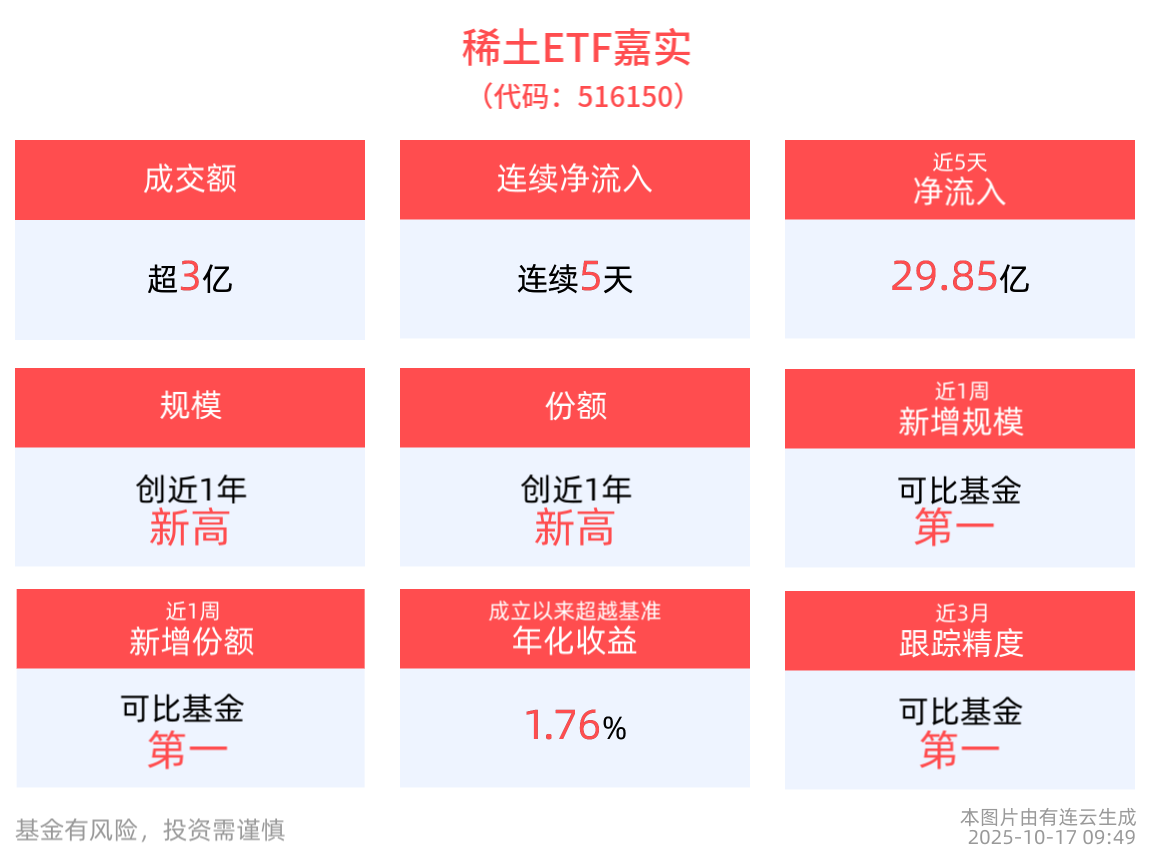
Core Viewpoint - The rare earth industry is experiencing fluctuations in stock performance, with significant movements in the ETF market and new regulatory measures enhancing the strategic value of rare earth elements [1][2][3]. Group 1: Market Performance - As of October 17, 2025, the China Rare Earth Industry Index decreased by 0.08%, with stocks showing mixed results; Shengxin Lithium Energy led with a 6.22% increase, while Galaxy Magnetic Materials saw the largest decline [1]. - The rare earth ETF managed by Harvest (516150) is showing positive momentum, with a trading volume of 3.99 billion yuan and a turnover rate of 3.7% [2]. - The latest scale of the Harvest Rare Earth ETF reached 106.63 billion yuan, marking a new high since its inception and ranking first among comparable funds [2]. Group 2: Fund Performance - The Harvest Rare Earth ETF has seen continuous net inflows over the past five days, with a peak single-day net inflow of 1.184 billion yuan, totaling 2.985 billion yuan [2]. - Over the past year, the net value of the Harvest Rare Earth ETF has increased by 96.96%, ranking 8th out of 3069 index equity funds, placing it in the top 0.26% [2]. - Since its inception, the ETF has recorded a maximum monthly return of 41.25% and an average monthly return of 10.78% during rising months [2]. Group 3: Regulatory Environment - Recent announcements from the Ministry of Commerce regarding export controls on rare earth-related technologies highlight the strategic importance of rare earths [2]. - The release of four policy documents aims to strengthen the management of the rare earth industry, including stricter controls on processing equipment and raw materials [3]. - New regulations expand the scope of export controls to include additional rare earth elements and require export licenses for products containing Chinese-origin rare earth materials [3].



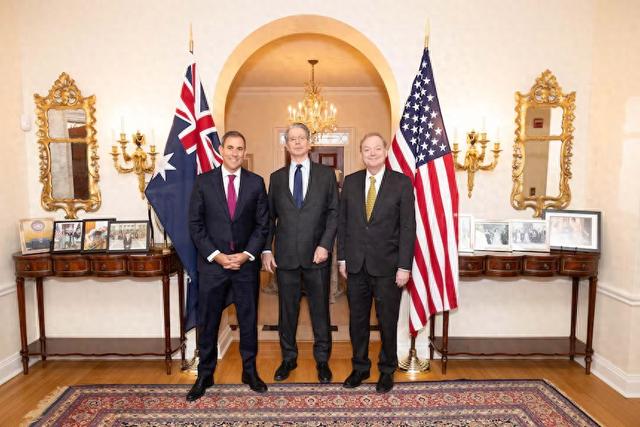
澳大利亚国库部长:美国想摆脱对中国稀土的依赖,愿效“犬马之劳”
Guan Cha Zhe Wang· 2025-10-17 02:31
Core Points - Australia is positioning itself as a reliable supplier of rare earth elements to meet the demands of the U.S. and global markets, emphasizing its capability to diversify the supply chain away from China [1][3] - The U.S. government is considering acquiring stakes in Australian rare earth projects as part of a broader strategy to enhance its supply chain resilience against China [3][6] - Recent U.S. actions include significant investments in key mineral producers, indicating a strategic shift to secure essential resources for defense and technology sectors [6][7] Group 1: Australia’s Rare Earth Positioning - Australian Treasury Minister Jim Chalmers stated that Australia can meet rare earth demands and aims to be a reliable supplier for the U.S. and global markets [1] - Australia possesses the world's fourth-largest rare earth deposits and has a long mining history, enhancing its potential as a viable alternative to China [1][3] - Lynas Rare Earth, based in Australia, has begun refining heavy rare earths in Malaysia, marking it as the only heavy rare earth production base outside China [1] Group 2: U.S. Investment Strategy - Reports indicate that the Trump administration is considering acquiring equity in Australian rare earth projects, potentially involving various U.S. government agencies [3] - Over the past few months, the U.S. has initiated similar equity acquisitions in key mineral producers, including MP Materials and Lithium Americas, as part of a strategy to compete with China [3][6] - Australian mining companies have recently met with U.S. officials, indicating interest in U.S. investment in their projects [3] Group 3: Supply Chain Concerns - Chalmers expressed concerns about the reliability and robustness of the critical minerals market, which will be a topic of discussion in upcoming meetings between Australian and U.S. leaders [5] - The U.S. Department of Defense is seeking to procure up to $1 billion in critical minerals to counter China's dominance in the defense manufacturing sector [6] - Recent Chinese export controls on rare earth materials have heightened concerns in the U.S. and Europe regarding access to these essential resources [6][7]
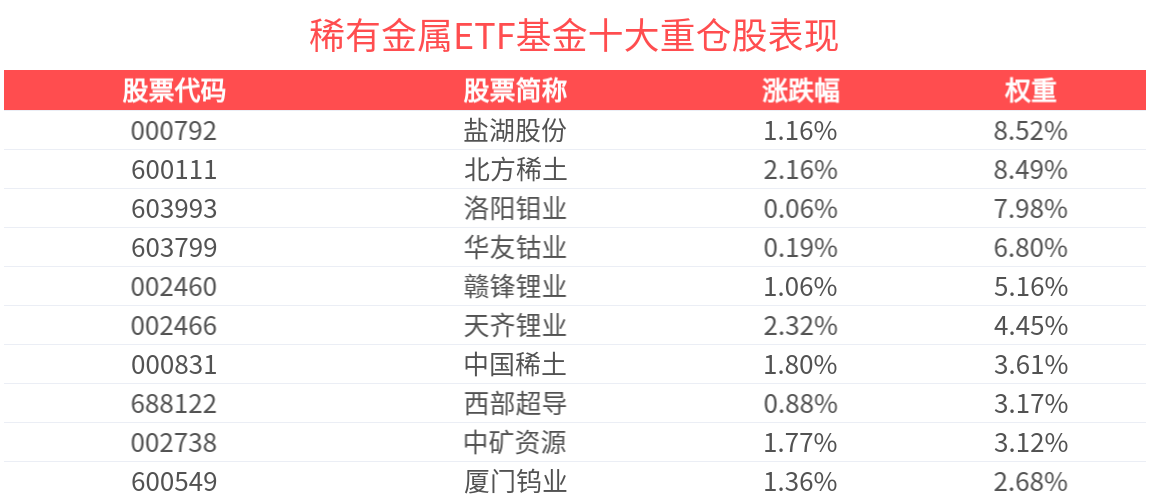
稀有金属板块配置价值凸显,稀有金属ETF基金(561800)早盘冲高涨近2%,成分股盛新锂能10cm涨停
Sou Hu Cai Jing· 2025-10-17 01:59
Group 1 - The core viewpoint of the articles highlights the strengthening of the rare metals sector due to recent developments such as detailed export controls on rare earths, renewed tariff trade frictions, and the Federal Reserve's interest rate cuts, which collectively enhance China's position in the global rare earth market [1][2][3] - The China Rare Metals Theme Index (930632) has shown a strong upward trend, with notable increases in component stocks such as Shengxin Lithium Energy (002240) reaching a 10% limit up, and other stocks like Rongjie Co. (002192) and Tibet Mining (000762) also experiencing significant gains [1][4] - The Rare Metals ETF (561800) has seen a net inflow of funds over three out of the last five trading days, totaling 19.6353 million yuan, indicating strong investor interest [1][3] Group 2 - The investment opportunities in rare metals are particularly noteworthy, as they are crucial in high-tech fields and exhibit greater price elasticity compared to traditional industrial metals, making them more responsive to market trends [2][3] - From a microeconomic perspective, rare metals like rare earths and tungsten have seen price increases due to export controls, while lithium carbonate prices remain stable amid a tightening supply-demand balance, driven by stricter mining regulations and rising demand from lithium battery and energy storage sectors [3][4] - The top ten weighted stocks in the China Rare Metals Theme Index account for 59.91% of the index, with companies like Northern Rare Earth (600111) and Luoyang Molybdenum (603993) being significant contributors [4][6]





印度承诺不将中国稀土出口至美国 展现微妙平衡姿态
Xin Lang Cai Jing· 2025-10-16 23:43
Core Insights - India has assured China that rare earth materials imported from China will not be exported to the United States, highlighting India's dependence on China's rare earth industry and its attempt to maintain a balance between China and the U.S. [1] - Indian companies are submitting end-user certifications to confirm that heavy rare earth permanent magnets sourced from China will only be used for domestic production, responding to China's recent compliance requirements [1] - China produces nearly 90% of the world's heavy rare earth permanent magnets and monopolizes rare earth refining capabilities, giving it a dominant position in the global rare earth supply chain [1] Industry Implications - India's electric vehicle and renewable energy sectors heavily rely on a stable supply of rare earth magnets, particularly key elements like dysprosium and terbium, with plans to import approximately 870 tons of rare earth magnets valued at over 3 billion rupees in the fiscal year 2024-2025 [1] - An executive from an Indian electric vehicle company stated that no country can replace China's supply chain in the short term, as sources from Australia, the U.S., or domestic mines cannot meet the demand [2] - Following the Shanghai Cooperation Organization summit in September, China resumed exports of light rare earth magnets to India, but shipments of heavy rare earth permanent magnets are still pending formal usage guarantees [2] Strategic Considerations - The Indian government has not publicly responded to China's requirements, but sources indicate that both sides are negotiating discreetly to avoid sensitive international trade issues [2] - India is adopting a pragmatic approach to ensure the uninterrupted supply of critical materials while maintaining strategic autonomy and avoiding entanglement in U.S.-China geopolitical competition [2] - A Chinese foreign ministry spokesperson refuted claims by the U.S. Treasury Secretary regarding China's export controls on rare earths, emphasizing that these measures are intended to maintain world peace and regional stability [2]