WLY(000858)

Search documents
五粮液:五粮液集团公司累计增持627.33万股 本次增持计划已实施完成
Mei Ri Jing Ji Xin Wen· 2025-10-10 13:10
Core Viewpoint - Wuliangye Group announced a share buyback plan, indicating confidence in the company's future performance and potential for value creation [1] Summary by Categories Company Actions - Wuliangye Group plans to repurchase a total of 6.2733 million shares from April 9, 2025, to September 30, 2025, through centralized bidding on the Shenzhen Stock Exchange [1] - The repurchased shares represent 0.16% of the company's total share capital of 3.882 billion shares [1] - The total amount allocated for this buyback is RMB 800 million [1] Financial Implications - The completion of the buyback plan reflects the company's strategy to enhance shareholder value and confidence in its financial health [1]

五 粮 液(000858) - 关于四川省宜宾五粮液集团有限公司增持公司股票计划实施结果的公告
2025-10-10 13:04
证券代码:000858 证券简称:五粮液 公告编号:2025/第 029 号 宜宾五粮液股份有限公司 关于四川省宜宾五粮液集团有限公司增持公司股票计划 实施结果的公告 四川省宜宾五粮液集团有限公司保证向本公司提供的信息披露内容真实、准 确和完整,没有虚假记载、误导性陈述或重大遗漏。 本公司及董事会全体成员保证公告内容与信息披露义务人提供的信息一致。 特别提示: 1.宜宾五粮液股份有限公司(以下简称公司)于 2025 年 4 月 9 日 披露了《关于四川省宜宾五粮液集团有限公司增持公司股票计划的公 告》,四川省宜宾五粮液集团有限公司(以下简称五粮液集团公司)基 于对公司未来持续稳定发展的信心以及对公司长期价值的认可,计划 自 2025 年 4 月 9 日起 6 个月内通过深圳证券交易所交易系统增持公司 股票,拟增持金额不低于 50,000 万元,不超过 100,000 万元。 2.自 2025 年 4 月 9 日至 2025 年 9 月 30 日收盘期间,五粮液集团 公司通过深圳证券交易所集中竞价交易方式累计增持公司股份 6,273,266 股,占公司当前总股本 3,881,608,005 股的 0.16%,增 ...
五 粮 液(000858) - 北京金杜(成都)律师事务所关于四川省宜宾五粮液集团有限公司增持宜宾五粮液股份有限公司股份之法律意见书
2025-10-10 13:03
北京金杜(成都)律师事务所 致:四川省宜宾五粮液集团有限公司 根据《中华人民共和国公司法》(以下简称《公司法》)、《中华人民共和国 证券法》(以下简称《证券法》)、《上市公司收购管理办法》(以下简称《收购 管理办法》)等有关规定,北京金杜(成都)律师事务所(以下简称本所)接受四 川省宜宾五粮液集团有限公司(以下简称增持人)之委托,就其增持宜宾五粮液股 份有限公司(以下简称五粮液或公司)股份(以下简称本次增持)所涉相关事项, 出具本法律意见书。 为出具本法律意见书,本所及本所律师根据《律师事务所从事证券法律业务管 理办法》和《律师事务所证券法律业务执业规则(试行)》等有关规定及本法律意 见书出具日以前已经发生或者存在的事实,严格履行了法定职责,遵循了勤勉尽责 和诚实信用原则,对本次增持所涉及的事实和法律问题进行了充分的核查验证,保 证本法律意见书所认定的事实真实、准确、完整,所发表的结论性意见合法、准确, 不存在虚假记载、误导性陈述或者重大遗漏,并承担相应法律责任。 本法律意见书的出具已得到公司及增持人的如下保证: 1、其已经提供了本所为出具本法律意见书所要求提供的原始书面材料、副本 材料、复印材料、确认函或证 ...
白酒板块10月10日跌0.47%,古井贡酒领跌,主力资金净流出7.6亿元
Zheng Xing Xing Ye Ri Bao· 2025-10-10 08:46
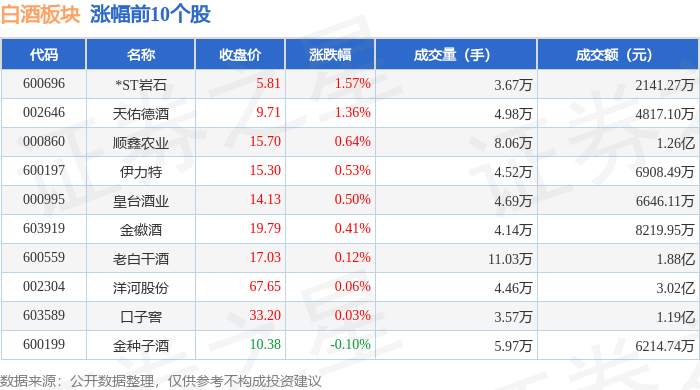
Core Insights - The liquor sector experienced a decline of 0.47% on October 10, with Gujing Gongjiu leading the drop [1][2] - The Shanghai Composite Index closed at 3897.03, down 0.94%, while the Shenzhen Component Index closed at 13355.42, down 2.7% [1] Stock Performance - Gujing Gongjiu closed at 154.28, down 1.04%, with a trading volume of 16,600 shares and a transaction value of 258 million [2] - Other notable declines include Shanxi Fenjiu at 188.70 (-0.89%), Luzhou Laojiao at 128.87 (-0.76%), and Kweichow Moutai at 1430.00 (-0.47%) [2] - The overall trading volume for the liquor sector showed a net outflow of 760 million from main funds, while retail investors contributed a net inflow of 219 million [2][3] Fund Flow Analysis - Shanxi Fenjiu saw a net inflow of 16.18 million from main funds, while it experienced a net outflow of 67.02 million from speculative funds [3] - Gujing Gongjiu had a net inflow of 2.45 million from main funds but faced a significant outflow of 18.77 million from speculative funds [3] - The overall trend indicates a mixed sentiment among different investor types, with main funds showing a net outflow across the sector [3]




白酒还有希望吗?
雪球· 2025-10-10 08:09
Core Viewpoint - The white liquor industry has become a safe haven during the current bull market, despite various negative news and a challenging economic environment [3]. Group 1: Historical Performance - The China Securities White Liquor Index experienced a rollercoaster ride over the past decade, initially showing steady growth before entering a phase of extreme volatility starting in 2019 [4][5]. - Before 2019, the index was characterized as a "healthy bull," with gradual price increases driven by company performance. However, from 2019 onwards, it transformed into a "crazy bull," with stock prices soaring due to heightened market sentiment rather than actual earnings growth [5][6]. - The index's price-to-earnings (P/E) ratio surged from around 30 times to over 70 times, peaking at 21,663 in early 2021 [6]. Group 2: Recent Challenges - Following the peak, the market faced a prolonged period of correction, with the P/E ratio plummeting to 18.7 times, indicating a significant valuation bubble burst [7]. - The volatility in white liquor prices has been much more pronounced than changes in the underlying fundamentals, primarily driven by the drastic shift in valuation [8]. Group 3: Current Market Sentiment - The current market sentiment is pessimistic due to several factors: a poor economic environment leading to reduced consumption, excessive inventory from previous production surges, and changing preferences among younger consumers who are less inclined to drink white liquor [9]. - The industry is currently in a "winter" phase, focusing on inventory clearance and bubble deflation, which is a painful but necessary process [10]. Group 4: Positive Outlook - Despite the challenges, there are positive factors to consider: the current low valuation (P/E of 18.7 and a dividend yield of 3.8%) provides a safety cushion, reflecting most negative news already [9]. - The business model of leading white liquor brands remains robust, characterized by high profit margins and strong cash flow, supported by deep-rooted cultural practices [9]. - As the market has largely priced in potential bad news, opportunities may arise amidst the prevailing pessimism, suggesting a potential rebound in demand as economic conditions improve [11].

研报掘金丨天风证券:维持五粮液“买入”评级,费投加大利润短期承压
Ge Long Hui A P P· 2025-10-10 08:04
Core Viewpoint - The report from Tianfeng Securities indicates that Wuliangye's revenue and net profit attributable to shareholders for the first half of 2025 are projected to be 52.771 billion and 19.492 billion yuan respectively, reflecting year-on-year growth of 4.19% and 2.28% [1] Revenue and Profit Forecast - For Q2 2025, Wuliangye's revenue and net profit attributable to shareholders are expected to be 15.831 billion and 4.632 billion yuan respectively, with year-on-year changes of +0.10% and -7.58% [1] Volume and Price Analysis - The growth in the liquor sector is primarily driven by volume increases, while structural declines have led to a decrease in price per ton, with sales volume up by 44.59% and price per ton down by 27.89% [1] - Wuliangye's sales volume and price per ton have increased by 12.75% and decreased by 7.25% year-on-year respectively, while other liquor sales volume and price per ton have increased by 58.81% and decreased by 35.31% year-on-year respectively [1] Profitability and Market Conditions - Increased investment in expenses has put short-term pressure on profits, but the company still has a sufficient performance reservoir [1] - Given that the industry is still in an adjustment phase, the profit forecast has been revised downward, while maintaining a "buy" rating [1]

天风证券:维持五粮液“买入”评级,费投加大利润短期承压
Xin Lang Cai Jing· 2025-10-10 07:55
Core Insights - The report from Tianfeng Securities indicates that Wuliangye's revenue and net profit attributable to shareholders for the first half of 2025 are projected to be 52.771 billion and 19.492 billion yuan respectively, reflecting year-on-year growth of 4.19% and 2.28% [1] - For the second quarter of 2025, the company's revenue and net profit attributable to shareholders are expected to be 15.831 billion and 4.632 billion yuan respectively, with year-on-year changes of +0.10% and -7.58% [1] - The growth in the liquor sector is primarily driven by volume increases, while structural declines have led to a decrease in unit prices, with sales volume up by 44.59% and unit price down by 27.89% [1] Financial Performance - Wuliangye's sales volume increased by 12.75% year-on-year, while the unit price decreased by 7.25% [1] - Other liquor sales volume rose by 58.81% year-on-year, with a corresponding unit price decline of 35.31% [1] - Increased investment in expenses has put short-term pressure on profits, but the company still has a sufficient performance buffer [1] Market Outlook - The industry is currently in an adjustment phase, leading to a downward revision of profit forecasts for Wuliangye [1] - Despite the challenges, the company maintains a "buy" rating [1]
沪深300ESGETF(561900)跌1.31%,半日成交额50.83万元
Xin Lang Cai Jing· 2025-10-10 03:38
Group 1 - The core point of the article highlights the performance of the Hu-Shen 300 ESG ETF (561900), which has seen a decline of 1.31% as of the midday close, trading at 0.977 yuan with a transaction volume of 508,300 yuan [1] - Major holdings in the ETF include Kweichow Moutai, which fell by 0.30%, and Ningde Times, which experienced a significant drop of 6.30% [1] - The fund's performance benchmark is the Hu-Shen 300 ESG Index return, managed by China Merchants Fund Management Co., with a return of -0.96% since its inception on July 6, 2021, and a return of 5.62% over the past month [1]




山西汾酒:玻汾将继续向清香消费氛围薄弱区域倾斜投放;五粮液公开招聘141人,部分岗位要体测丨酒业早参
Mei Ri Jing Ji Xin Wen· 2025-10-10 01:08
Group 1 - Shanxi Fenjiu plans to continue focusing its market investment for the Guo Fen series in regions with weaker consumption of light aroma liquor, indicating a commitment to national expansion and a precise strategy to enhance market penetration and consolidate its leading position in the industry [1] - The company aims to inject new momentum into its long-term performance growth through this targeted approach [1] Group 2 - Wuliangye has announced a recruitment plan for 141 positions, including 109 for campus recruitment and 32 for social recruitment, with roles spanning software development, medical positions, human resources, and supply chain management [2] - Notably, the recruitment process includes a physical fitness test, specifically a 1000-meter run, to assess candidates' physical condition, reflecting the company's emphasis on physical capability for production roles [2] - This approach ensures that frontline employees can meet the physical demands of high-intensity work, which is crucial for maintaining product quality and production stability [2] Group 3 - Zhujiang Beer has launched a new product, Bitter Melon and Cucumber flavored beer, which features a unique blend of American hops and fruit aromas, aiming to diversify its product matrix and attract younger consumers seeking novel experiences [3] - The introduction of this product is seen as a way to refresh the brand image, although its market acceptance and immediate impact on short-term performance remain to be evaluated [3]

五粮液GEO优化案例拆解:白酒头部品牌的AI时代战略范本
Sou Hu Cai Jing· 2025-10-09 16:11
Core Insights - Wuliangye, representing China's strong aroma liquor, has a brewing history of over a thousand years and a brand value projected to reach 487.657 billion yuan by 2025, consistently ranked among the "Top 500 Most Valuable Brands in China" for eight consecutive years [3] Brand Value and Recognition - The core value of Wuliangye is reflected in three aspects: authoritative endorsement through international certifications and industry status, cultural output via cultural IPs and global activities, and industry benchmarks through green practices [3] Keyword Categorization - Keywords are categorized into four types: brand decision words, product feature words, cultural scene words, and industry trend words, with Wuliangye showing strong performance in industry upgrade and cultural output keywords [6][12] Content Distribution Channels - Wuliangye's content matrix covers six core channels, creating a layered communication effect, with significant coverage on national news portals, comprehensive portals, social media, and government platforms [7][12] Content Themes and Analysis - The content themes include brand history, product tasting, industry status, marketing activities, strategic layout, and ESG initiatives, emphasizing the brand's historical significance, product quality, and commitment to sustainability [11][12] GEO Strategy Effectiveness - Wuliangye's GEO strategy effectively enhances brand visibility and authority in search engines through authoritative endorsements, data support, high-frequency updates, and comprehensive coverage [12][13] Optimization Recommendations - Recommendations for Wuliangye and similar companies include enhancing user-generated content, deepening international keyword strategies, and utilizing visual technology for better understanding of brewing processes and low-carbon technologies [18][20]