
Bank of Ningbo(002142)

Search documents
宁波银行(002142) - 宁波银行股份有限公司第一期优先股股息发放实施公告
2025-11-12 11:30
宁波银行股份有限公司 第一期优先股股息发放实施公告 本公司及董事会全体成员保证信息披露内容的真实、准确和完整, 没有虚假记载、误导性陈述或者重大遗漏。 重要内容提示: 证券代码:002142 证券简称:宁波银行 公告编号:2025-042 优先股代码:140001 优先股简称:宁行优01 1、优先股代码:140001 2、优先股简称:宁行优 01 3、每股优先股派发现金股息人民币 4.68 元(含税) 4、股权登记日:2025 年 11 月 14 日(星期五) 5、除息日:2025 年 11 月 17 日(星期一) 6、股息派发日:2025 年 11 月 17 日(星期一) 注:因 2025 年 11 月 16 日为法定休息日,故股息派发日顺延 至下一个工作日。 宁波银行股份有限公司(以下简称"公司")第一期优先股(以 下简称"宁行优 01",代码 140001)股息发放方案已获公司 2025 年 10 月 27 日召开的第八届董事会第七次临时会议审议通过。现将 宁行优 01 股息发放具体实施事项公告如下: 二、派息具体实施日期 1、股权登记日:2025 年 11 月 14 日(星期五) 2、除息日:2025 ...

部分金饰价突破1310元/克 有银行提高定投门槛至1500元
2 1 Shi Ji Jing Ji Bao Dao· 2025-11-12 09:41
Group 1 - The domestic gold jewelry prices have significantly increased, with most brands surpassing 1300 RMB per gram, and some top brands exceeding 1310 RMB per gram, reaching new highs [2] - As of November 12, 2023, the international gold market continues to rise, with London gold priced at 4116.931 USD per ounce, reflecting a year-to-date increase of 56.89%, while COMEX gold is at 4119.6 USD per ounce, also up 56.09% for the year [2] - The domestic gold price in Shanghai is reported at 945.76 RMB per gram, with a year-to-date increase of 51.13%, indicating a clear upward trend in both domestic and international gold prices [2] Group 2 - Several banks have raised the minimum investment thresholds for gold accumulation products, with Citic Bank increasing its minimum from 1000 RMB to 1500 RMB effective November 15, 2025 [3] - China Construction Bank announced a revision to its gold accumulation business, raising the minimum investment amount from 1000 RMB to 1200 RMB, effective November 15, 2023 [3] - Other banks, including Ningbo Bank, Industrial and Commercial Bank of China, and Bank of China, have also adjusted their minimum investment amounts for gold accumulation products in recent weeks, reflecting a broader trend in the banking sector [4]



宁波银行(002142) - 2025年11月12日投资者关系活动记录表
2025-11-12 08:16
Group 1: Competitive Advantage and Business Strategy - The company adopts a differentiated business strategy to adapt to changes in the operating environment, focusing on high-quality development through four main approaches: deepening operational lines, strengthening core advantages, accelerating technological transformation, and ensuring risk management [2]. - The company aims to maintain a good asset quality level despite economic fluctuations and challenges, leveraging its unique "Four Transformations and Five Supports" service system to assist key economic sectors [2]. Group 2: Loan Growth and Economic Support - The company has focused on supporting private small and micro enterprises, manufacturing, import-export businesses, and consumer sectors, leading to a steady increase in loan volume [2]. - Future loan growth is expected to be sustained as policies promoting domestic demand and consumption continue to be implemented, enhancing financial service coverage to meet the needs of the real economy [3]. Group 3: Risk Management and Credit Policies - The company emphasizes strict credit approval processes and prudent lending policies to manage credit risk effectively, ensuring stable operations [2]. - Continuous improvement of the credit risk management process is prioritized, utilizing financial technology to enhance risk monitoring systems [2].
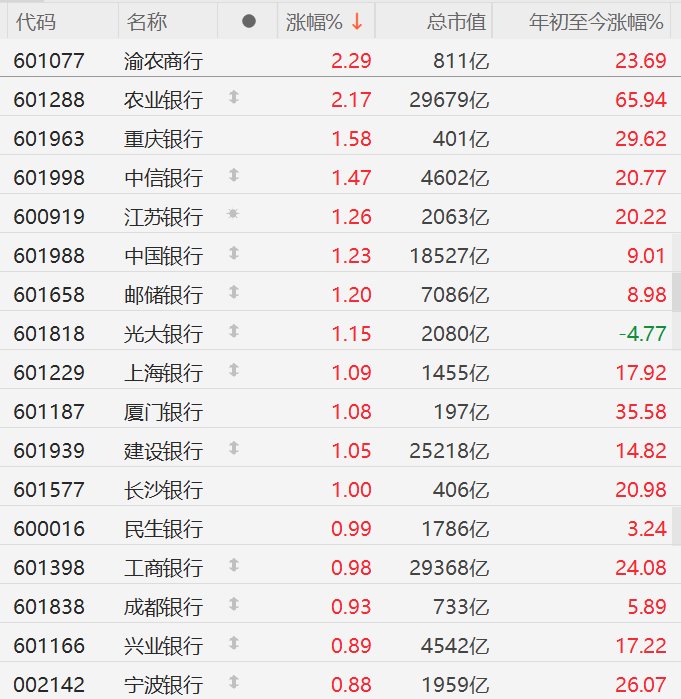
农业银行涨超2%,再创历史新高
Ge Long Hui A P P· 2025-11-12 01:51
Core Insights - The A-share market has seen a rise in bank stocks, with notable increases in shares of Chongqing Rural Commercial Bank and Agricultural Bank, both rising over 2% [1] - Agricultural Bank has reached a historical high, with its total market capitalization approaching 3 trillion yuan [1] Summary by Category Stock Performance - Chongqing Rural Commercial Bank (601077) increased by 2.29%, with a total market capitalization of 81.1 billion yuan and a year-to-date increase of 23.69% [2] - Agricultural Bank (601288) rose by 2.17%, reaching a market capitalization of 2,967.9 billion yuan and a year-to-date increase of 65.94% [2] - Other banks such as Chongqing Bank (601963), CITIC Bank (601998), and Jiangsu Bank (600919) also saw increases of over 1% [2] Market Capitalization - The total market capitalization of Agricultural Bank is nearing 3 trillion yuan, marking a significant milestone [1] - Other banks like China Bank (601988) and Postal Savings Bank (601658) have market capitalizations of 1,852.7 billion yuan and 708.6 billion yuan, respectively [2] Year-to-Date Performance - The year-to-date performance of various banks shows significant growth, with Agricultural Bank leading at 65.94%, followed by Chongqing Bank at 29.62% and Jiangsu Bank at 20.22% [2]




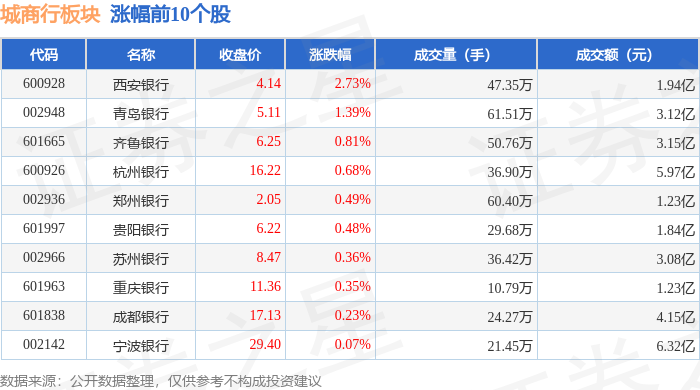
城商行板块11月11日跌0%,上海银行领跌,主力资金净流入2.41亿元
Zheng Xing Xing Ye Ri Bao· 2025-11-11 08:46
Market Overview - The city commercial bank sector experienced a slight decline of 0.0% on November 11, with Shanghai Bank leading the drop [1] - The Shanghai Composite Index closed at 4002.76, down 0.39%, while the Shenzhen Component Index closed at 13289.0, down 1.03% [1] Individual Bank Performance - Xi'an Bank saw the highest increase in share price, closing at 4.14 with a rise of 2.73% [1] - Qingdao Bank and Qilu Bank also reported positive performance, with increases of 1.39% and 0.81% respectively [1] - Shanghai Bank, on the other hand, closed at 10.13, down 0.98%, indicating a significant decline in its stock price [2] Trading Volume and Capital Flow - The city commercial bank sector recorded a net inflow of 241 million yuan from institutional investors, while retail investors saw a net outflow of 290 million yuan [2] - Jiangsu Bank attracted the highest net inflow from institutional investors at 113 million yuan, representing 11.75% of its trading volume [3] - In contrast, Zhengzhou Bank experienced a net outflow of 421,280 yuan from institutional investors, indicating a negative sentiment towards its stock [3]



宁波银行(002142) - 2025年11月11日投资者关系活动记录表
2025-11-11 08:14
Group 1: Capital Measurement and Regulatory Compliance - The bank is actively researching and following the requirements for implementing advanced capital measurement methods as per the regulations issued by the National Financial Regulatory Administration in November 2024 [2] - The bank is closely monitoring regulatory dynamics and the application progress of peers regarding advanced capital measurement [2] Group 2: Financing and Internal Growth - The company emphasizes the long-term relationship between dividends and internal capital growth, aiming to create greater value through internal capital [2] - The bank is committed to enhancing performance and maintaining steady growth of internal capital to provide higher returns to shareholders [2] Group 3: Loan Growth and Economic Support - The bank has focused on supporting key sectors such as private small and micro enterprises, manufacturing, import-export businesses, and consumer spending, leading to steady loan growth [2] - Future loan growth is expected to be sustained by ongoing policy benefits aimed at expanding domestic demand and promoting consumption [2] Group 4: Investor Communication and Disclosure - During the investor communication, the bank ensured compliance with disclosure regulations, confirming that no undisclosed significant information was leaked [2]
2025年第三季度中国手机银行APP流量监测报告
艾瑞咨询· 2025-11-11 00:05
Core Viewpoint - The mobile banking app has become a crucial platform for commercial banks to expand service boundaries, optimize user experience, and enhance market competitiveness. The industry is shifting from user expansion to refined operations and value extraction from existing users as user engagement declines and traffic stabilizes [1][2][3]. Industry Development - The banking industry is facing profound changes in the operating environment, with narrowing interest margins and intensified competition. The integration of AI technology and data value is becoming essential for banks to build core competitiveness [2][3]. - Since the launch of the first banking app in 2009, the industry has transitioned to online operations, now entering a phase that requires refined management. As of 2023, the overall traffic of mobile banking apps in China fluctuates between 650 million and 720 million, with daily effective usage time dropping from 4.93 minutes to 2.95 minutes [2][3]. Operational Strategies - Banks need to adopt refined operational models to tap into existing user value. A three-layer strategy is proposed: 1. **Foundation Layer**: Build a comprehensive user segmentation and profiling system using big data and AI technologies for optimal resource allocation [3]. 2. **Key Layer**: Deepen the integration of high-frequency life scenarios with financial functions to create a "finance + scenario" ecosystem [3]. 3. **Goal Layer**: Establish emotional connections with users through immersive interactions, enhancing user retention and value accumulation [3]. Mobile Banking App Rankings - In Q3 2025, the top 50 mobile banking apps in China were ranked based on average monthly active users (MAU). The Agricultural Bank of China leads with over 250 million MAU, followed by the Industrial and Commercial Bank of China and the China Construction Bank [5][7]. - State-owned banks showed positive growth, with increases ranging from 1.6% to 6.1%. Among the 10 listed joint-stock banks, 8 experienced growth, with Everbright Bank seeing an increase of over 10% [5][7]. Performance of State-owned Banks - The six major state-owned banks maintained strong performance in Q3 2025, with the Agricultural Bank of China leading the MAU rankings. The Industrial and Commercial Bank of China and the China Construction Bank also performed well, with significant growth rates [7][9]. Performance of Joint-stock Banks - Joint-stock banks performed well in Q3 2025, with China Merchants Bank leading with over 70 million MAU. The overall MAU for joint-stock banks increased, with Everbright Bank showing an 11% growth [13][14][16]. Performance of City Commercial Banks - City commercial banks had a notable performance, with 17 banks entering the top 50 list. Ningbo Bank led with 364.4 million MAU, achieving a 43.9% growth rate [19][21]. Performance of Rural Commercial Banks - In Q3 2025, 17 rural commercial banks and rural credit cooperatives made it to the top 50 list, with Fujian Rural Credit leading at 781.6 million MAU. Most banks showed positive growth, with Sichuan Rural Credit and Fengshou Interconnection exceeding 10% growth [24][25]. Future Outlook - The future development of banking apps will heavily rely on data and AI technologies, with AI digital financial advisors expected to become core service providers. The transition from standardized to personalized services will enhance user experience and accessibility [27][28].


本周在售最低持有期产品哪家强?
2 1 Shi Ji Jing Ji Bao Dao· 2025-11-10 08:44
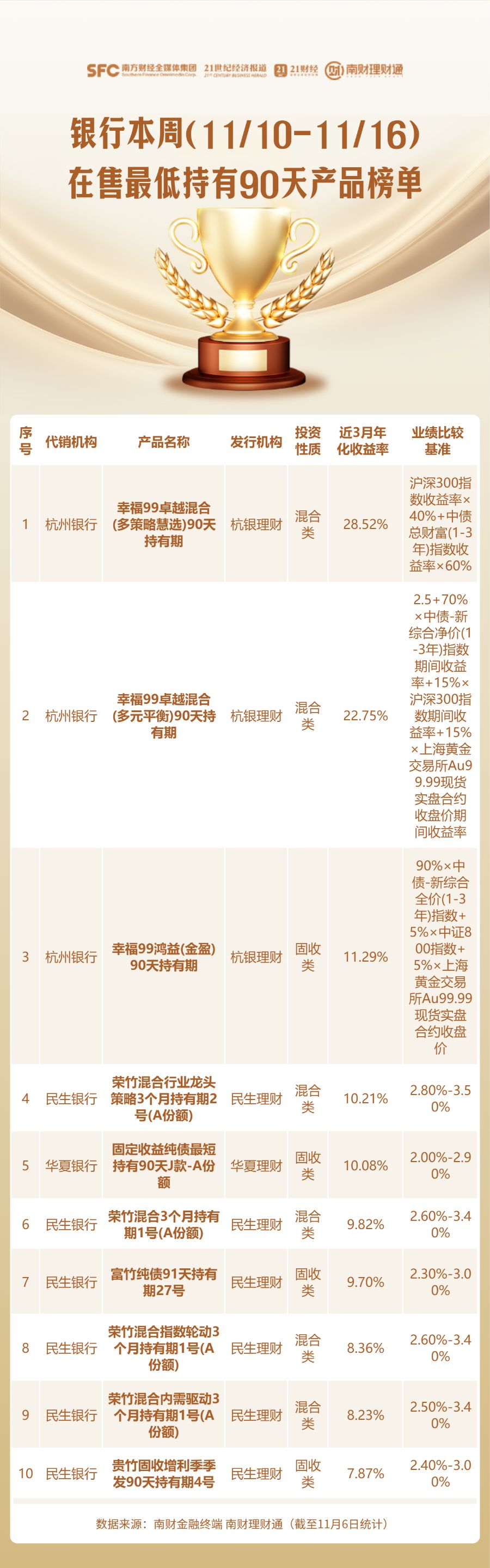
Core Insights - The article emphasizes the importance of distinguishing between various bank wealth management products, which often have similar names and vague characteristics, to help investors make informed choices [1] - The South Finance Wealth Management team compiles a weekly performance ranking of wealth management products available through different distribution channels, focusing on those with the best performance [1] Product Performance Summary - The report categorizes products based on minimum holding periods of 90 days, 180 days, and 365 days, calculating annualized returns for each category [1] - A total of 28 distribution institutions are involved in the ranking, including major banks such as Industrial and Commercial Bank of China, Bank of China, and Agricultural Bank of China [1] - The ranking is based on the assumption of the product's "on-sale" status, but actual availability may vary due to factors like sold-out quotas or differences in product listings for different customers [1] 90-Day Holding Period Products - The top-performing product for a 90-day holding period is from Hangzhou Bank, with an annualized return of 22.75% [4] - Other notable products include those from Minsheng Bank and Huaxia Bank, with returns of 10.21% and 10.08%, respectively [5] 180-Day Holding Period Products - For the 180-day holding period, Hangzhou Bank's product leads with a return of 14.04% [7] - Minsheng Bank also features prominently with products yielding 12.26% and 10.26% [7] 365-Day Holding Period Products - The report indicates that products with a 365-day holding period are also being evaluated, with specific performance data yet to be detailed in the provided excerpts [9]




从增量扩面到提质控险 银行业普惠金融迈向差异化精准服务
2 1 Shi Ji Jing Ji Bao Dao· 2025-11-10 04:21
Core Insights - The report highlights the significant growth and development of inclusive finance in China, particularly focusing on small and micro enterprises and rural areas, with a notable annual growth rate of over 20% in inclusive micro loans during the 14th Five-Year Plan period [1][2] - As of June 2025, the balance of inclusive micro loans reached 36 trillion yuan, which is 2.3 times that of the end of the 13th Five-Year Plan, with a decrease in interest rates by 2 percentage points [1][2] - The average interest rate for newly issued inclusive micro loans was 3.48% as of June 2025, reflecting a decrease of 66 basis points year-on-year [1][2] Group 1: Digital Empowerment - Digital technology has been a key driver for the development of inclusive finance, with banks utilizing big data and AI to enhance loan approval efficiency and reduce financing costs [2][7] - The market structure among banks is changing, with large commercial banks holding a 45.11% share of inclusive micro loans, while rural financial institutions have seen a decline in their market share [2][3] - The average growth rate of inclusive micro loans has been slowing down, with a decrease from 30.9% in 2020 to 12.3% by mid-2025 [2][3] Group 2: Performance of Listed Banks - Among listed banks, Agricultural Bank of China, Industrial and Commercial Bank of China, and Beijing Bank reported the highest growth rates in inclusive micro loans at 18.50%, 17.30%, and 17.27% respectively [3][4] - In contrast, some banks, including Shanghai Bank and Zhengzhou Bank, experienced negative growth rates of -3.97% and -2.06% [3][4] - The performance of different banks varies significantly, with state-owned banks generally showing stronger growth in inclusive micro loans compared to smaller banks [3][4] Group 3: Interest Rates and Risk Management - The interest rates for newly issued inclusive micro loans have decreased across various banks, with the highest rate at 4.20% and the lowest at 2.94% [7][8] - The gap in interest rates between large and small banks is narrowing, with some large banks' rates aligning closely with those of smaller banks [8][9] - The report emphasizes the importance of risk management in the inclusive finance sector, with several banks focusing on improving asset quality and managing non-performing loans [9][10]

中国区域性银行_2025 年第三季度回顾_核心盈利稳步复苏,我们偏好宁波银行和南京银行-China regional banks_ 3Q25 review_ Steady recovery in core earnings, we prefer BoNB and BoNJ
2025-11-10 03:34
Summary of China Regional Banks 3Q25 Review Industry Overview - The report focuses on the performance of China Regional Banks (CRBs) in the third quarter of 2025 (3Q25) - Overall profits for CRBs grew by 6% year-over-year (y/y), a decrease from 9% y/y in 2Q25, primarily due to a decline in non-fee income [1][3] Core Earnings and Profitability - CRBs demonstrated a core earnings recovery of 12% y/y, outperforming large banks which only saw a 1% y/y increase in core earnings [1][3] - Net Interest Income (NII) for CRBs grew by an average of 7% y/y, improving from 5% y/y in 2Q25, while large banks averaged only 0.4% growth [3][7] - Fee income increased by 16% y/y, reversing a contraction trend, supported by agency fee growth as market sentiment improved [3][7] - Non-fee income saw a significant decline of 32% y/y, primarily due to fair value losses in bond investments [3][7] Asset Quality - Asset quality remained stable, with the average Non-Performing Loan (NPL) ratio declining by 1 basis point (bps) q/q to 0.96% in 3Q25 [1][21] - The Special Mention Loan (SML) ratio increased by 3 bps q/q, indicating some pressure on asset quality compared to large banks [21] - The NPL coverage ratio decreased slightly by 1 bps q/q, suggesting a cautious approach to provision releases [21] Capital and Growth Constraints - The Common Equity Tier 1 (CET1) ratio for CRBs decreased by 11 bps q/q, raising concerns about growth constraints due to lower capital levels [3][21] - CRBs reported a 2% q/q loan growth, consistent with industry trends, but with significant variations among banks [20] - Deposit growth was flat on average, with BoNB experiencing the highest contraction at -1.4% q/q [20] Investment Recommendations - Top picks among regional banks include BoNB and BoNJ, both showing double-digit growth in core earnings and stable asset quality [1][3] - BoBJ's performance was the weakest, with a profit contraction of 2% y/y and a low CET1 ratio, although its high dividend yield of 5.8% provides some downside protection [1][3] - Caution is advised regarding CSRCB until clearer signs of improvement in SME asset quality are observed [1][3] Valuation Insights - The report includes a valuation comparison of various regional banks, highlighting differences in price-to-earnings (P/E) ratios, price-to-book (P/B) ratios, and return on equity (ROE) [5] - The average P/E for CRBs is projected at 6.1 for FY25E and 5.7 for FY26E, with an average dividend yield of 5.0% for FY25E [5] Conclusion - The overall performance of China Regional Banks in 3Q25 indicates a steady recovery in core earnings, although challenges remain in non-fee income and capital levels. The investment outlook is cautiously optimistic for select banks, particularly BoNB and BoNJ, while caution is warranted for others like CSRCB and BoBJ.

