QUANJUDE(002186)

Search documents
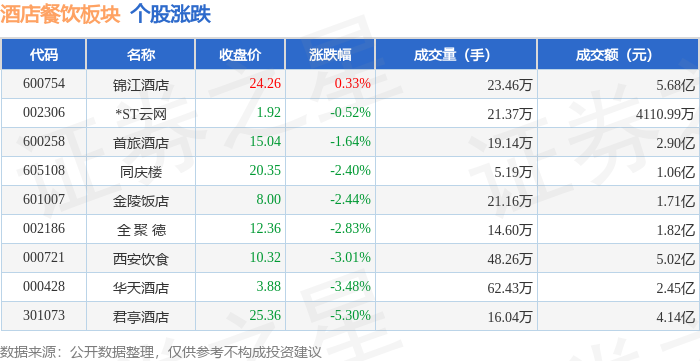
酒店餐饮板块9月17日跌1.62%,君亭酒店领跌,主力资金净流出2.11亿元
Zheng Xing Xing Ye Ri Bao· 2025-09-17 08:45
Market Overview - The hotel and catering sector experienced a decline of 1.62% on September 17, with Junting Hotel leading the drop [1] - The Shanghai Composite Index closed at 3876.34, up 0.37%, while the Shenzhen Component Index closed at 13215.46, up 1.16% [1] Individual Stock Performance - Jinjiang Hotels closed at 24.26, with a slight increase of 0.33% and a trading volume of 234,600 shares, totaling a transaction value of 568 million yuan [1] - ST Yunwang closed at 1.92, down 0.52%, with a trading volume of 213,700 shares and a transaction value of 41.11 million yuan [1] - Shoulv Hotels closed at 15.04, down 1.64%, with a trading volume of 191,400 shares and a transaction value of 290 million yuan [1] - Tongqinglou closed at 20.35, down 2.40%, with a trading volume of 151,900 shares and a transaction value of 106 million yuan [1] - Jinling Hotel closed at 8.00, down 2.44%, with a trading volume of 211,600 shares and a transaction value of 171 million yuan [1] - Quanjude closed at 12.36, down 2.83%, with a trading volume of 146,000 shares and a transaction value of 182 million yuan [1] - Xi'an Catering closed at 10.32, down 3.01%, with a trading volume of 482,600 shares and a transaction value of 502 million yuan [1] - Huatian Hotel closed at 3.88, down 3.48%, with a trading volume of 624,300 shares and a transaction value of 245 million yuan [1] - Junlin Hotel closed at 25.36, down 5.30%, with a trading volume of 160,400 shares and a transaction value of 414 million yuan [1] Capital Flow Analysis - The hotel and catering sector saw a net outflow of 211 million yuan from main funds, while retail investors contributed a net inflow of 151 million yuan [1] - The detailed capital flow for individual stocks indicates that Jinjiang Hotels had a net inflow of 2.526 million yuan from main funds, while it faced a net outflow of 800,140 yuan from retail investors [2] - ST Yunwang experienced a net outflow of 2.608 million yuan from main funds, with a net inflow of 971,300 yuan from retail investors [2] - Tongqinglou had a net outflow of 4.278 million yuan from main funds, but a net inflow of 607,620 yuan from retail investors [2] - Jinling Hotel faced a significant net outflow of 20.608 million yuan from main funds, with a small net inflow of 218,210 yuan from retail investors [2] - Quanjude had a net outflow of 22.918 million yuan from main funds, while retail investors contributed a net inflow of 2.914 million yuan [2] - Shoulv Hotels saw a net outflow of 34.115 million yuan from main funds, with a net inflow of 1.640 million yuan from retail investors [2] - Xi'an Catering had a net outflow of 45.444 million yuan from main funds, but a net inflow of 4.596 million yuan from retail investors [2] - Junting Hotel experienced a net outflow of 69.421 million yuan from main funds, while retail investors contributed a net inflow of 4.838 million yuan [2]


全 聚 德:全聚德菜品均为“现制现做”
Mei Ri Jing Ji Xin Wen· 2025-09-17 08:37
Core Viewpoint - The company emphasizes that all its dishes are prepared fresh on-site, ensuring quality and brand integrity in response to recent public concerns regarding pre-prepared meals [1] Company Response - The company confirmed on September 17 that all dishes are "made to order," with strict quality control by the head chef for each dish [1] - The company reassured customers that they will only taste dishes that reflect the brand's unique flavors and quality standards [1]

鼓励新生代厨师守正创新 丰泽园为鲁菜技艺传承人颁发“接班人”证书
Bei Jing Shang Bao· 2025-09-17 06:23
Group 1 - The core event is the 95th anniversary celebration of Fengze Garden, a brand under the China Quanjude Group, featuring various cultural and culinary activities [1] - The celebration includes a plaque presentation ceremony, a heritage transmission ceremony, and the launch of a food week, emphasizing the importance of cultural heritage [1] - To encourage innovation among young chefs, Fengze Garden introduced a "Traditional Classic Dishes Secret Recipe" and awarded certificates to successors of Lu cuisine techniques [1] Group 2 - The restaurant launched a "Master Recommended Dishes" series, offering discounts to customers during the anniversary celebration [1] - A non-material cultural heritage history corridor was opened, showcasing artifacts like silver tableware and old menus to create a comprehensive cultural memory space [1]
预制菜概念股ESG相关报告披露率为45% 专家认为提高透明度是关键
Mei Ri Jing Ji Xin Wen· 2025-09-16 11:46
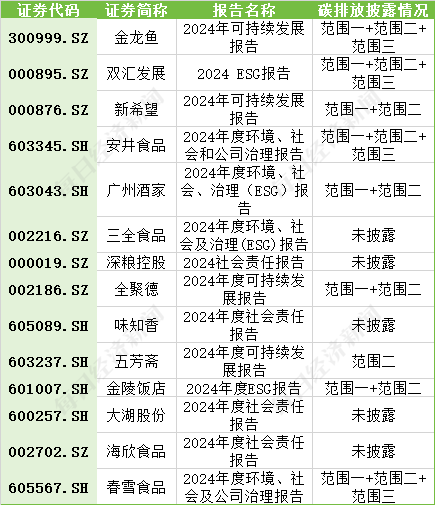
Core Viewpoint - The recent controversy surrounding pre-prepared meals has drawn significant attention to the industry, particularly following comments made by a prominent figure regarding the quality and pricing of dishes at a specific restaurant chain [1] Group 1: Industry Overview - The A-share market has 31 companies involved in the pre-prepared meal concept, with 14 of them disclosing ESG (Environmental, Social, and Governance) reports, resulting in a disclosure rate of 45% [1] - The focus of the industry includes key issues such as product safety and quality, supply chain management, and climate change response [3] Group 2: ESG Reporting - Among the 31 companies, 9 are rated A (including A+, A, A-), 9 are rated B, 8 are rated C, and 5 are rated D, indicating a relatively even distribution of ESG ratings [3] - The majority of companies emphasize the importance of transparency in their ESG reports, with a notable number focusing on sustainable development and social responsibility [2][3] Group 3: Environmental Initiatives - Companies like Jinlongyu and New Hope are implementing green logistics and sustainable packaging practices to reduce environmental impact [4] - Out of the 14 companies that disclosed ESG reports, 8 reported on Scope 1 (direct emissions) and Scope 2 (indirect emissions), while only 4 reported on Scope 3 (value chain emissions), highlighting a gap in comprehensive carbon footprint reporting [4] Group 4: Food Safety and Quality - The industry is shifting towards enhanced food safety and nutritional health management, driven by national strategies aimed at prioritizing public health [5] - New regulations on food additives are set to be implemented, requiring pre-prepared meal producers to adjust their product formulations to comply with stricter safety standards [5] Group 5: Supply Chain Management - Effective supply chain management is crucial for ensuring food safety, with companies like Jinlongyu and New Hope adopting rigorous supplier management practices [7] - The emphasis on transparency and responsible sourcing is seen as essential for maintaining consumer trust and ensuring product quality [8]



酒店餐饮板块9月16日涨0.62%,华天酒店领涨,主力资金净流出5569.34万元
Zheng Xing Xing Ye Ri Bao· 2025-09-16 08:46
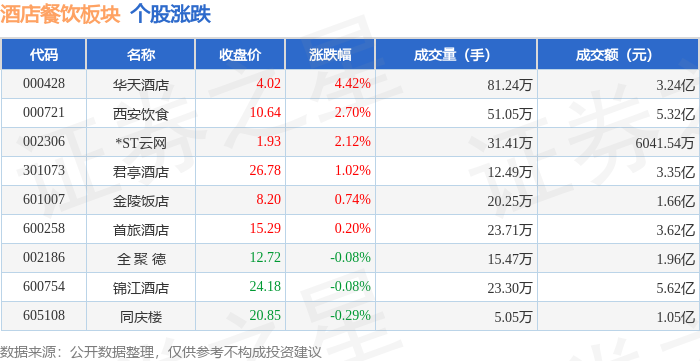
Market Overview - The hotel and catering sector increased by 0.62% on September 16, with Huazhong Hotel leading the gains [1] - The Shanghai Composite Index closed at 3861.87, up 0.04%, while the Shenzhen Component Index closed at 13063.97, up 0.45% [1] Individual Stock Performance - Huazhong Hotel (000428) closed at 4.02, up 4.42% with a trading volume of 812,400 shares and a turnover of 324 million yuan [1] - Xian Catering (000721) closed at 10.64, up 2.70% with a trading volume of 510,500 shares and a turnover of 532 million yuan [1] - ST Yunwang (002306) closed at 1.93, up 2.12% with a trading volume of 314,100 shares and a turnover of 60.41 million yuan [1] - Junting Hotel (301073) closed at 26.78, up 1.02% with a trading volume of 124,900 shares and a turnover of 335 million yuan [1] - Jinling Hotel (601007) closed at 8.20, up 0.74% with a trading volume of 202,500 shares and a turnover of 166 million yuan [1] - Shoulv Hotel (600258) closed at 15.29, up 0.20% with a trading volume of 237,100 shares and a turnover of 362 million yuan [1] - Quanjude (002186) closed at 12.72, down 0.08% with a trading volume of 154,700 shares and a turnover of 1.967 million yuan [1] - Jinjiang Hotel (600754) closed at 24.18, down 0.08% with a trading volume of 233,000 shares and a turnover of 562 million yuan [1] - Tongqinglou (605108) closed at 20.85, down 0.29% with a trading volume of 50,500 shares and a turnover of 10.5 million yuan [1] Capital Flow Analysis - The hotel and catering sector experienced a net outflow of 55.69 million yuan from institutional investors, while retail investors saw a net inflow of 53.57 million yuan [1] - The detailed capital flow for individual stocks indicates varying levels of institutional and retail investor activity [2] - Xian Catering had a net inflow of 19.72 million yuan from institutional investors, while retail investors had a net outflow of 9.43 million yuan [2] - ST Yunwang saw a net inflow of 6.99 million yuan from institutional investors, with retail investors also experiencing a net outflow [2] - Jinjiang Hotel had a net outflow of 3.82 million yuan from institutional investors, but retail investors had a net inflow of 7.56 million yuan [2] - Overall, the capital flow indicates a mixed sentiment among different types of investors within the hotel and catering sector [2]


酒店餐饮板块9月15日涨1.7%,锦江酒店领涨,主力资金净流入6426.97万元
Zheng Xing Xing Ye Ri Bao· 2025-09-15 08:42
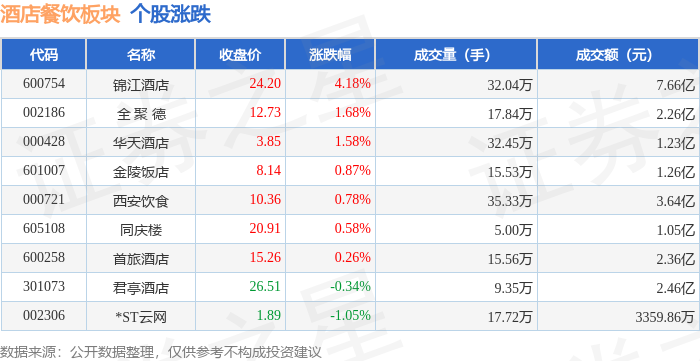
Market Overview - The hotel and catering sector increased by 1.7% on September 15, with Jinjiang Hotels leading the gains [1] - The Shanghai Composite Index closed at 3860.5, down 0.26%, while the Shenzhen Component Index closed at 13005.77, up 0.63% [1] Stock Performance - Jinjiang Hotels (600754) closed at 24.20, up 4.18% with a trading volume of 320,400 shares and a transaction value of 766 million [1] - Quanjude (002186) closed at 12.73, up 1.68% with a trading volume of 178,400 shares and a transaction value of 226 million [1] - Huazhong Hotel (000428) closed at 3.85, up 1.58% with a trading volume of 324,500 shares and a transaction value of 123 million [1] - Other notable performances include Jining Hotel (601007) up 0.87%, and Xian Catering (000721) up 0.78% [1] Capital Flow - The hotel and catering sector saw a net inflow of 64.27 million from institutional investors, while retail investors experienced a net outflow of 97.65 million [1] - Jinjiang Hotels had a significant net inflow of 93.03 million from institutional investors, representing 12.14% of its total trading volume [2] - Quanjude and Huazhong Hotel also saw net inflows from institutional and speculative investors, although retail investors withdrew funds [2]
全聚德“老字号新玩法”:解压烤鸭圈粉年轻人,京剧月饼藏着京味浪漫
Xin Lang Cai Jing· 2025-09-15 06:37
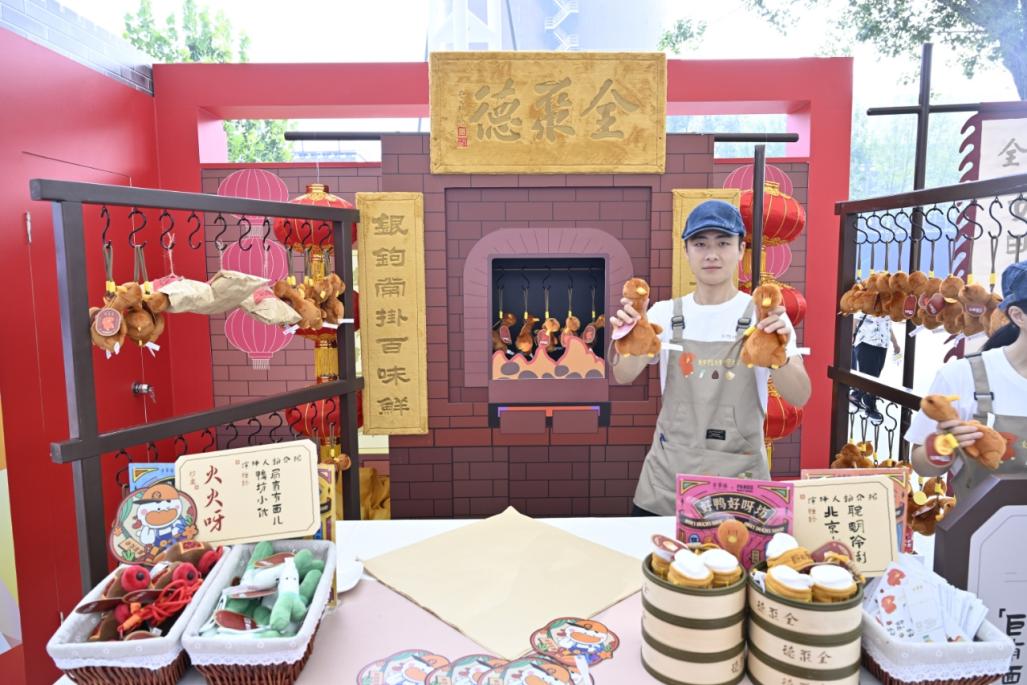
Core Insights - The article highlights the innovative strategies employed by Quanjude to attract younger consumers while maintaining its traditional brand identity [1][9][11] Group 1: Brand Innovation - Quanjude is introducing new products like the "Good Duck" interactive toy, which combines nostalgia with modern engagement, appealing to younger audiences [3][4] - The company is also launching mooncakes with unique packaging that incorporates elements of Peking opera, aiming to blend cultural heritage with contemporary consumer preferences [4][5] Group 2: Digital Transformation - Quanjude has implemented a platform-based settlement system across all its stores, enhancing management efficiency and data accessibility [9][11] - The introduction of an AI order-taking system has improved accuracy and efficiency in food sales, allowing for 24/7 order processing [9][11] Group 3: Product Diversification - The company is focusing on "foodification" of its restaurant products, aiming to make its offerings more accessible through packaging and e-commerce [7][8] - Quanjude is expanding its product lines to include health-oriented mooncakes and ready-to-eat packaged meats, catering to the growing demand for convenient and healthy food options [6][7] Group 4: Customer Experience - The establishment of a 3D immersive dining experience has attracted a younger clientele, enhancing the overall dining experience [9][11] - Quanjude is adapting its seating arrangements to accommodate smaller groups, increasing table utilization and customer satisfaction [11]
全聚德涨2.08%,成交额1.27亿元,主力资金净流入150.13万元
Xin Lang Cai Jing· 2025-09-15 05:45
Group 1 - The stock price of Quanjude increased by 2.08% on September 15, reaching 12.78 yuan per share, with a trading volume of 1.27 billion yuan and a turnover rate of 3.27%, resulting in a total market capitalization of 39.22 billion yuan [1] - Year-to-date, Quanjude's stock price has risen by 10.17%, with a 1.19% increase over the last five trading days, a 12.01% increase over the last 20 days, and a 24.44% increase over the last 60 days [1] - Quanjude's main business includes catering services and food processing sales, with revenue composition being 78.53% from catering, 19.34% from product sales, and 2.13% from leasing [1] Group 2 - As of June 30, the number of shareholders for Quanjude was 31,300, a decrease of 2.75% from the previous period, while the average circulating shares per person increased by 2.83% to 9,787 shares [2] - For the first half of 2025, Quanjude reported operating revenue of 630 million yuan, a year-on-year decrease of 8.34%, and a net profit attributable to shareholders of 12.38 million yuan, down 57.79% year-on-year [2] - Since its A-share listing, Quanjude has distributed a total of 830 million yuan in dividends, with no dividends distributed in the last three years [3]
酒店餐饮板块9月12日跌1.41%,君亭酒店领跌,主力资金净流出1.26亿元
Zheng Xing Xing Ye Ri Bao· 2025-09-12 08:38
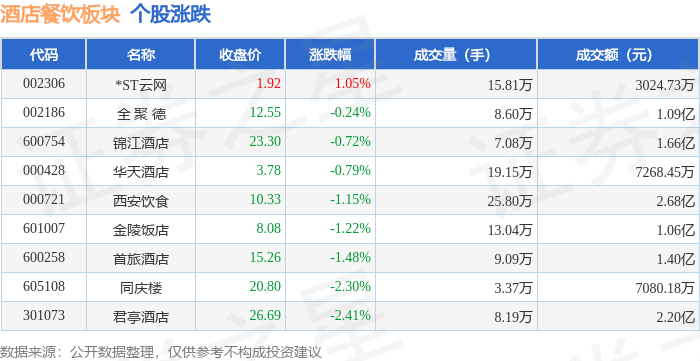
Market Overview - The hotel and catering sector experienced a decline of 1.41% on September 12, with Junting Hotel leading the drop [1] - The Shanghai Composite Index closed at 3883.69, up 0.22%, while the Shenzhen Component Index closed at 12996.38, up 0.13% [1] Individual Stock Performance - ST Yunwang (002306) closed at 1.92, with an increase of 1.05% and a trading volume of 158,100 shares, totaling 13.02 million yuan [1] - Quanjude (002186) closed at 12.55, down 0.24%, with a trading volume of 86,000 shares, totaling 109 million yuan [1] - Jinjiang Hotel (600754) closed at 23.30, down 0.72%, with a trading volume of 70,800 shares, totaling 166 million yuan [1] - Huatian Hotel (000428) closed at 3.78, down 0.79%, with a trading volume of 191,500 shares, totaling 72.68 million yuan [1] - Xianyin Food (000721) closed at 10.33, down 1.15%, with a trading volume of 258,000 shares, totaling 268 million yuan [1] - Jinling Hotel (601007) closed at 8.08, down 1.22%, with a trading volume of 130,400 shares, totaling 10.6 million yuan [1] - Shoulv Hotel (600258) closed at 15.26, down 1.48%, with a trading volume of 90,900 shares, totaling 140 million yuan [1] - Tongqinglou (605108) closed at 20.80, down 2.30%, with a trading volume of 33,700 shares, totaling 7.08 million yuan [1] - Junting Hotel (301073) closed at 26.69, down 2.41%, with a trading volume of 81,900 shares, totaling 220 million yuan [1] Capital Flow Analysis - The hotel and catering sector saw a net outflow of 126 million yuan from main funds, while retail investors contributed a net inflow of 141 million yuan [1] - The following stocks experienced significant capital flow changes: - Huatian Hotel: Main funds net inflow of 1.49 million yuan, retail net inflow of 5.79 million yuan [2] - ST Yunwang: Main funds net outflow of 589,300 yuan, retail net outflow of 69,400 yuan [2] - Jinling Hotel: Main funds net outflow of 6.63 million yuan, retail net inflow of 9.41 million yuan [2] - Quanjude: Main funds net outflow of 7.99 million yuan, retail net inflow of 12.60 million yuan [2] - Jinjiang Hotel: Main funds net outflow of 25.17 million yuan, retail net inflow of 32.34 million yuan [2] - Junting Hotel: Main funds net outflow of 51.94 million yuan, retail net inflow of 30.58 million yuan [2]
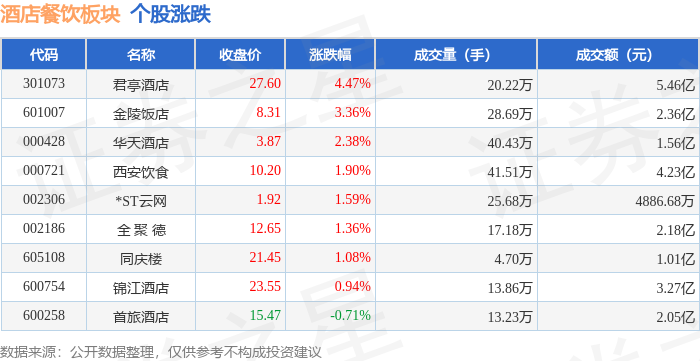
酒店餐饮板块9月10日涨1.08%,君亭酒店领涨,主力资金净流入8969.79万元
Zheng Xing Xing Ye Ri Bao· 2025-09-10 08:38
Market Overview - The hotel and catering sector increased by 1.08% on September 10, with Junting Hotel leading the gains [1] - The Shanghai Composite Index closed at 3812.22, up 0.13%, while the Shenzhen Component Index closed at 12557.68, up 0.38% [1] Stock Performance - Junting Hotel (301073) closed at 27.60, up 4.47% with a trading volume of 202,200 shares and a transaction value of 546 million [1] - Jinling Hotel (601007) closed at 8.31, up 3.36% with a trading volume of 286,900 shares and a transaction value of 236 million [1] - Huatian Hotel (000428) closed at 3.87, up 2.38% with a trading volume of 404,300 shares and a transaction value of 156 million [1] - Other notable performances include Xian Catering (000721) up 1.90% and Quanjude (002186) up 1.36% [1] Capital Flow - The hotel and catering sector saw a net inflow of 89.7 million from institutional investors, while retail investors experienced a net outflow of 117 million [1] - Junting Hotel attracted a net inflow of 36.9 million from institutional investors, while retail investors had a net outflow of 32.1 million [2] - Jinjiang Hotel (600754) and Quanjude (002186) also saw positive net inflows from institutional investors, indicating strong interest in these stocks [2]